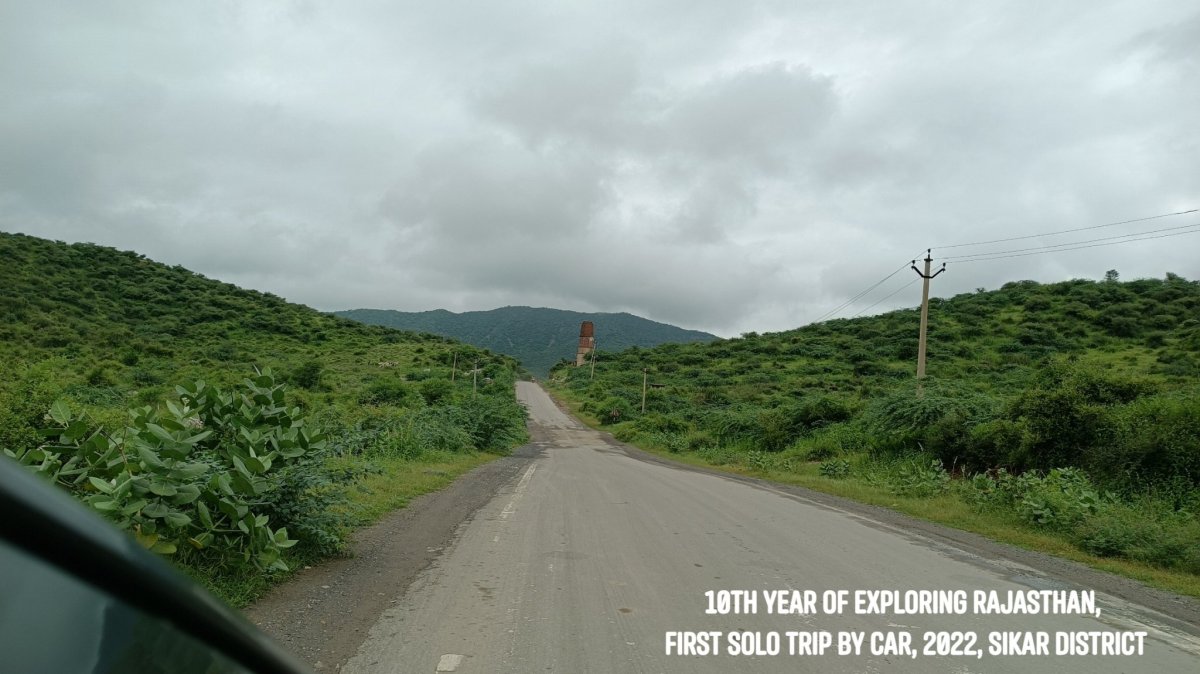
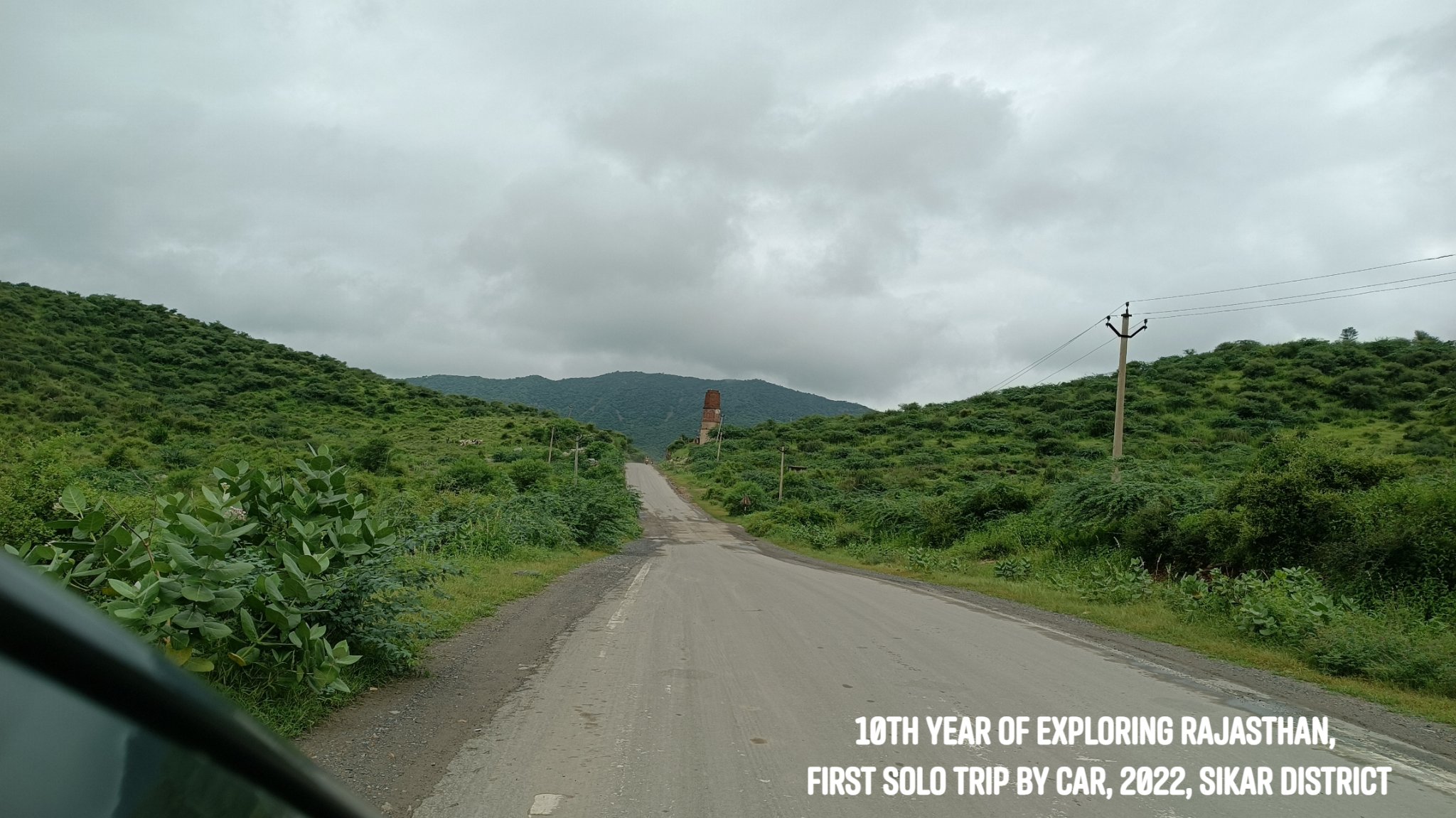
In April 2012, my first ever trip to Rajasthan was solo – by public transport, with the destination being Jaipur. In August 2022, I rounded off a decade of exploring Rajasthan by reprising the solo trip to Jaipur – only this time it was by driving on my own. A 700km self-driven solo adventure!
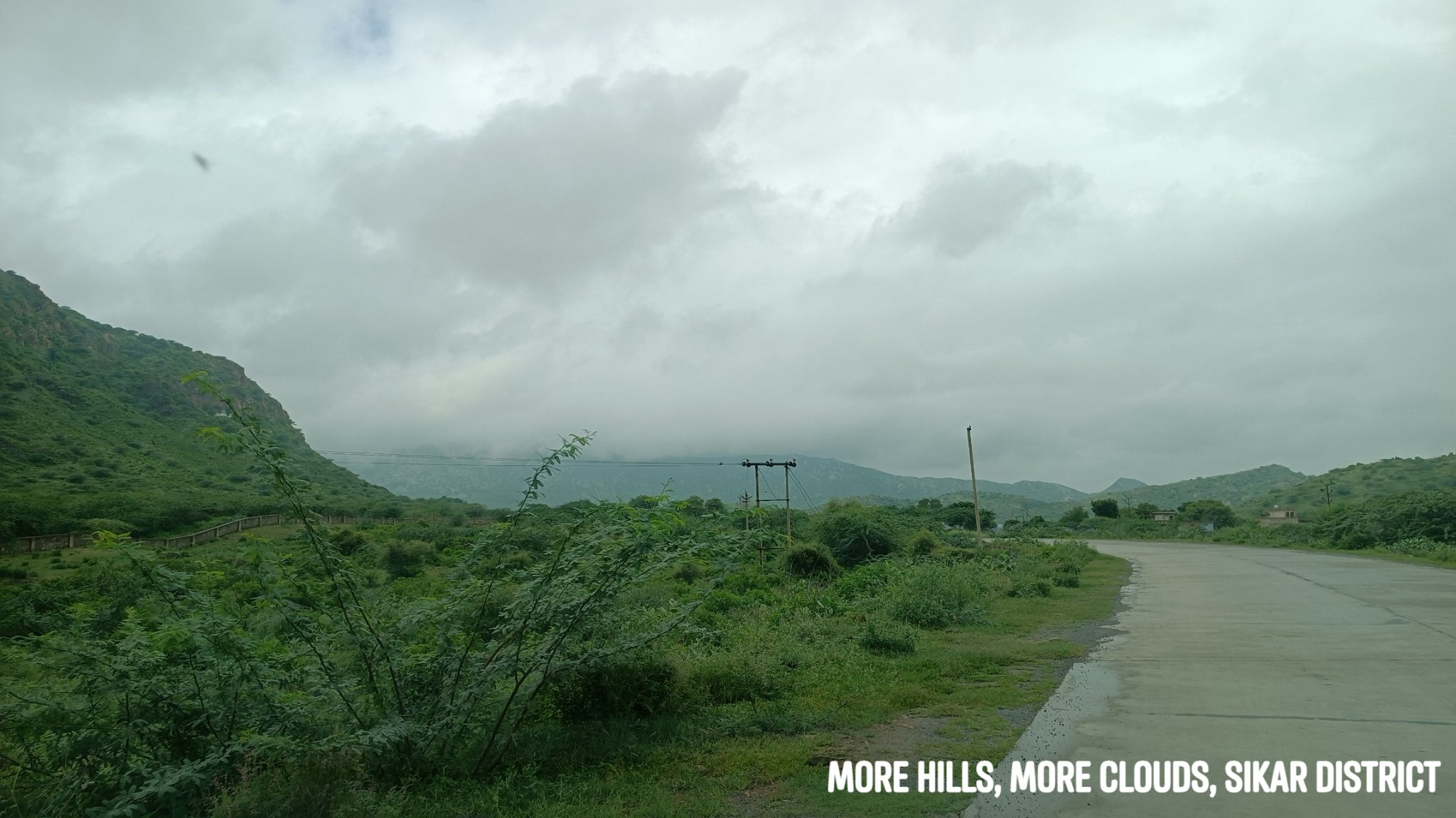
As always, it is rarely about the destination – and so off I went wandering through roads I had not trodden before, exploring a bit of the Aravallis in the Shekhawati region, while the sun and rain played hide and seek, and folds of hills lay in the distance in front and around me, their peaks crowned with fluffs of cloud.
I plead guilty to the charge of scooting off to Rajasthan every chance I get, even at the risk of inviting ridicule. ‘Why don’t you try out some other place this time – why not Himachal, Uttarakhand, UP?’, I have been asked. I say, some people love the mountains, some the beaches – as for me, I yearn most for the desert, the Aravallis, the forts…
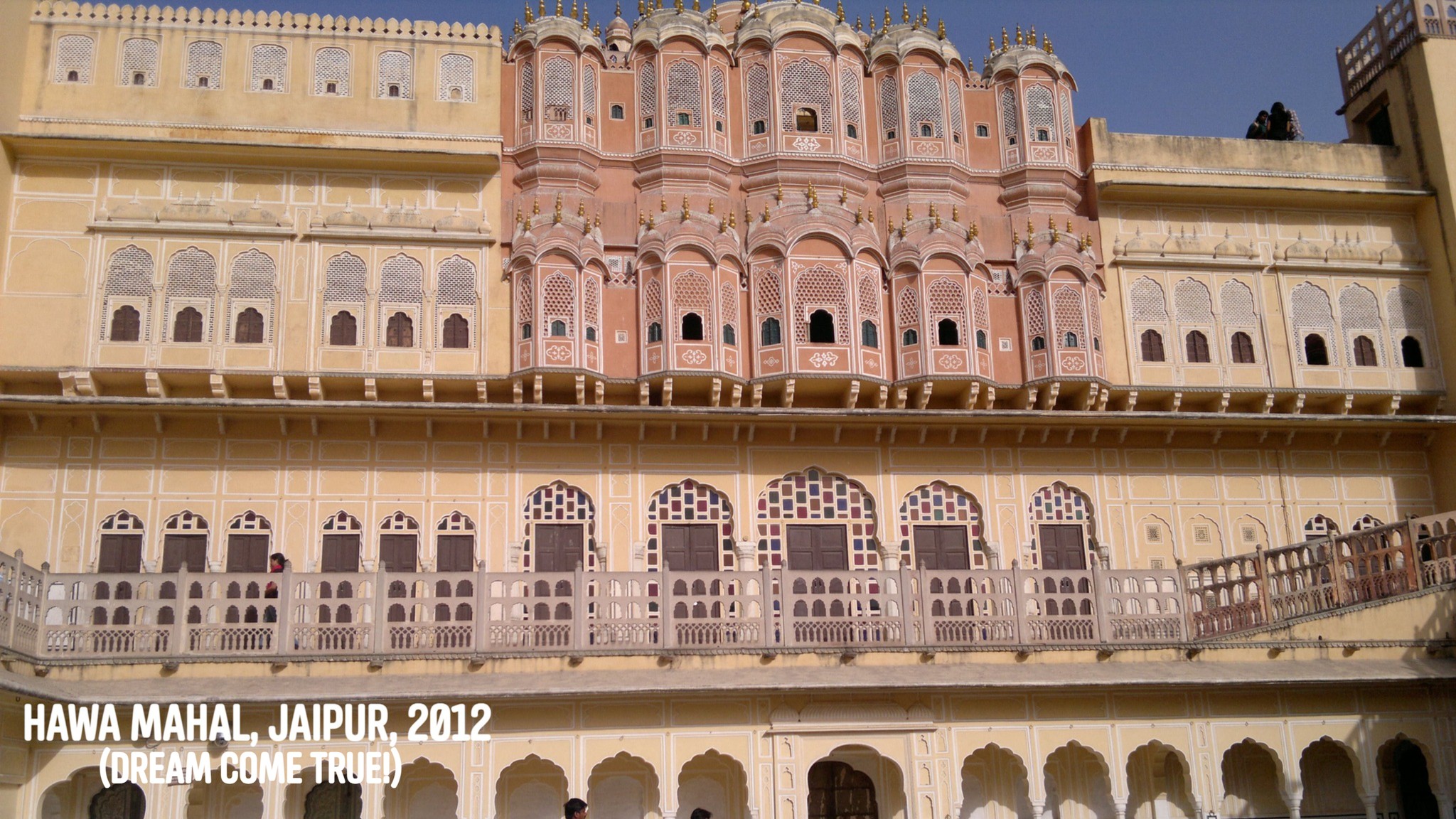
Growing up in Odisha, I had had a fascination with Rajasthan long since I could remember. In Grade 4 – the black-&-white picture of the Hawa Mahal in a textbook, and the mention of the Thar around Bikaner and Jaisalmer, images of the Vijay Stambh at Chittorgarh and the Dilwara temples at Mount Abu were imprinted in my head. A General Knowledge book addressed Jaipur as the Pink City, and Jodhpur as the Blue City. I always wondered looking at those black-and-white pictures how the cities might look like in real life in their famed hues.
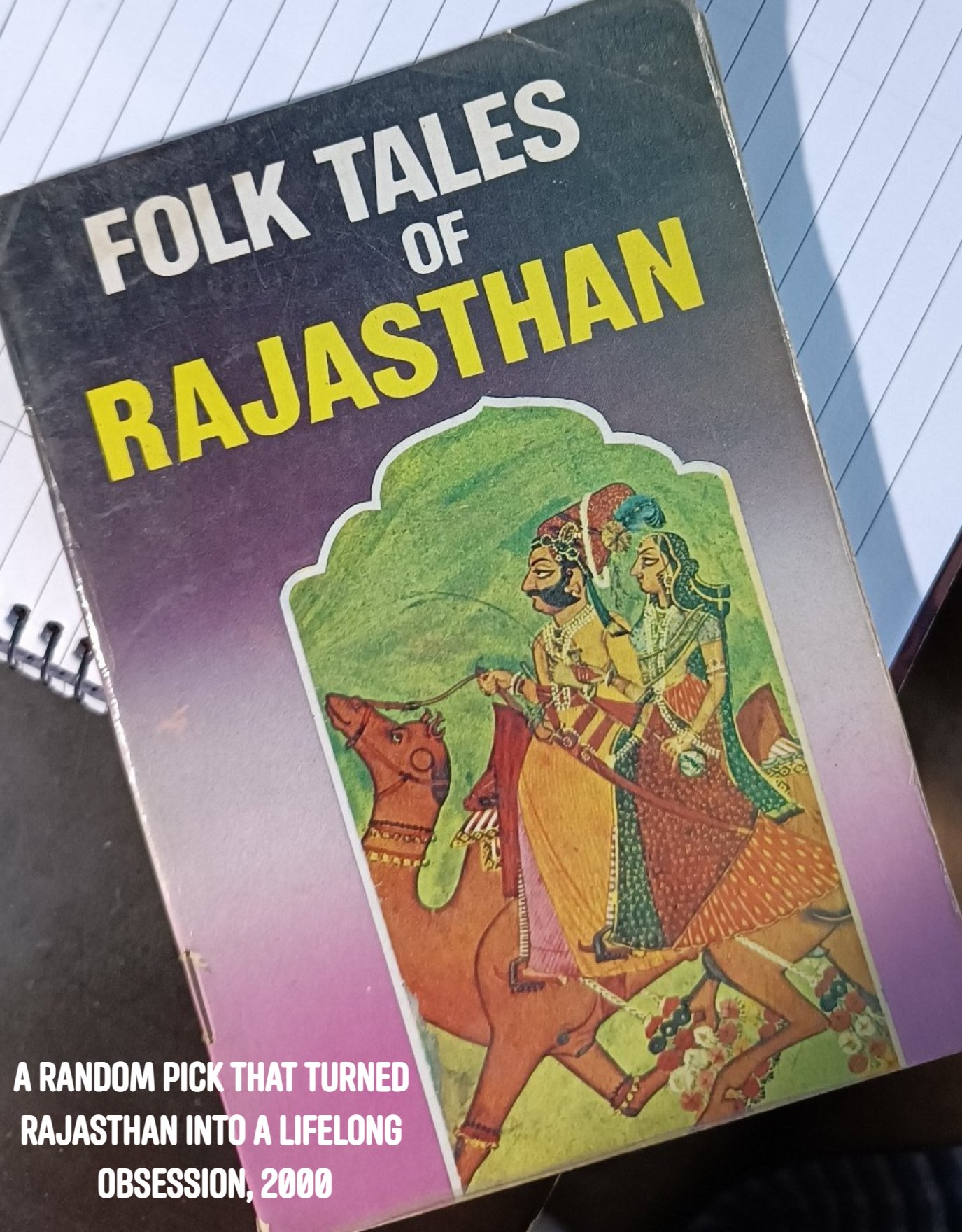
Some years later as we were embarking on a train journey, Dad let me pick up a thin paperback from the book stall on the railway station- it was called ‘Folk Tales of Rajasthan’. While on that train, in my mind, Rajasthan turned into a place of magic, of kings, bards & princesses, of Pabuji, star-crossed lovers & clever thieves, of camels & shifting sands…I was enamoured.
Rajasthan was always just too far away though, and little did I know I would later land up at the gateway to it – Delhi. Little did I know as time progressed, I would reside at a place, on the outskirts of Gurgaon, where I could simply lug a backpack on my back and in half an hour, be inside Rajasthan. Little did I know I would once also drive solo to Rajasthan…
***
On this trip, instead of driving directly to Jaipur from Gurgaon, I took a detour midway, towards the north and drove through some of the most exotic sounding places – Kotputli, Neem ka Thana, Udaipurwati.
Udaipurwati
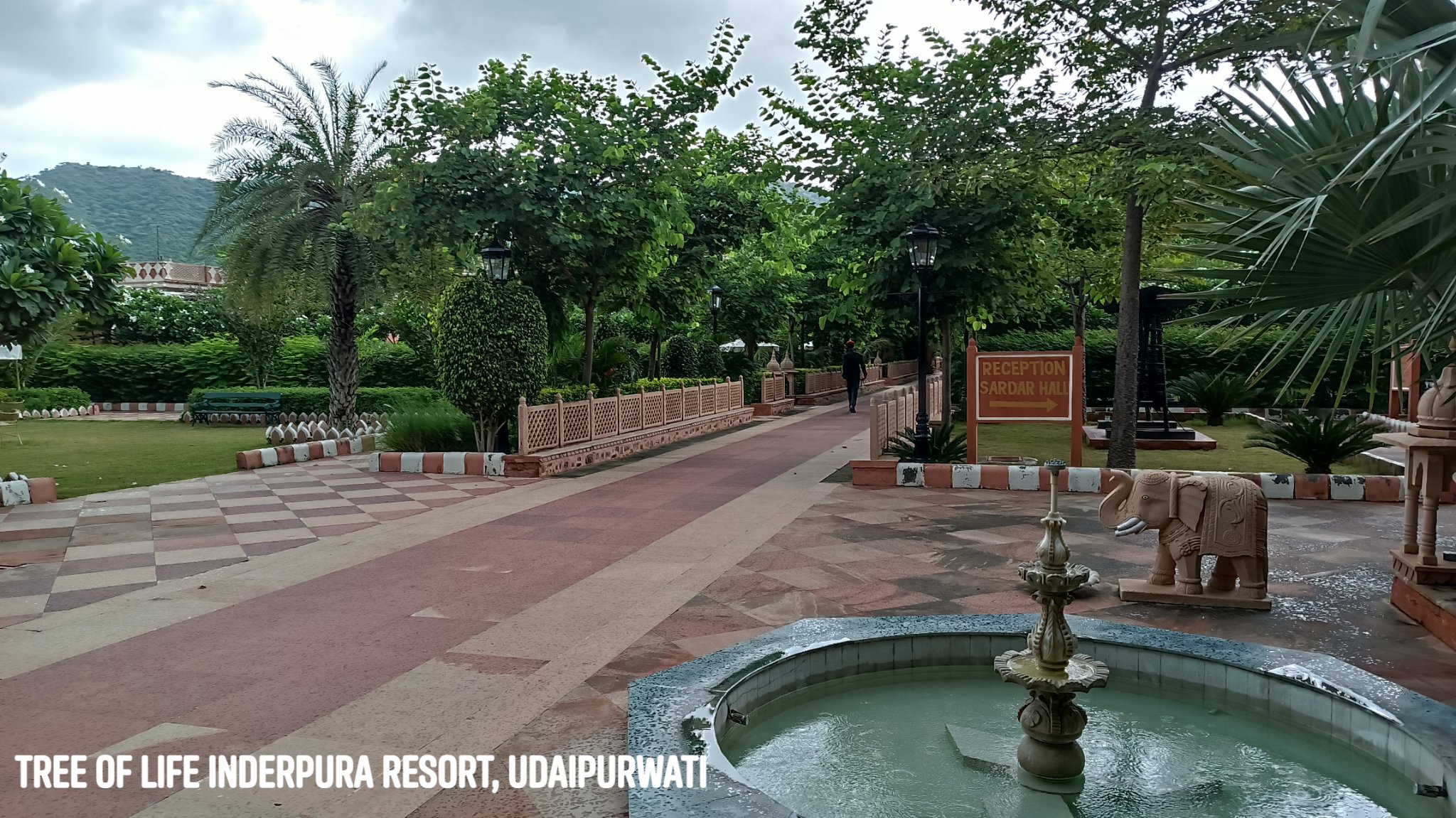
A quaint little town nestled within a gap in the Aravallis, is home to an excellent resort called The Tree of Life Inderpura.
Lohargal
Near Udaipurwati, within a crevice in the hills is a holy spot with a natural spring feeding a bathing tank and ancient Sun Temple. According to myth, weapons and armour of a Pandava army that camped here after their victory, dissolved in the water, giving the place its name: Loha (Iron)+Gal (To melt).
From thereon in Jaipur, I visited a couple of places that I had not seen before, both nestled in the Aravallis.
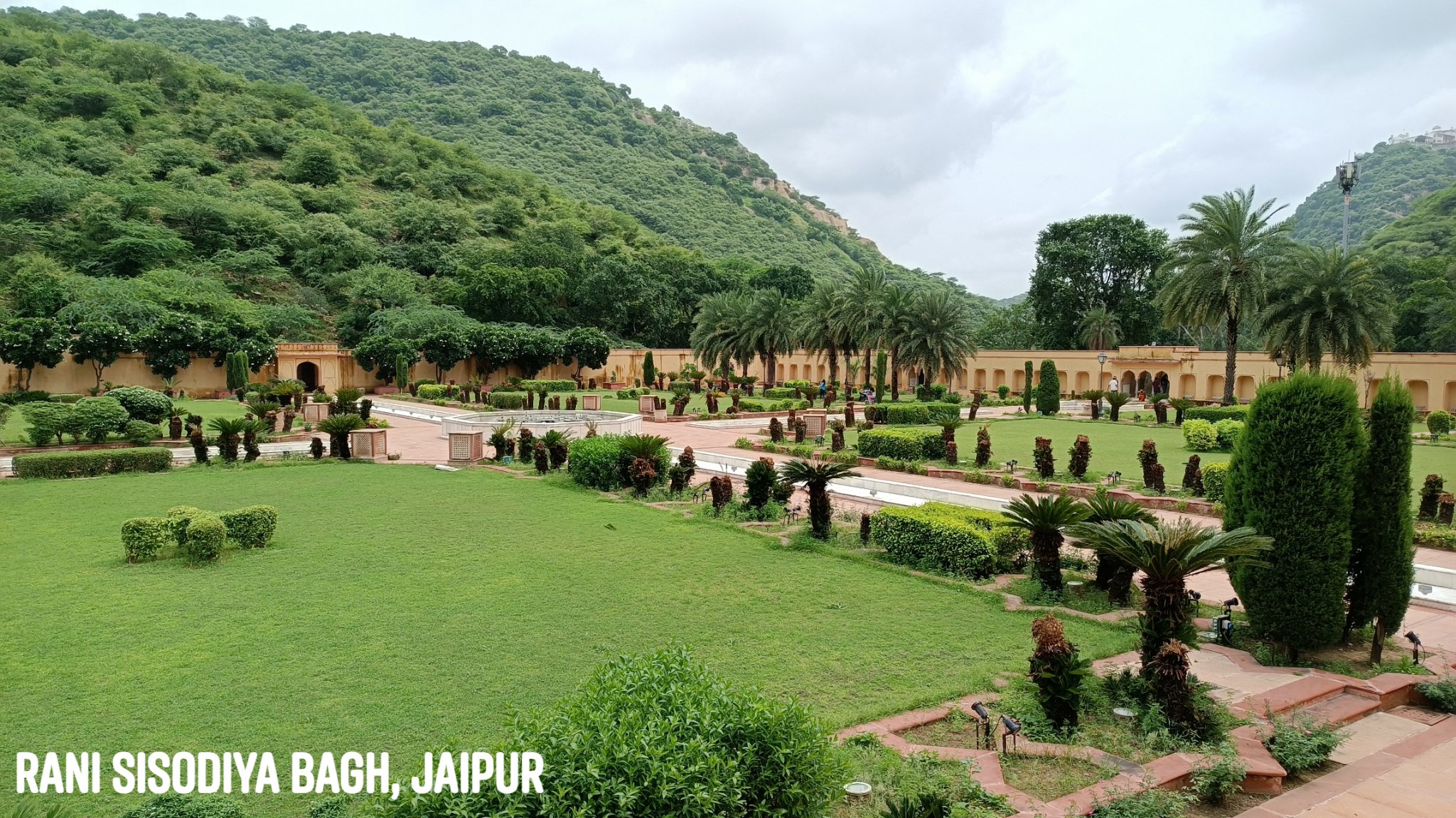
Rani Sisodiya Bagh
A hidden gem of a garden built by Sawai Jai Singh II for a princess of Udaipur, who agreed to marry him only on the condition that she be made the main queen of Jaipur.
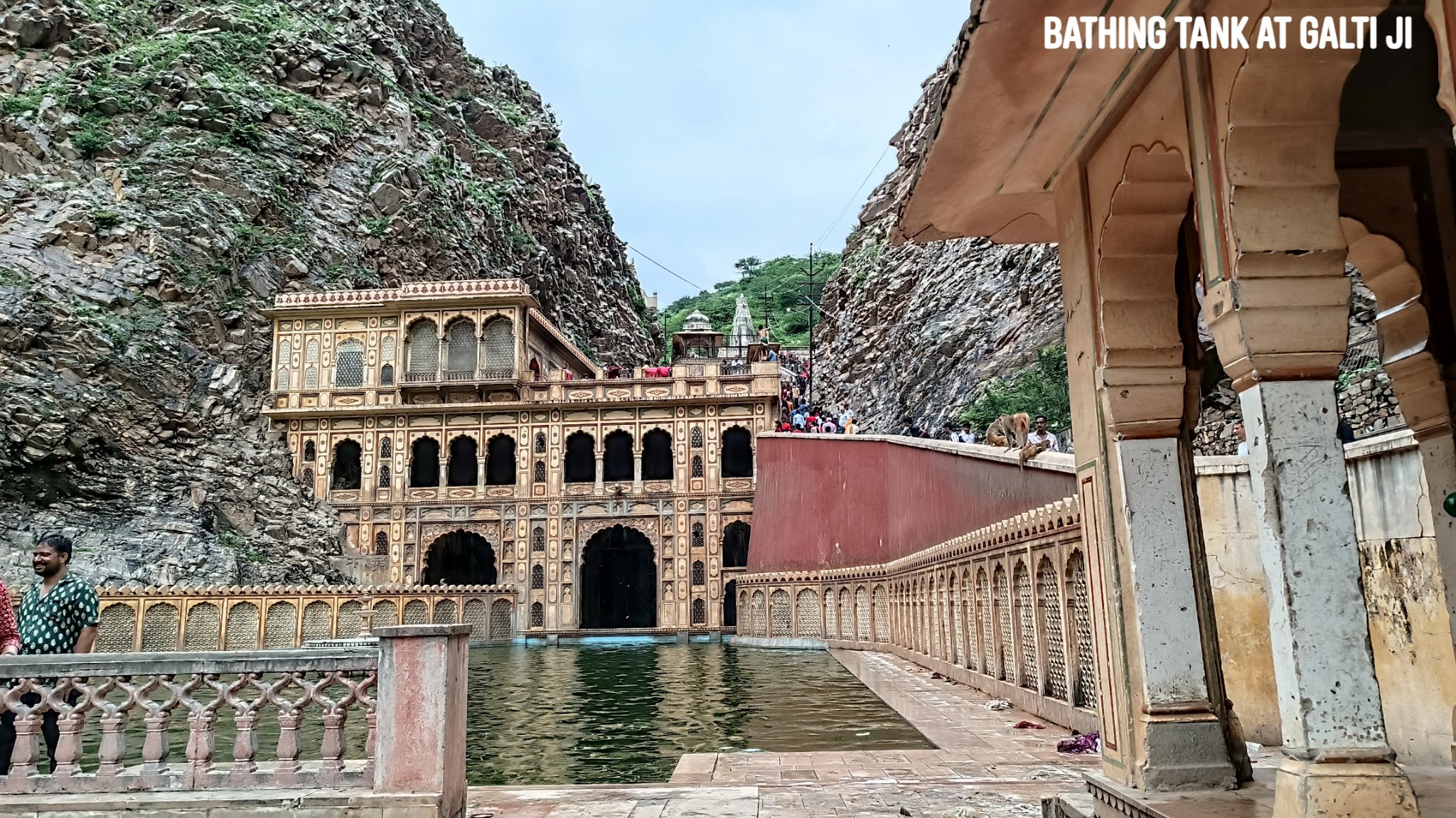
Galta Ji
Home to a bathing tank fed by a perennial spring and a temple dedicated to a hermit named Galta ji, along with temples dedicated to Krishna and Ram. At the peak of the hill is a 350 year old Sun temple, reached after a hike of about 1.5km. The first rays of the Sun reaching Jaipur apparently fall on the idol in the temple. Views from the hill are outstanding.
Trip Summary Day 1: Gurgaon to Udaipurwati via Neem-ka-Thana & Patan -250 km, 6 hours Udaipurwati to Lohargal – 15km, 30 min Lohargal to Jaipur via Udaipurwati & Reengus – 160km, 3 hours
Day 2: Jaipur sightseeing of Rani Sisodiya Bagh and Galtaji – 25km, 2 hours Jaipur to Gurgaon – 230km, 4 hours
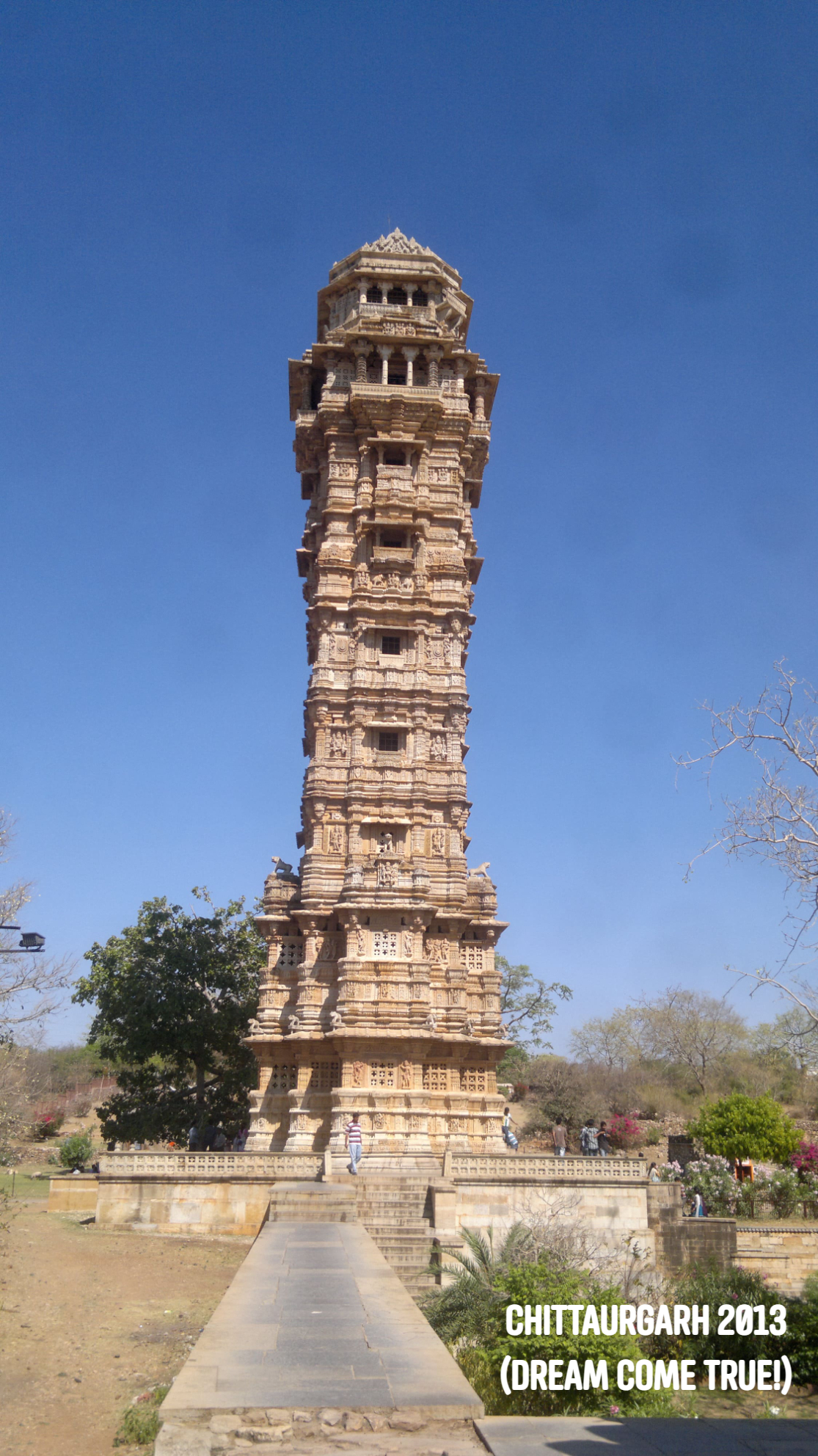
As a kid, I had been entranced by the pictures of sand dunes and forts in school textbooks and children’s magazines. One particular image from a Tinkle issue – a coloured sketch of the Vijaya Stambh at Chittorgarh fort had stuck in my mind, and in 2013, on one of my solo trips, I finally set foot on the Chittorgarh fort, and was absolutely spellbound by the location atop a table-top hill and the scale of the area bounded by its imposing walls. I have explored Rajasthan further, making it a point to explore at least one new place every year. Until before the pandemic struck, I had visited almost every major city of Rajasthan and then some.
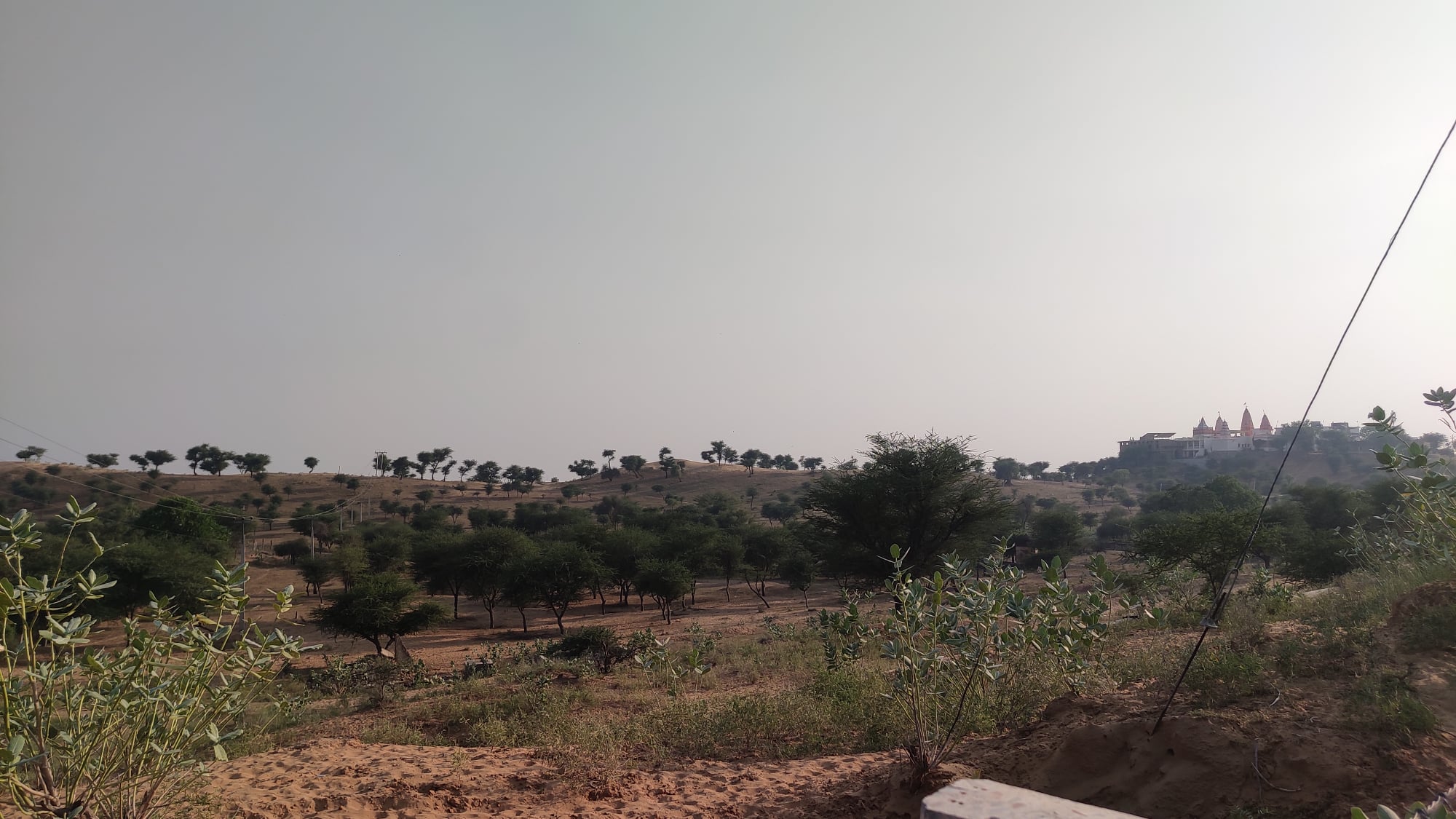
However, it has never been about the destination as far as Rajasthan is concerned. Looking through the State Roadways bus windows, or craning the neck out from cabs and fancily decked-up auto-rickshaws, I have often marvelled at the intriguing shifts in landscapes – straddled by the Aravallis intercepting you shortly after you have entered from the East, with its table-top ranges swishing across like stripes of a tiger, some covered in a rich green cloak, yet others balding with their denuding rocky surfaces exposed, flanked now by swathes of lush green agricultural land, now turning light brown or pink or yellow with short lean trees strewn around as if social-distancing since time immemorial, then slowly turning golden as the ground surface mutates into waves of sandy dunes of the Thar. Abandoned forts and fortress walls crown hill tops every few scores of kilometres. Further south near Mount Abu, the Aravallis look nothing short of a slice from the Western or Eastern Ghats.
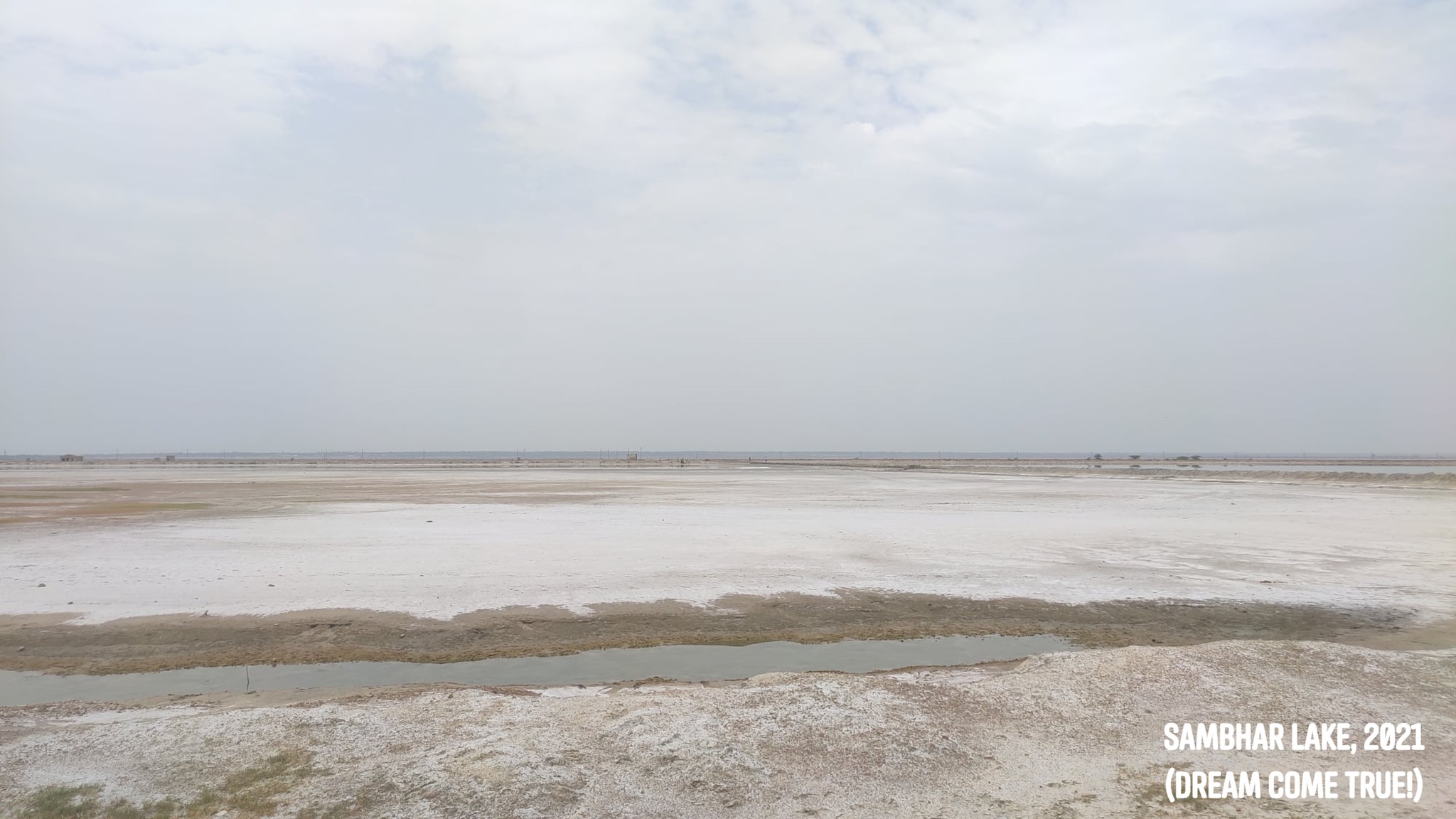
There is also a vast Salt Lake (Sambhar) somewhere at the edge of the desert in the heart of Rajasthan. Villages only turn up after long sprees of nothingness, and even then they are a collation of a handful of houses. Dried river channels cross your path occasionally, their sandy beds hinting at an older time of more abundance. Camels trundle along serenaded by their handlers, their upturned mouths betraying an indifference towards their dreary lives. Nomadic herders appear out of nowhere with flocks of little sheep and goats. Deeper in the desert, if you’re lucky, you may spot a monitor lizard or a hyena lurking amidst the shrubs.
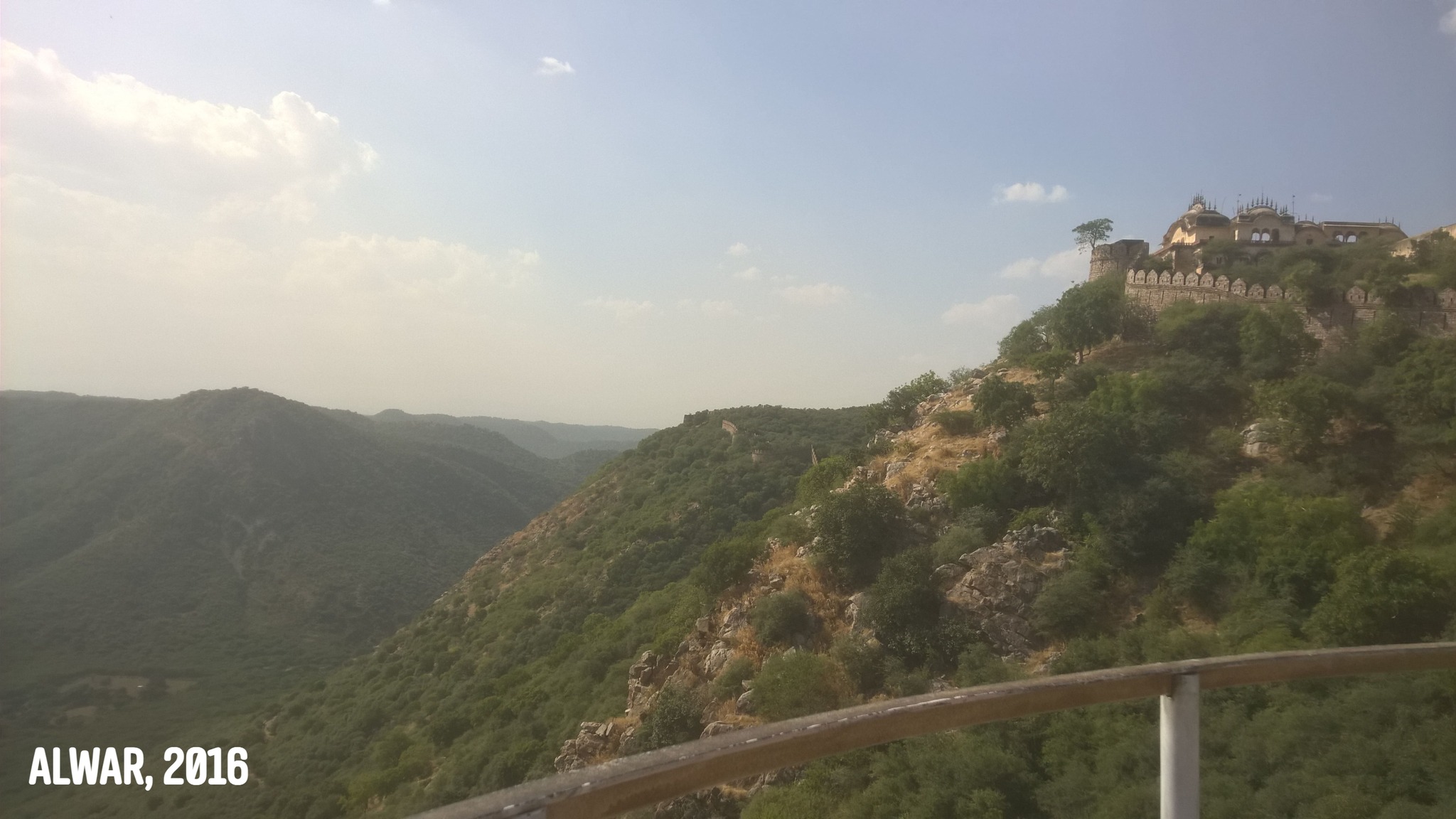
Siliserh Lake, Alwar
Bissau, ShekhawatiFatehnagar, Shekhawati
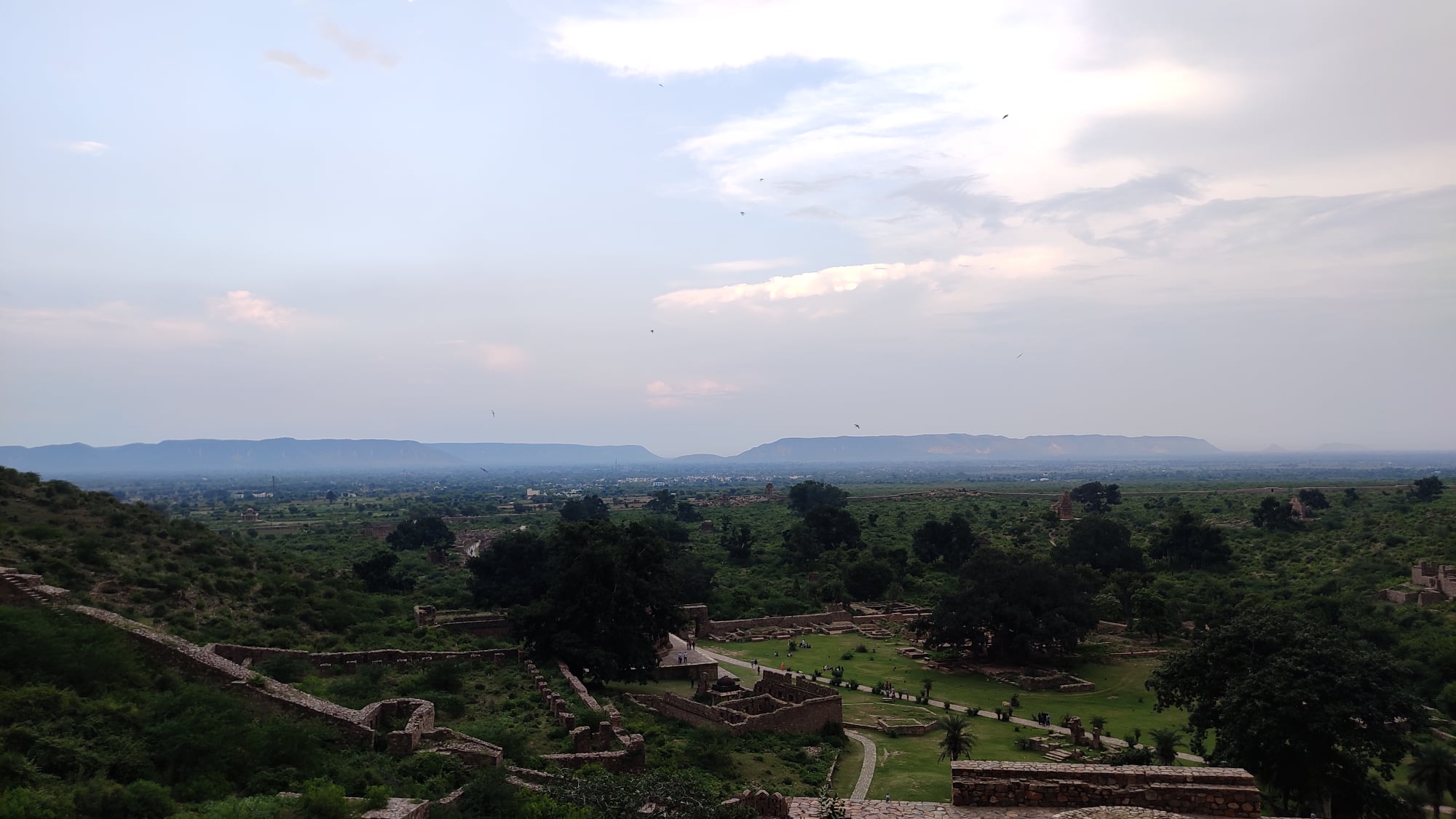
Bhangarh
Gadwaji, AlwarAlsisar, Shekhawati
In all of my trips prior to the pandemic, I have often been constrained by the mode of transport. There have been points or locations on the routes, which I have earmarked to return to later at my own leisure, since stopping by then was not an option. There have been roads emanating from the main roads that have often left me wondering as to where they led to. Now at 35, after learning to drive, I finally have the wherewithal to indulge in the fantasies that I harboured while travelling in my erstwhile cloistered fashion. This is an album to celebrate the many facets of the Rajasthan landscape that I have chanced upon on my most recent and some of my very first ever self-driving trips, which will hopefully be enriched with future trips.
Ruminating over fond memories of my previous excursions to the Thar, I realized that it was time my family members also got a taste of the desert, and so materialized my family’s first tryst with the Thar – and my third – in the end of November 2019. We took the Mandore Express from Gurgaon railway station, where we had to execute the train boarding with rocket-science precision on account of the train stopping only for 2 minutes, and reached Jodhpur at 8 AM next morning.
Day 1: Jodhpur and Mandore
We checked in to the Om Heritage hotel that afforded an excellent view of the Mehrangarh fort from its rooftop. The plan for the day, drawn on the experience of my previous sole trip to Jodhpur, was set, and so, the first thing we did was hire for the whole day one of those large auto-rickshaws that could accommodate all five of us, and headed over to the Umaid Bhawan Palace. Our next stop after that was at Mandore Garden, the place that had me mesmerized in my previous trip to Jodhpur.
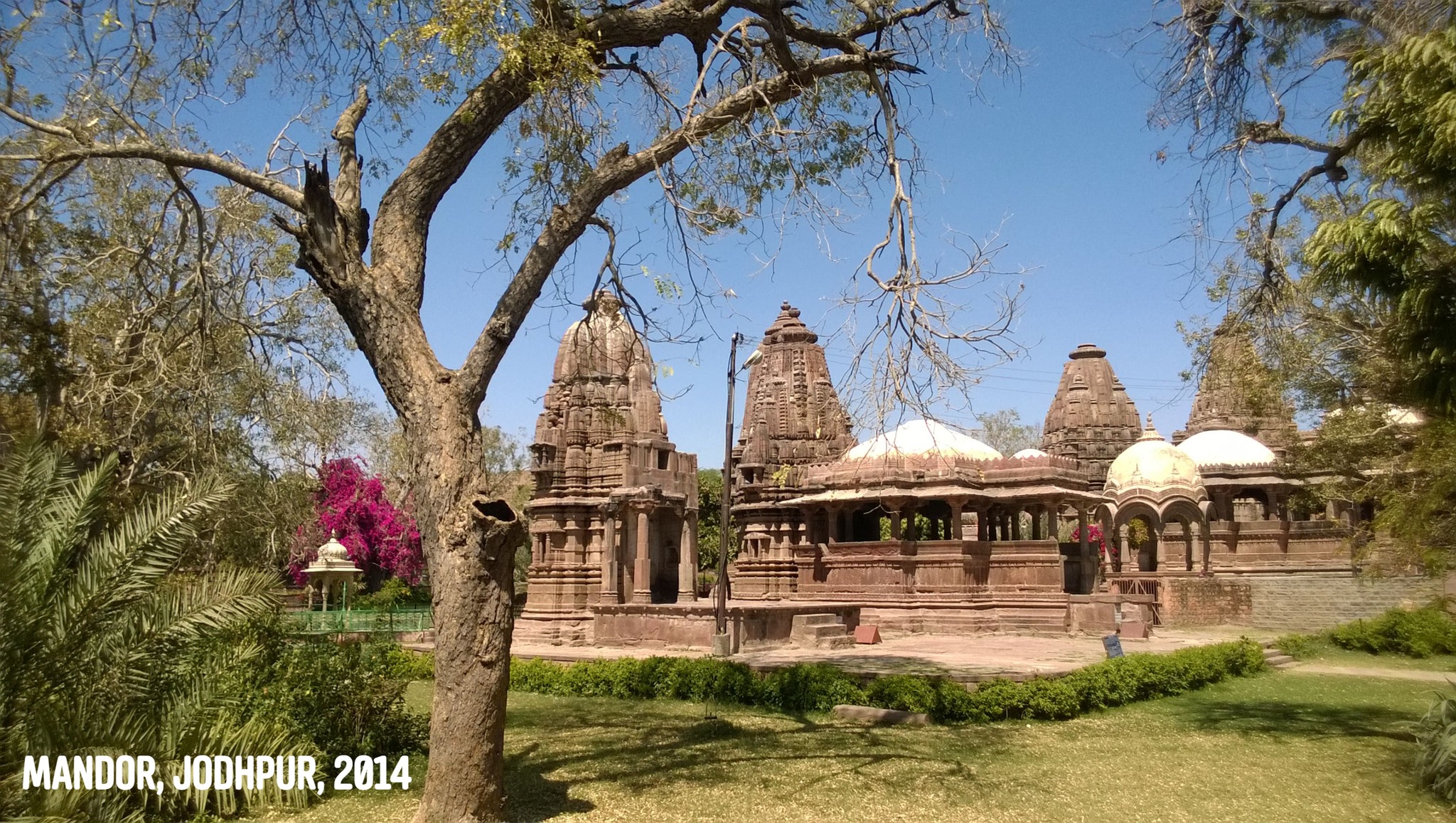
Mandore, the seat of the Gurjara-Pratiharas in the 6th century AD, later became the capital of the Rathores before Rao Jodha shifted to the newly-founded city of Jodhpur. At Mandore, we first walked through the lawns and saw some of the temples and royal cenotaphs, and then visited the Government Musuem. From there, walking up an incline, we crossed a dammed mini-reservoir, and reached the ruined Mandore fort located on the top of a hill, getting a panoramic view of Mandore. After an hour and half well spent, we had our lunch in Mandore, and proceeded to Jaswant Thada on our way to Mehrangarh Fort.
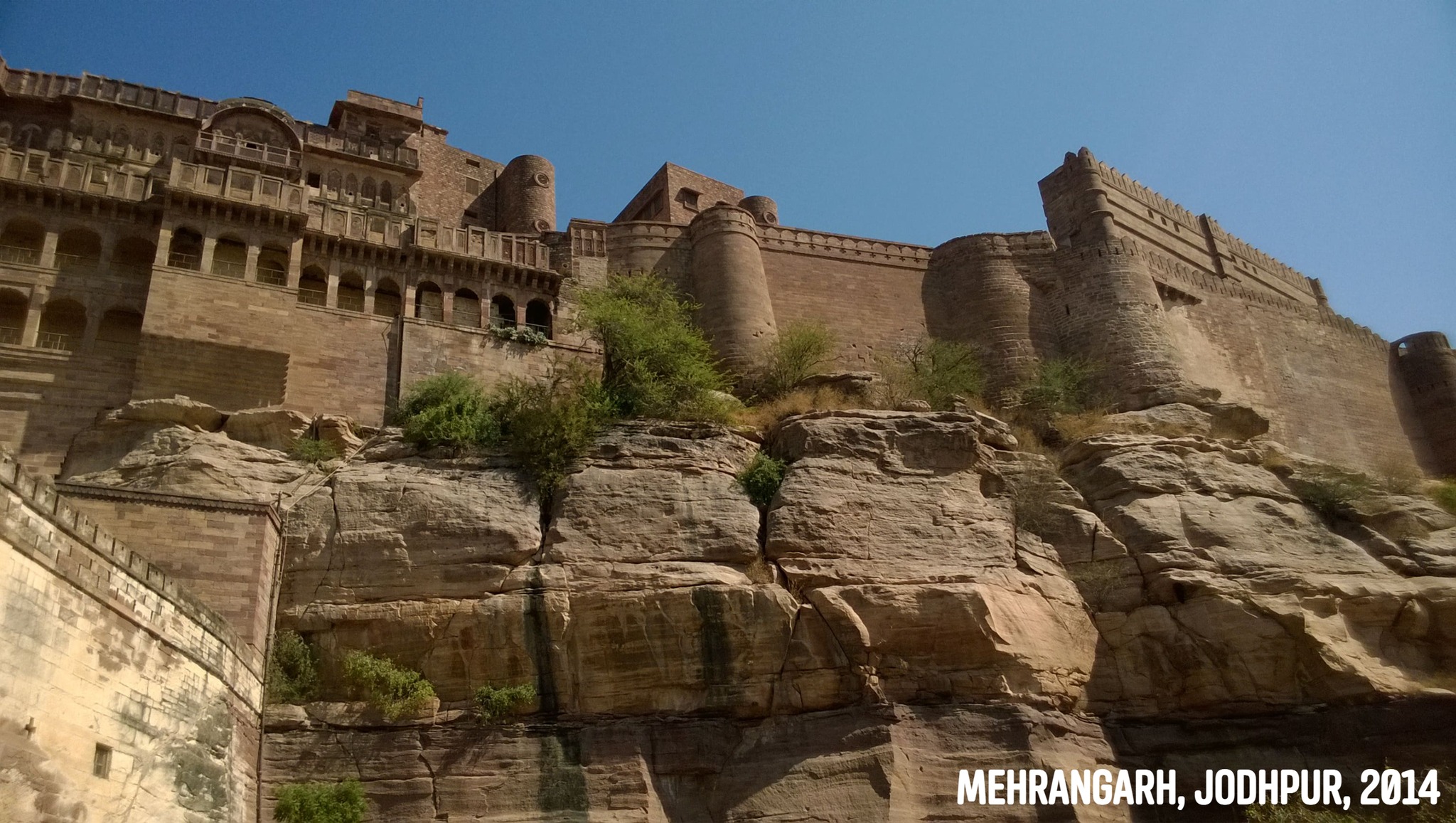
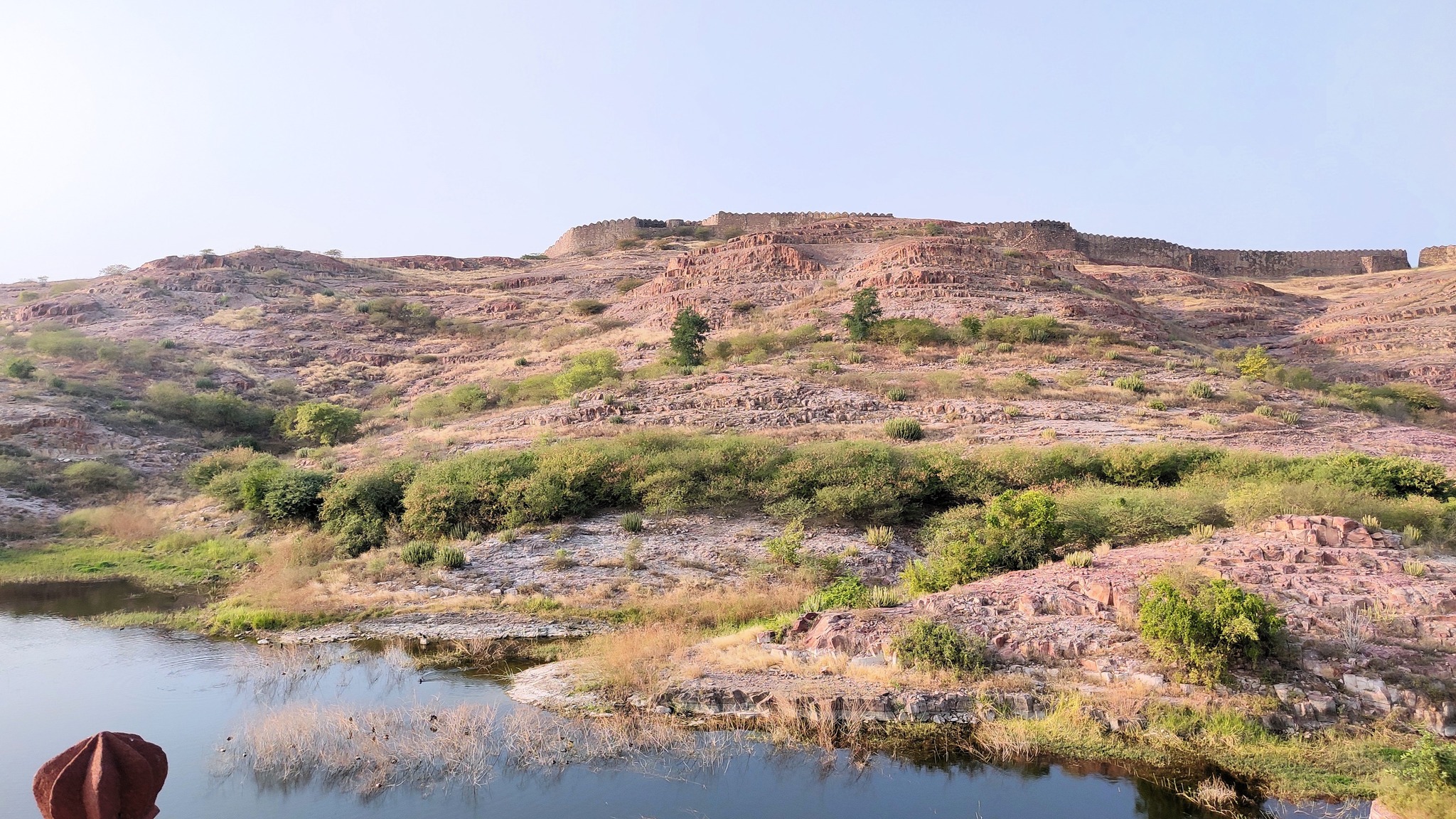
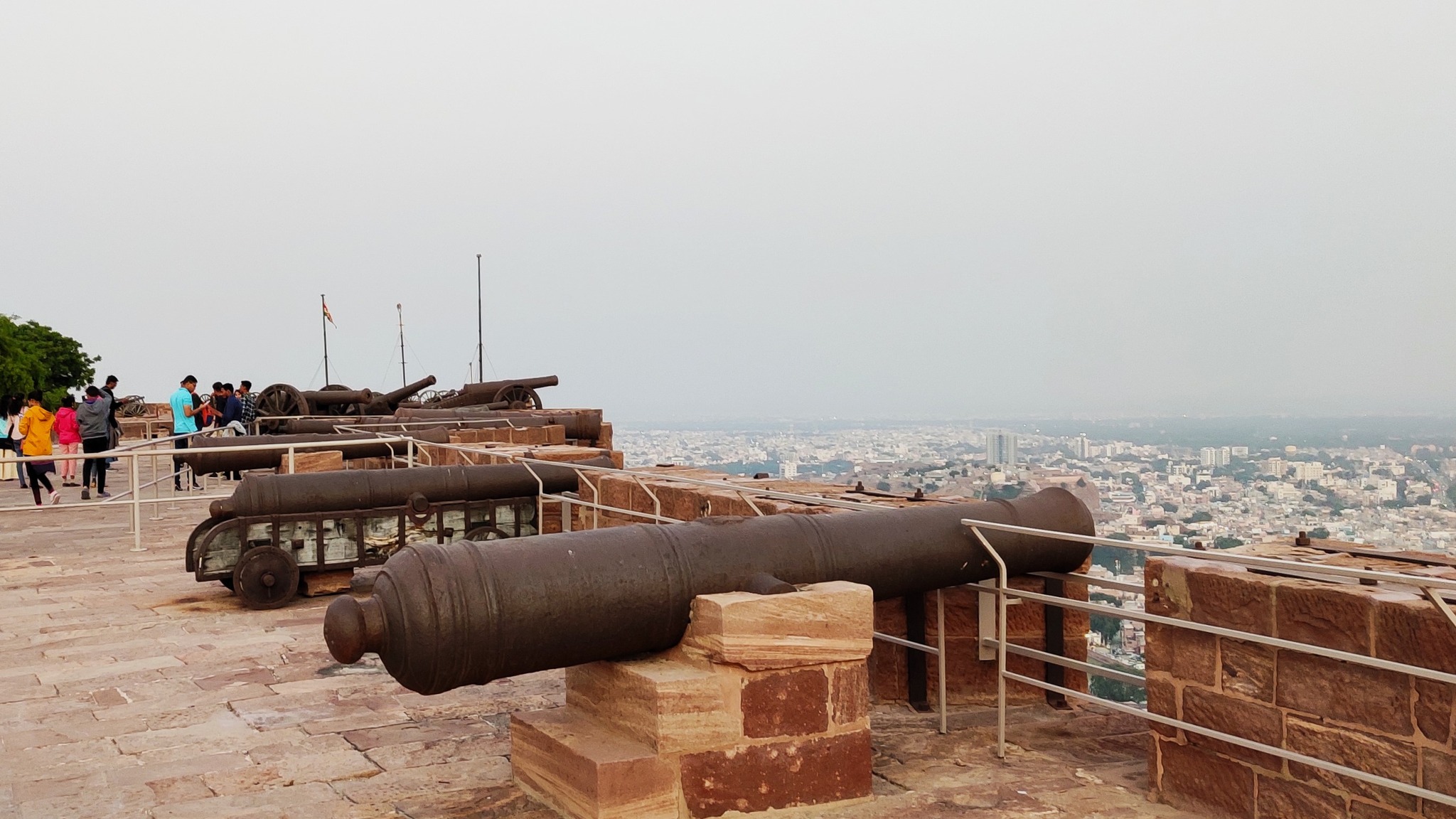
The Jaswant Thada itself is located on the top of a flat red-coloured rocky hill which is barren, only punctuated with water pools, and has the scenic backdrop of the Mehrangarh fort on one side. Next up was Mehrangarh fort, which we reached at 4.30 PM just in time before the gates closed for entry. Taking up a guided tour, we gawked at the imposing palaces and exquisitely done interiors, before ending the tour at the raised long platform lining the fort wall the end of the fort where the cannons stand. We were then back in the hotel to have dinner, and prepare for checking out next day to proceed to the next leg of our trip.
Mehrangarh fort as seen from the rooftop of Om Heritage Hotel
At Mandore Garden, on the outskirts of JodhpurLandscape around Jaswant Thada, JodhpurPalace in Mehrangarh fort, JodhpurCannons at Mehrangarh fort, Jodhpur
Day 2: Exploring Jaisalmer city
The next morning, we started at 8.30 AM by the Innova car we had booked for the remainder of the trip. We passed through Balesar, as the land became progressively arid, with it becoming more distinctively barren and sandy as we approached Pokhran. By 2 PM, we had reached Jaisalmer and checked in at Hotel Heritage House, a hotel modelled as a typical Jaisalmer-style haveli. After a quick lunch at Shree Jee Restaurant, we went to see Patwon ki Haveli, actually a cluster of five small havelis, of which the most famous is the one in the front called Kothari’s Patwa Haveli.
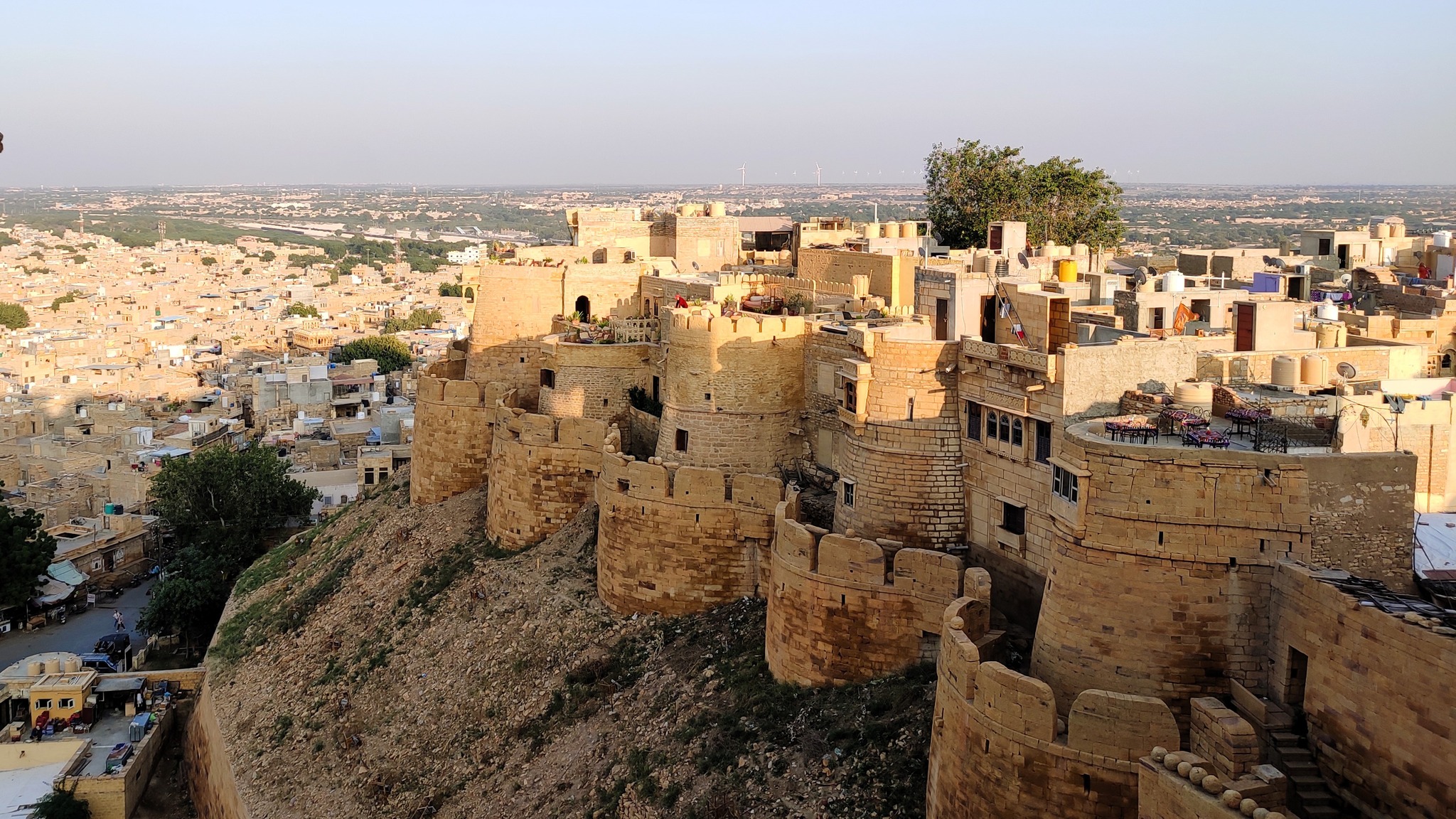
Patwon ki Haveli was constructed over 50 years, starting in 1805 AD commissioned by Guman Chand Patwa, a trader of jewelry and fine brocade. The haveli is typified by latticed balconies carved out of sandstone but seeming as if carved from wood, ornate wall paintings, exquisitely carved pillars, and extensive corridors and chambers. After seeing the haveli, we proceeded to Jaisalmer Fort. At Jaisalmer fort too, we took a guided tour through the main palaces, hearing stories of the past, getting transported to the times when these were inhabited by the royals.
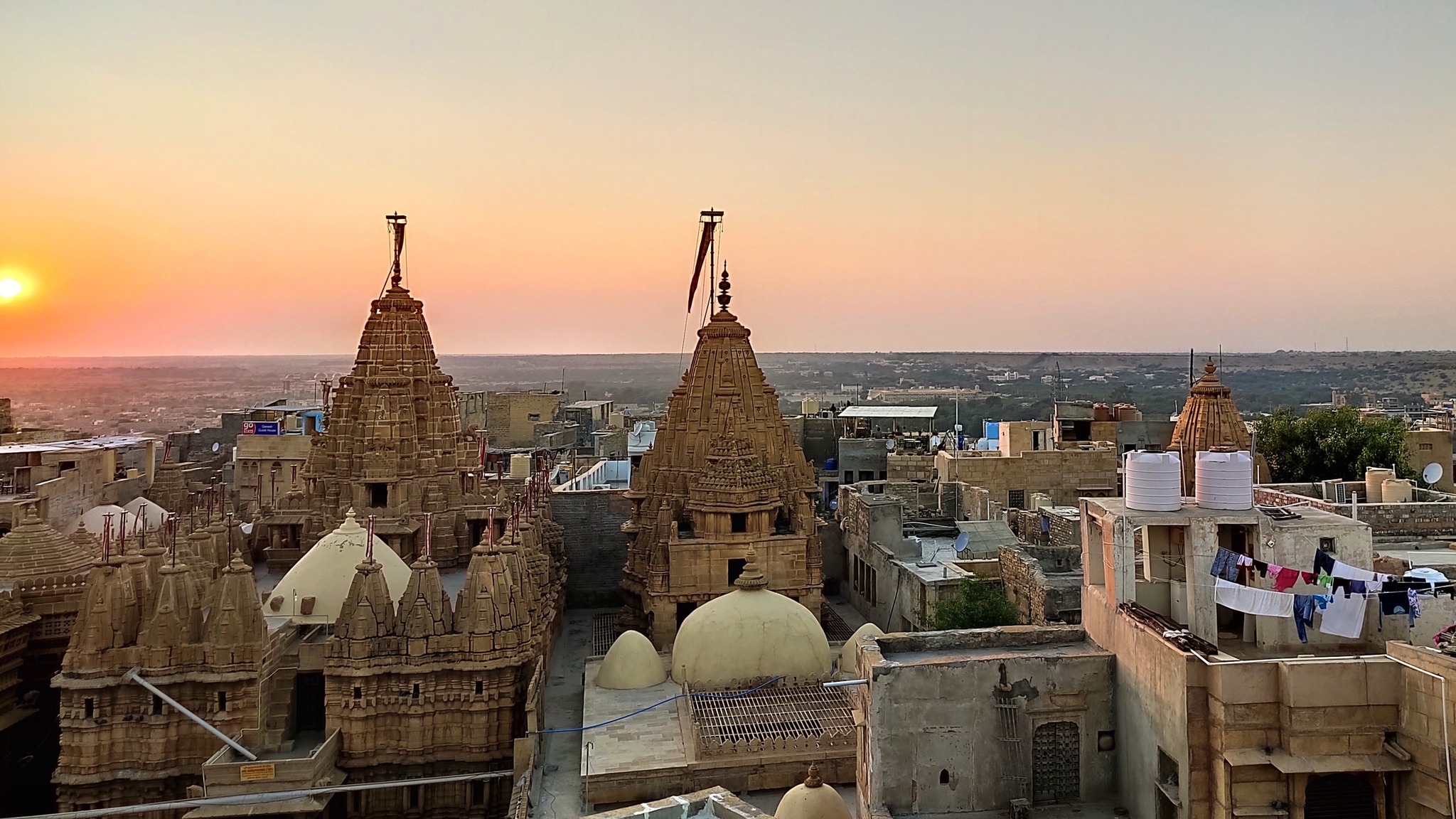
Later, we walked through the streets outside the palace, passing by and entering the street on the left side of the Lakshminathji temple. Just 100 metres in, we came upon the Baa ri Haveli, which we entered out of curiosity and were treated to interesting tidbits of the Rajasthani culture by way of of the artifacts on display, such as sculptures, furniture, toys, handicrafts etc. As we reached the terrace of the haveli, we saw the sun setting in the horizon marked by a long sandy ridge running in the distance outside the city limit, while twin spires of two temples stood in the foreground right in front of us.
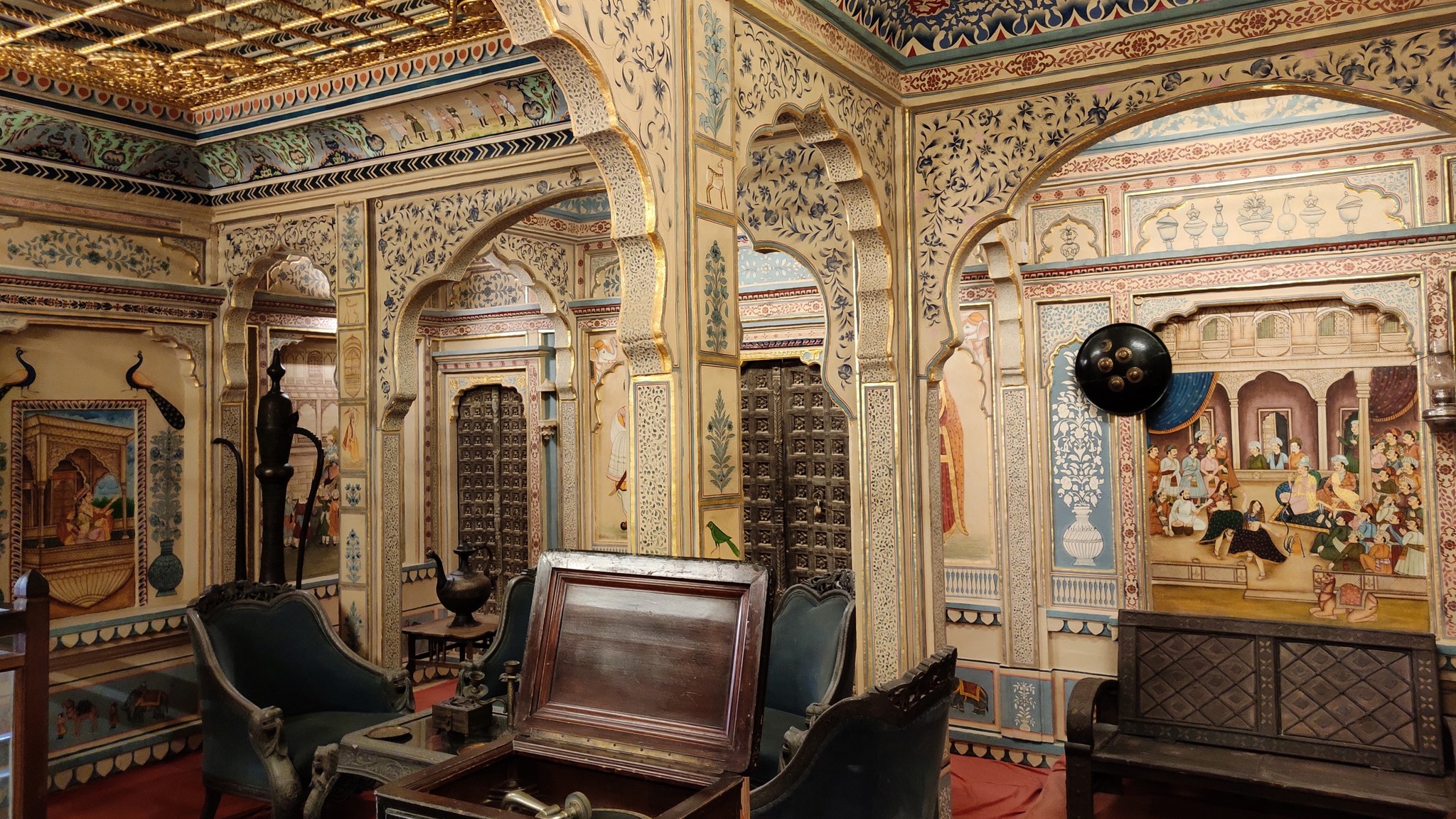
An ornately decorated and painted hall in the Patwon ka Haveli, Jaisalmer
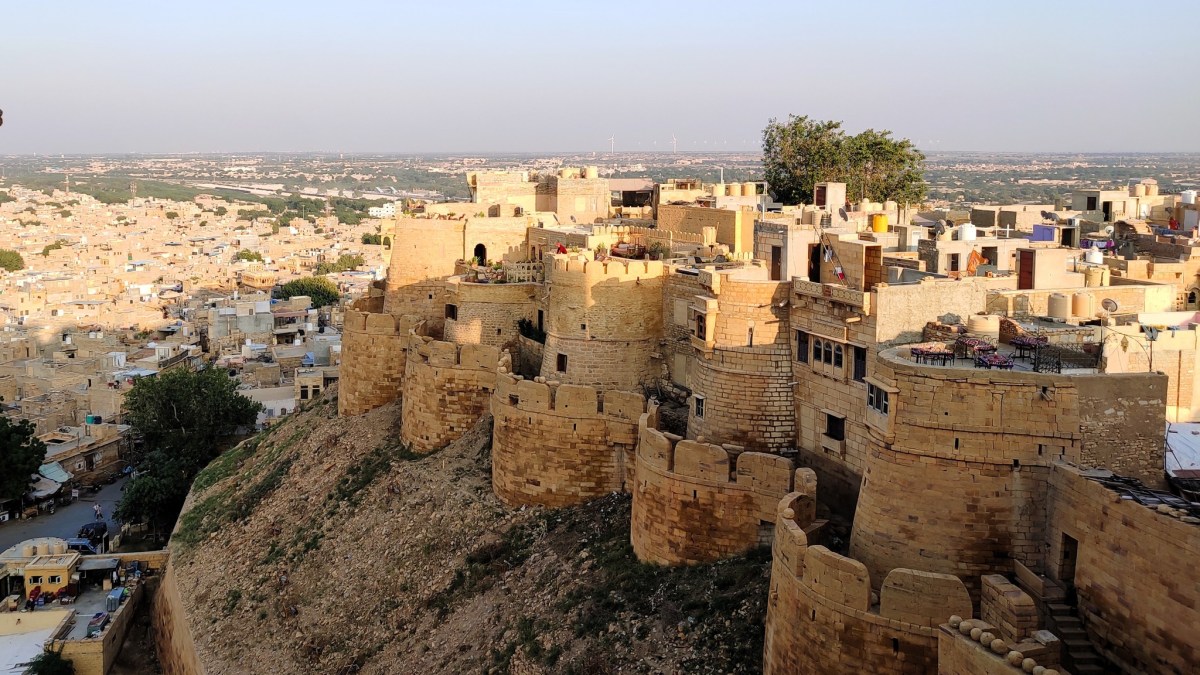
View of fort walls from the balcony of a palace in the Jaisalmer fort
Sunset view from Baa ri Haveli, Jaisalmer fort
Soon after, we had tea and snacks at a roof-top restaurant hugging the fort wall while enjoying views of the city and the barren landscape beyond it. Back in the hotel, we retired to bed after dinner in anticipation of our outstation trip from Jaisalmer the next day.
Day 3: Off to the Border – Ranao, Tanot and Longewala
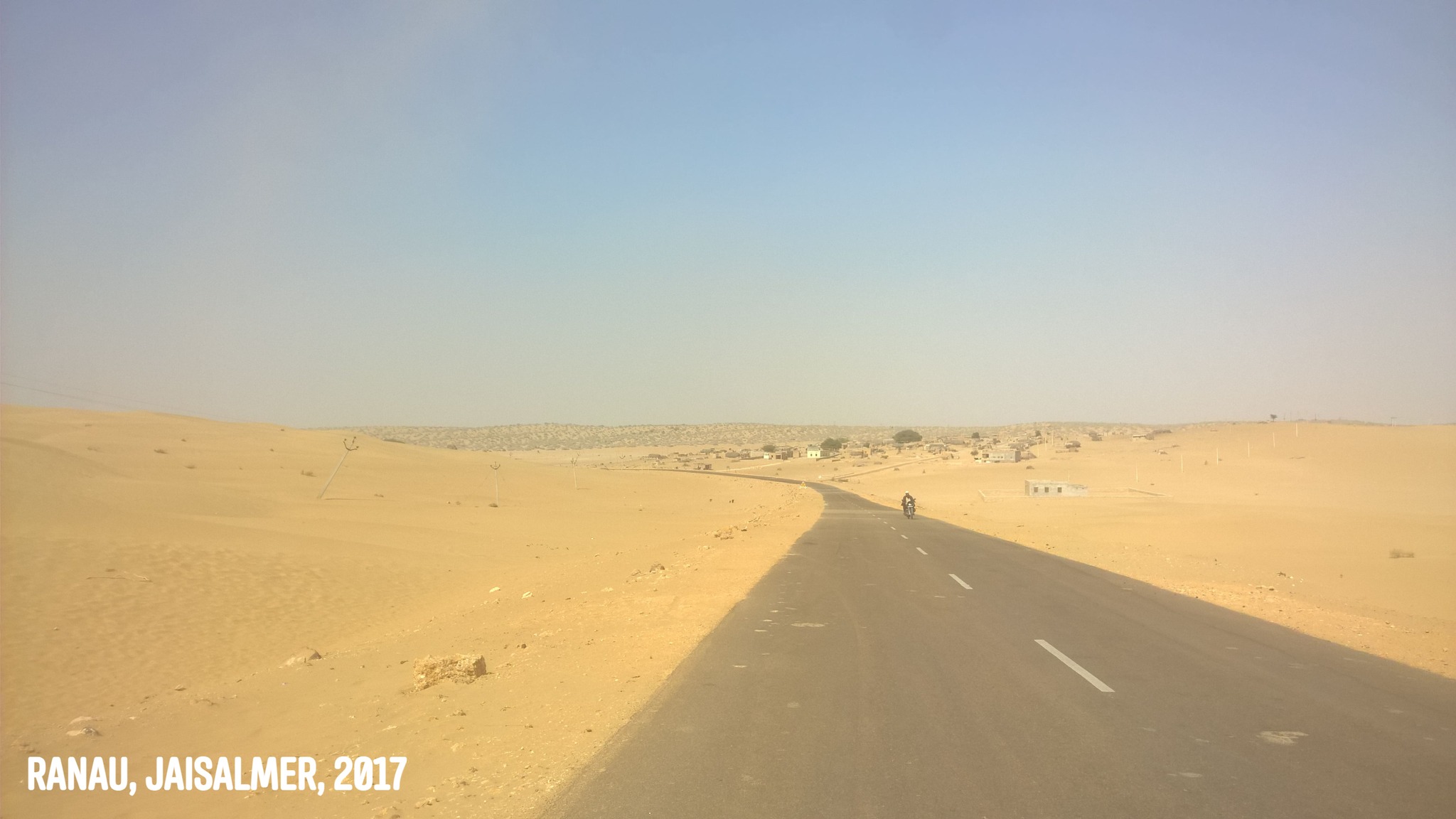
We started lazily next day, checking out of the hotel at around 11 AM and proceeded towards Tanot, stopping at places to get down to admire the desert landscape, and taking pictures of the landscape and of ourselves. By 1 PM, we reached the location that had left such a lasting impression in my mind the last time that it was the primary reason I was so excited about the trip, keen to show it to my family too. Yes, the place was Ranao, and it lived up to its promise and how!
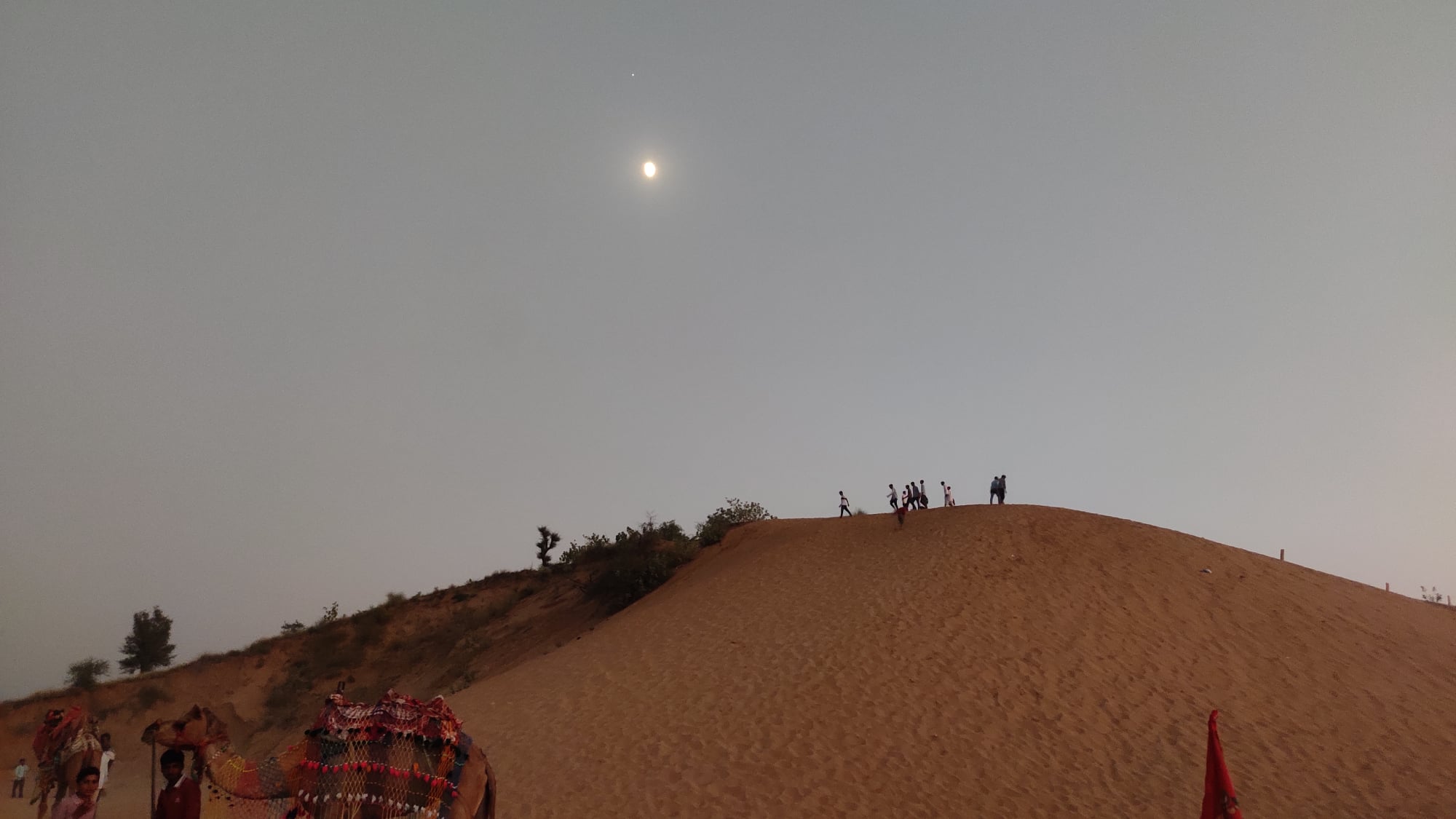
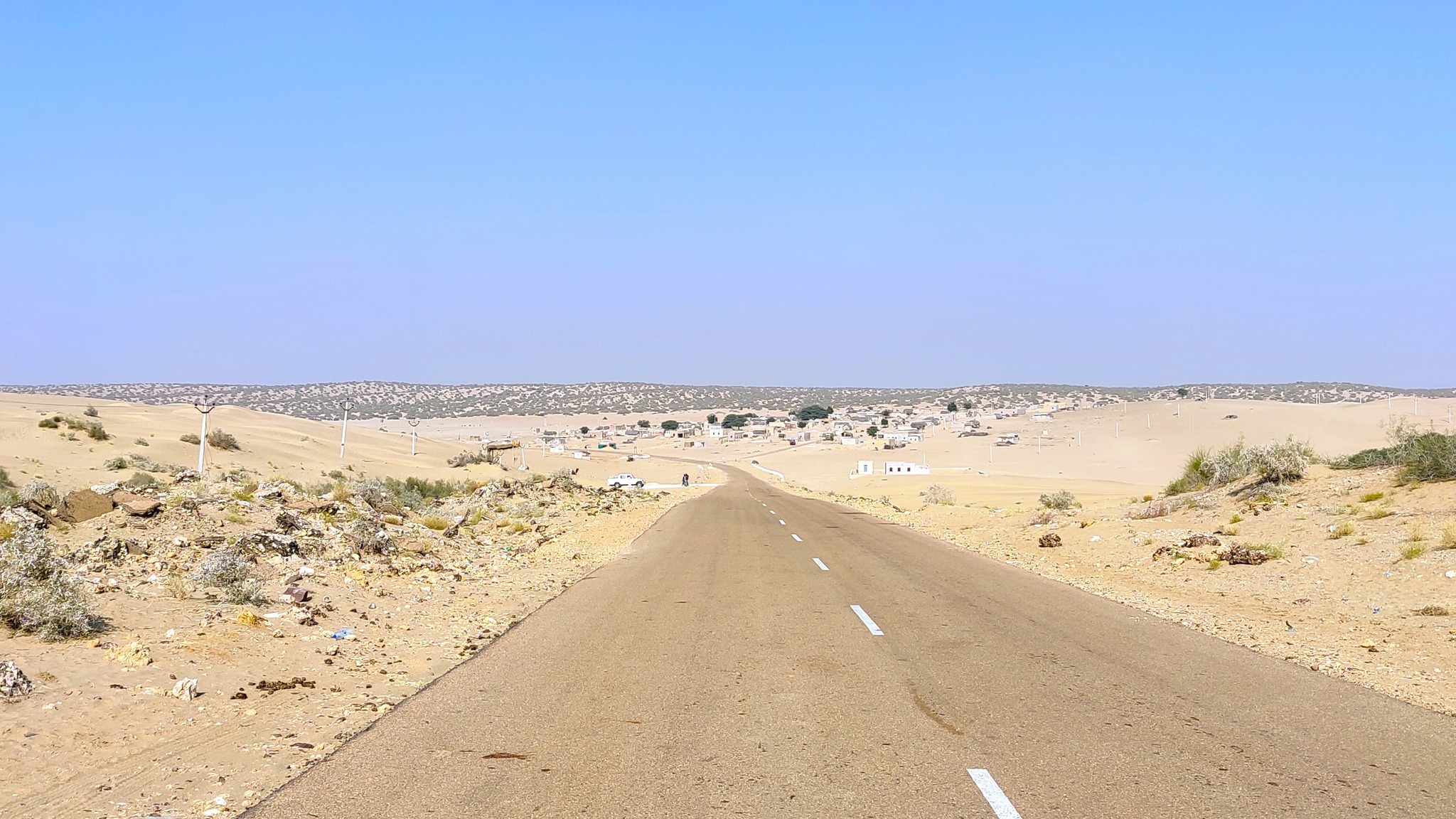
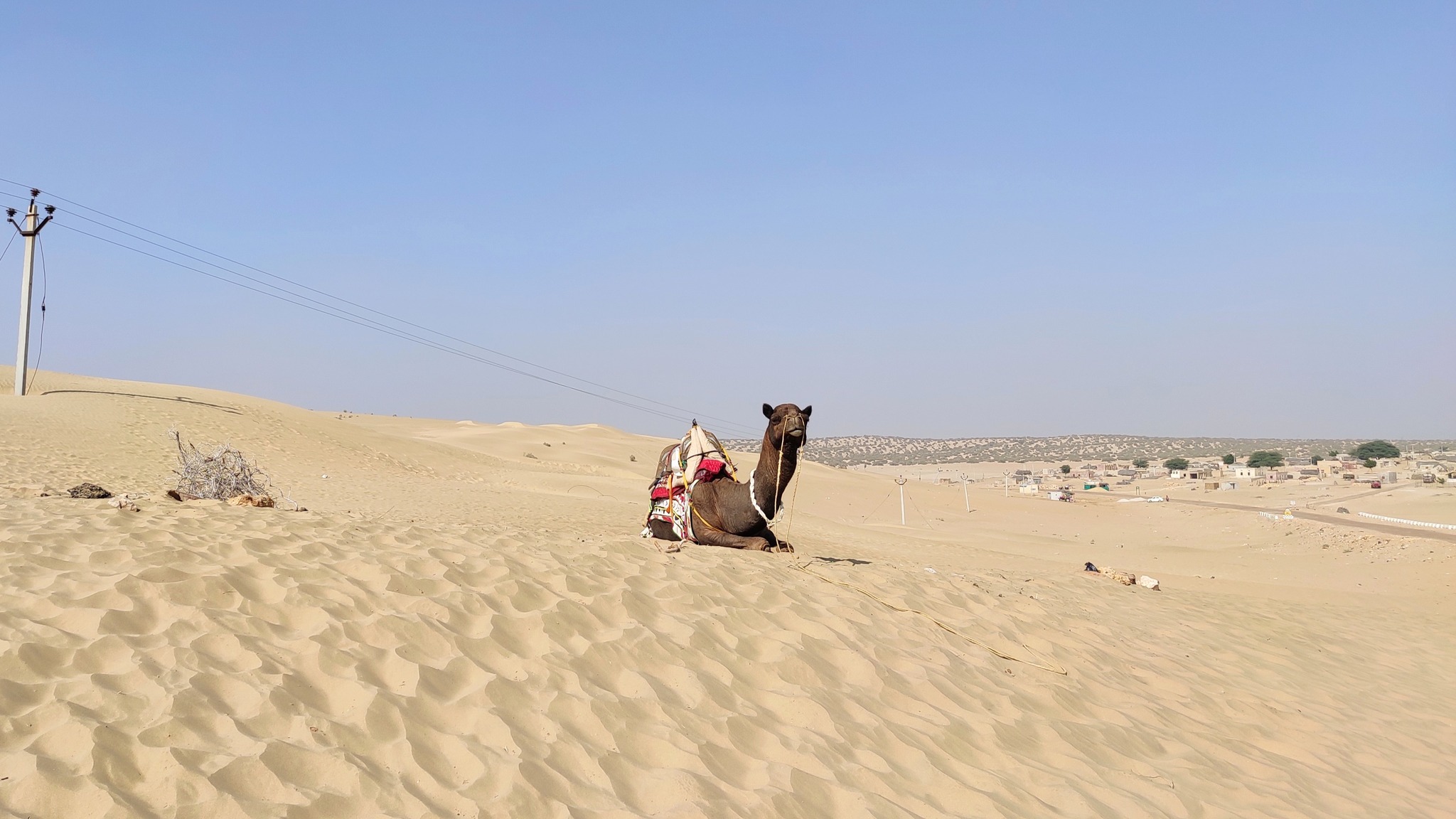
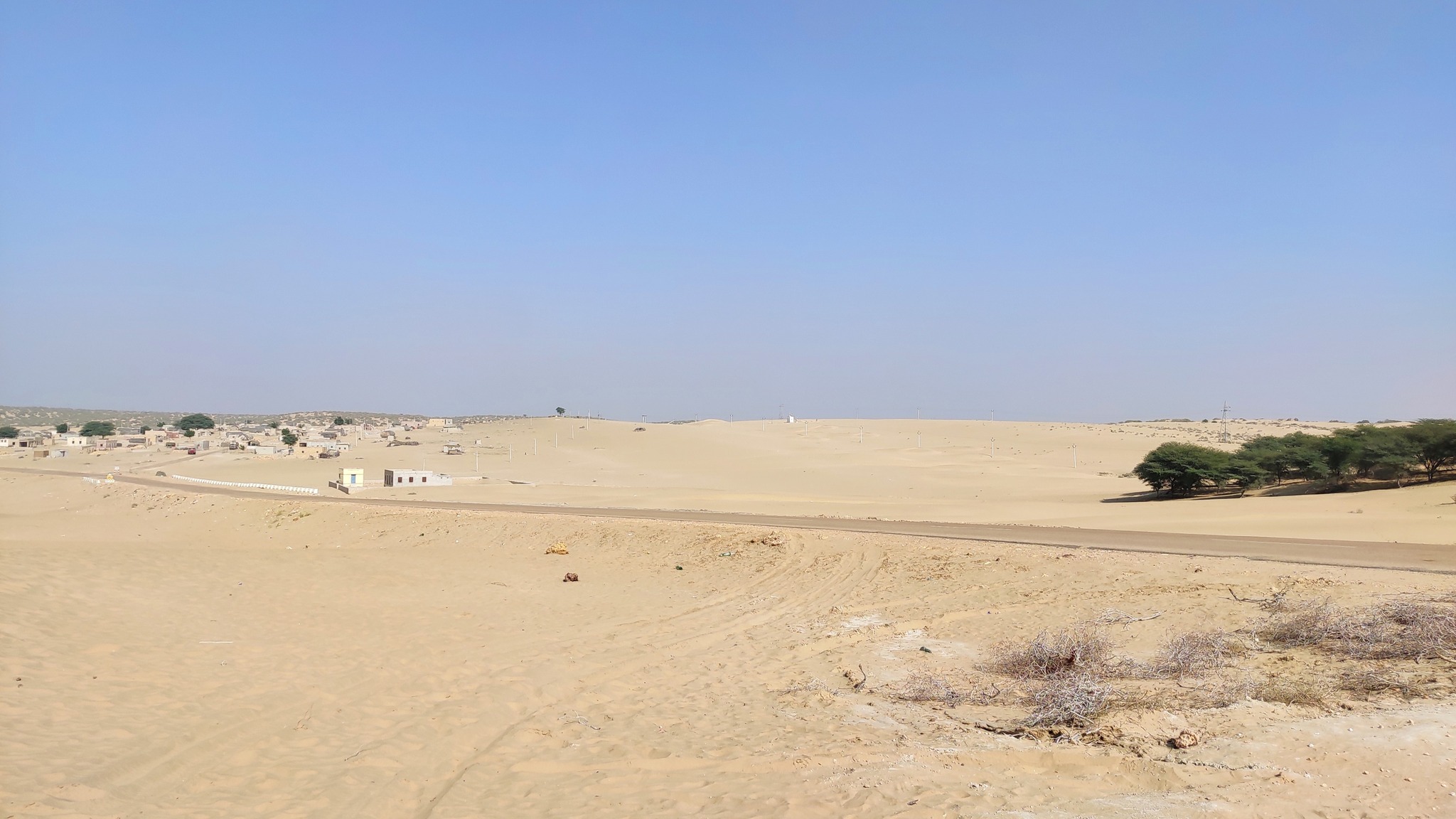
We got down at the decline before the road reached the lowermost point of the depressed stretch reminiscent of a river bed, and ventured into the sand dunes lying on the side of road, taking pictures. As we began to move on, and were almost reaching the bottom of the ‘bed’, we were hailed by a person standing beside a Bolero pick-up, who offered us a paid session of dune-bashing as well as a tour of the vestiges of the Indo-Pak war. We readily agreed, and were amply rewarded with an enriching experience as we wandered through the sands going up and down the dunes. Further, we checked out the numerous bunkers, and sat on the sands partaking of the views of the oceans of sand.
Ranao village lies in the dried ‘river bed’
A camel lounges about at RanaoA little further in the sand dunes
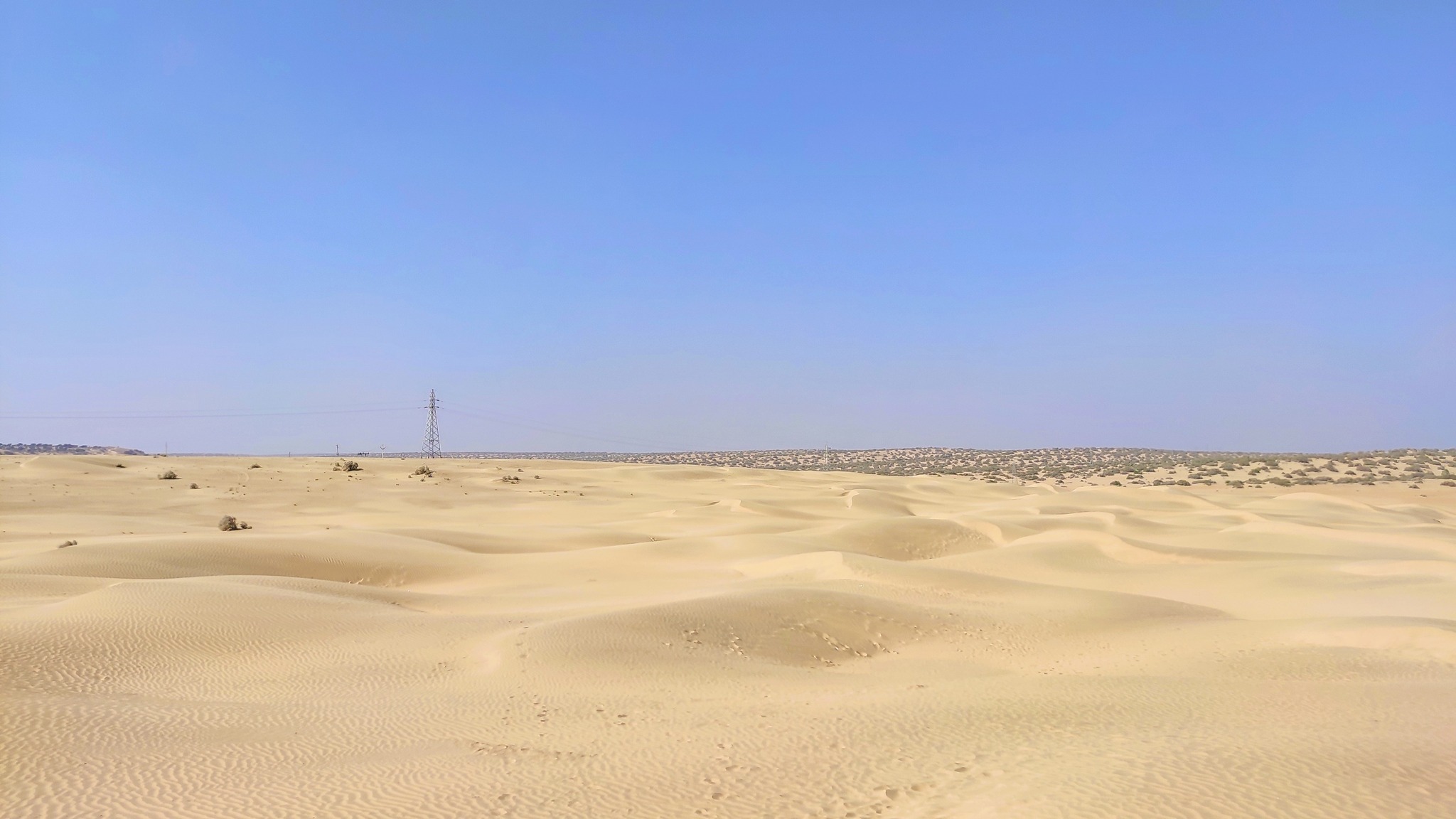
Deep in the sand dunes area in Ranao
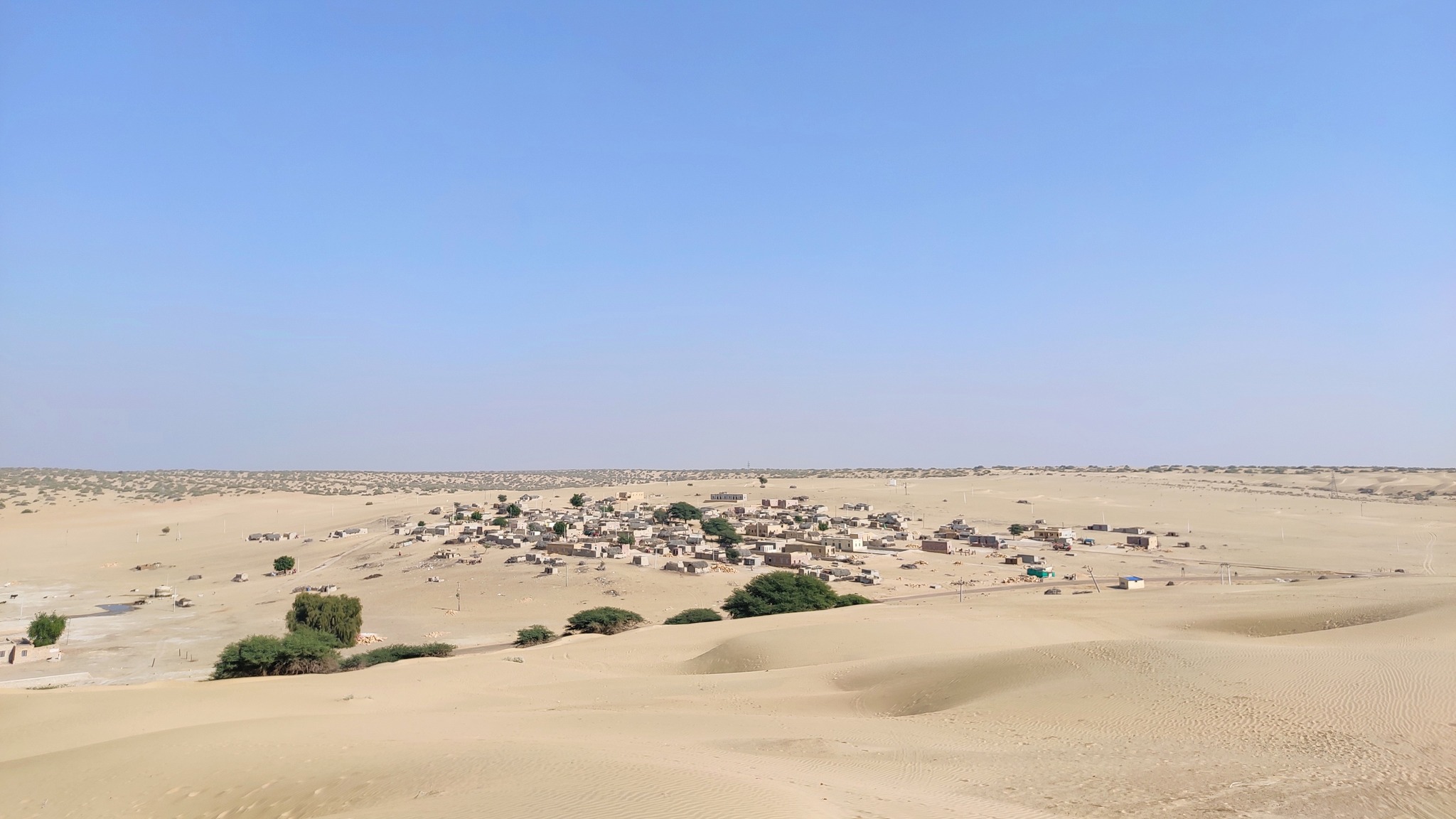
A view of Ranao village from another point on the ocean of sand dunes surrounding it
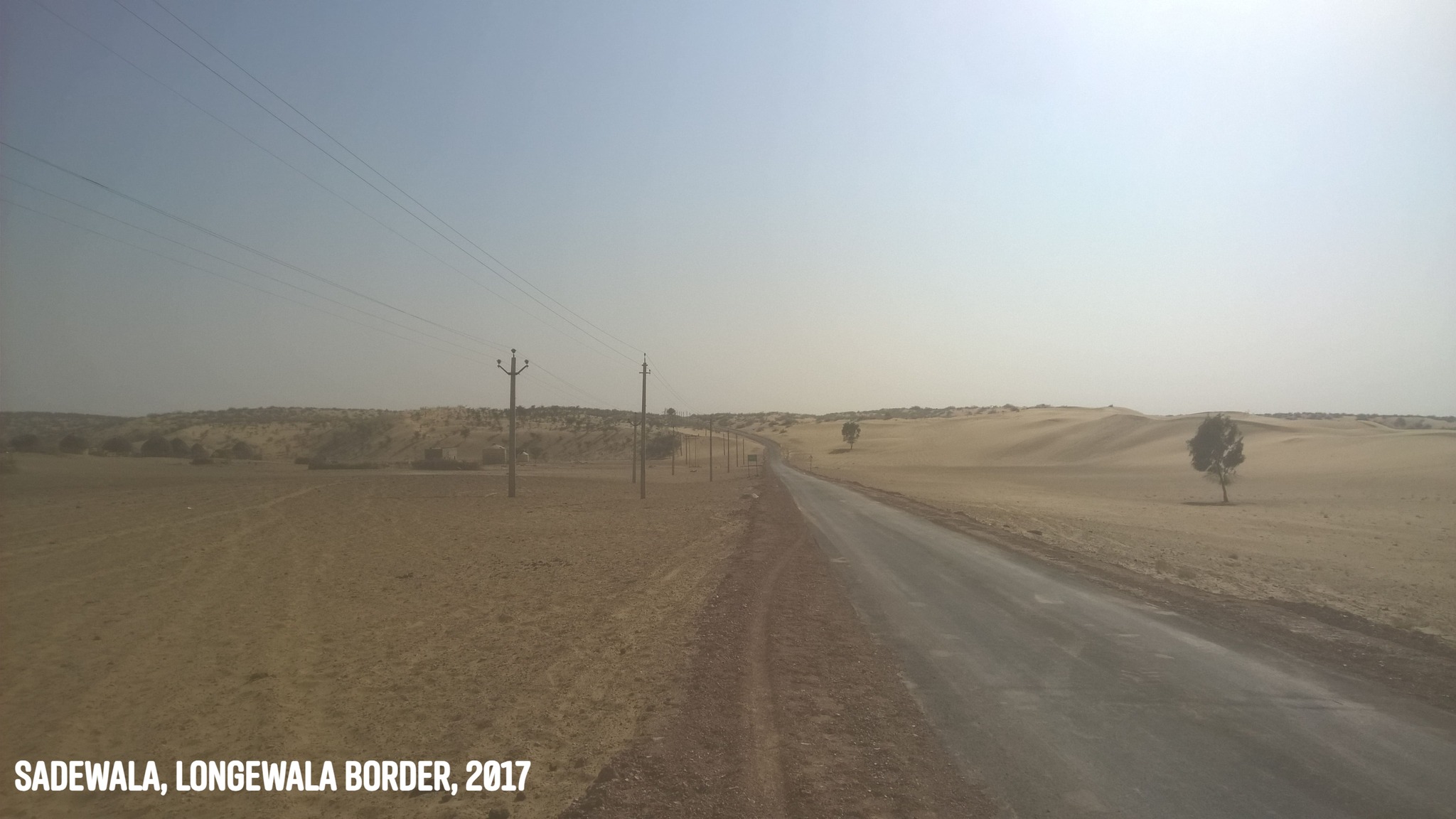
Finally, even though not content, in the interest of time, we left Ranao for Tanot which we reached by 3 PM. There, having a light meal, we proceeded to Longewala moving alongside the Pakistan border, reaching at 4 PM the War Memorial where we could spend just a little over half hour as evening was fast approaching. Thereafter, we headed back in the direction of Jaisalmer, reaching Sam Sand Dunes around 6.30 PM by when darkness had already fallen. We checked in to the Vinayak Desert camp, our stay for the night, where after seeing the folk art programme and a Rajasthani buffet, we went to sleep.
Day 4: Back to Jopdhpur through Osian
Early next morning, I woke up specifically to see sun rise from behind the sand dunes, barely catching the marvellous sight. A little later, we had breakfast, and then checking out from the camp around 10 AM, proceeded to do some camel-riding near the sand dunes. After that, we were headed to the last site of our Jaisalmer leg, the ruins of Kuldhara, which was as fascinating to me this time as it was the previous two times I was here. I was glad to see the family was enamoured too.
Sunrise as seen from the Desert camp at Sam Sand Dunes
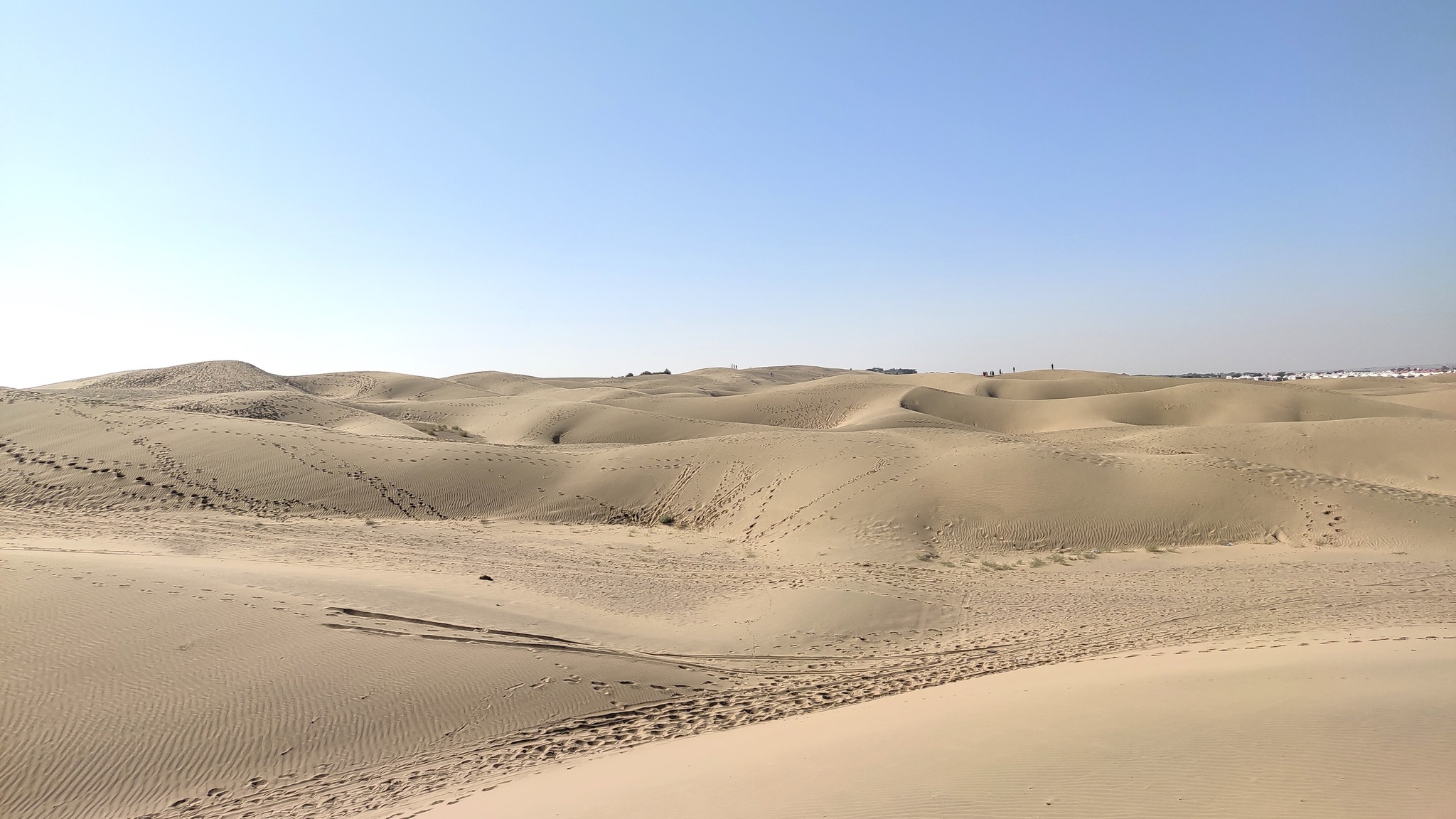
Morning at the Sam Sand Dunes
View of the ruined village from a restored building in Kuldhara
By 12, we were back again on the road headed back to Jodhpur, through a different route than the one we took for the outward leg from Jodhpur. Around 2.30 PM, we stopped at Phalodi to have lunch, and by 4.30 PM, we were at Osian. Osian, dubbed an oasis in the Thar, was a major religious centre of the Gurjara-Pratihara period dating from the 5th to 12th century AD, and had been a trading centre from well before that, at least from the Gupta period onwards. Today, the ruins of Jain and Hindu temples from that period stand witness to its glorious past. The Oswal community is said to have originated from Osian.
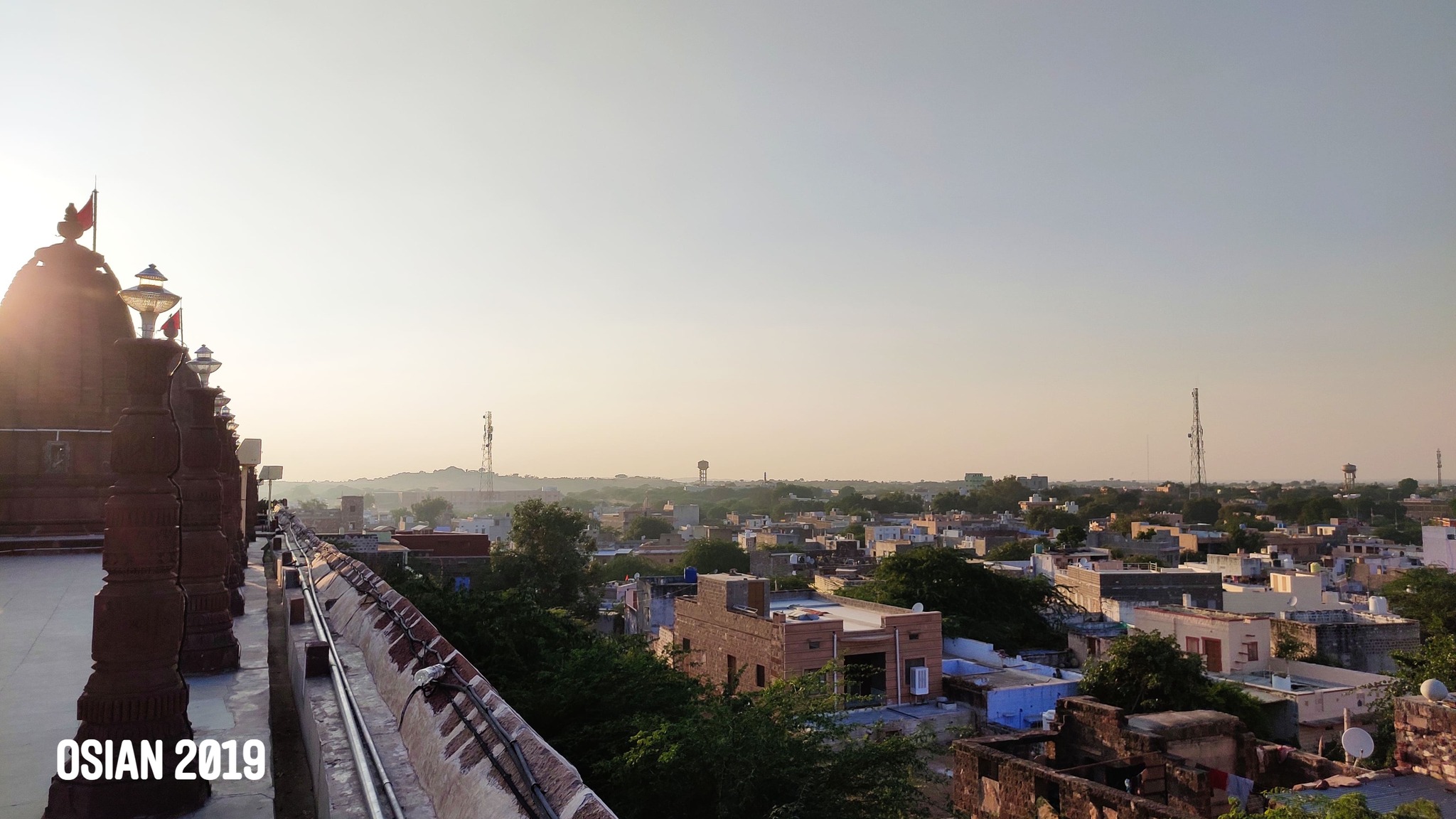
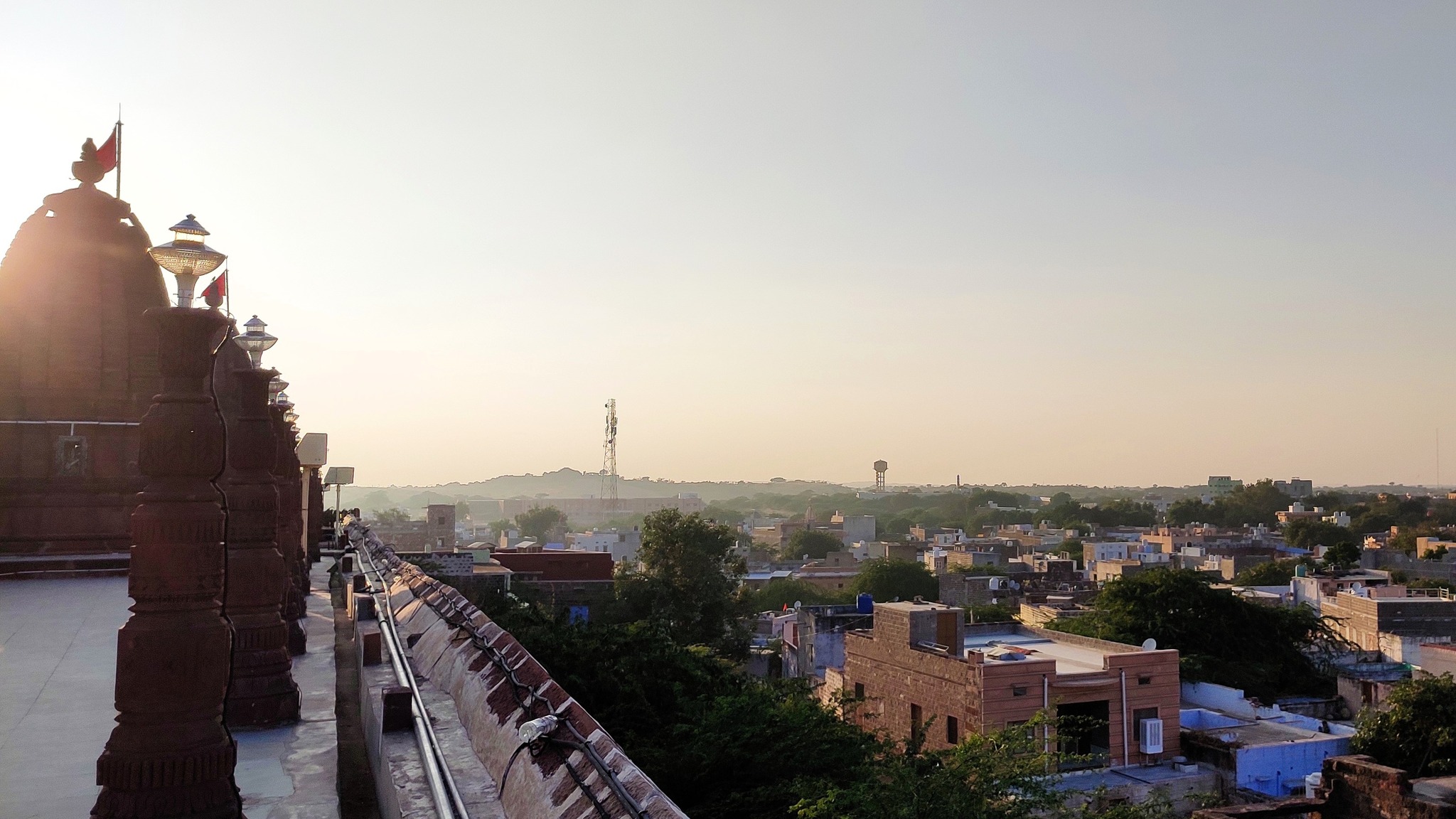
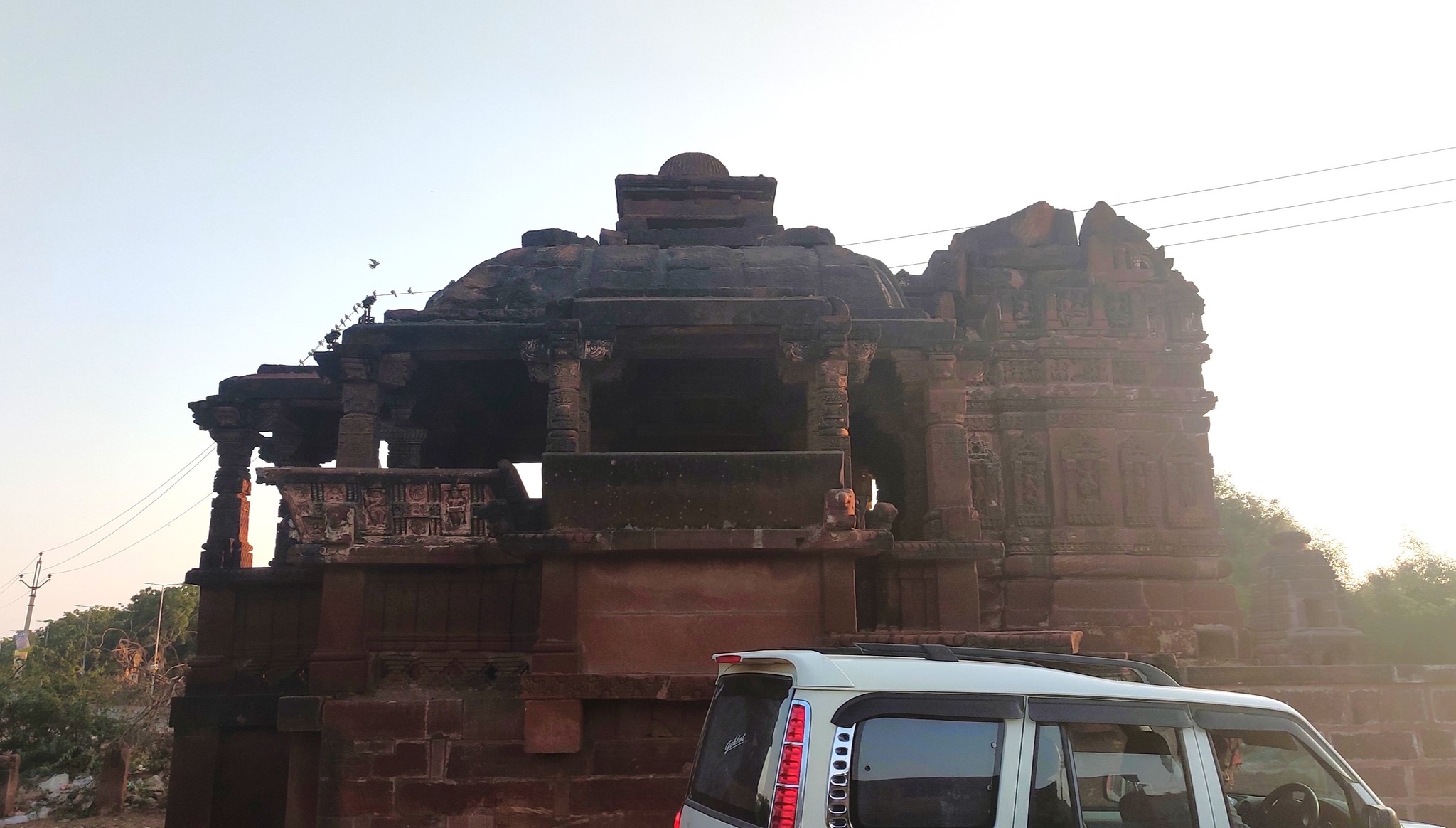
At Osian, we visited the Sachiya Mata temple – Sachiya Mata being the town deity, who as per Jain legend is the form of Chamunda that was turned vegeterian by Acharya Ratnaprabhasuri in 457 BCE. As a result, Sachiya Mata is worshipped also by Jains, and the temple itself has many Jain features. From the temple which is situated on a hillock affords a panoramic view of the landscape beyond the town, including the sand dunes located on the outskirts of the town. Apart from the Sachiya Mata temple, I managed to get a glimpse of a few other temples, including the ruins of the Harihara temple, Vishnu temple and Sun temple that were located on or in the vicinity of the main road.
View of Osian town and beyond from Sachiya Mata temple premise
A ruined temple in OsianA ruined temple in Osian
By 5.30 PM, we had to leave Osian as it was getting dark and we had a train to catch from Jodhpur. We caught the 8.30 PM Mandore Express from Jodhpur and reached Gurgaon the next morning, still delirious from the memorable family expedition into the Thar desert.
Eager to get away from the humdrum of our job, my colleague Amit and I, decided to make a weekend getaway to Jaipur.
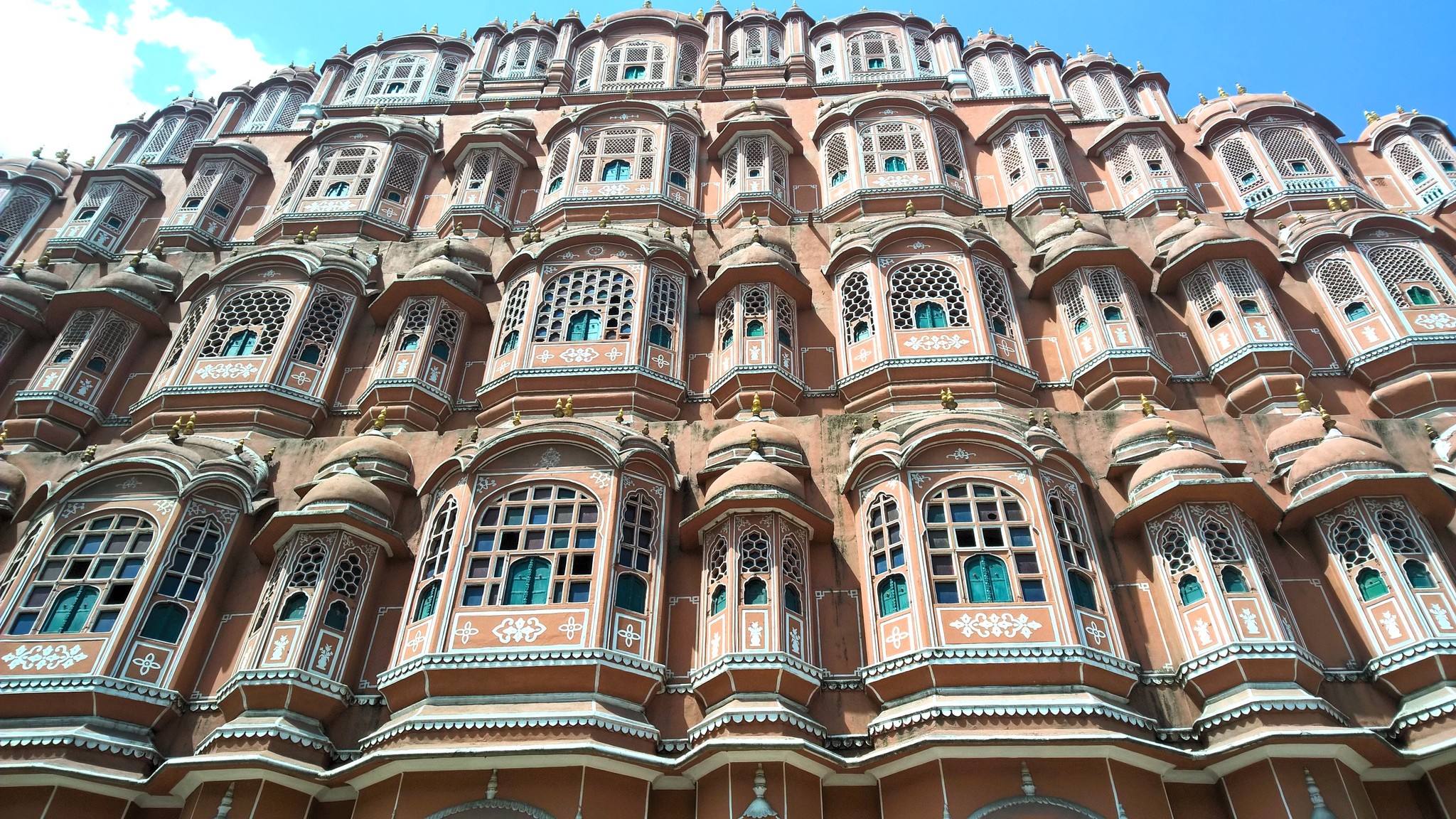
This being my third visit to Jaipur and Amit’s first, I drew from my previous experience, and we booked a day-long package with an auto-rickshaw driver, who took us to Hawa Mahal, Jantar Mantar, Amer fort, Jaigarh fort, and finally, to Nahargarh fort. Later, in the evening, we got a taste of Rajasthani culture and cuisine at Chokhi Dhani.
Hawa Mahal, Jaipur
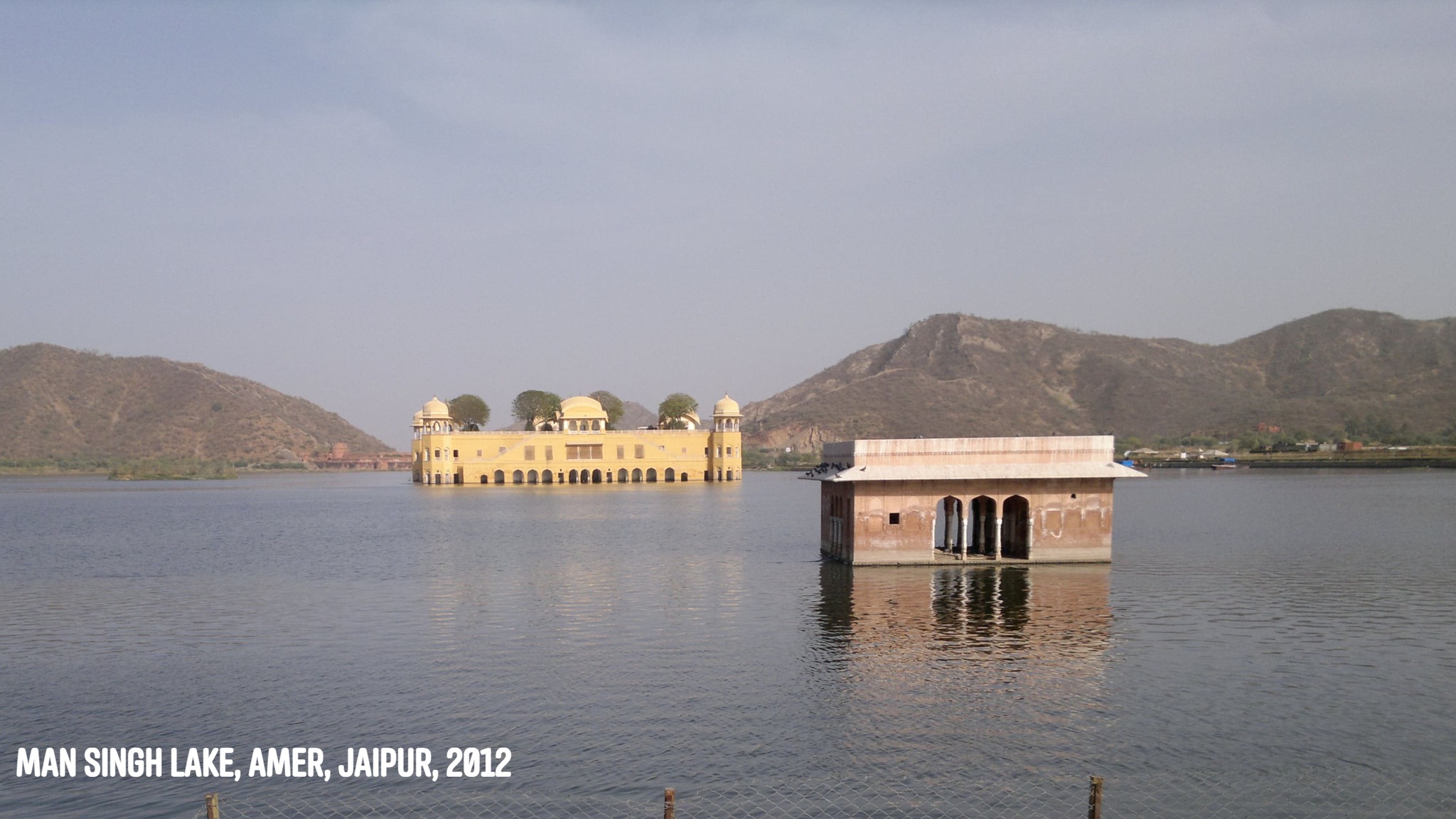
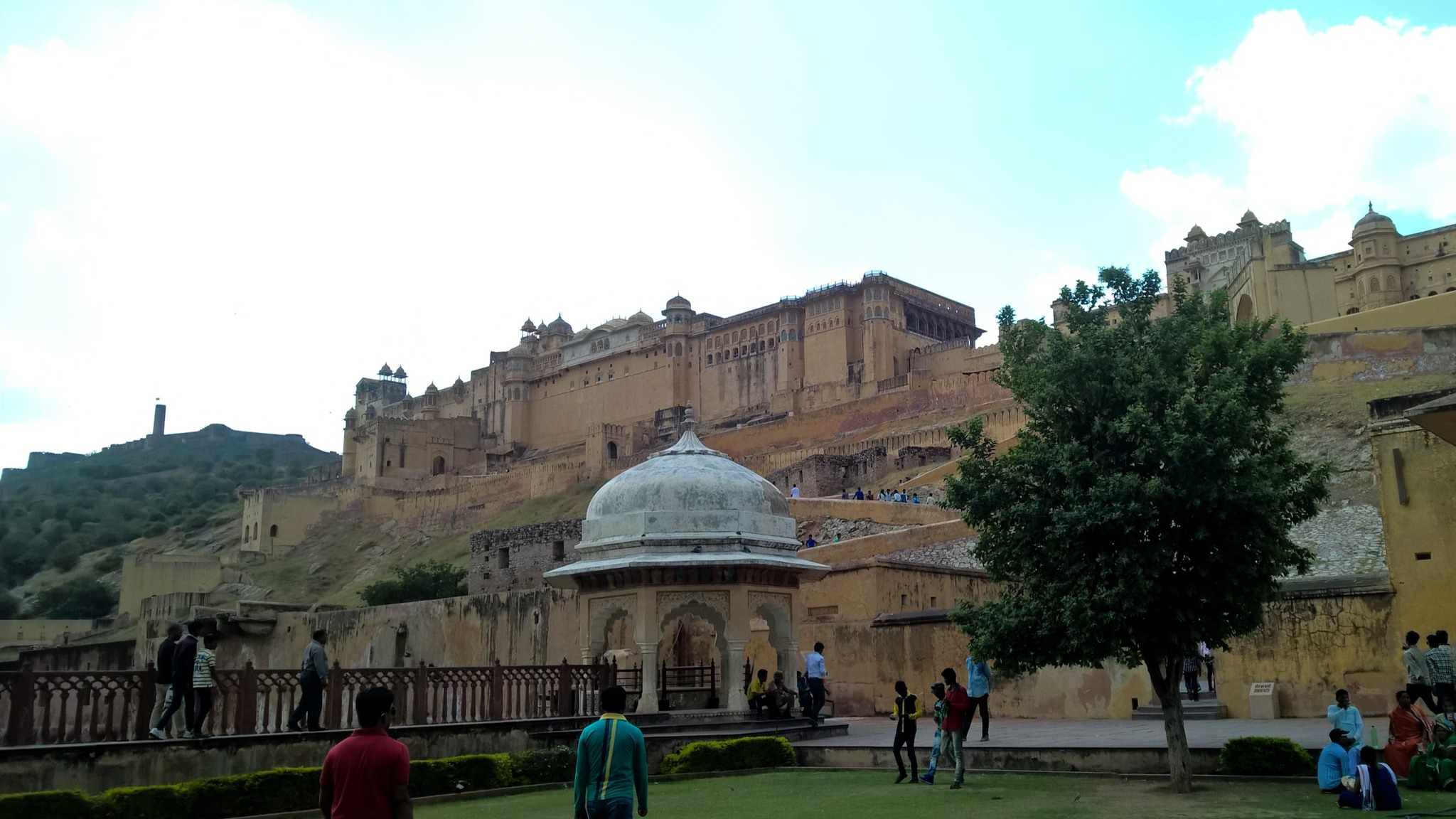
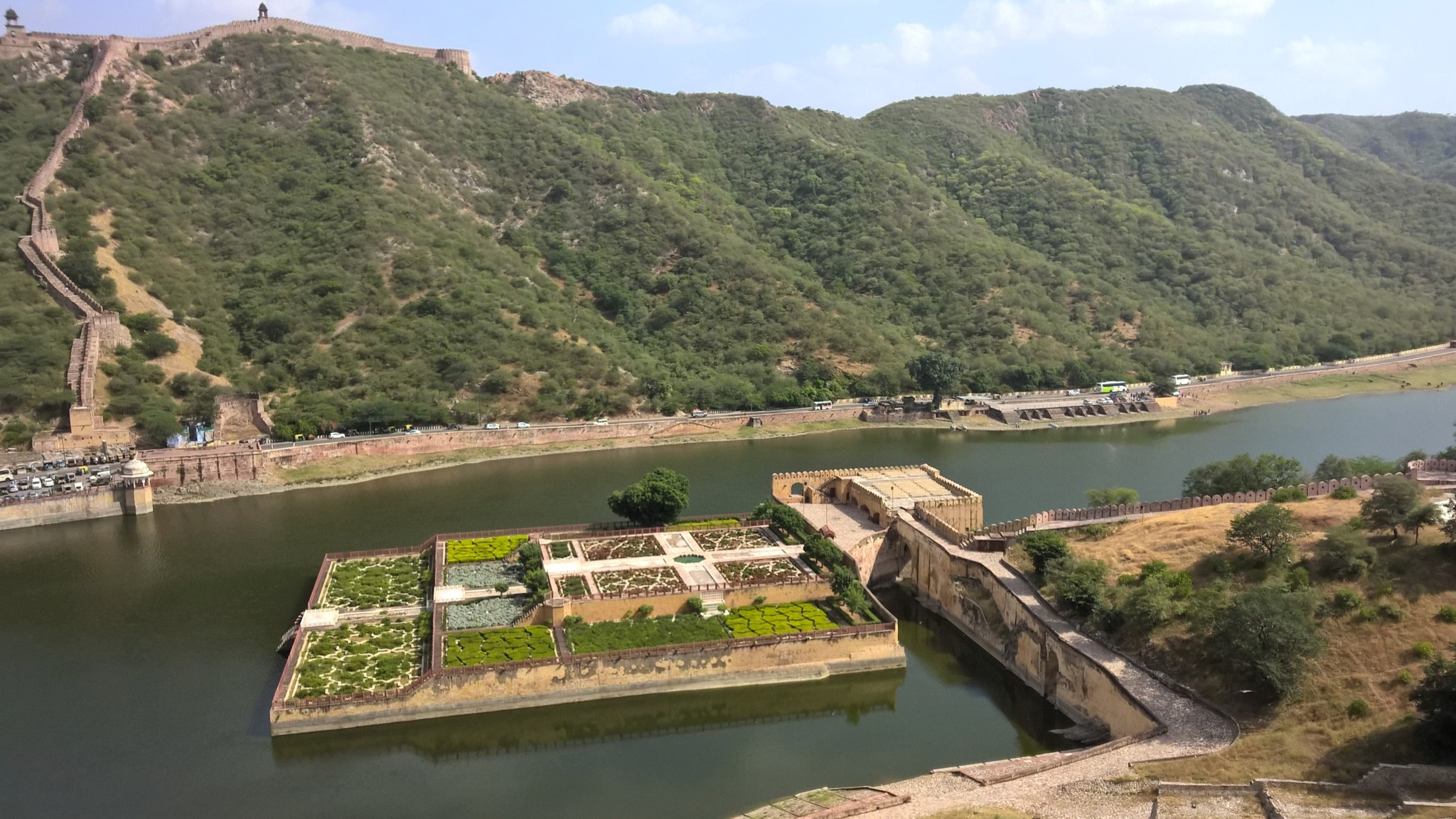
Amer fort, JaipurSaffron Garden, Maota Lake, Amer
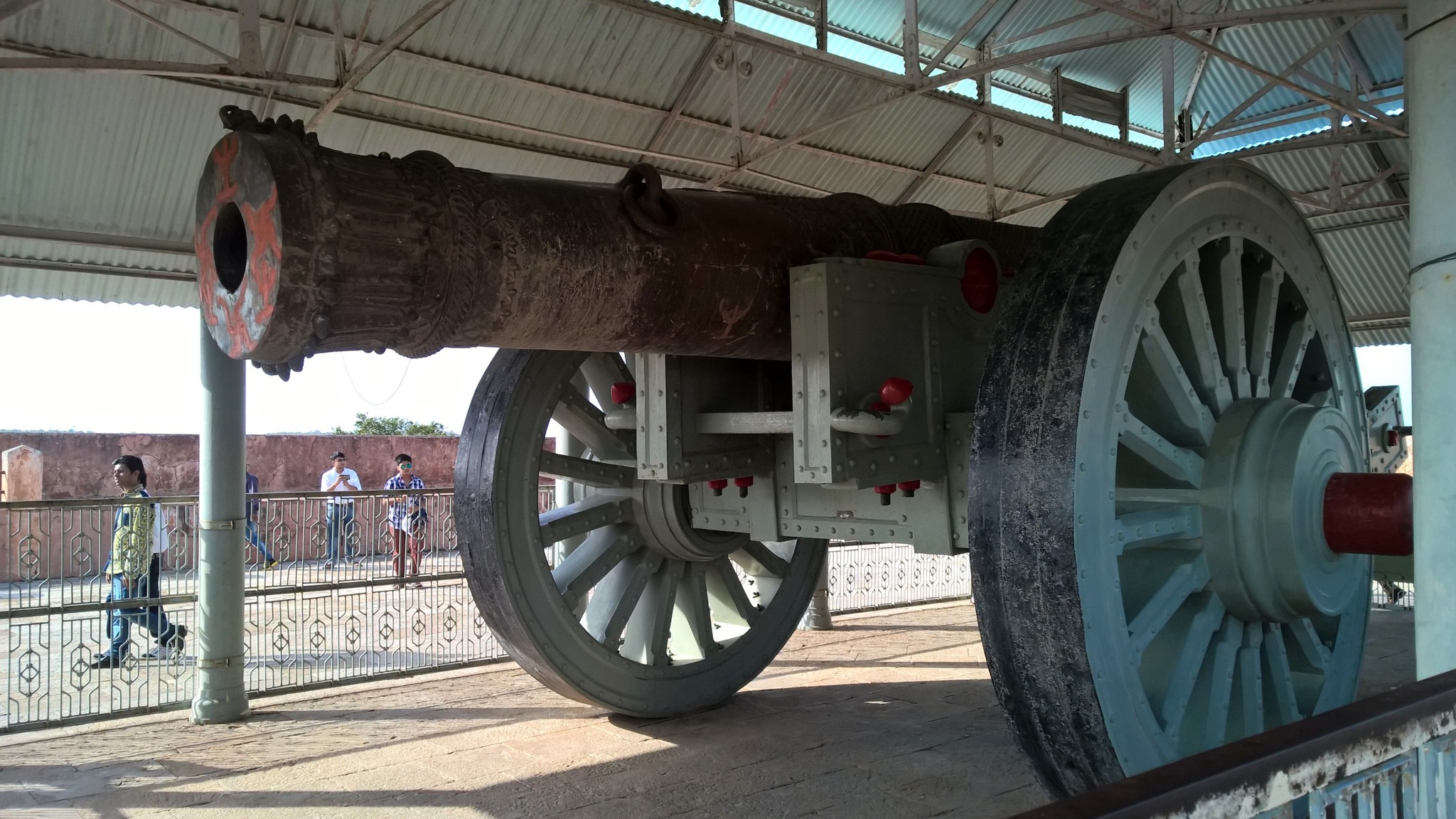
Jaivana cannon, largest cannon in the world at its time of manufacture in 1720 AD, Jaigarh fort
At the roof of Nahargarh fort
Now, where do we go to the next day? I really wanted to go to Sambhar Lake, but not able to find any information on how to reach there, we considered other places, which is when I remembered Mandawa, from two movies released a couple of years ago, namely, P.K. and Bajarangi Bhaijaan. It turned out Mandawa could be reached by public transport, complemented by a bit of local transport.
So, the next day at 8 AM, we set off by public road transport to Mukundgarh. As we passed Sikar, and then, Nawalgarh, I was fascinated by the set-ups of the towns – lying as disjointed clusters in the midst of the semi-arid landscape, with not much construction found along the road connecting the towns. The road cutting through each town was flanked on both sides by houses with their facades aligned, albeit in a jagged manner, with other houses on their respective side of the road. The houses, mostly painted yellow or white, wore an old world charm, transporting you to at least a hundred or more years back.
Getting down at Mukundgarh, we got around to looking for conveyance to Mandawa, when a strange-looking vehicle drew up alongside us. It was an auto-rickshaw which was decked up with fancy colourful decorations, with even more decorations on the inside, and covered with a canopy that formed a closed compartment! We were so intrigued that we hopped into the fanciful auto-rickshaw without even haggling.
As we advanced on the road to Mandawa, we saw the landscape gradually becoming more and more arid, and as we got nearer to Mandawa, we could see on both sides endless expanses of undulating sandy flats with a few sprinklings of low trees and shrub, even as villages each comprising just a handful of huts greeted us from time to time. Soon, we saw a bigger cluster of houses, and were welcomed by an arched gate on a wall that seemingly enclosed a town inside – Mandawa was here.
As we entered the gate, we were ushered in by two arrays of verandahs of the buildings abutting either side of the narrow road. Some buildings hosted shops, some others were residences, and some were merely the entrance to a larger building standing behind the front row.
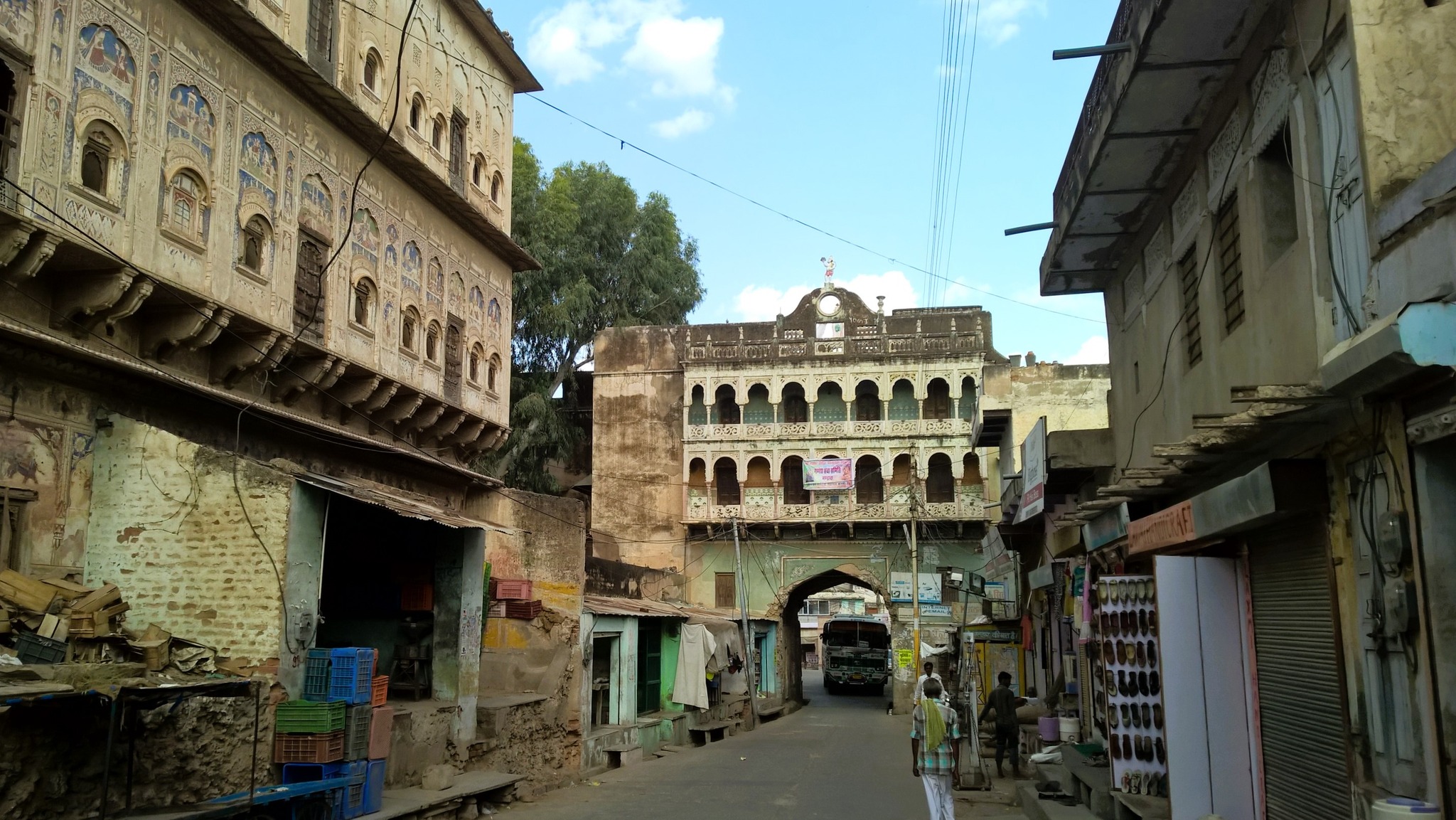
Entrance gate, Mandawa
Before we could get a hang of the place, we entered a bylane that apparently led to the Mandawa castle, but failing to locate the gate, we kept walking, past many havelis, until we reached an open area somewhere adjacent to the castle. We saw a shanty serving Maggi instant noodles and tea, and decided to first fill our tummies, while scratching our heads as to how really to explore the place, in the absence of a guide or any prior knowledge.
This is when appeared a boy – someone we would later refer to as Chhutku – barely 8 years of age, with disheveled hair, dressed in crumpled, undersized clothes, who sensing we were the touristy types, offered to show us around, for a price, and kept insisting on it until we had finished our meal. Partly to humour him, and partly impressed with his enterprise at such an early age, we relented.
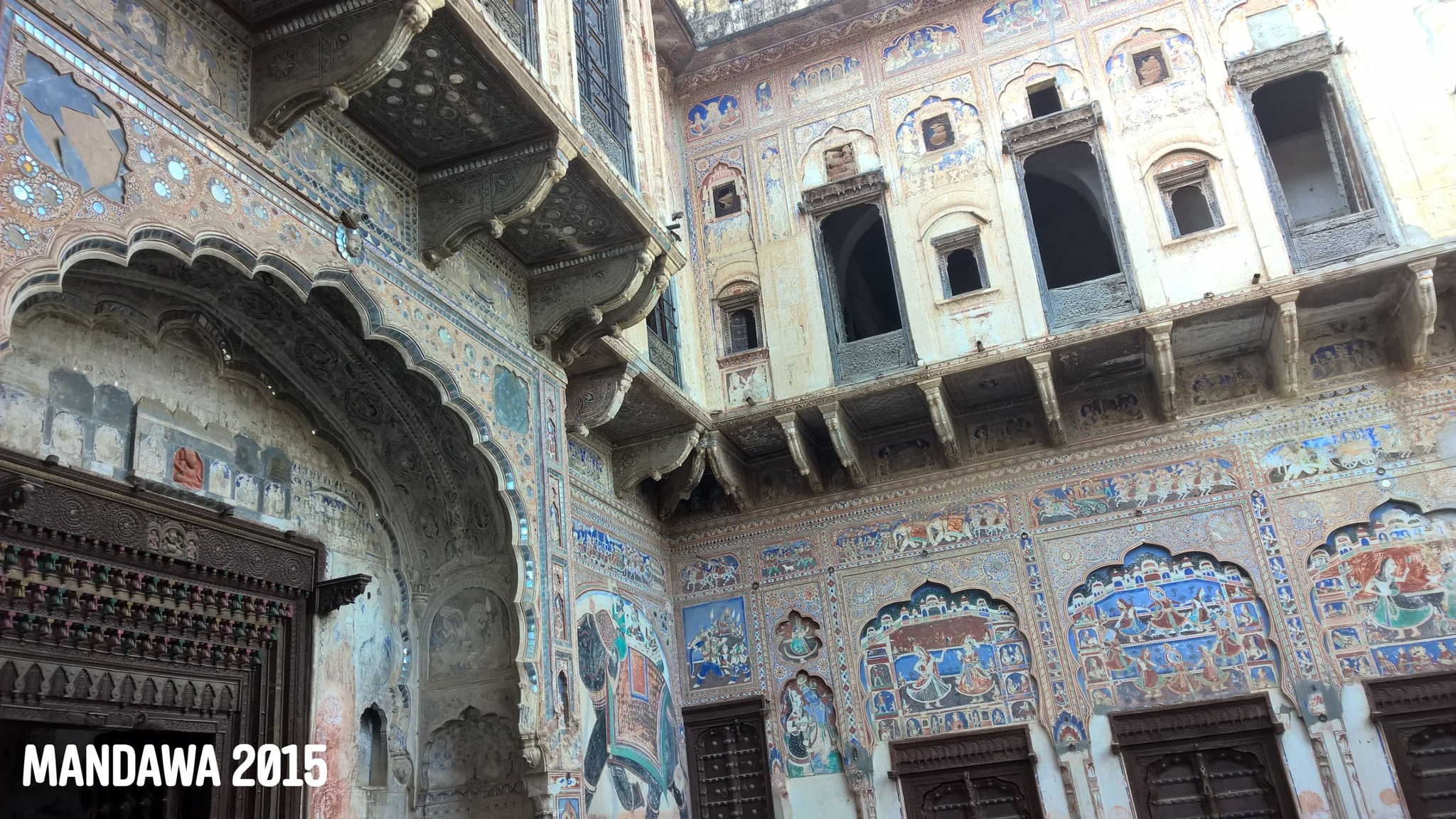
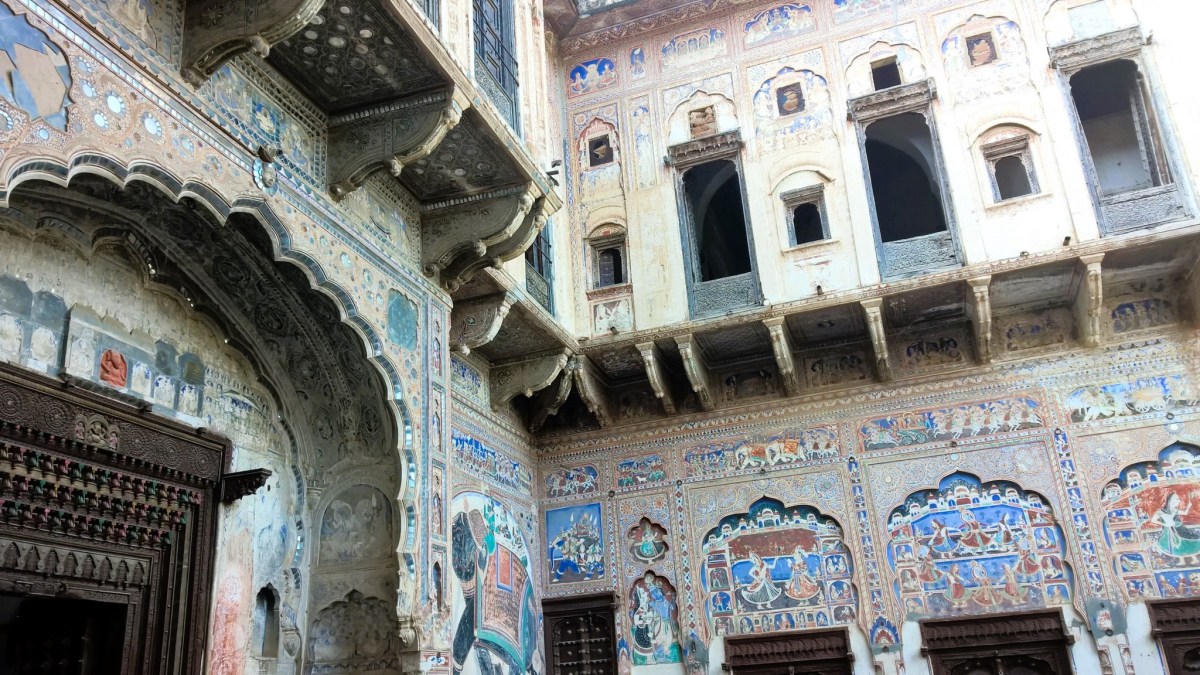
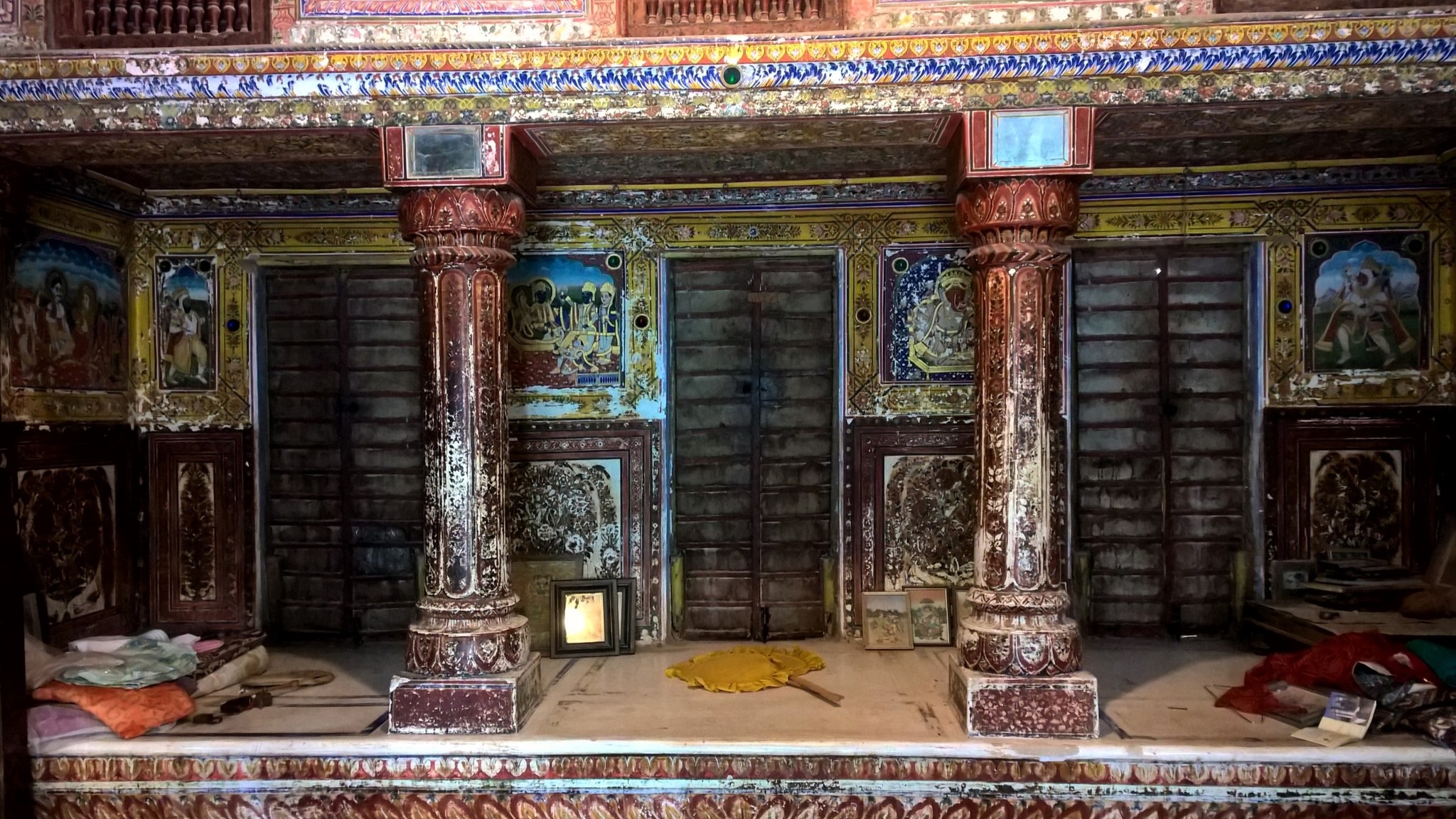
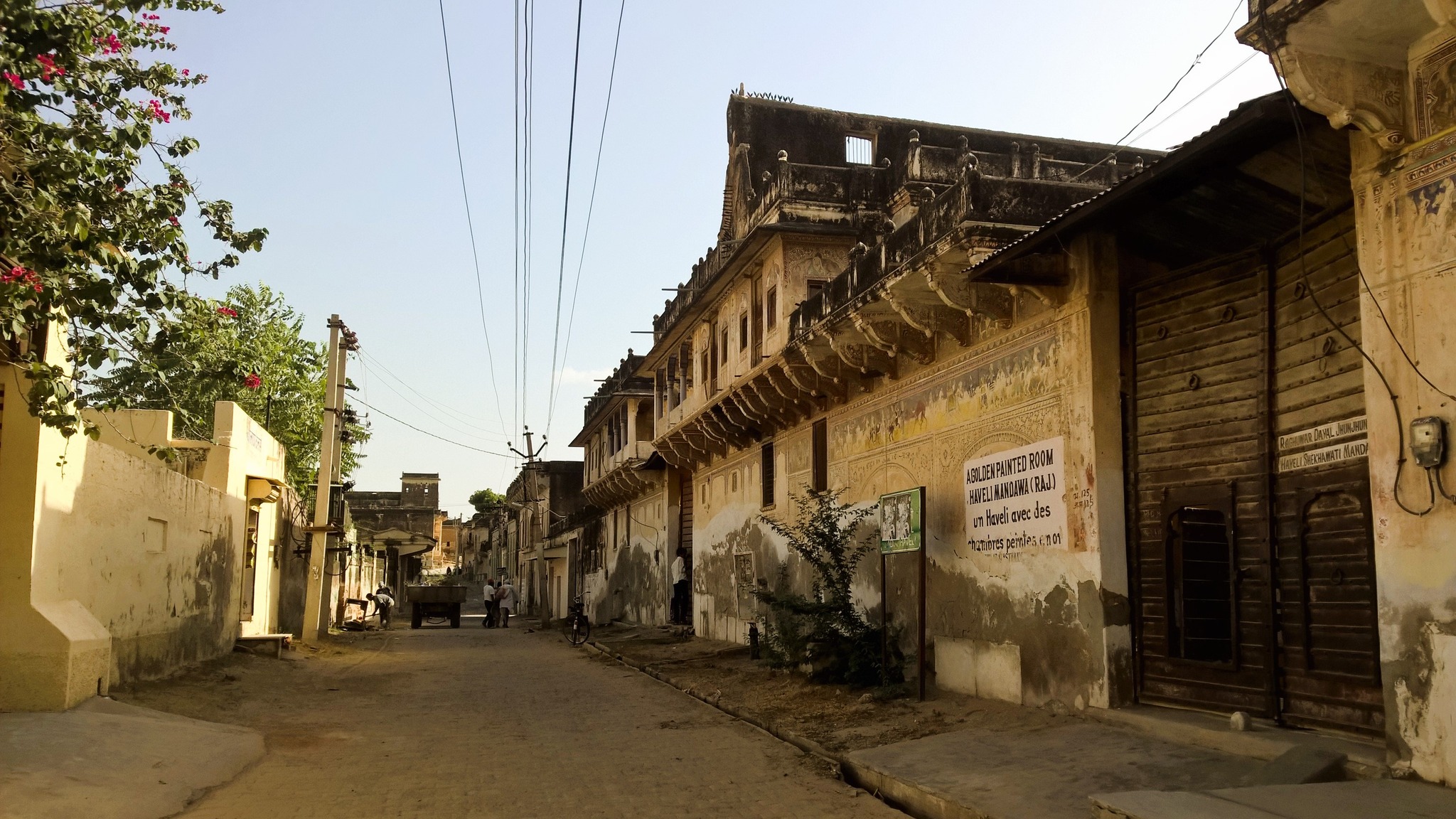
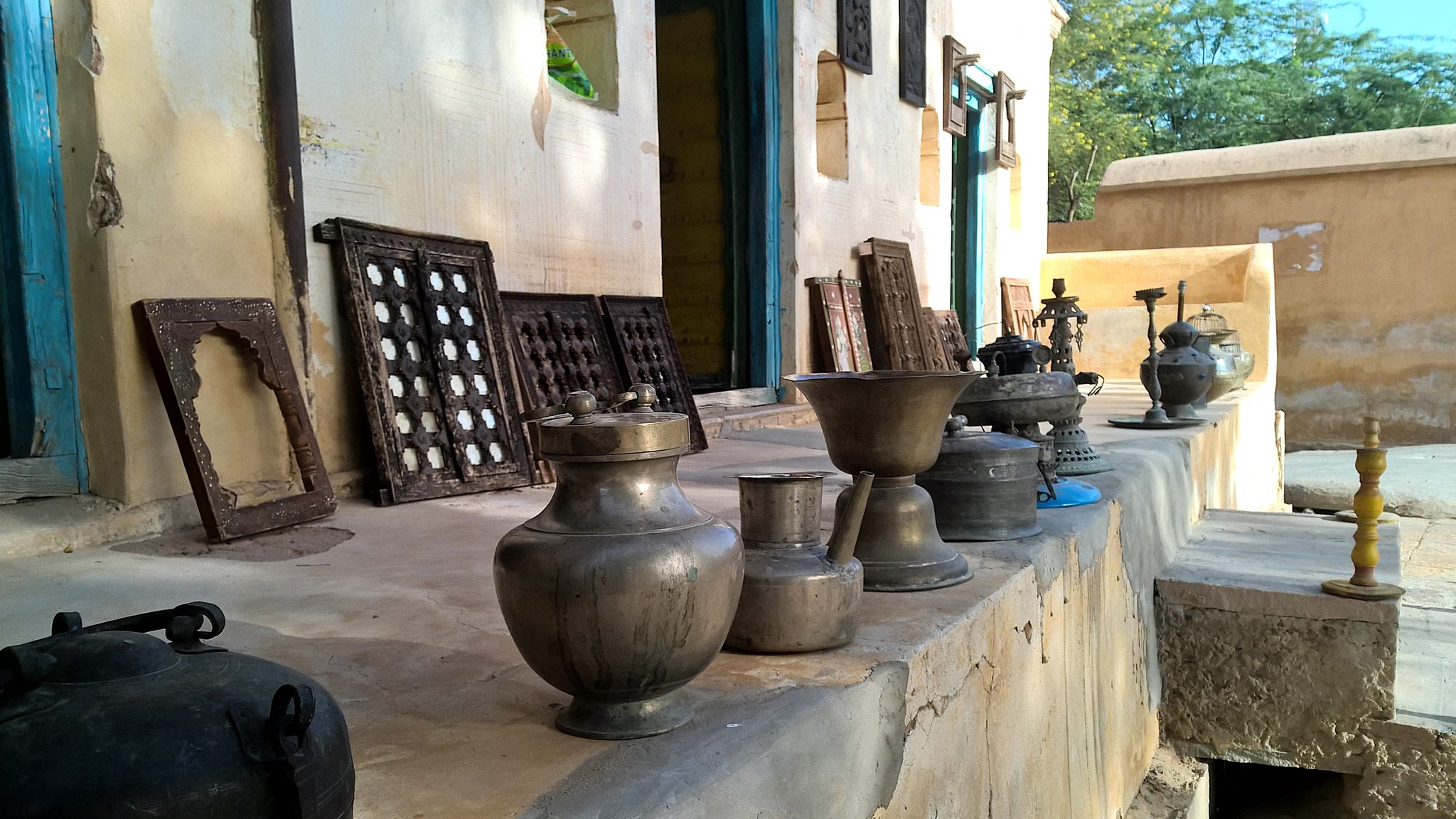
So, courtesy of Chhutku, we saw a handful of havelis, with their painted facades, part covering the balconies jutting out and peering over the street, and part forming the front wall proudly strutting their evocatively painted visages, all but weathered by time. One particular haveli, Jhunjhunwala Haveli, aptly nicknamed the Golden Haveli, houses a room with intricately painted golden-coloured decorations, along with artifacts from a time gone by – giving us a glimpse of the lives and times of the merchants that built and lived in the lavish residences.
Frescoes on the inside of a haveli in Mandawa
Jhunjhunwala’s Golden Haveli, Mandawa
A typical Mandawa laneArtifacts from the past, Mandawa
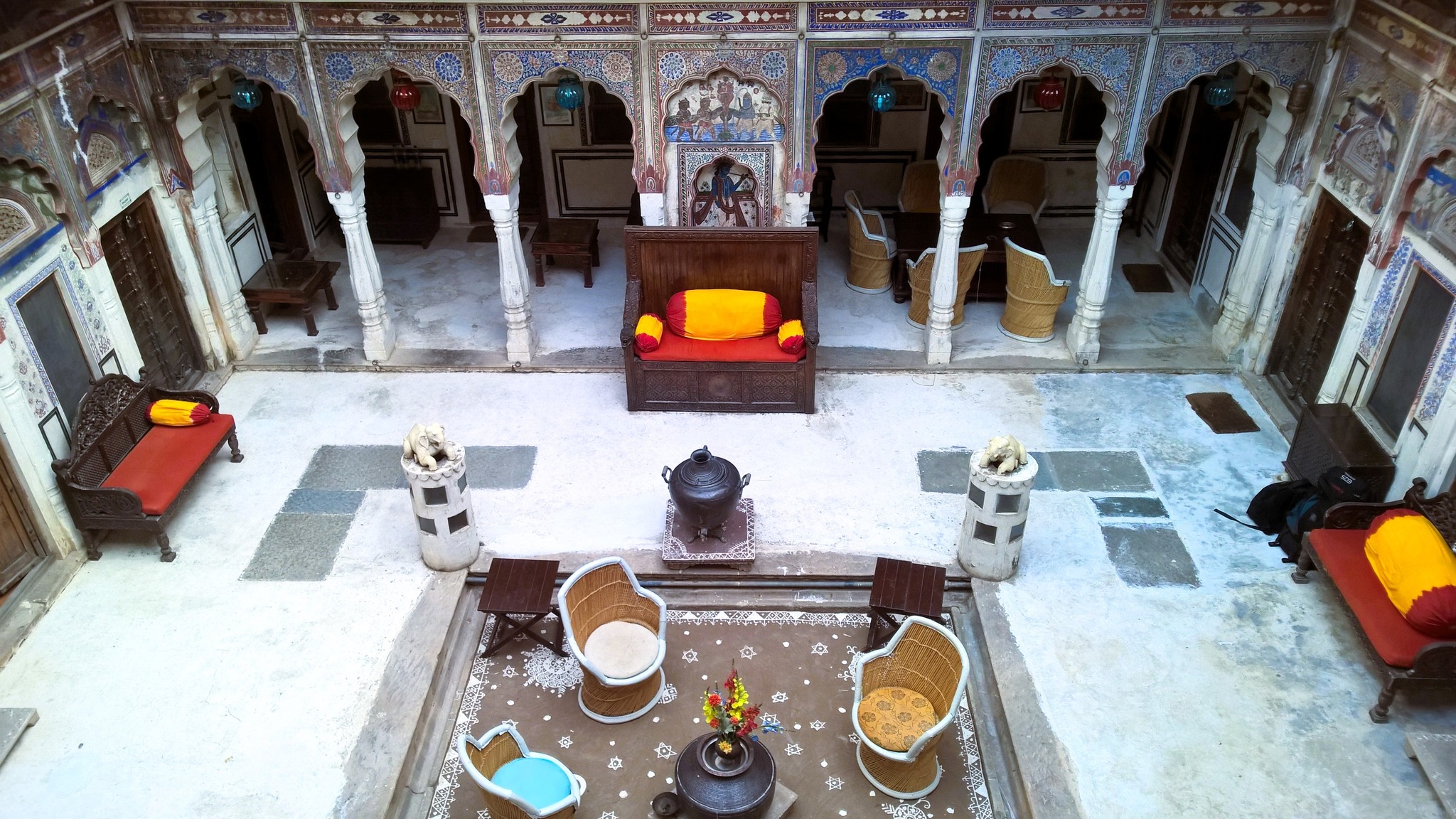
The inner courtyard of the Mandawa Haveli, now turned into a hotel
After the tour of the havelis, Chhutku bid us adieu at the Mandawa Castle, where we learnt the castle had long since been operating as a hotel, but was also open to tourists in lieu of a hefty fee. Nevertheless, we took the opportunity to see around the castle, get views of the town and the countryside from the rooftop, and take pictures around the sprawling swimming pool.
Entering the Mandawa Castle precincts
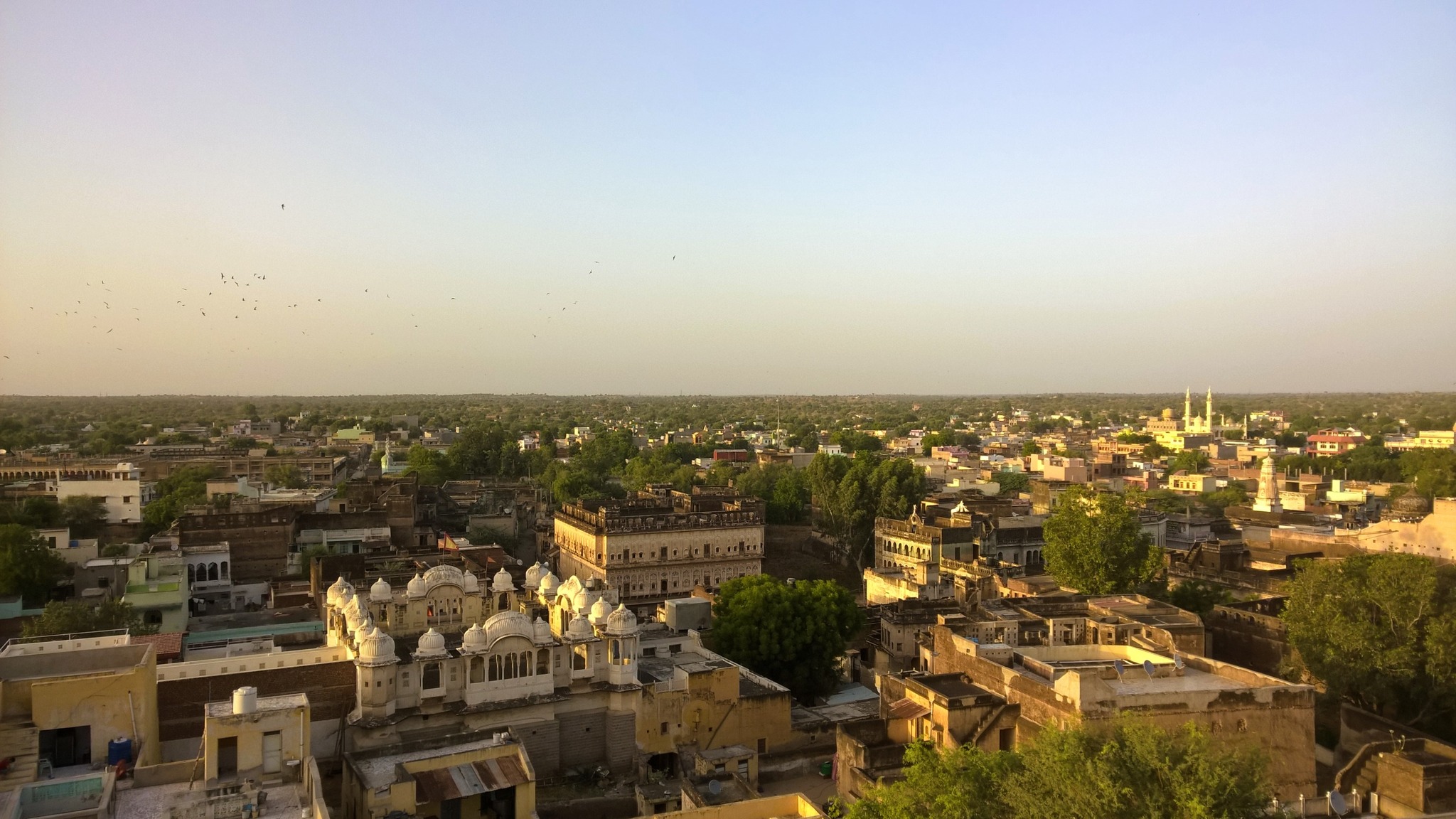
Skyline of Mandawa and beyond
At long last, darkness fell, and it was time to confront the dilemma of whether to stay the night or return to Delhi – it was resolved when we learnt that there was a 10 PM public road transport bus running directly to Delhi. Following dinner at a Tripadvisor-recognized restaurant, we boarded the bus, still not having got a bearing of where exactly we were located with respect to Delhi.
By 5 o’clock in the morning though, when I opened my eyes as we entered Delhi, I was still hungover from the overwhelming and intriguing air of the quaint town that stood astride the trading routes of the past. Although located amidst the barrenness of the desert, the unique vantage point of the town in those times ensured that its mien and ambience remained anything but barren.

















 The Timber Trawler