My little brother paid the motherland a visit after 2 years, and before the Indian summer set in with its full glory, the family decided to make it the first ever self-driven road trip for the family. So, off we set in late March, on a 6-day road trip with an itinerary so fluid that we only knew the first 3 places we planned to visit. Deciding to let the vagaries of chance sprinkle our journey with generous doses of surprise, we did not also book a hotel prior.
And boy, was it rewarding! With a mix of the famous and the little known (or even barely-frequented), this time we forayed through the desert to brush with history stretching back to 5000 years ago, in search of a lost river and a lost civilization, chanced upon desert lakes and desert wildlife, hobnobbed with human-like rats, and delved deep into a jungle on a temple chase while the sun was going down.
Hanumangarh
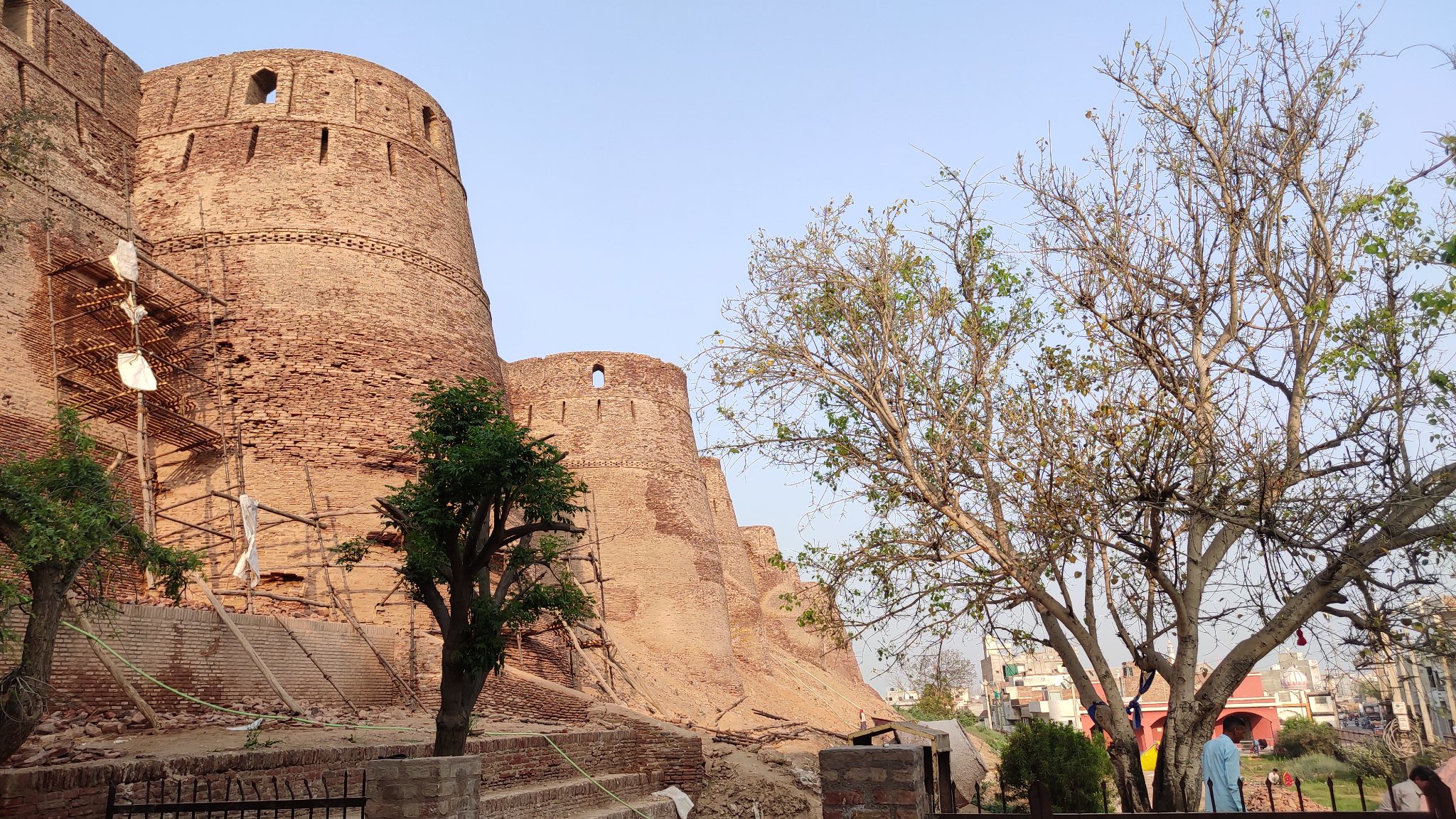
Our search of the mythical River Saraswati led us to the desert town of Hanumangarh, where we came upon the Bhatner fort, which dates its origin to the 2nd century AD. The old structures are now buried in mud, and the fort is being renovated.
Walls of Bhatner fortMounds over structures, Bhatner fort
Kalibangan
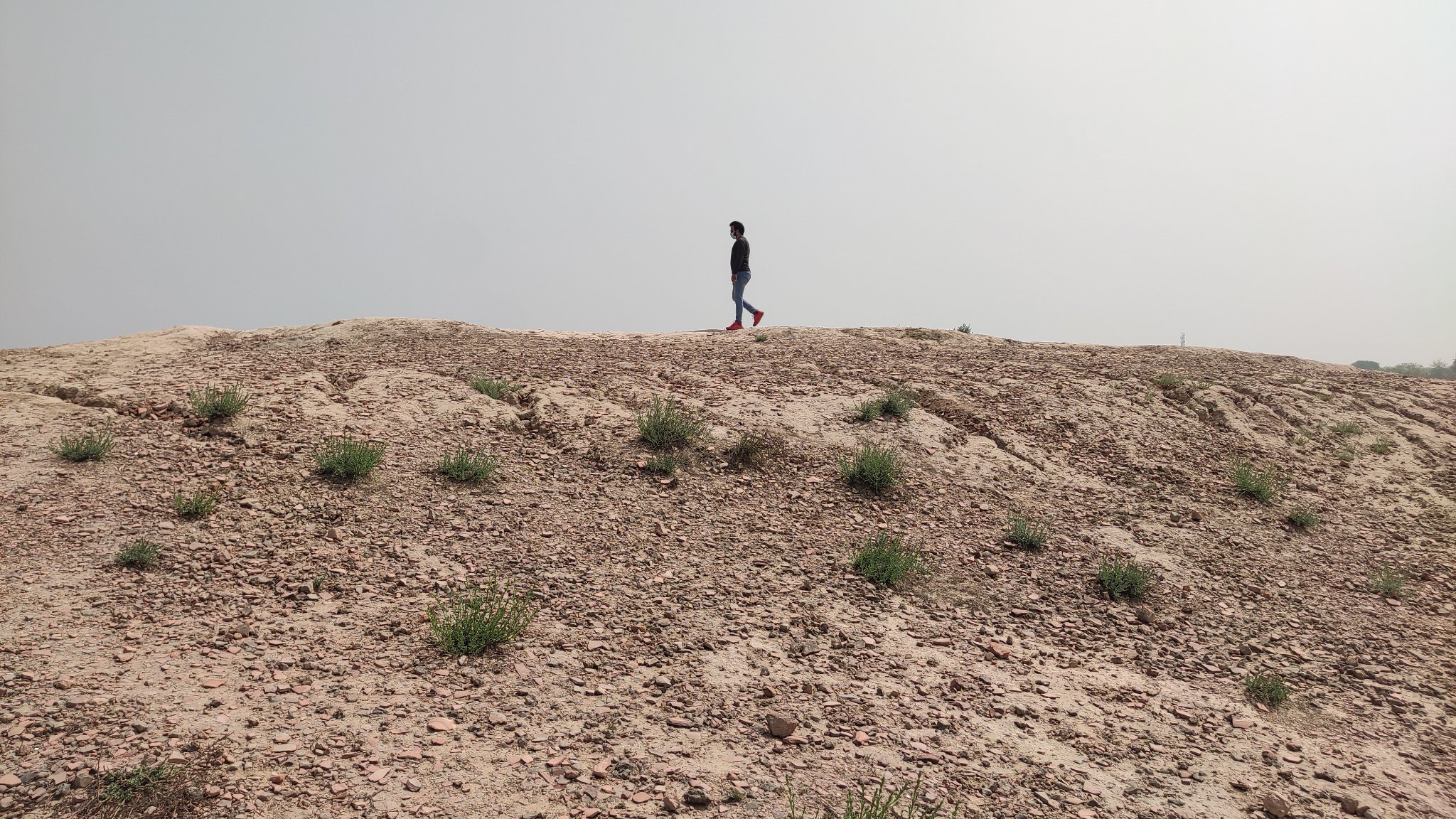
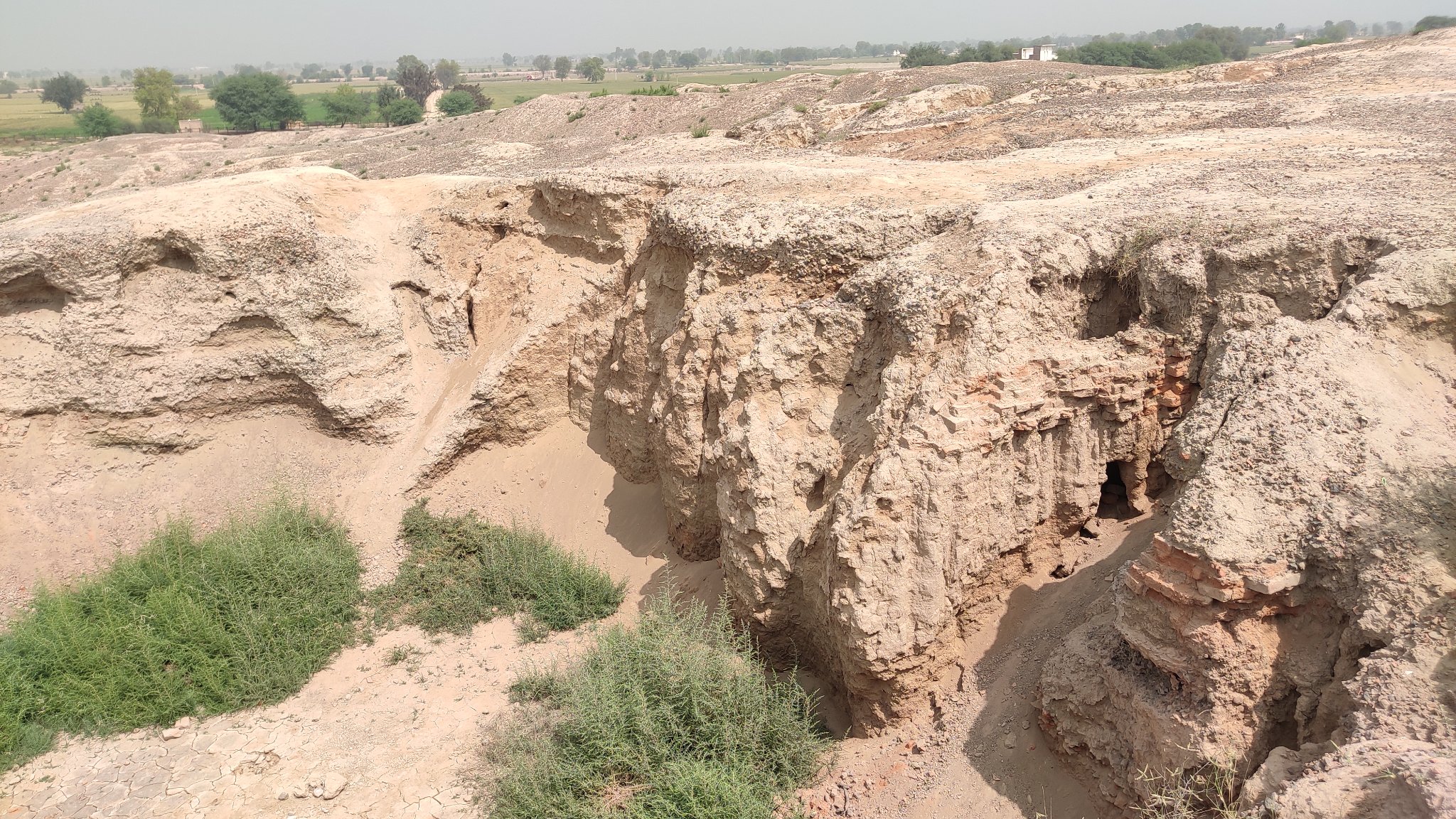
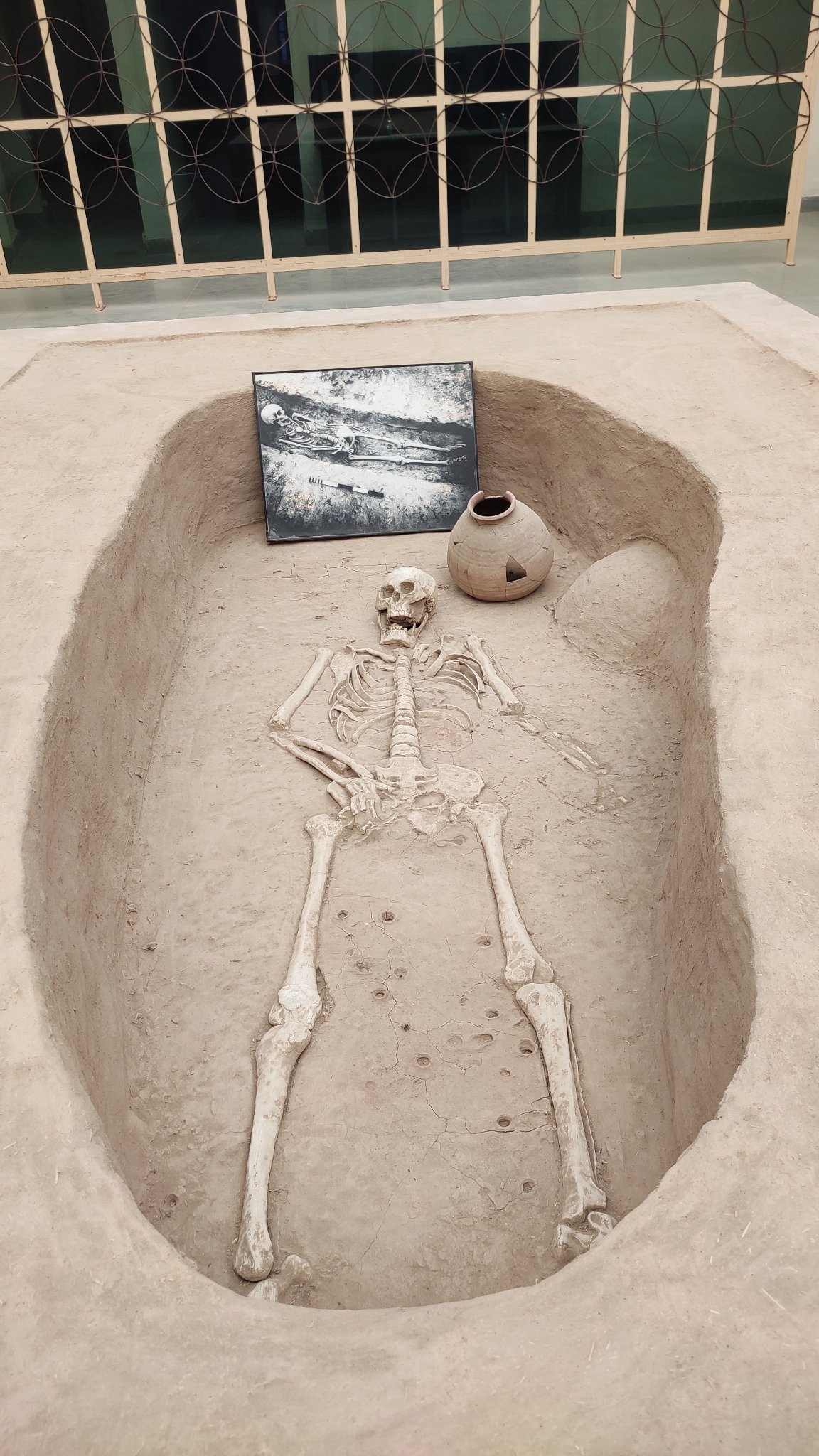
One of the earliest discovered and excavated Harappan sites, Kalibangan gave us a sneak peek into 5 millennia earlier. Sadly, the ruins are buried in mud, even the excavations have been covered up by the Archaeology Survey of India (ASI) to prevent further deterioration.
Walking on 5000 years of history, a civilization now lies buried under mounds
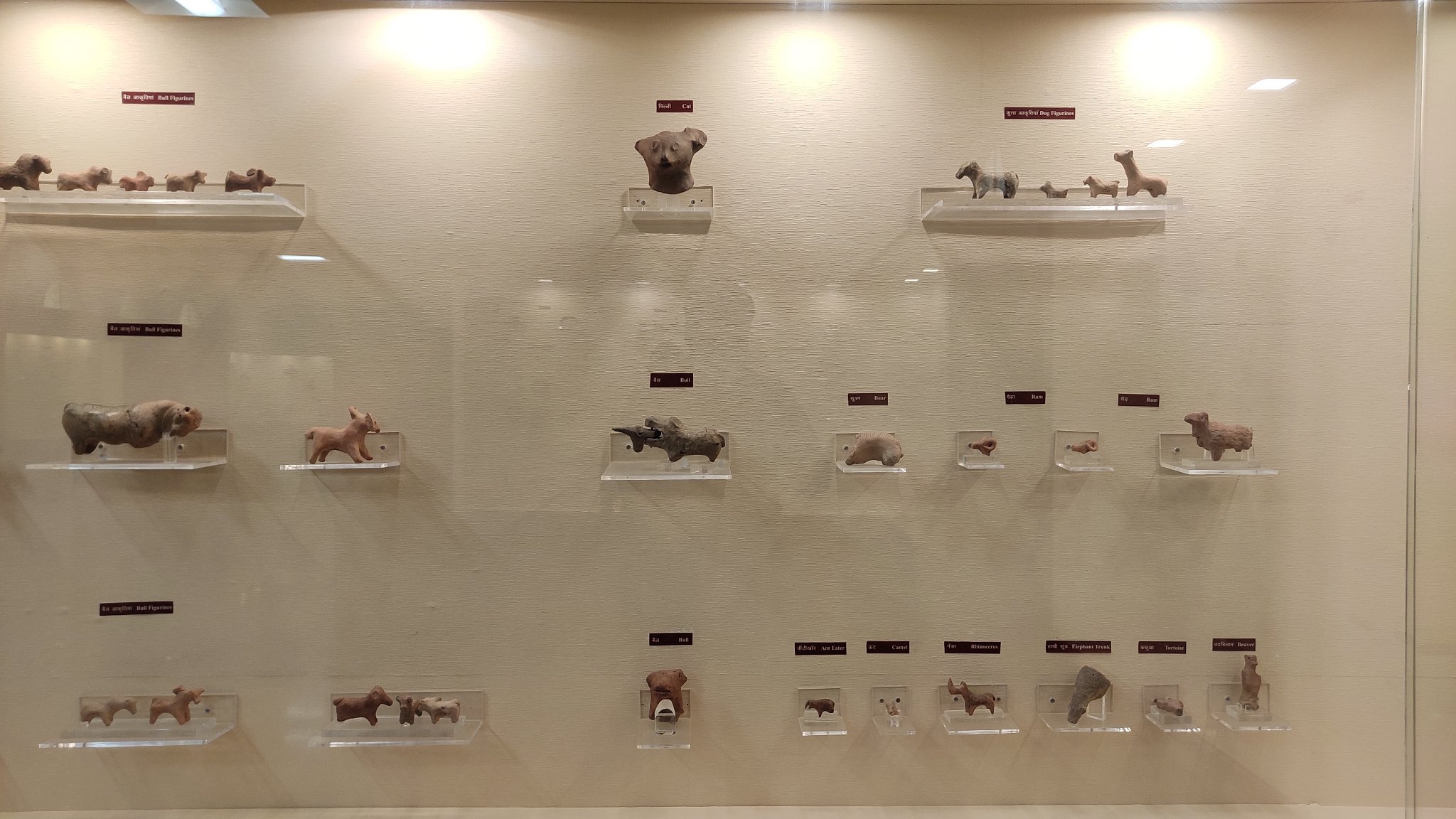
Harappan structures lay below the mudArtifacts from the past
A Harappan
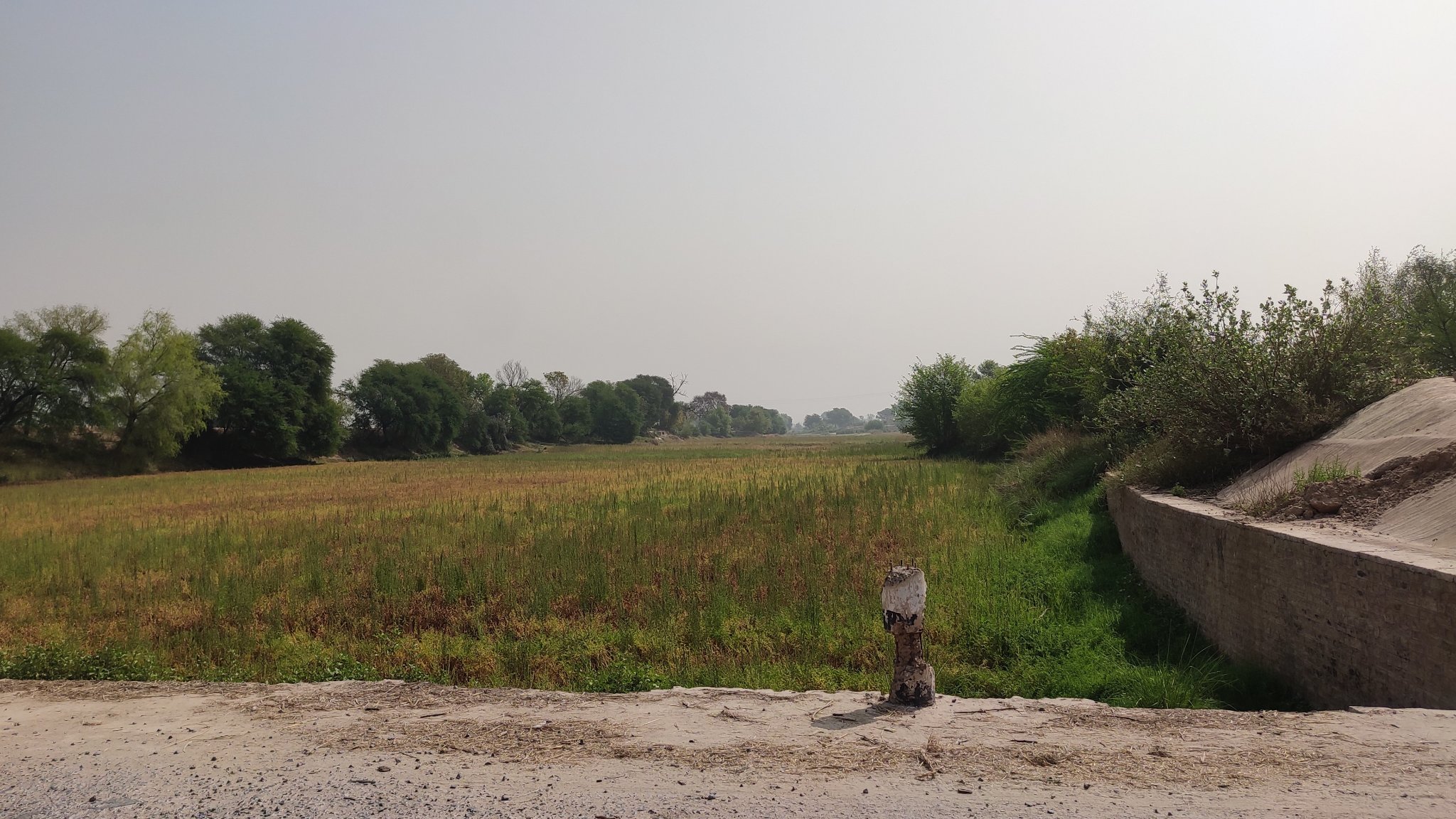
In the vicinity, we finally met the Ghaggar River, which is purported to be the Vedic Saraswati River – nothing more than a dried-up intermittent, almost obscure rivulet right now.
The dried bed of the Ghaggar river – purported to be the mythical Saraswati river
Badopal Lake
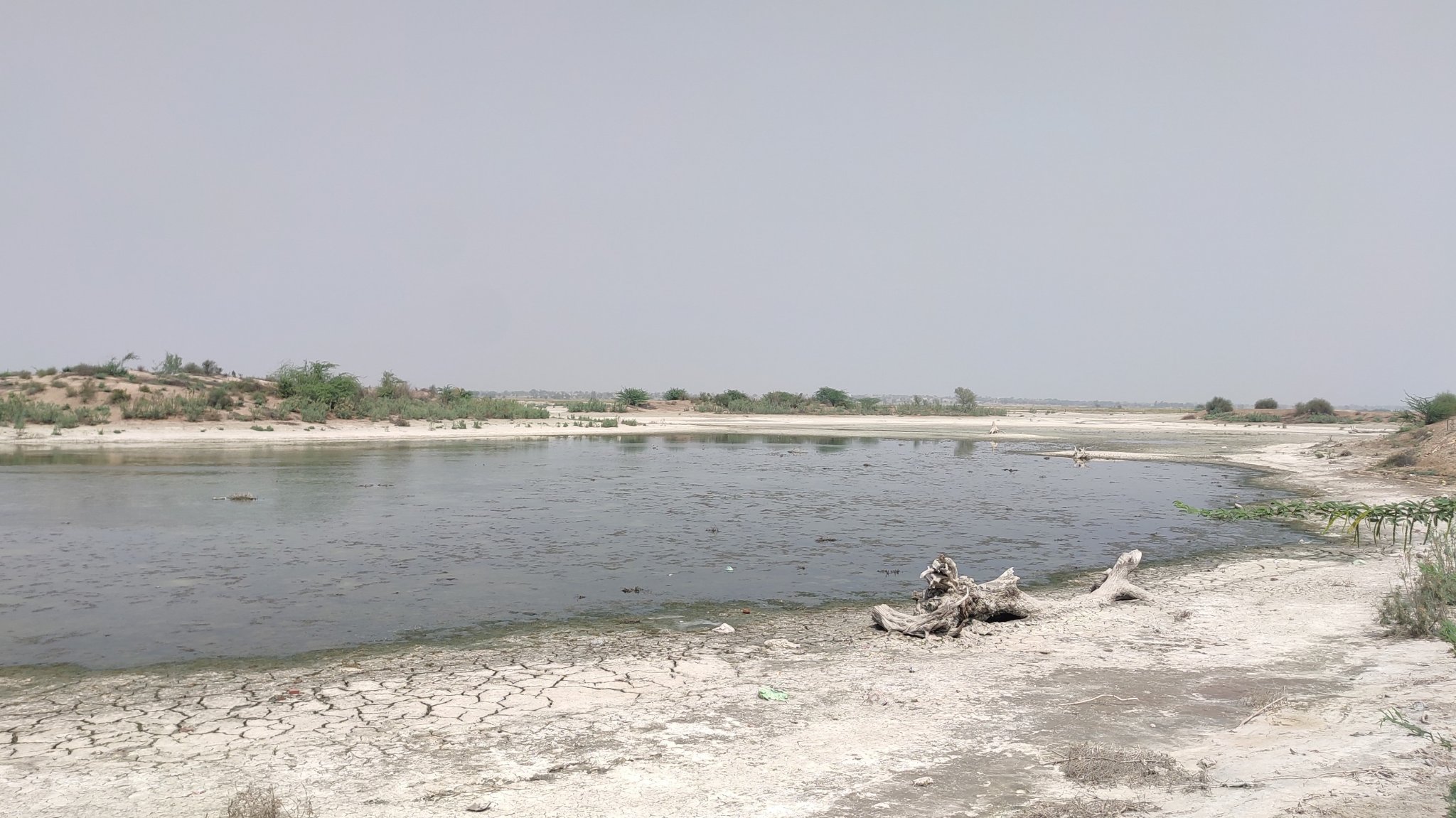
We took a slight detour through the desert hinterland to take a peek at the Badopal lake, a salt lake located beside the Badopal, an ancient mound, and part of the Rang Mahal culture.
Badopal Lake
Suratgarh
Another desert town midway between Hanumangarh and Bikaner, noted for its Thermal Power station and the air force base.
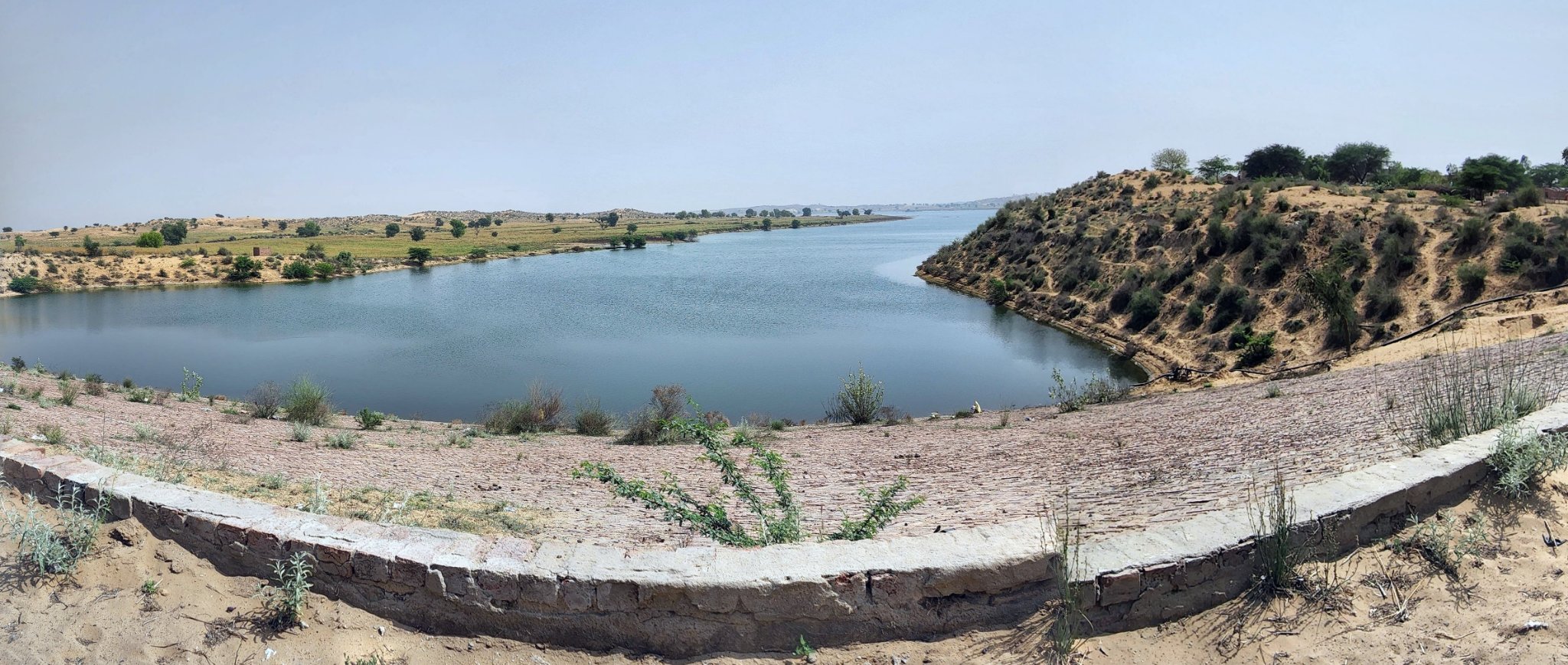
Dam on the outskirts of Suratgarh approaching from Badopal
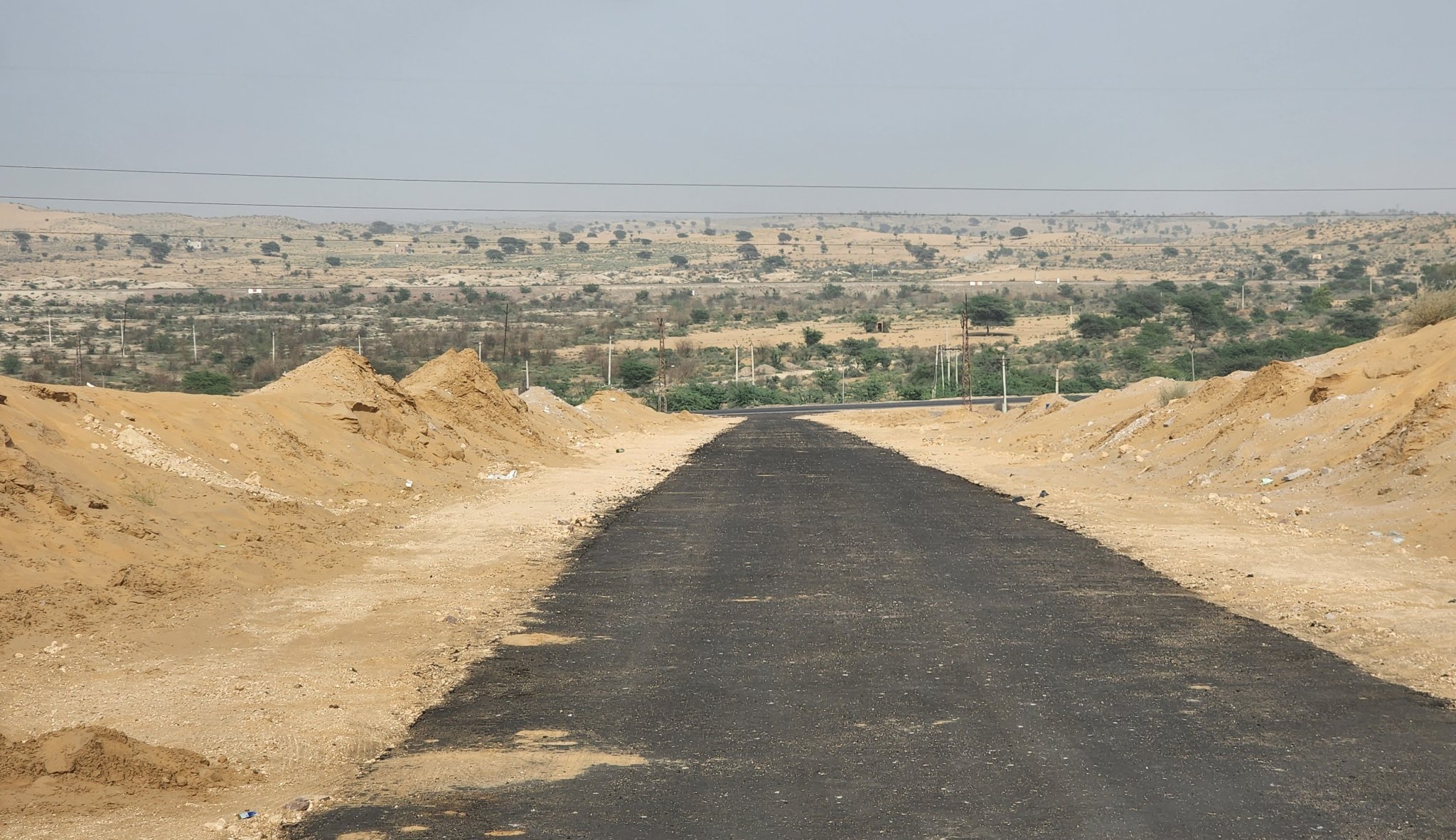
Dunes outside Suratgarh enroute Bikaner
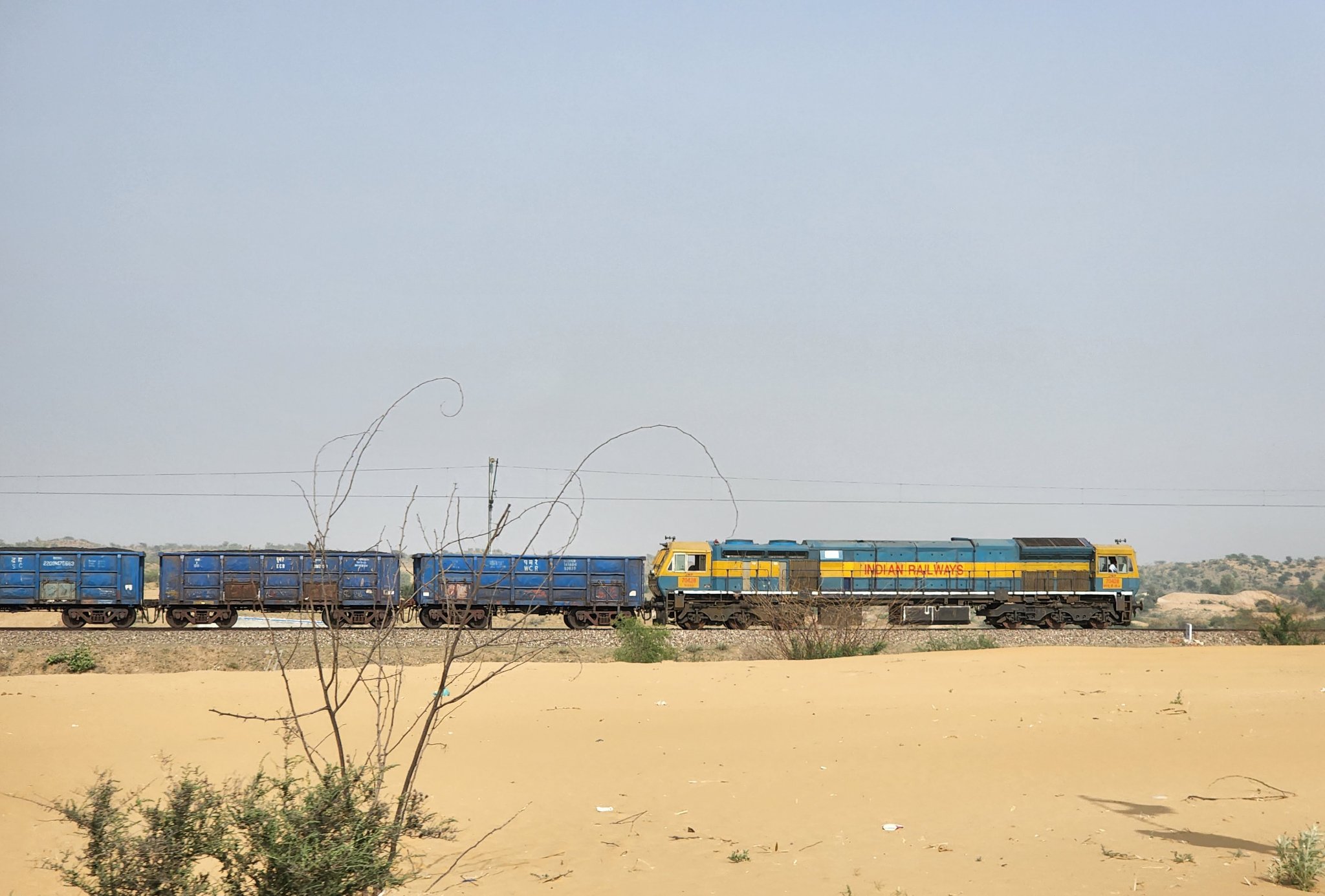
Keeping pace with a train, SuratgarhA view of the landscape, Suratgarh
Lunkaransar
A fairly expansive salt-lake that is home to migratory birds, midway between Suratgarh and Bikaner
Salt lake at Lunkaransar
Bikaner
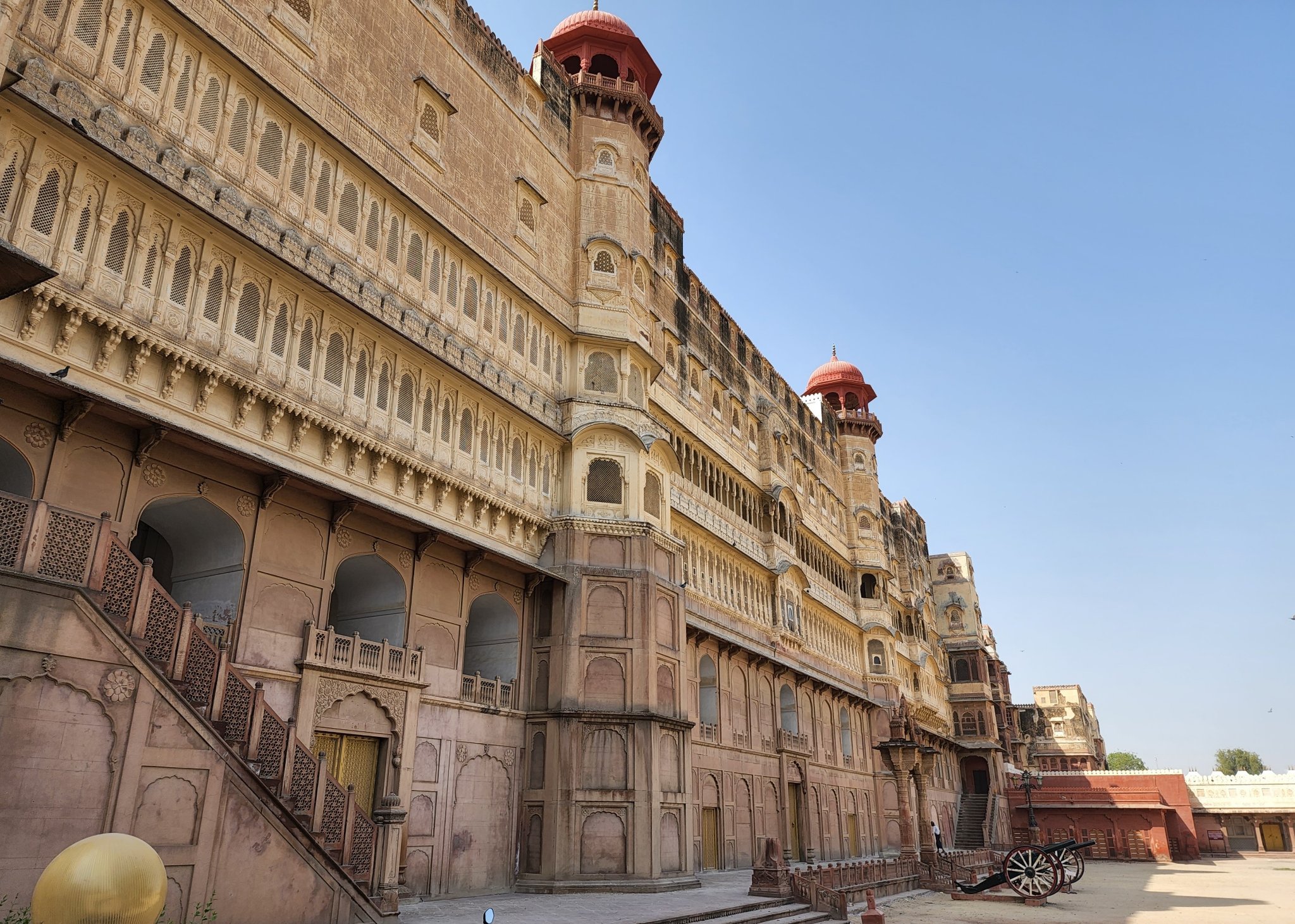
One of the major cities of Rajasthan, founded by Rao Bika, famous for Junagadh Fort and savory sweets and snacks
Bikaner fort
Deshnoke
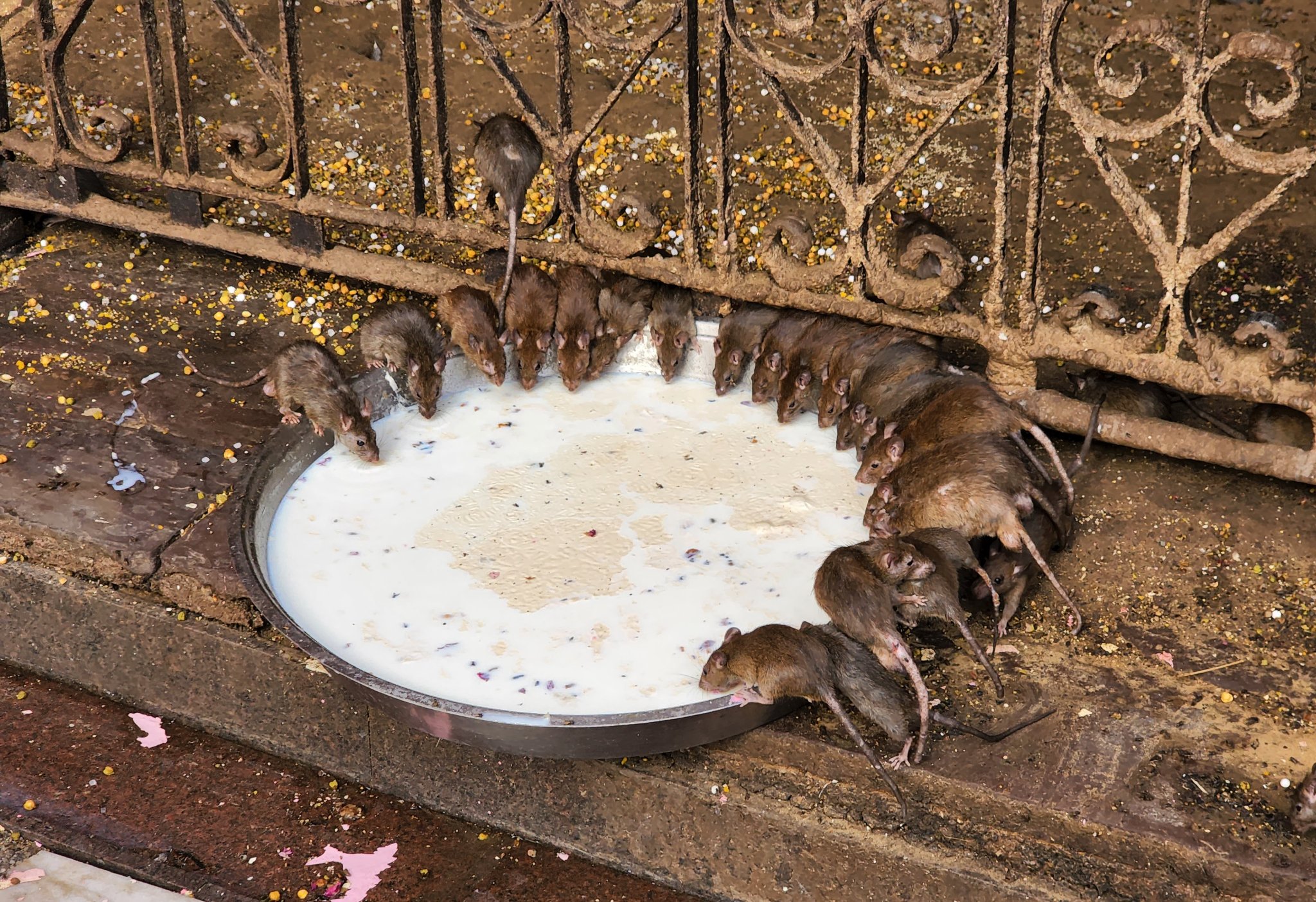
Home to the Karni Mata Temple, where rats, who are considered children of the Goddess, behave just as humans! Eating nibbled on by the rats is considered auspicious. Accidentally or deliberately killing a rat requires replacing it with one made of gold or silver as atonement.
Rats feeding on offerings at Karni Mata temple
Kolayat
The place where the Vedic Sage Kapil (Kapil Muni) is said to have shed his body. Home to a lake and temples on its bank.
Lake at Kolayat
Bundi
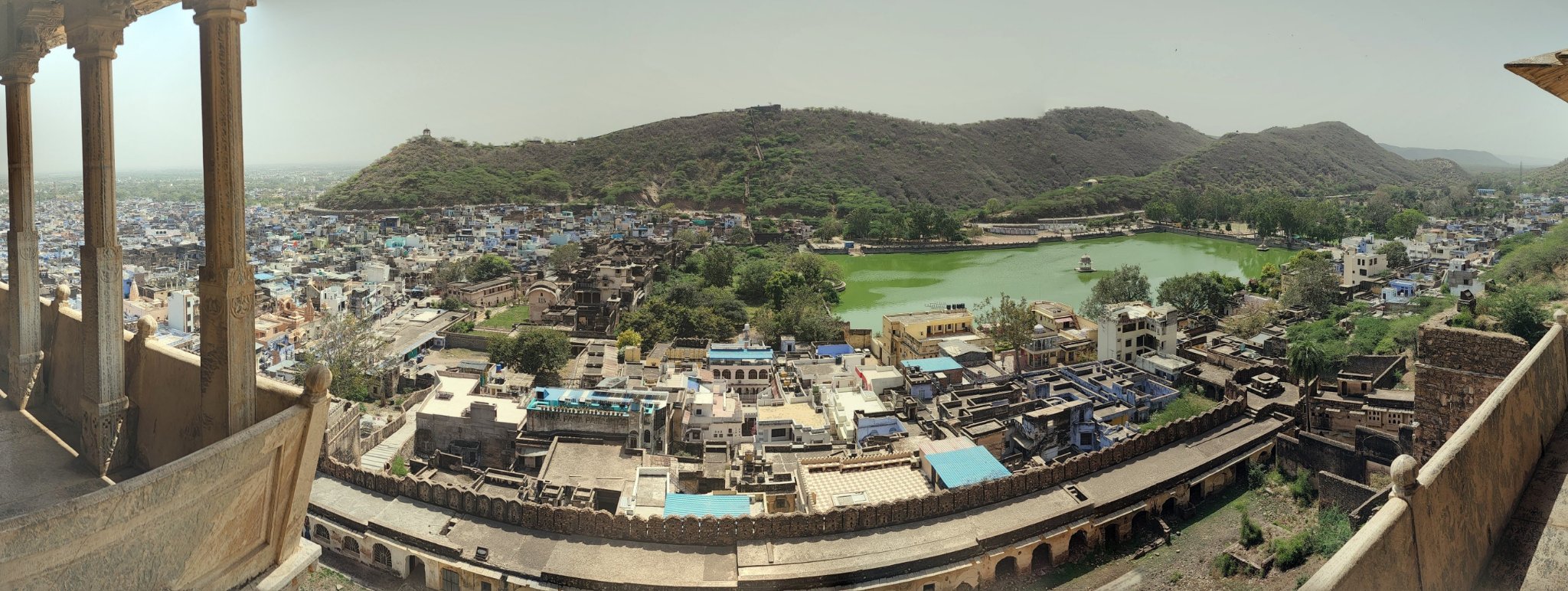
A quaint town nestled in the Aravallis, with an imposing hill-side palace overlooking a lake.
View of the Garh Palace from the main road, Bundi
View of the surroundings from a balcony in the Garh Palace, Bundi
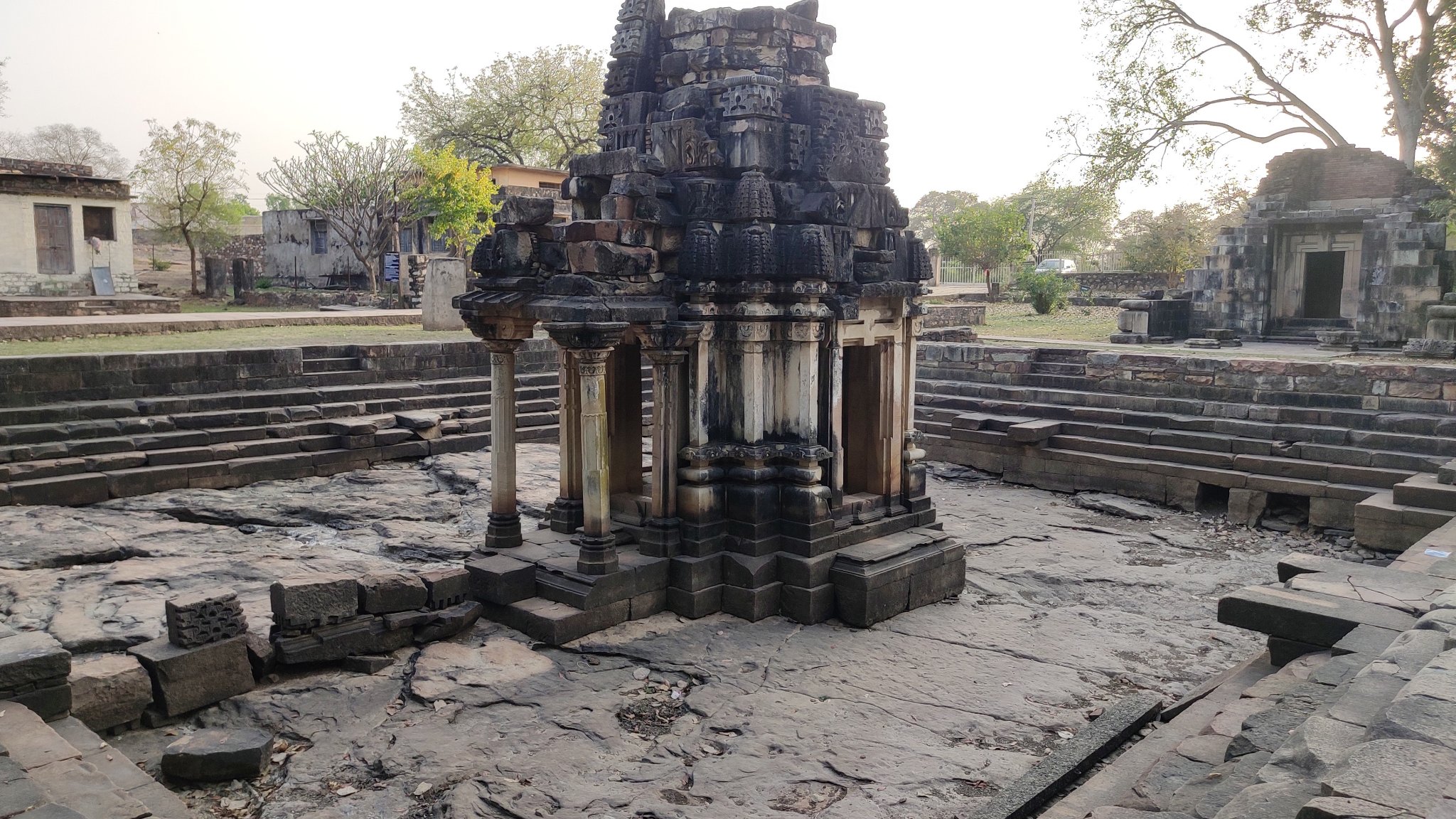
Badoli Temple Complex
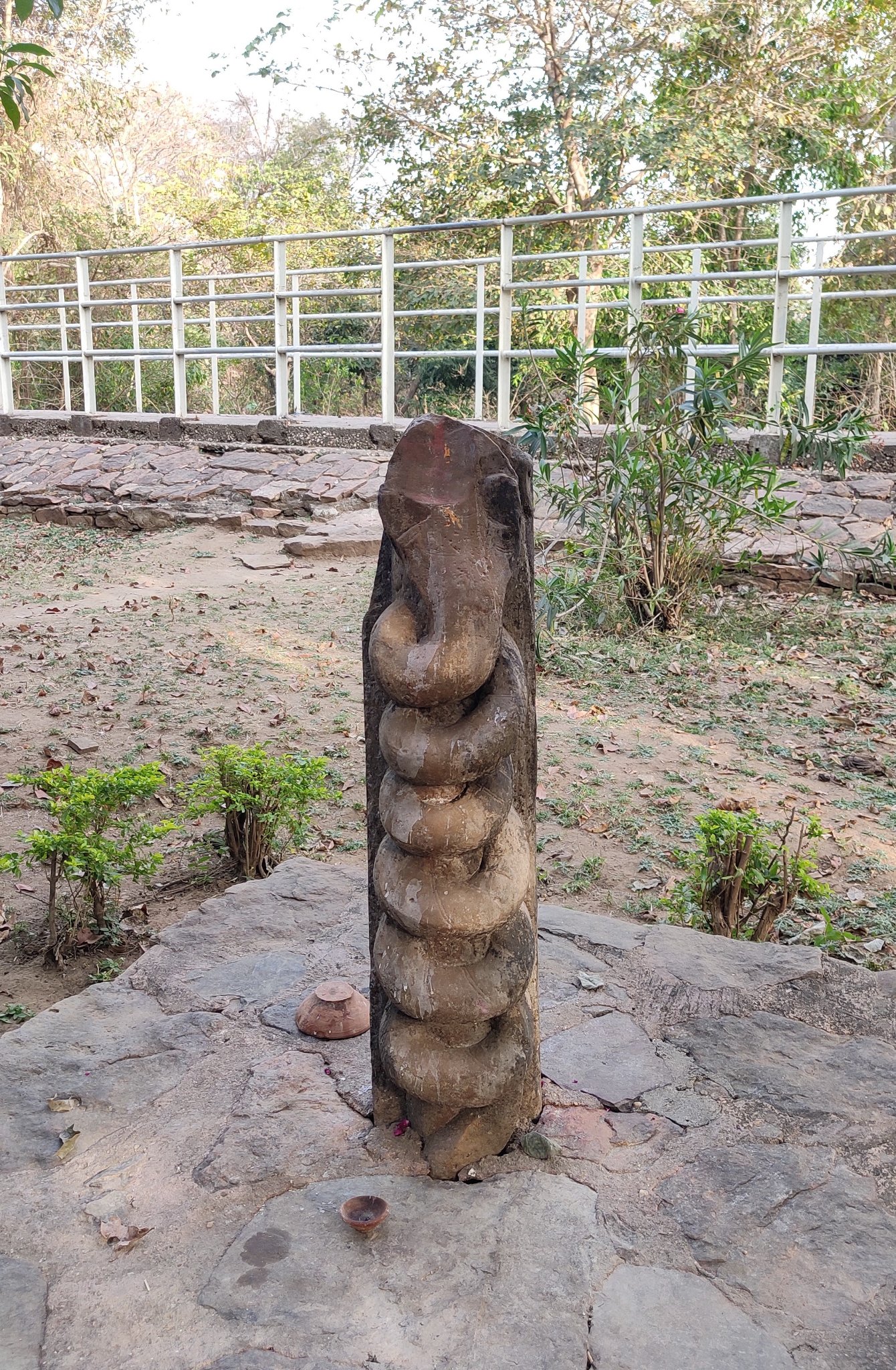
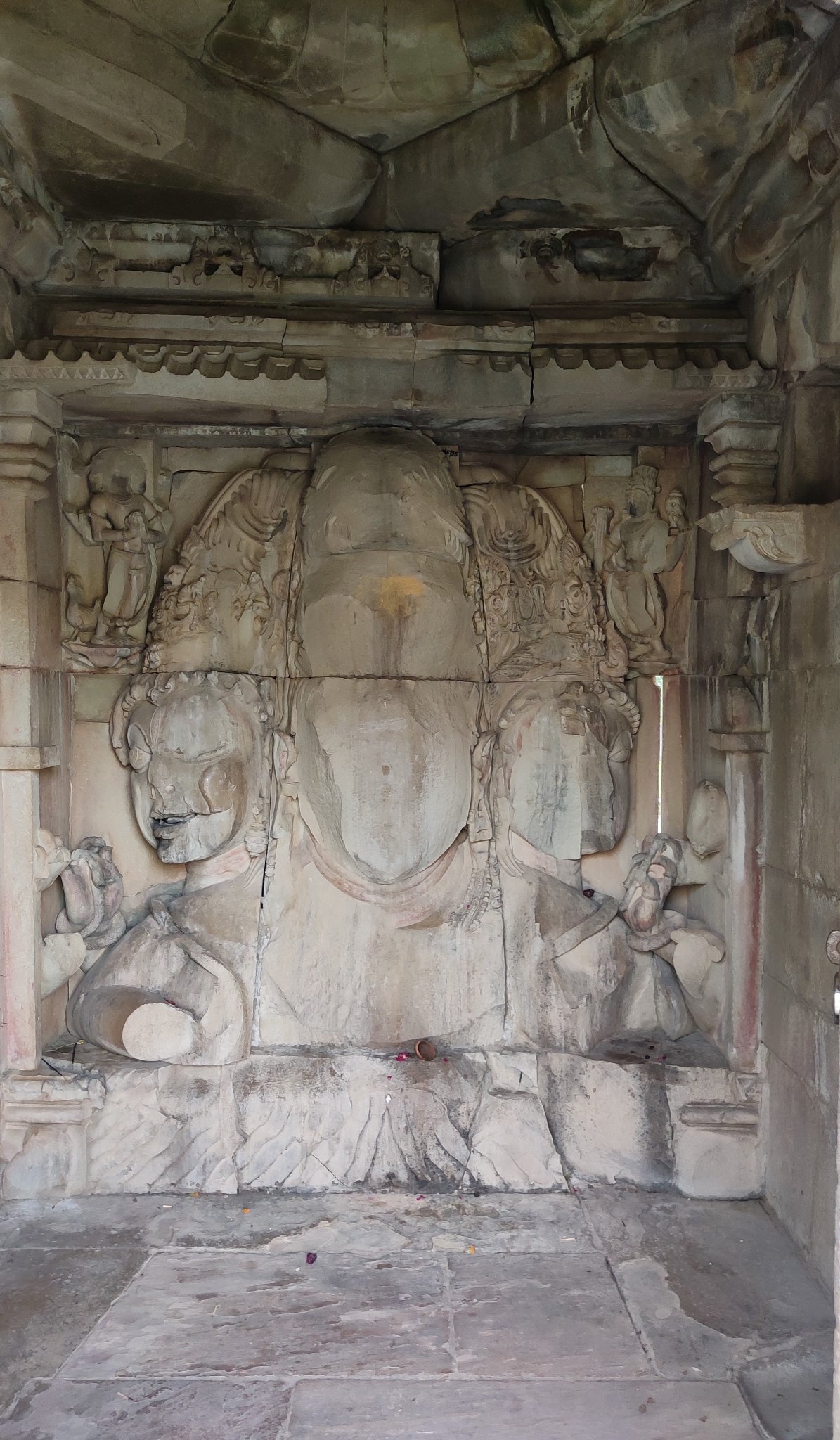
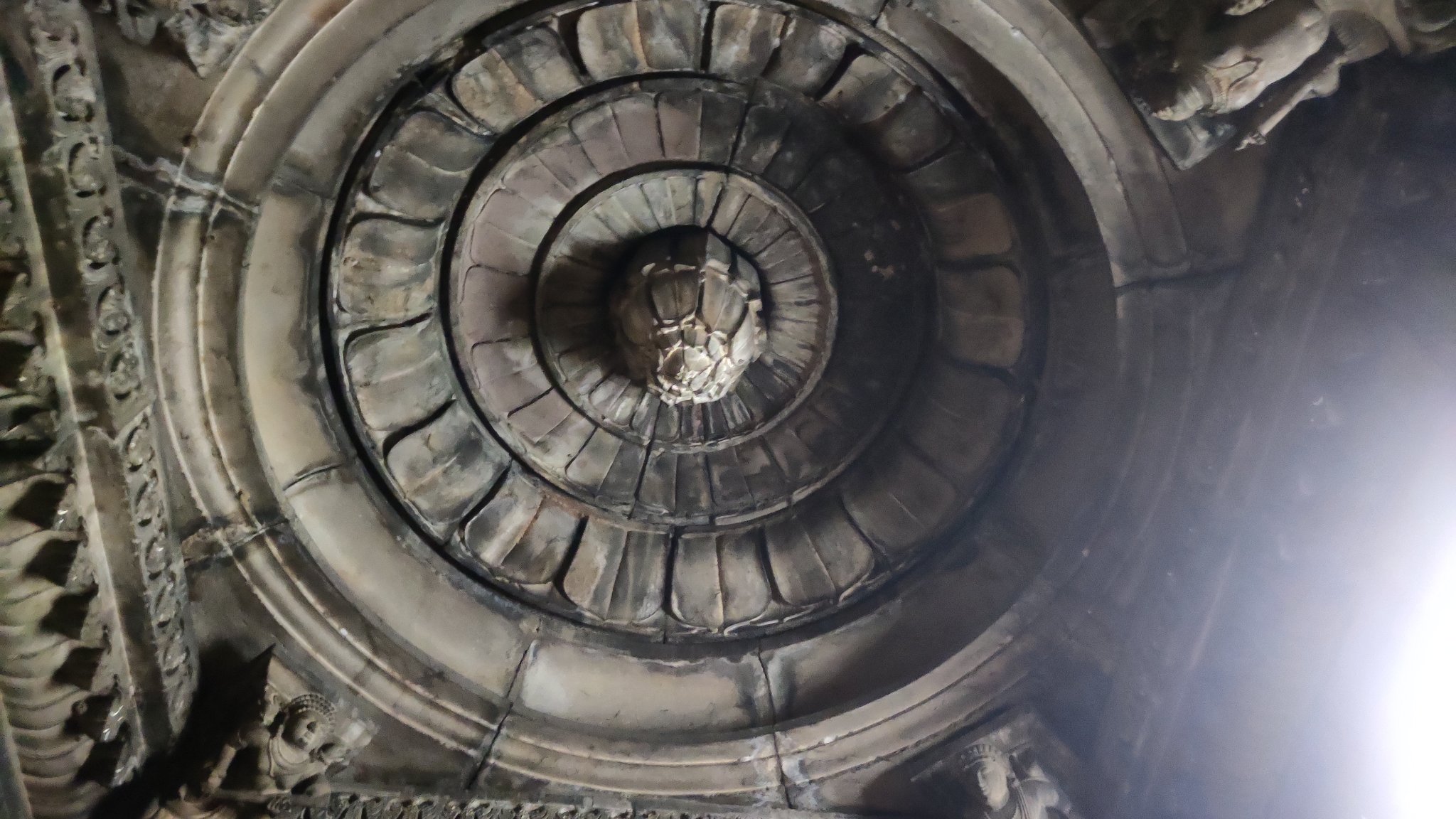
A 10th-11th century temple complex which crept into our plan by serendipity as we were short on time to visit the Gagron fort. The temples, dedicated to Shiva, Vishnu, Ganesha etc., were built by the Gurjara-Pratihara dynasty, and are described as one of the best representations of the temple. Situated on the banks of the Chambal just outside the village of Rawatbhata, it can be reached from Kota through winding roads cutting across hills and forest. As the sun was beginning to set, the ride through the forest was a race against time, and quite the adventure!
Glimpses of the Badoli Temple complex
Ranthambore Fort
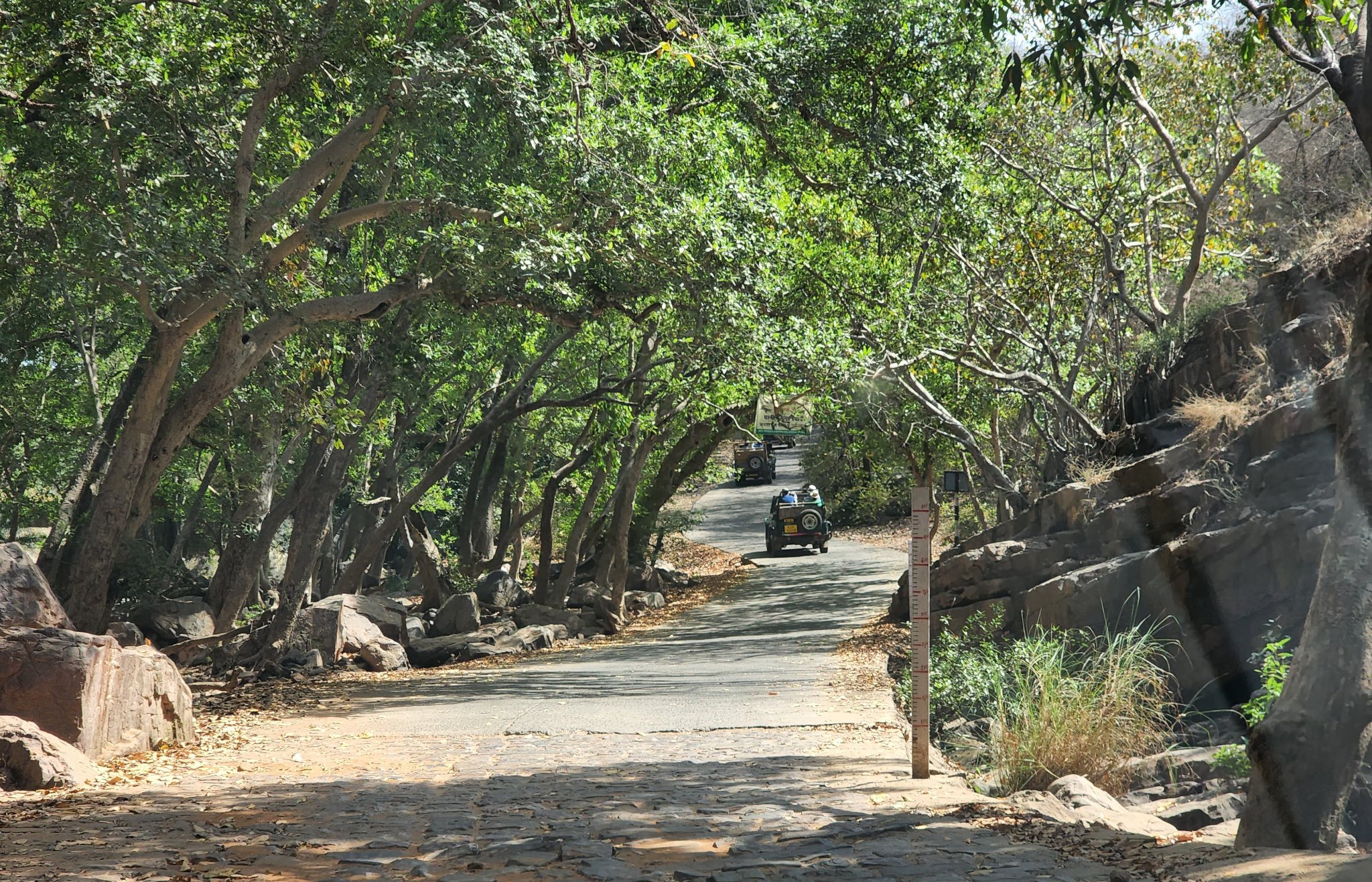
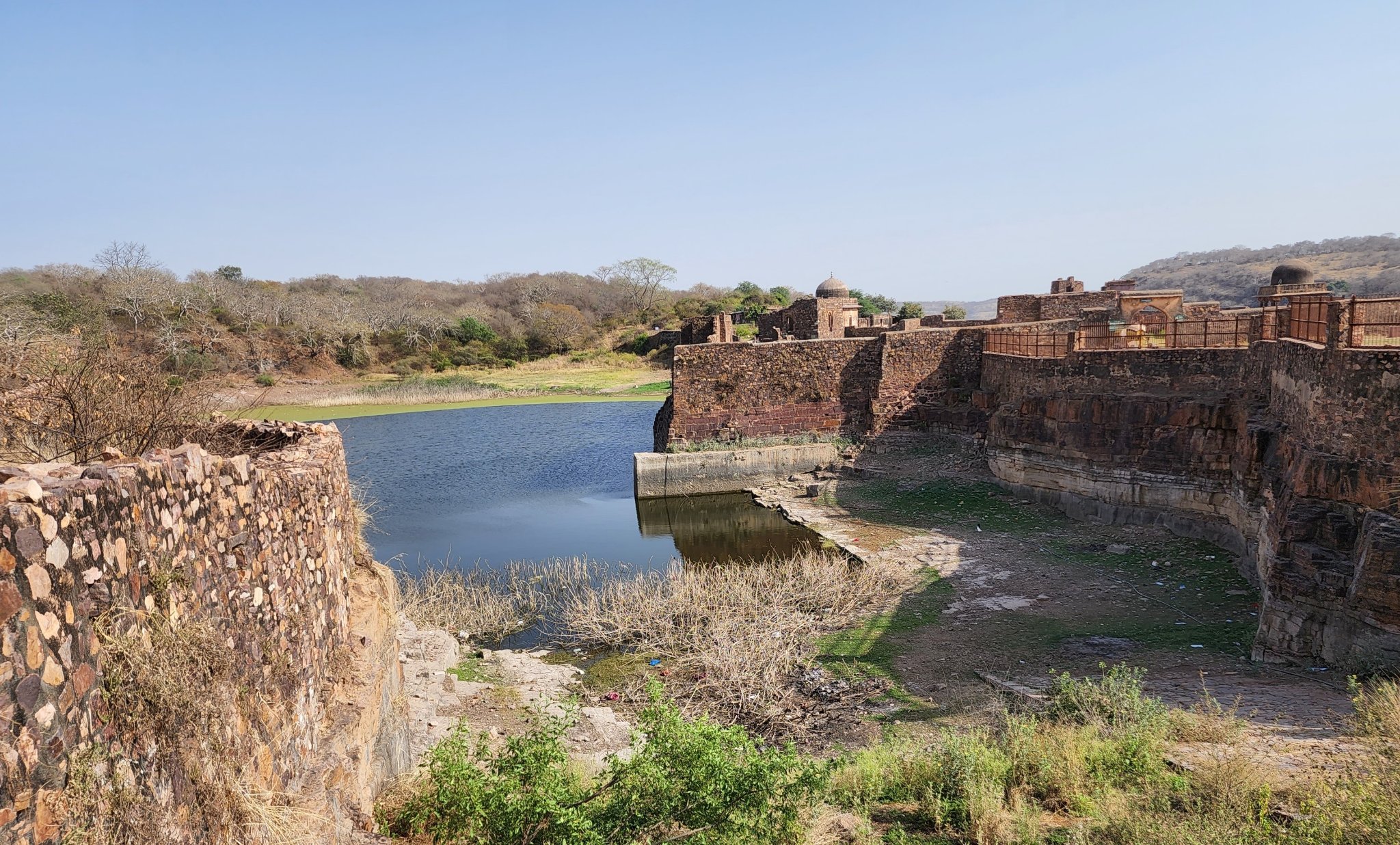
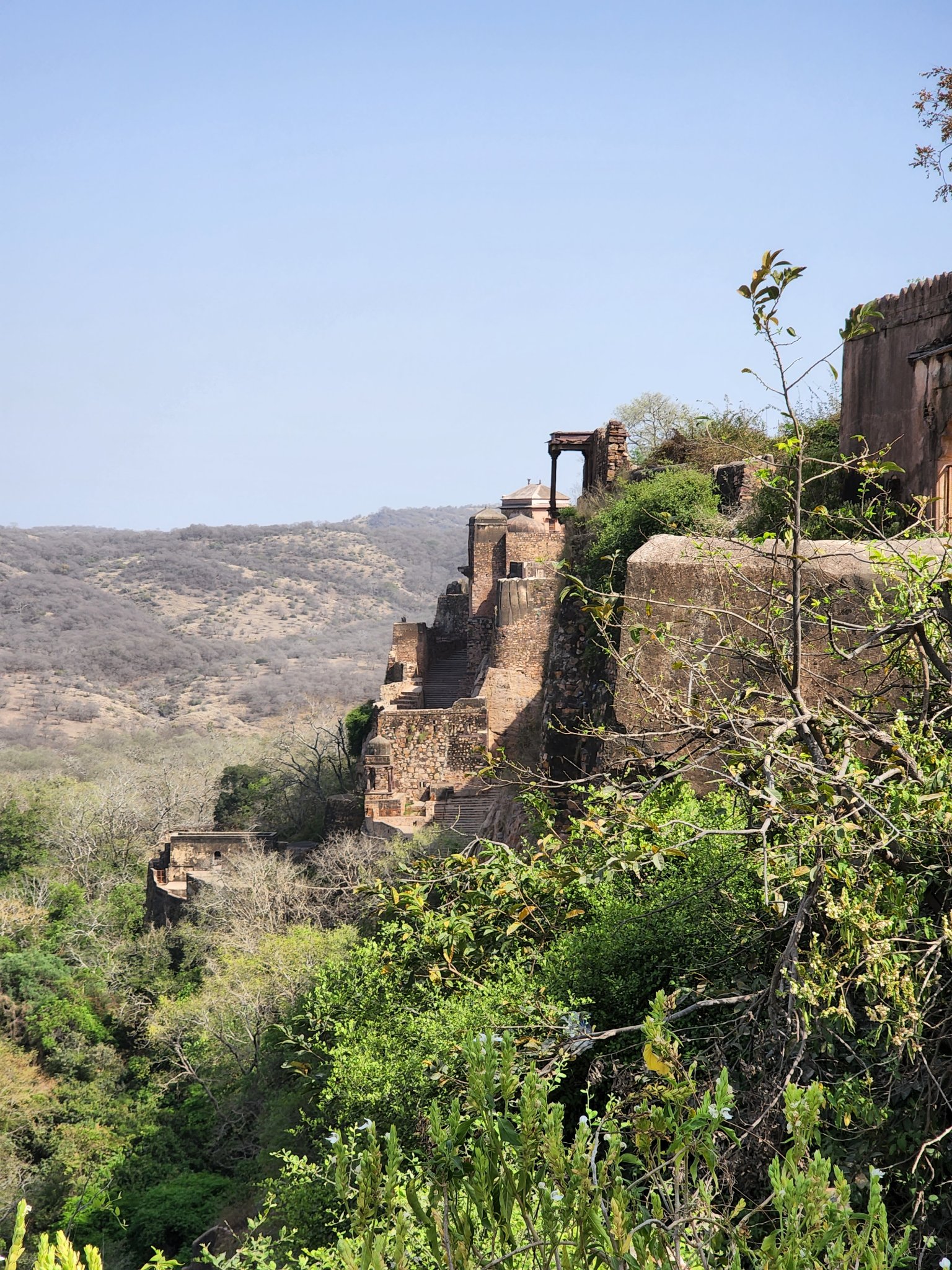
Rounding off the trip was the magnificent and legendary Ranthambore fort, situated on top of a hill right in the middle of the Ranthambore Tiger Sanctuary. The ride through the forest is memorable and so are the sights from atop the fort.
Approach road leading to the Ranthambore fort through the Ranthambore sanctuary
Water tank inside Ranthambore temple
The entrance road to Ranthambore fort as seen from a ledge inside the fort
Trip Summary Day 1: Gurgaon to Hanumangarh via Sirsa (lunch break in Sirsa) Saw Bhatner fort at Hanumangarh (overnight stay in Hanumangarh)
Day 2:
Hanumangarh to Kalibangan Kalibangan to Suratgarh via Badopal (lunch break in Suratgarh) Suratgarh to Bikaner via Lunkaransar (overnight stay in Bikaner)
Day 3: Bikaner fort early morning (lunch at Bikaner after seeing the fort) Bikaner to Deshnoke to Kolayat, and back to Bikaner (overnight stay in Baikaner)
Day 4: Bikaner to Jaipur via Sikar (overnight stay in Jaipur)
Day 5: Jaipur to Bundi Bundi to Badoli Temple complex (Rawatbhatta) Badoli to Kota (overnight stay in Kota)
Day 6: Kota to Ranthambore Ranthambore to Gurgaon via Dausa and Manoharpura
With my B-school admission fast approaching, and my mobility improving 2.5 months into the recovery after my accident in Khajuraho, I decided to make one last big trip before I left Delhi for the year-long intensive course. So, my friend and colleague Amit and I took off to Jaisalmer by Ranikhet Express, which started around 10 AM from Delhi after a 6 hour delay. That did not put a dent to our itinerary though, since we reached Jaisalmer early the following morning instead of reaching the same night.
After a quick check-in at a motel just below the Jaisalmer fort and freshening up, we set out to have breakfast at a roof-top restaurant. And then, undecided on what to do next, we loitered around, first in search of a hostel, where Amit wanted to put up, while I dissuaded him from the same telling him that we were better off spending that money on an outstation trip, and camping out in the desert. Anyway, we still went to check out a Zostel property, ran into an old acquaintance of Amit and again got back to bickering about the next steps – the bone of contention being, whether we should first see Jaisalmer and then go outstation or do it vice versa.
Part 1: Off to the Border
The bickering was only the beginning of our shenanigans. Continuing to dawdle and finally agreeing upon a plan to go outstation first , we reached a lassi shop near the road leading into the Jaisalmer fort, where we were told we could get our lassis spiked with bhaang, an offer that my wise friend took up on. It tasted about the same, my friend reported while downing the drink, even as I found a cab driver and started negotiating with him for a two-day trip. Shortly, we were on the road leading to Tanot, on the border with Pakistan.
As soon as we left Jaisalmer town behind, we were looking at swathes of yellow with windmills standing tall in the distance. As we pushed deeper into the Thar desert, Amit kept tell me about how useless the lassi was, as it had no effect on him. Meanwhile, the density of vegetation kept decreasing and the distance between the occasional hamlet gradually increased.
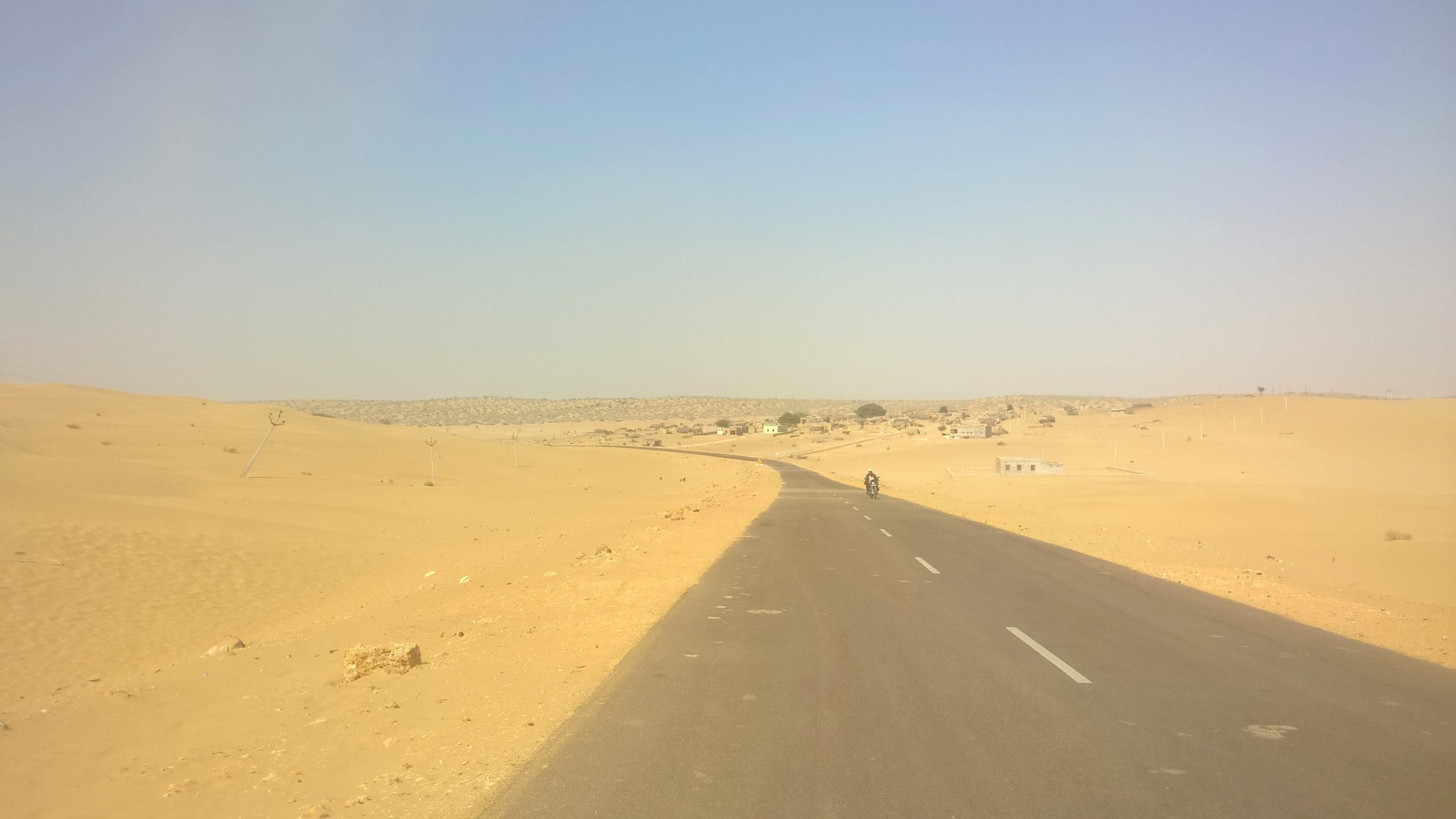
About an hour-and-half of driving deep into the desert, passing by expanses of sand dunes with smatterings of grass and shrub, we came upon a steep decline – ahead of us was a depression in the ground, stretching from one end to the other. It looked like the dried bed of a river – only the surface of the bed still looked indistinguishable from the higher ground all around – even as the road winded down the depression and rose again on the other side. There was no trace of vegetation, with only a handful of huts strewn around being the only habitation for as far as we could see of the other side of the ‘river bed’.
Google Maps told us that the place was called Ranao or Ranau, and it was quite a sight, prompting us to stop and stare. We got down, admiring and taking pictures of the landscape. By now, an air of whimsy was descending upon Amit, and he suggested we take staged ‘candid’ photographs of ourselves in the marvellous background, resulting in us whiling away time posing for self-timed clicks for the next half hour.
The road declines to a depression that resembles a dried ‘river bed’ at Ranao
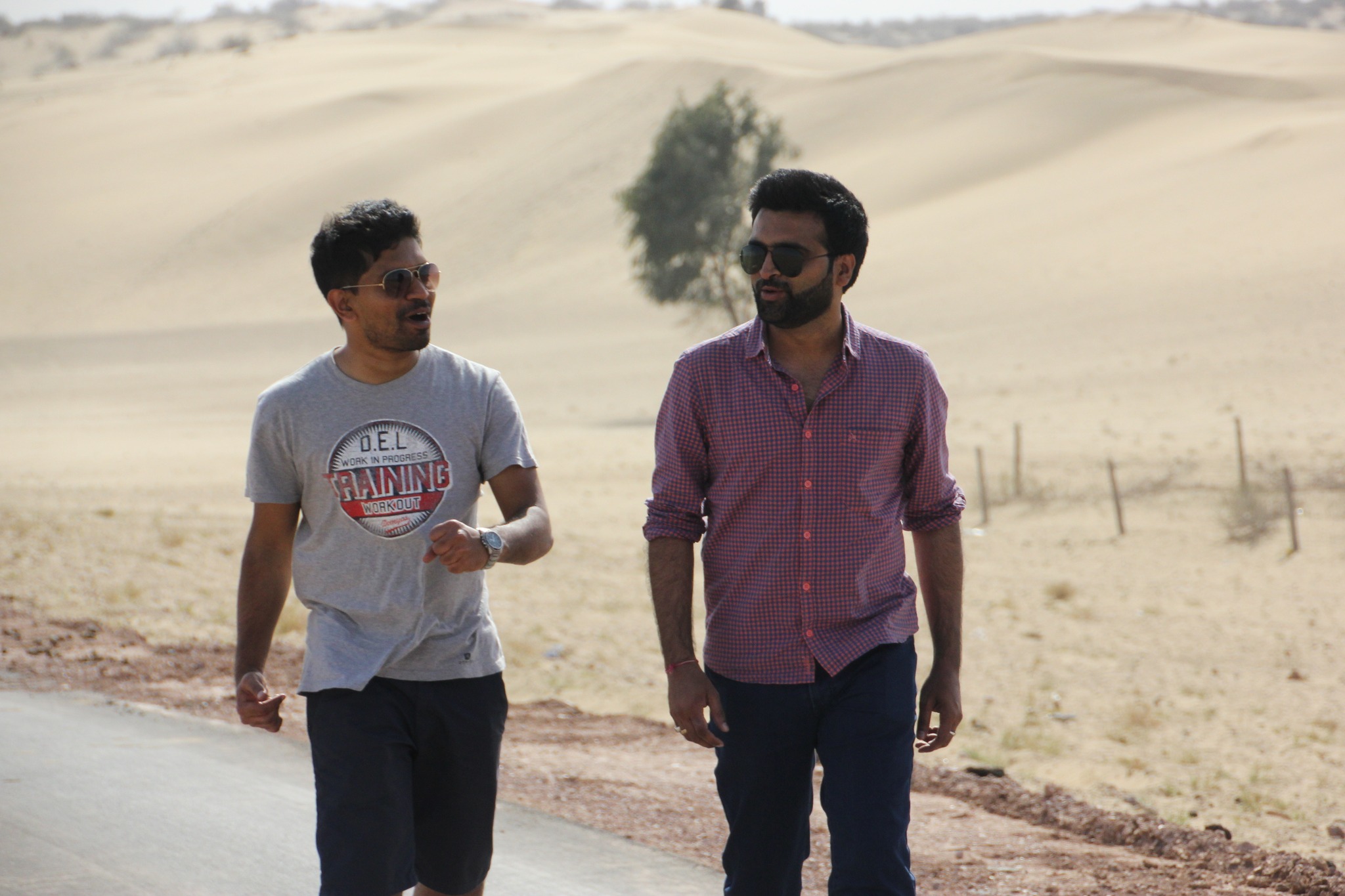
Staged ‘candid’ at Ranao (taken on Amit’s Canon DSLR camera)
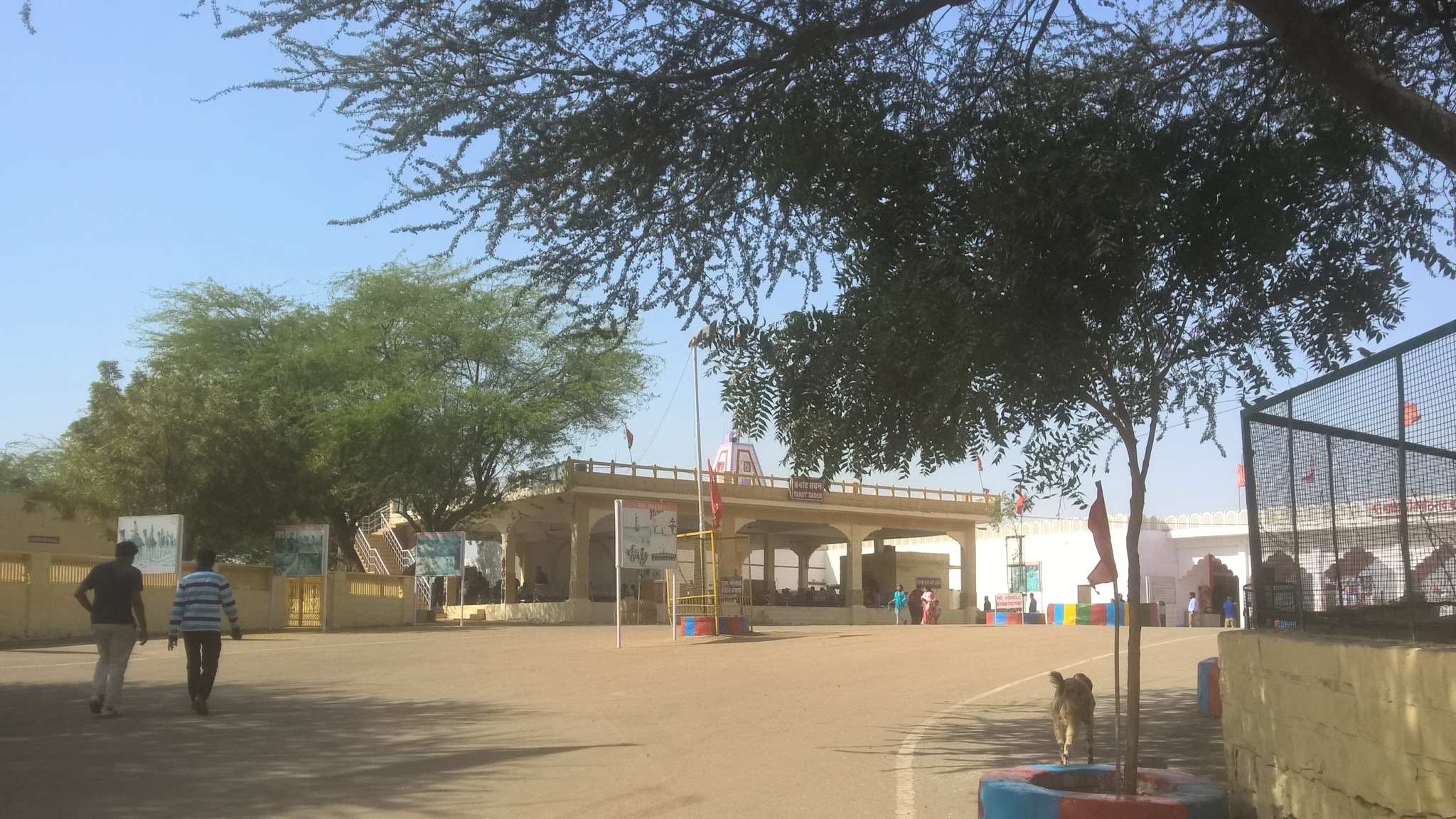
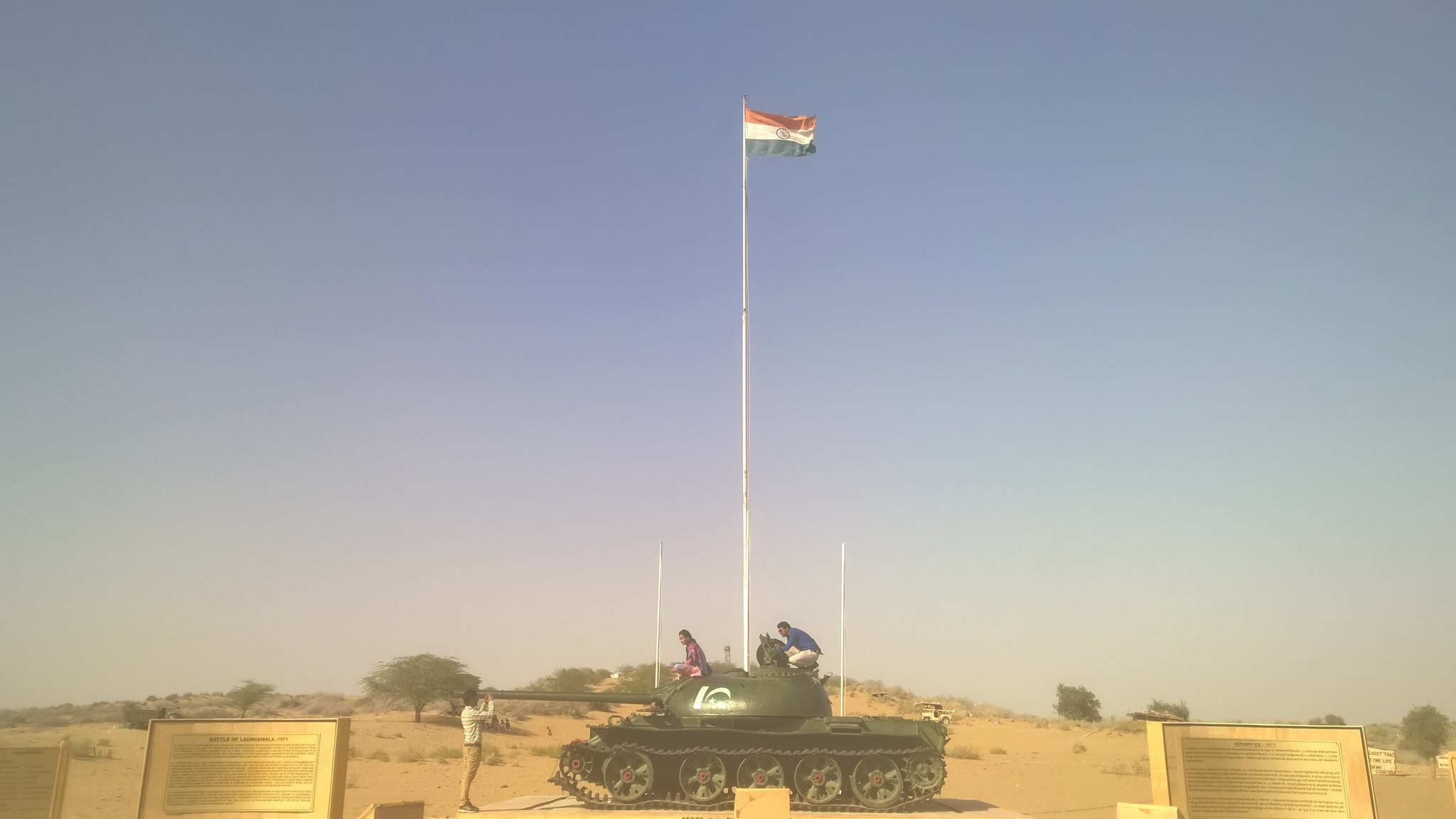
Moving on from Ranao, another half hour later, we were at Tanot, where Amit was washed over by a wave of religiosity and euphoria, forcing him to admit that the lassi was finally taking effect. Paying our respects at the Tanot Mata temple, we proceeded alongside the Pakistan border towards Longewala, through completely empty desert, with only electric poles with transmission lines, the narrow tarred road, our car and its passengers indicating the only traces of human existence. At Sadewala, midway to Longewala, we finally saw humans – a few kids, with whom we took a few pictures.About 45 minutes after leaving Tanot, we were at the Longewala War Memorial, where again under the spell of Amit’s exuberance, we clicked a host of zany pictures.
Tanot Mata temple
Dunes at Sadewala, on the way to Longewala, driving parallel to the Pakistan border
Longewala War Memorial
It was now already 4.30 PM – with the prospect of darkness descending soon, we decided to turn back in the direction of Jaisalmer. By 6 PM, we were at the Sam Sand Dunes, horsing around amidst the camels in the glare of the setting sun, for about an hour, after which we checked-in to the first desert tent-camp resort that our eyes fell on. Watching the folk-arts programme, and having dinner, we went off to sleep.
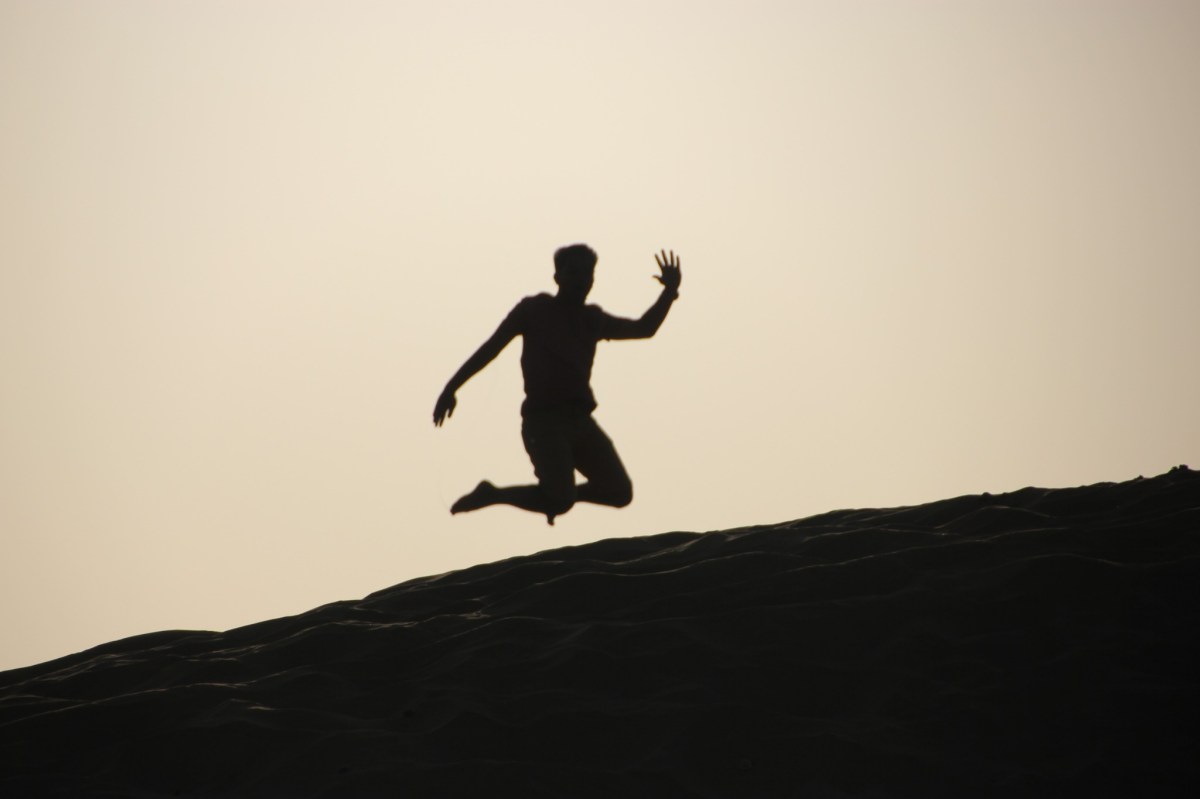
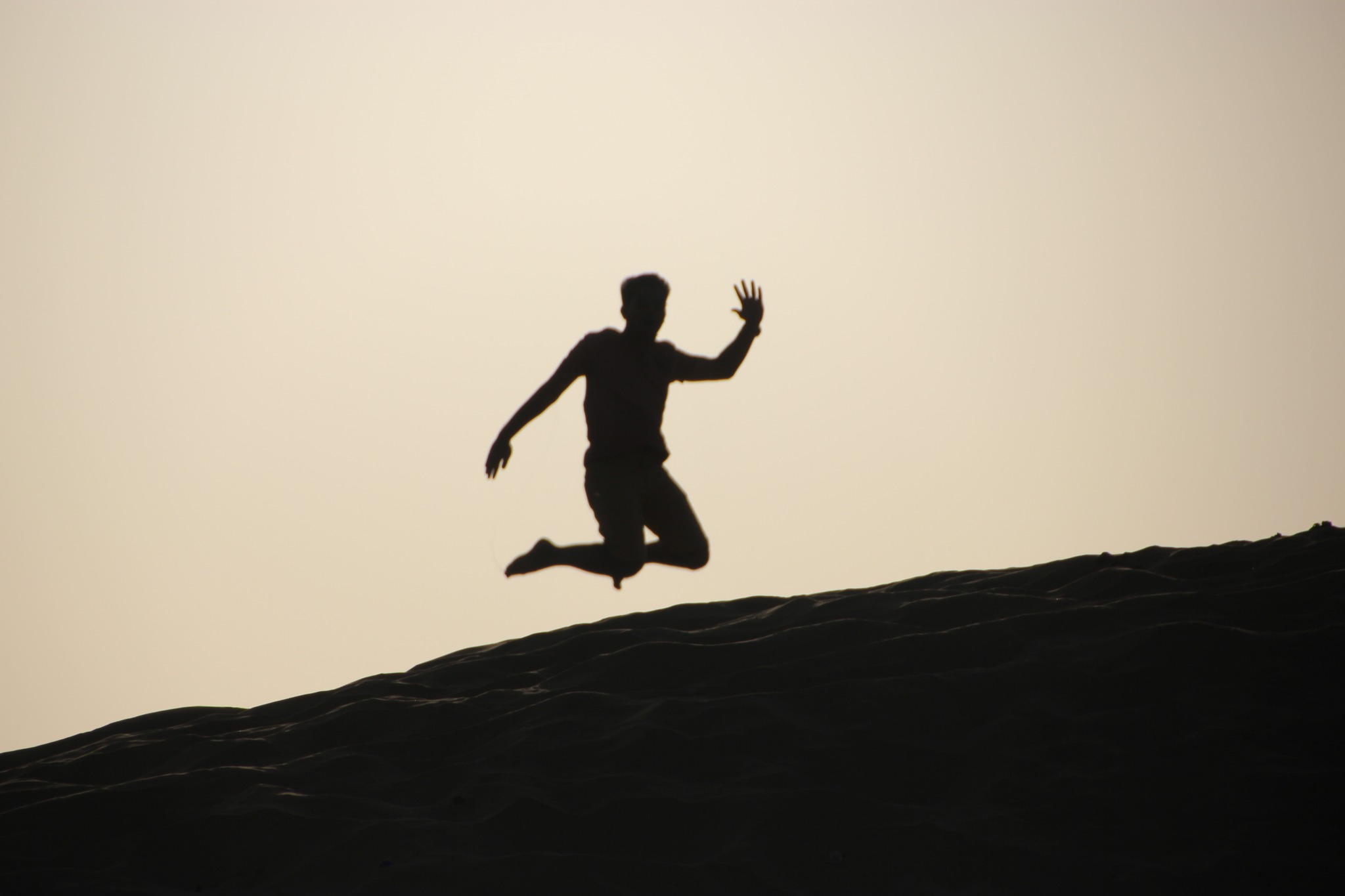
Tomfoolery at the Sam Sand Dunes (Taken on Amit’s Canon DSLR camera)
Part 2: Jaisalmer and Nearabouts
Actually, the title for this part should have been: Nearabouts of Jaisalmer and Jaisalmer, as we started the day 45 km away from Jaisalmer, at Sam. Although the effect of bhang on Amit had worn off, still taking some cues from the freedom it gave us, we did some more tomfoolery on the Sam sand dunes, and moved to the south, reaching the Desert National Park, which I had been forced to miss in my sole previous trip to Jaisalmer due to paucity of time.
The Desert National Park is a vast area of desert including a variety of topographical features, such as, sand flats, dunes, craggy rocks, and compact salt bottoms, straddling the Jaisalmer and Barmer districts. Earmarked by the government to preserve the unique and fragile ecosystem of the Thar, the park is home to species, including the monitor lizard, desert fox, Russell’s viper, and many migratory and resident birds, of which one of the most noteworthy is the Indian Bustard.
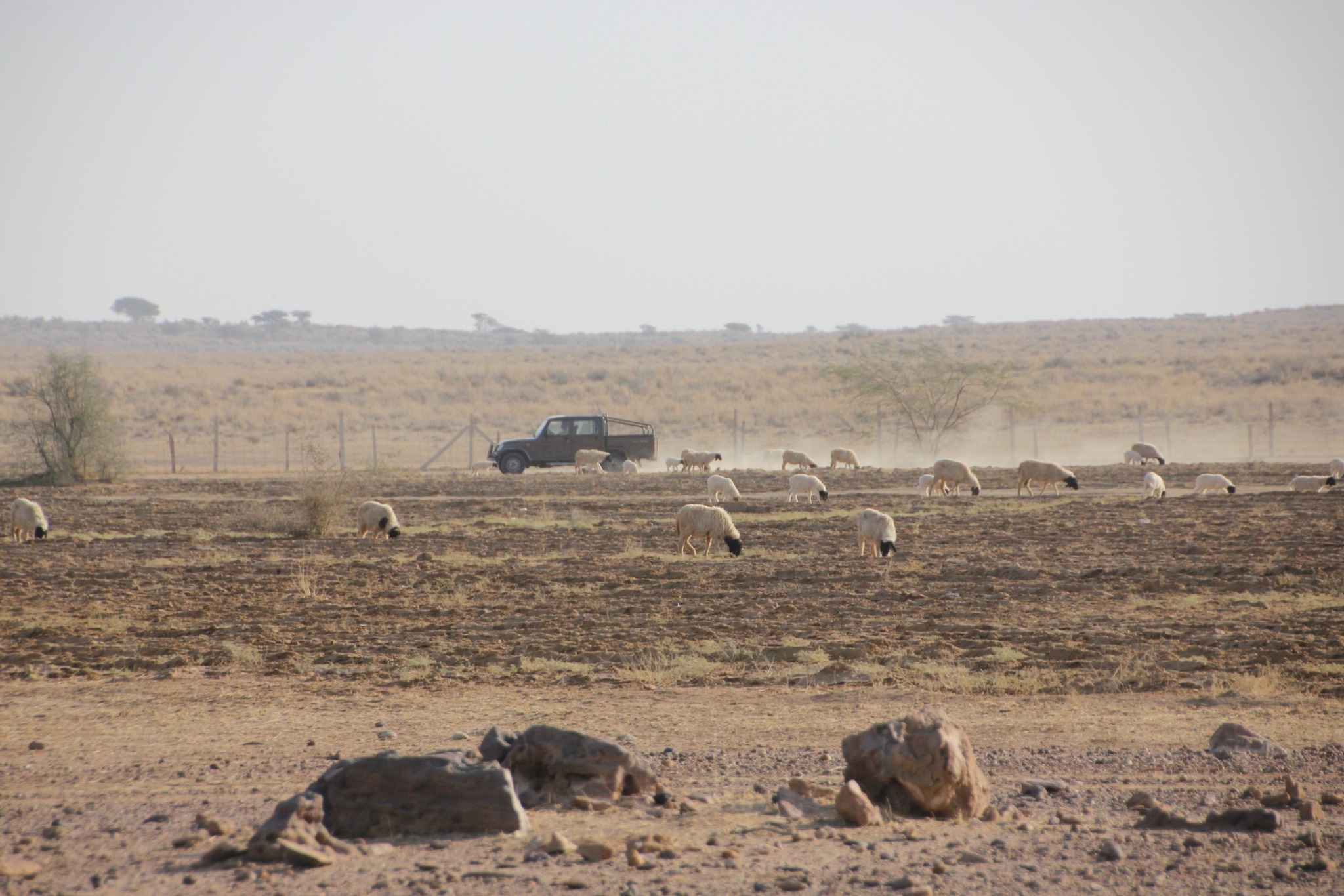
Nevertheless, from the little Park office located just some distance inside the park, we booked a safari, and spent more than an hour roving inside the park, taking pictures with a flock of sheep, and then spotting eagles, monitor lizards, and finally, an Indian Bustard. On the whole, the safari was easily one of the most memorable experiences of my life. For those on a leisurely trip to Jaisalmer and mildly interested in nature, the Desert National Park is highly recommended, in fact, a must-visit.
At the Desert National Park, a must visit! (Picture credits: Amit)
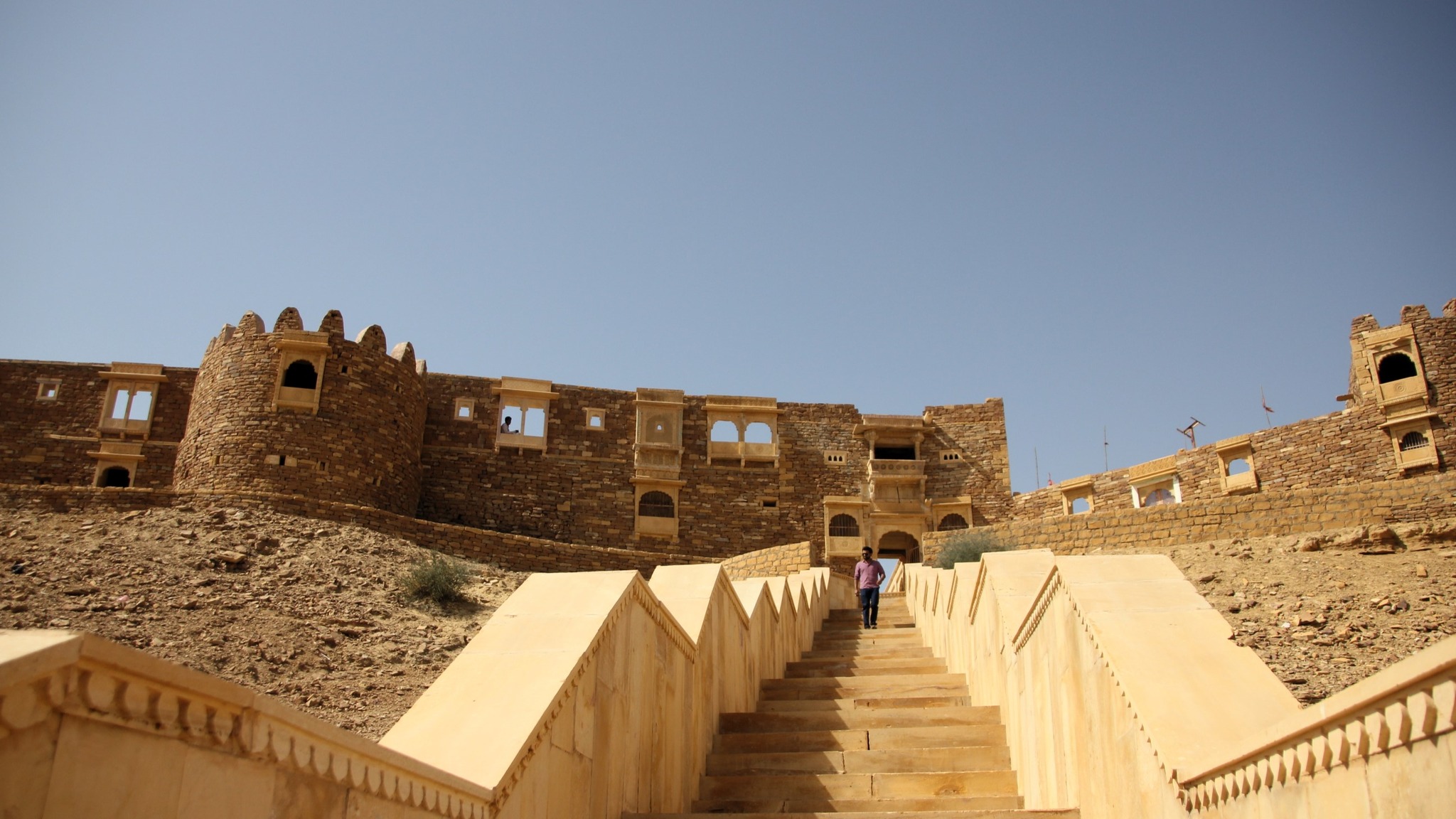
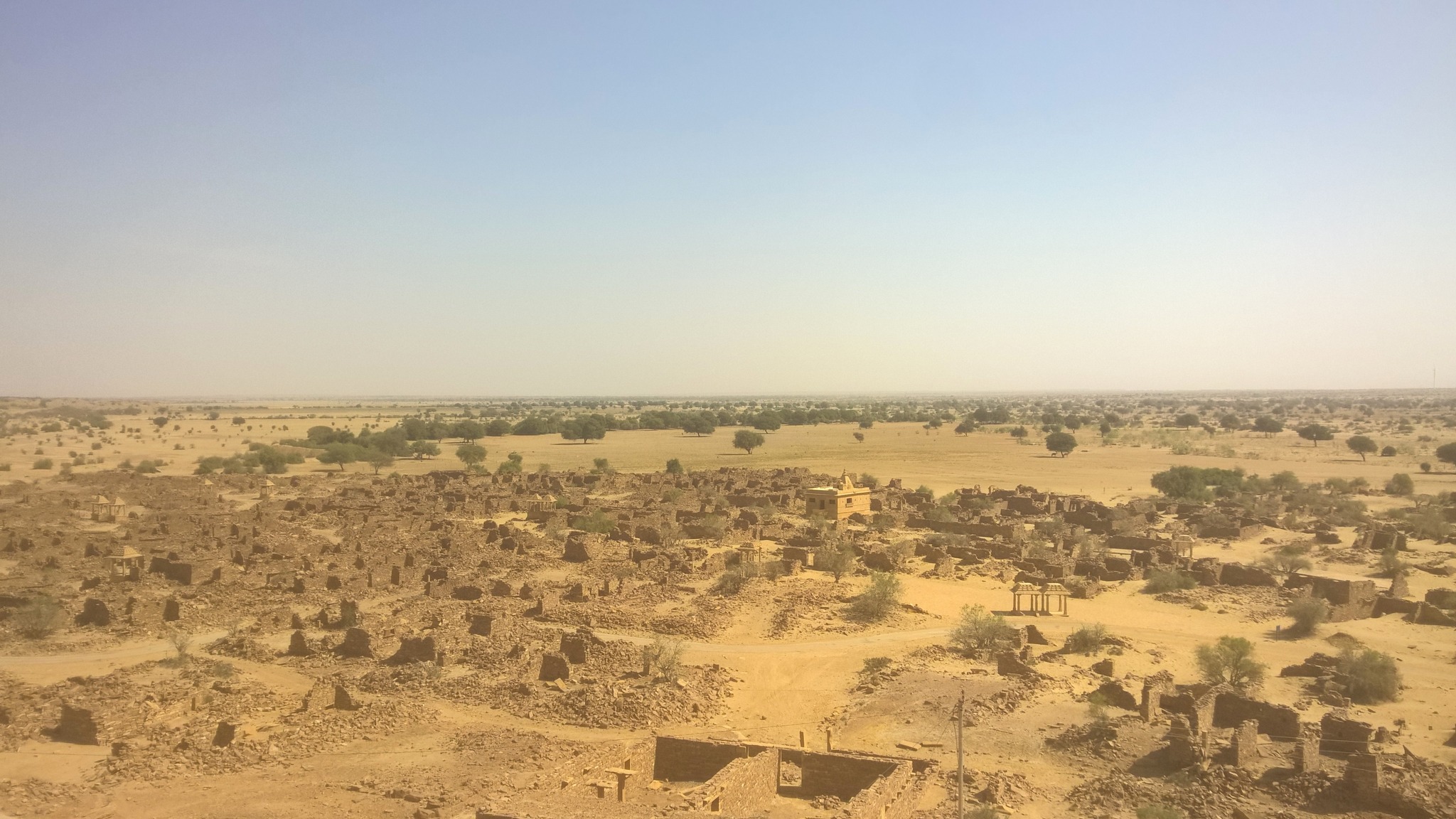
After the safari, we took an interior road that ran through the sands, then passed by craggy outcrops on which stood tall windmills, and more than an hour later, reached Khabha fort, a compact structure that stood like a lone sentinel on the edge of a low cliff in the middle of the desert. Down in the escarpment lay the stony ruins of an abandoned town, a sight similar to which we found in Kuldhara, which we reached half an hour later. Touted as a haunted village, Kuldhara does give off eerie vibes, more so in the sense of transporting you to a time gone by than anything else.
Khabha fort (Picture credits: Amit)
Ruins at Khabha, as seen from Khabha fort
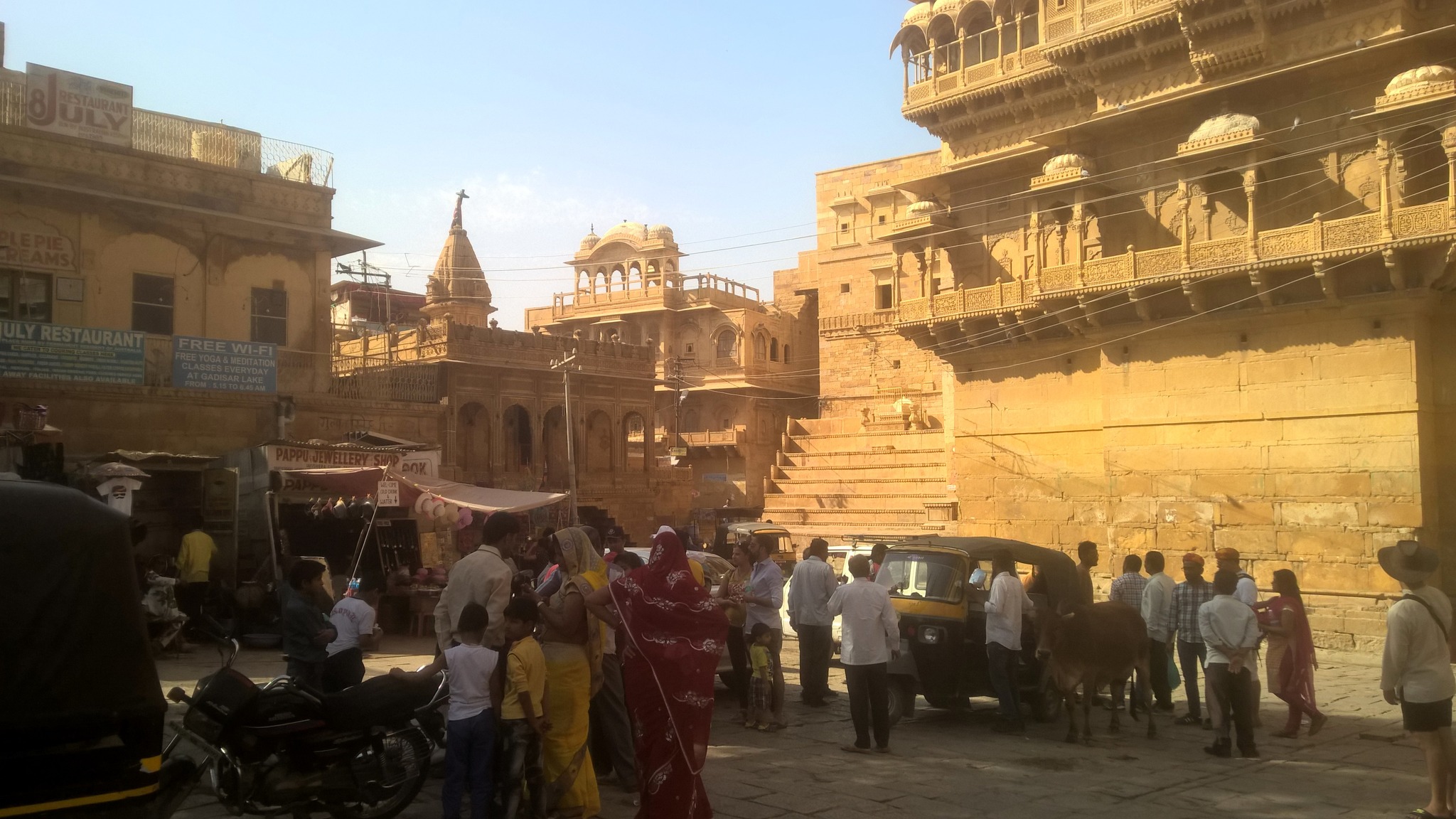
We then re-entered Jaisalmer, and headed off to theJaisalmer fort, where we spent another hour walking through the corridors and halls in the palaces and the alleys along the fort wall. After that we headed off to Akal Wood Fossil park that lies about half hour south-east of Jaisalmer, which we reached around 5 PM. We trudged through the barren, desolate rocky land, coming across preserved fossilized wood dating back to more than 200 million years, then climbed on a flat hill, and surveyed the intriguing landscape.
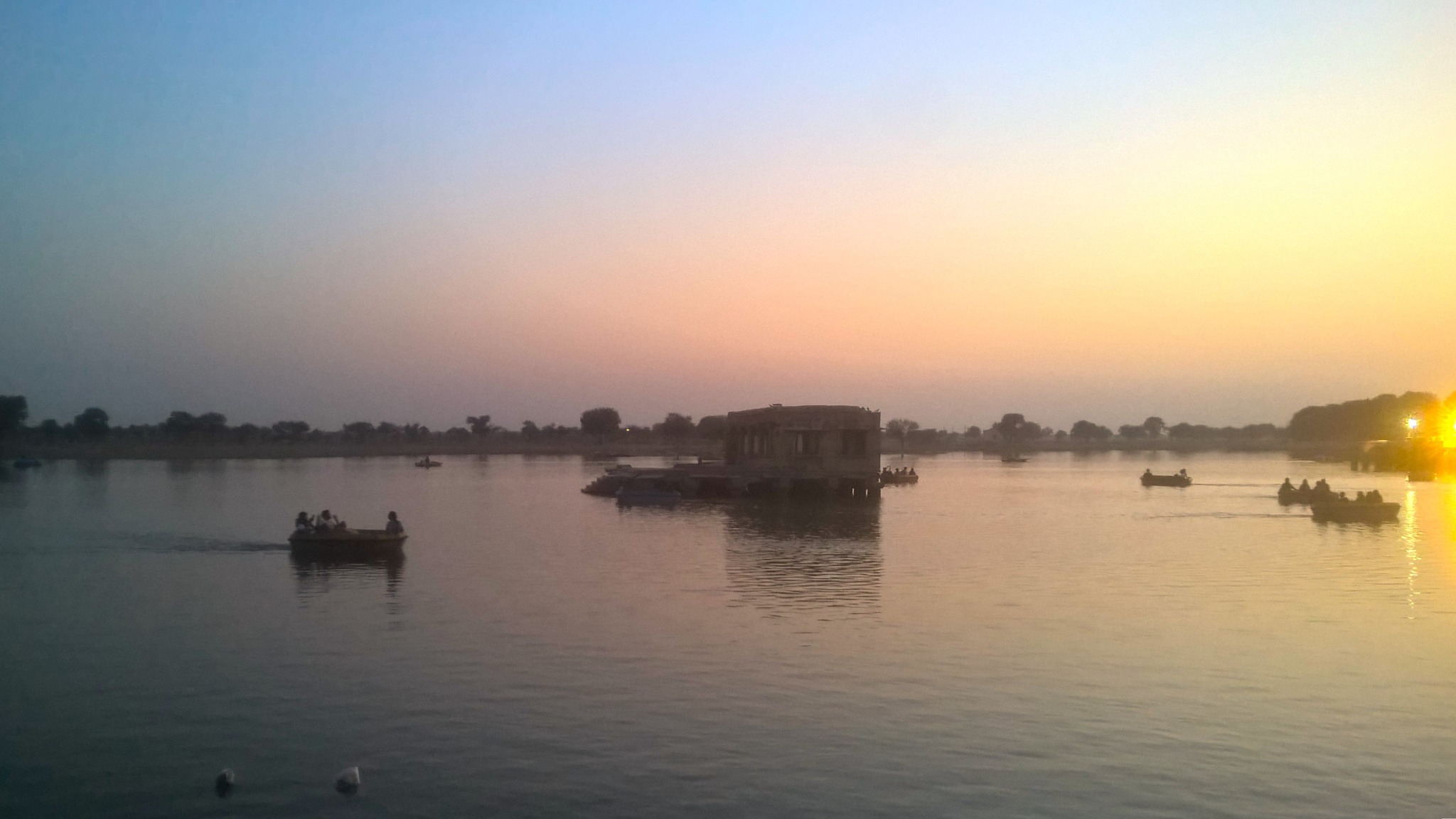
As it began to get dark, we headed back to Jaisalmer city, and bid adieu to the cab driver, who by then had become a partner in our shenanigans, at Gadisar Lake. Spending the twilight at the lake, we headed off to the railway station to catch the overnight Leelan Express train to Bikaner.
Inside Jaisalmer fortLandscape at Akal Wood Fossil Park
Twilight at Gadisar lake, Jaisalmer
Part 3: Bikaner
Next morning, we got down at Bikaner railway station and checked-in to a hotel nearby. After resting a while, freshening up, and having breakfast, we hired an auto-rickshaw to take us around for the day, and were in Junagarh fort by noon.
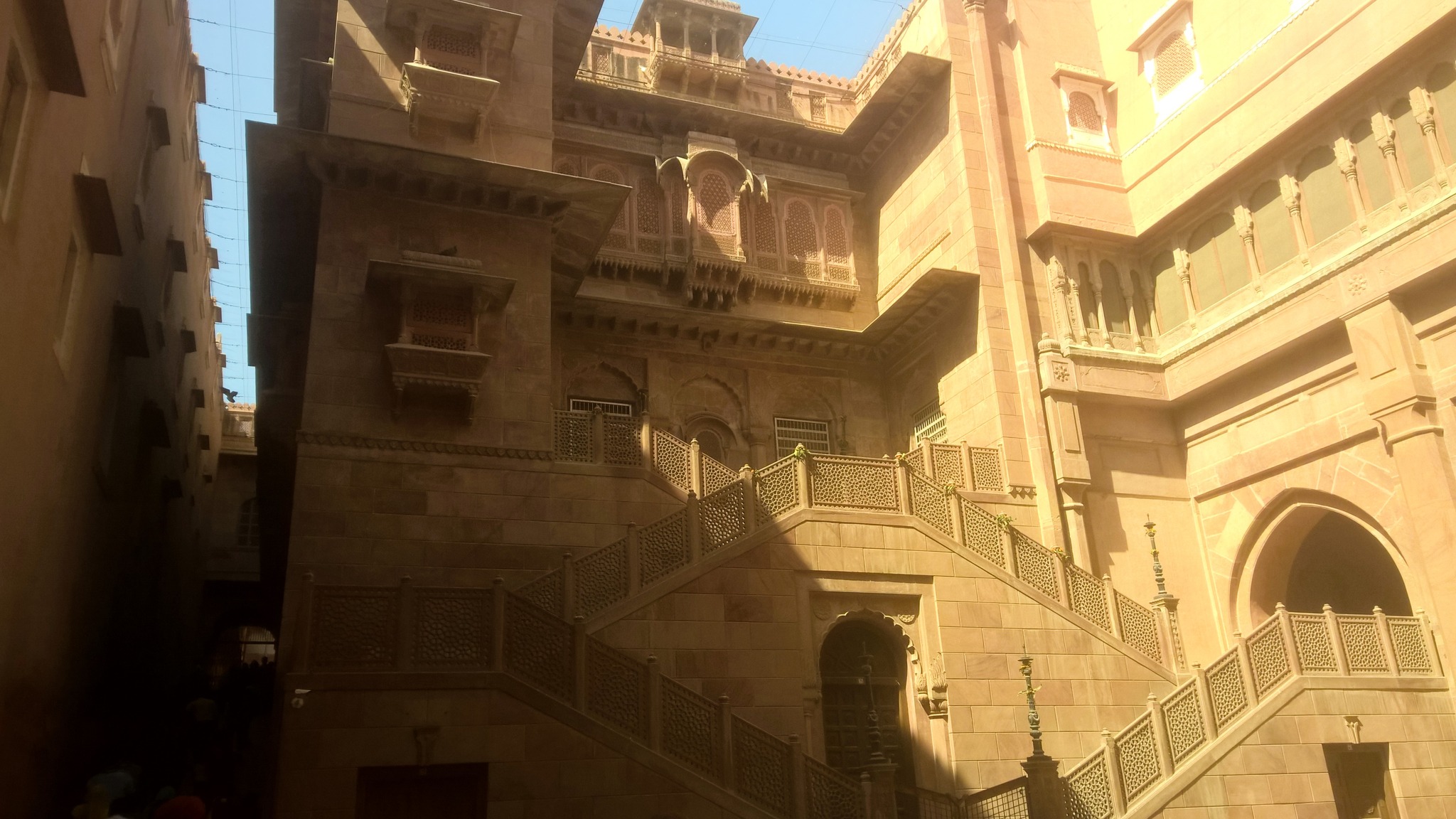
Bikaner city was founded Rao Bika in 1488 AD, after striking out on his own not wanting to inherit Jodhpur state from his father, despite being heir apparent to the throne. The Junagarh fort, itself was built from 1589 to 1594 AD by the sixth ruler of Bikaner, Raja Rai Singh. Earlier called Chintamani, the fort only got its present name in the early 20th century after the royal family moved to the nearby Lalgarh Palace, ‘Juna’ meaning ‘old’. The Junagarh fort is open to public as musuem, with many daily use items including furniture intact in their respective places in the rooms, giving a glimpse of how the royal family of Bikaner lived in the past.
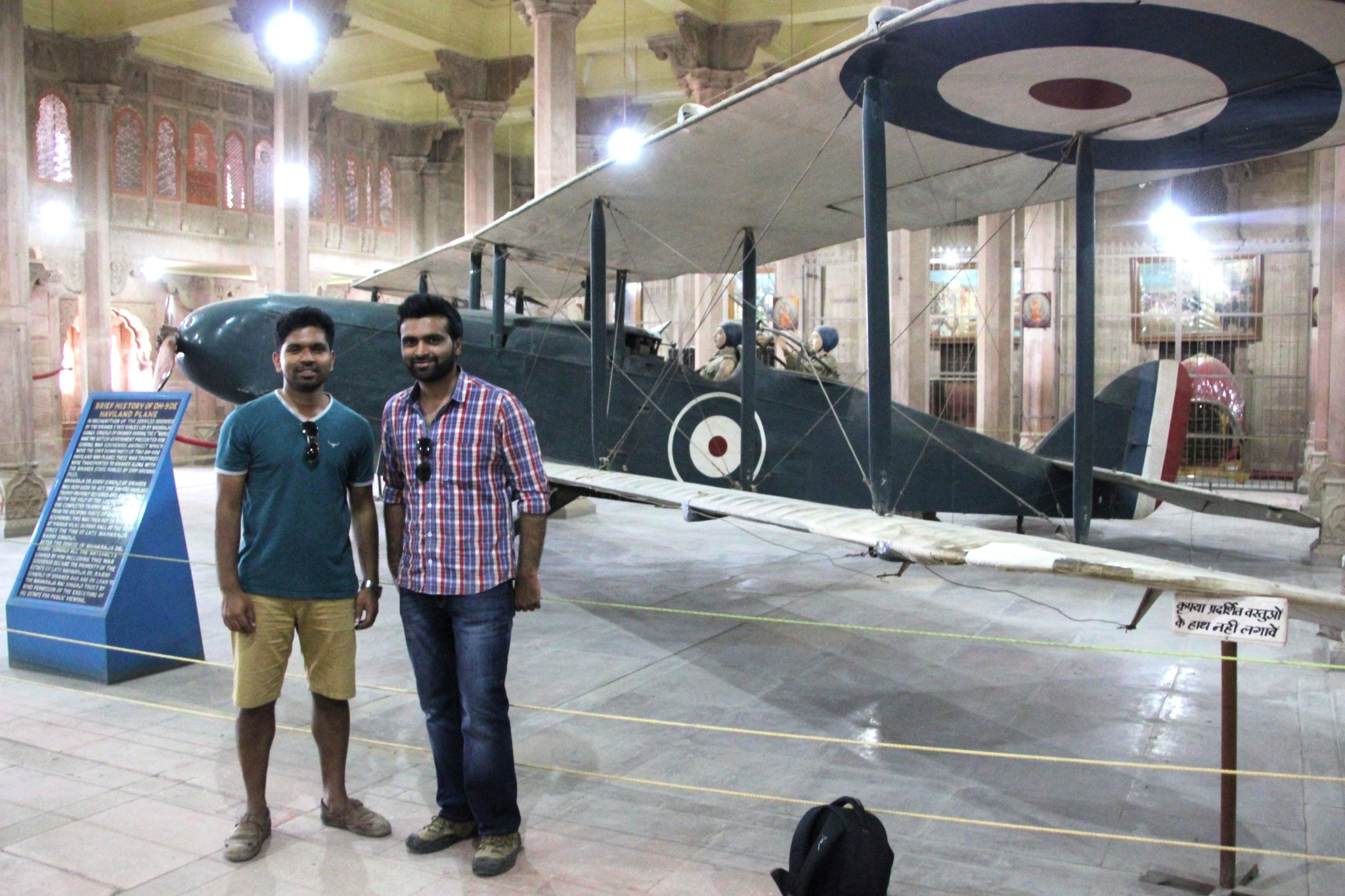
Walking through the various palaces, halls, hallways, corridors, flights of steps, terraces – every succeeding ruler progressively adding more structures and accommodations – we finally came upon a large section, which held in display a DH-9 De Havilland single-engine biplane that saw action in the First World War. This was installed by piecing together the parts from one of two such warplanes shot down in the First World War, which were gifted to Bikaner state in recognition of the 500-strong camel cavalry support provided by Maharaja Ganga Singh to the British Government in the war then-dubbed as the Imperial War.
Palace just inside the entrance of Junagarh fortThe DH-9 de Havilland at Junagarh fort
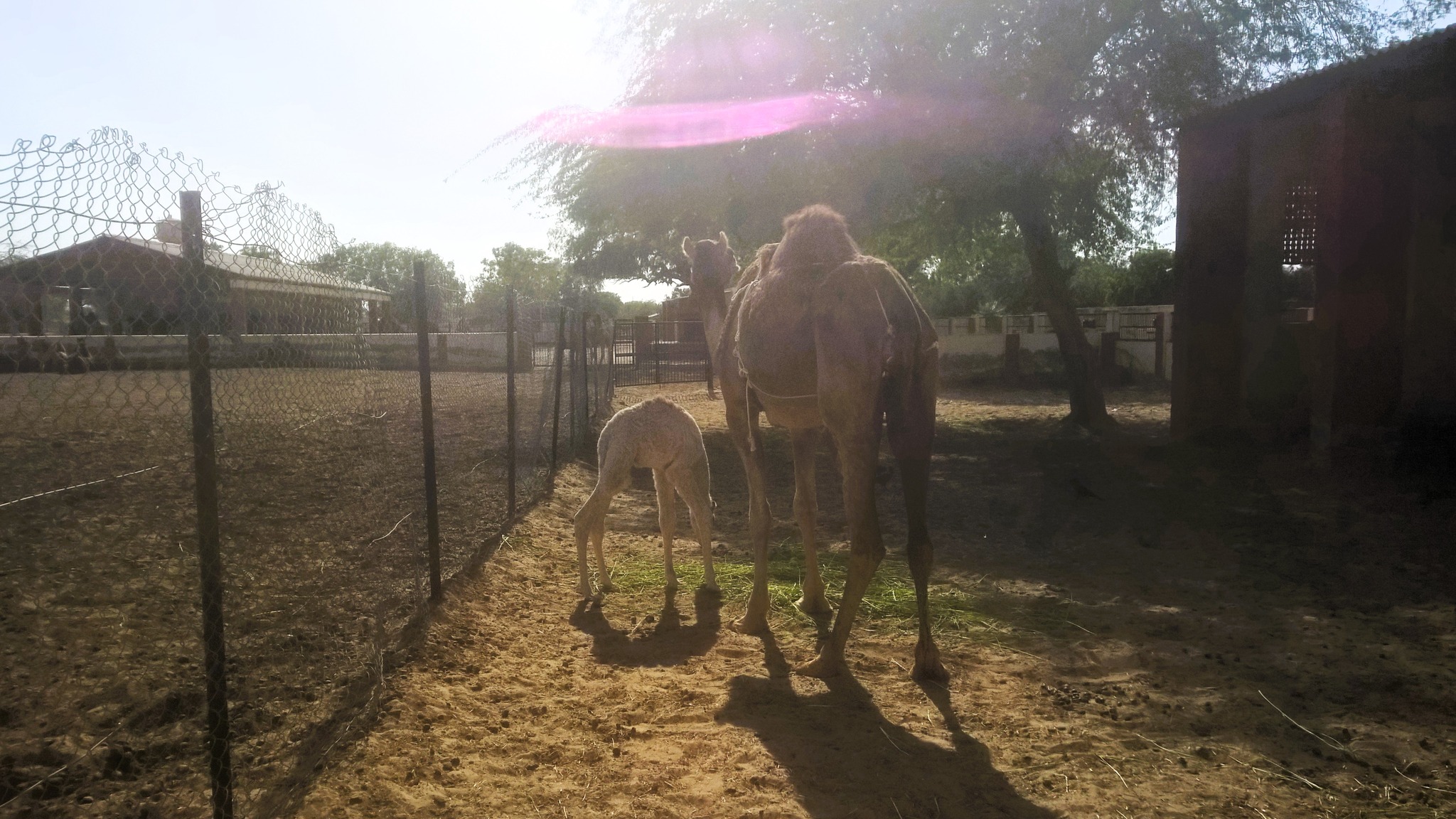
At around 2 PM, we left the fort, had lunch and reached the ICAR-National Research Centre on Camel lying on the outskirts of the city, where we learned about five breeds of camels, namely, Bikaneri, Jaisalmeri, Kachchi, Mewari and Jalori, and their respective lifecycles. We also learned how significant and integral the camel is to the human sustenance in the Thar – the camel is useful not while it is alive, but also after it dies, when its skin, fat and bones including teeth are turned into useful products, such as water bags, pouches, lighting oil, ornaments , decorative items etc.
At ICAR-National Research Centre on Camel, Bikaner
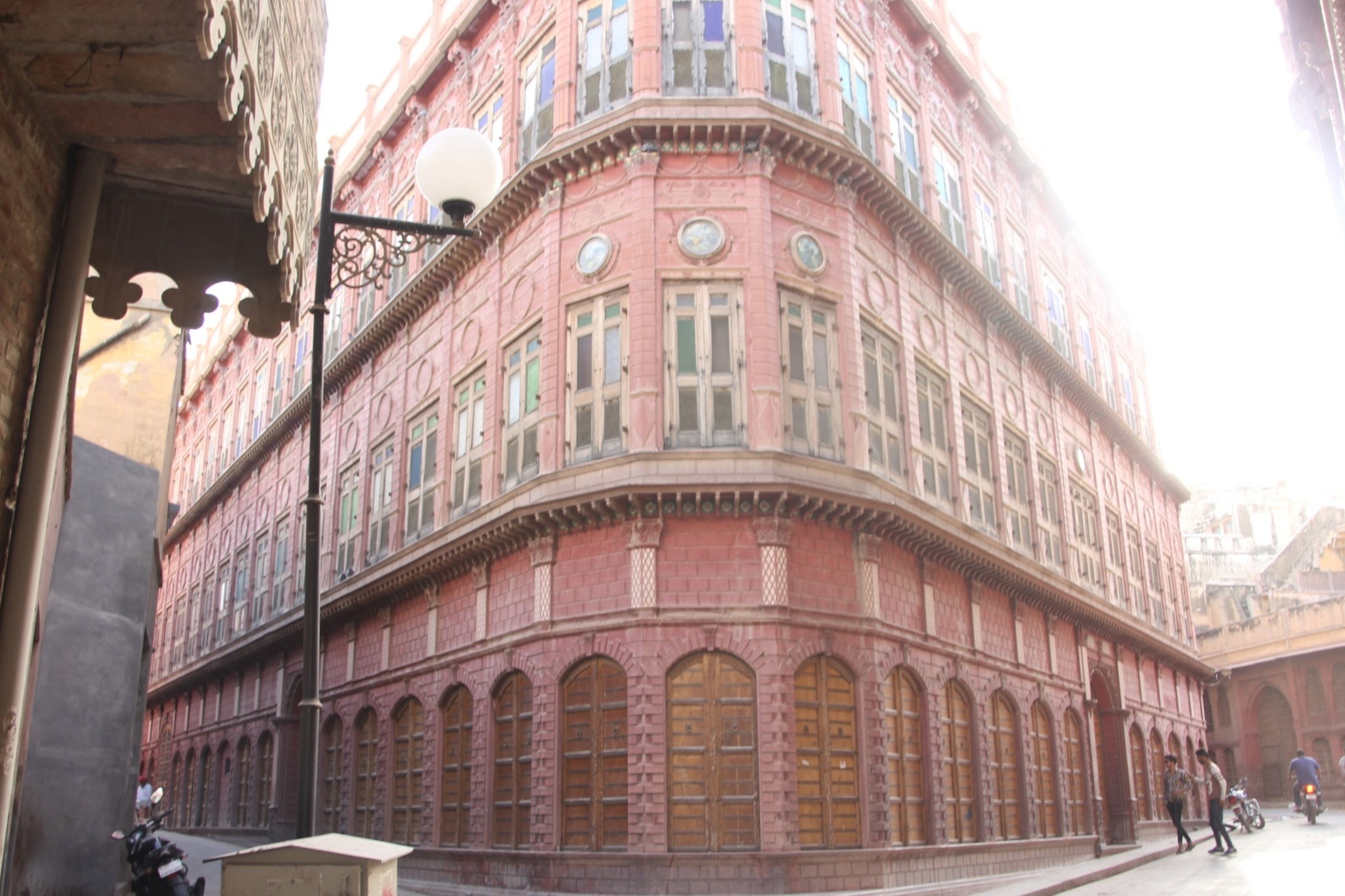
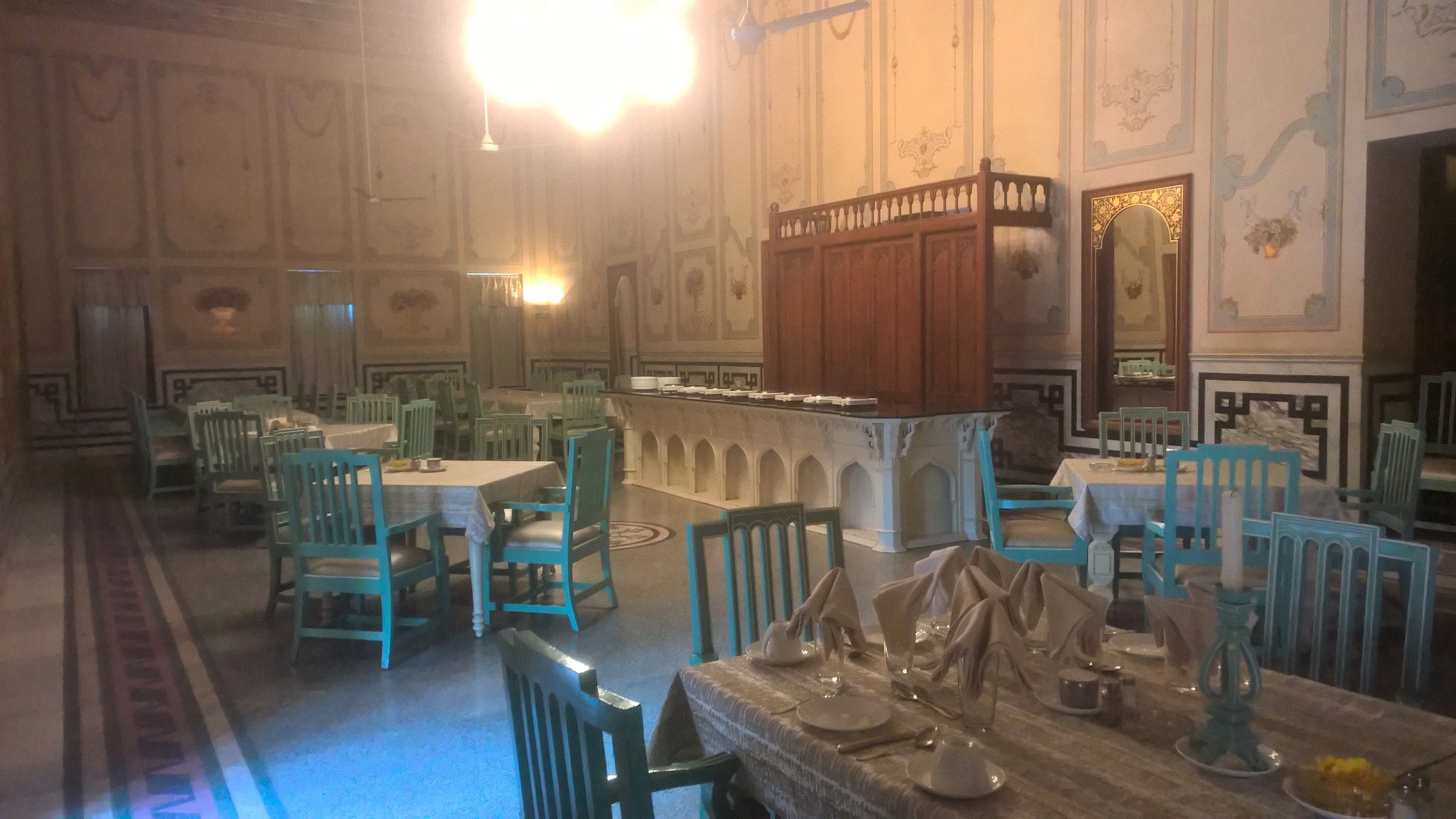
Around 4.30 PM, we reached the old part of Bikaner, where lie many havelis of merchants and royal ministers of the past, one of the most notable havelis being the Rampuria Haveli. Just behind the Rampuria Haveli is the Bhanwar Niwas, now turned into a hotel, which we took a short walking tour of by requesting the gateman. Then, walking through the narrow lanes, we came upon the 12th century Bhandasar Jain temple – dedicated to the the 5th Tirthankara Sumatinatha – notable for its beautiful leaf paintings, frescoes and ornamented mirror work.
Rampuria Haveli, Bikaner (picture taken on Amit’s Canon DSLR camera)
Dining Hall in Bhanwar Niwas, BikanerBhandasar Jain temple
At long last, we surveyed the Rajasthani snack shops, now run by descendants of the originators of traditional Bikaneri snacks, such as Bikaneri bhujia, lehsun sev, gathia etc, packets of which we picked up for family members back home. After dinner at one of the restaurants in the old town, we headed to railway station to catch the overnight train to Delhi, and were back in our office the next day.












 The Timber Trawler