Ah friendship! To what depths can you plummet, In the advent of your sombre twilight? Does that back oozing red not highlight The stark imminence of your sorry death? Time was when you fed your morsels of faith To a parched palate lying stripped of taste; But all now fills this drab expanse of waste Is the portent of your lumbering wraith! Yes, I, the wretched king of ‘ungratefuls’, Have seen you writhing in my betrayal, Despite your standing by gold-tinted rules, All of which, now consigned to history, Has, doubtless, enticed the friend disloyal To stab your back to end your misery.
The Sun rises rather early on my heart, And the days of pining, are longer and hard; So much sweat for so short a walk! Empty rivers, but so much to ask, Unbearable nights, writhing in the dark! Heat waves and so much more, And you thought that was summer? Well, that’s the season you never knew… That season is – You.
The Heavens are a picture of gloom, They cloud my heart, in my ears boom; Thunder there and the lightning’s here, Mayhem there but the impact’s here, Swelling rivers, breaking dams far and near! Flash floods are here for good reason, But this isn’t the rainy season; That’s the season you never knew… That season is – You.
Now they’re pushing me, to the inside, To slip into my wools, to turn the tide, Aching joints, frostbite in my heart! Icy winds tearing the woods apart, Chill in the muscles till the colds depart! Snowstorms, blizzards and snowfall, But that’s no winter, after all, That’s another season you never knew… That season is – You.
Then She decides to flaunt Her bounty, And unleash it all throughout the county; What’s in the heart… a song of eternal bliss! What’s in the air… a kindred spirit’s kiss! Green, yellow and red do seem not amiss- A dance of the flowers, And Spring could be all ours; Now that’s a season I wish I knew… That season is – You.
How much more shall I extol you To the Heavens, to all garments divine? Long have I wondered it is few, So I’ll praise till the sun shall shine.
I have not these labours done So you shall jeer at me later on, Still have I clothed you in jewels ethereal, With supplies that are beyond my all.
How much more shall I drag my feet When it causes not for me a single beat? Must I fire my imagination for nothing? Must I write, must I praise and sing?
Tell me what royalty I do seek From you, for this offering unique? Soaked I am in a drizzle of compassion, Fie, fie on my endeavours of passion!
Long have I wondered what is new- Exhausted as I am, no more shall I spew And shall now to you, bid adieu, No more, no more shall I extol you!
A few months ago, I came across an old friend of mine, who had left three years before and had just come back to town for a short visit. His skin was sun-burnt and his hair had turned a greyer lot. He did not seem the same guy as from three years before. I have to admit it was he who first recognized me when I simply, just as an arrogant dog, was minding my own business.
“How are you friend?”, he asked.
“Oh, you are back then? How come you…Oh, come on, let’s talk.”, I answered back.
“Talk we can do later.”, he said, “But tell me how you are faring here.”
“I’m doing well!”, I said and stopped for a while before opening my mouth again, “Well, why are you so concerned now? Did you bother to ask when you were away?”
“If I had your address.”, he quipped back.
Well, then we parted promising to meet again the same night at the restaurant round the corner of the same street.
That night, I prepared for my best outing and before locking the door, did not forget to pick a pen which I had kept aside to present him three years ago before he left, and had failed to do so. The pen had developed rust over it, for I had left it discarded and had never used it until I was reminded of it that night. But even then, it was a gift. And I did not feel ashamed to gift the old friend a pen because we had always shared our things as school-going children and had always happily swapped old goods.
I was thankful to God that he had not forgotten me but I was still not aware of what that night was going to do to me.
I reached the restaurant well on time and found that he had still not arrived. Choosing a good table, I sat and made myself comfortable. That was when I heard my friend calling out to me.
I greeted him, and we sat down together. We chose from the menu and having ordered, I began the conversation.
“Where are you actually now?”
“I would not be able to answer that – it’s a secret base that I am working in.”
“Now, what’s that?”
“I said I can’t – I am needed not to reveal it.”
“You mean you work for a secret company and do secret business?”
“Yes, and let me tell you that I am on a secret mission here too.”
I leaned back startled, “What, you are a secret agent, work for a secret company, and are a on a secret mission?” I exclaimed, “That does not make sense to me!”
“Shut up and sit quiet,” he muttered, “You’re going to dox me!”
I sat upright. For the rest of the meal, we did not talk much.
At the end of it, I said, “Well, that’s why you never contacted me. You did not even inform me when you were leaving and before that, did not even tell me you were leaving town.”
“Well, yes.”, he answered sharply. And just as were getting up, I beckoned him to remain in his seat. I produced the pen from my pocket, and with a smile presented it to him.
“And this to celebrate our friendship which has till now lasted twelve years.”, I said, and handed it to him.
He looked contemptuously at it, took it in his hand and throwing it back to me, said, “Is this what you’re gifting me? I could have a thousand better pens than this with the money I am earning as a secret agent.”
He got up quickly, went up to the counter, forked out some notes and without waiting for any change, walked away.
I watched him leave, with wet eyes. Was this the same guy who had always wanted to be with me, who had always wanted to share his things with me, was always ready to part with any good old thing for another, had always shared his feelings, I wondered. I wondered was he really that friend who had grown up with me and now had thrown my present back at me.
“Money does wonders.”, I said, and walked up to the counter only to learn that the former gentleman had already paid the check. I went back to my home, and a had a good night’s sleep.
I have not seen him since, and I hope to never see him again because that would remind me of what a friend could do to another. But even if I wanted to see him, it is doubtful I would get the chance to do so because only today morning I saw his name in the news, accused of being a spy for the neighbour country.
Batman v Superman is a movie that has director Zack Snyder trying hard to marry two worlds – a world that is inhabited with DC Comics characters and another world, enamored with Marvel Comics characters, that has already been shown how an extended Cinematic Universe should look, and indeed looks, like. So you have Warner Bros. and Zack Snyder teaming up to cobble together a DC Comics alternative universe and to pit one superhero against another just in time, before Paramount and Marvel steal their thunder with their own interpretation of a similar scenario – only they are trying a little too hard.
That is the problem plaguing the movie for the better part of its run-time – trying hard to quickly establish things or rather, to make you believe things, without having much to show for it. For example, you must believe Batman is fed up with Superman’s God-like reverence from the masses, because Zack Snyder shows a single scene of Batman getting miffed at the newspaper headlines. You must tell yourself the world is on the brink of yet another catastrophe because the characters are saying something on those lines, looking into, perhaps, a crystal ball that is never shown. You must convince yourself that Batman and Superman are in a conflict of war-like proportions – and, since they never showed a real buildup – simply because the movie title says so. You are asked to take huge leaps of faith and logic, because Zack Snyder wants you to never be sure about what really is happening up until the big reveal, which, after it arrives, is deliberately drowned in noise and chaos so Snyder can stretch the aura of mystification half an hour longer. On the way, you never know the reason behind why Superman would suddenly turn up in the middle of Batman’s daily business and let him know he let him off out of mercy. You never know how Lois Lane knows that the spear that she threw away held the key to annihilating the newest monster in Metropolis.
Add to that the mix and match of the different universes that Zack Snyder is attempting. Despite having made it amply clear ahead of the movie’s release that his universe was different to that of Nolan’s, he still imbues his universe with a forced darkness that evokes the ambience of Nolan’s, while also borrowing for his Batman, traits, most notably, the dead-pan, from the pre-Christian Bale incarnations. The problem with this forced grimness is that it draws itself to unnecessary comparisons with Nolan’s creation – and fails miserably at it because the bar has been set so high by both Nolan and Bale – while simultaneously flying in the face of the slightly upbeat mood of the same universe portrayed in Man of Steel. And if the intention was to show a Superman in deep conflict, a sign of the times he is living in, then it is back to the initial problem – you must believe without being made to spontaneously believe, that Superman is in turmoil.
The movie is hobbled by poor direction and banal dialogue, if not by tunnel vision and hammy or wooden acting. Visual effects are run-of-the-mill, and Ben Affleck is just OK as Batman – he is no Bale after all. Jesse Eisenberg goes over-the-top and strangely strikes you as a white version of Shah Rukh Khan in virtually every movie of his (ever). Amy Adams, Henry Cavill, and Gal Gadot, in that order, try to hold on to dear life in a floundering ship. Jeremy Irons’ cocky, wise-crack Englishman Alfred is an apology of a replacement for Michael Caine’s fatherly, sympathetic portrayal. But not all is hopeless though, since the best moments are reserved for the last half-hour, that is, after Wonder Woman appears and joins forces with the other two, when the movie begins to become bearable. From there on, it is uphill for the movie – reaching its zenith in the very last shot – but by then you wonder if it was an uptick two hours too late.
If you have been waiting for months to watch ‘The Revenant’, be forewarned it is not one for the faint-hearted. That this could be the case is alluded to five minutes into the runtime, when you have barely settled in for, perhaps, a popcorn-munching, cola-guzzling, sweet-faced Leo-watching binge that you are yanked out of your cosiness by a violent attack scene, thereby preparing you for a possible further assault of bloodiness, and thrusting you into a sustained state of alertness and stoicism. You will need a lot of those – either those or a deep slumber – for there is no let-up in the gore and violence following that. Whether it be the bear-mauling or arrows piercing foreheads & torsos and jutting out from the other side or axes slashing off appendages or mauled & mangled flesh or even Nature doing its thing, director Iñárritu’s goriness is remarkably realistic in detail and in-the-face – as opposed to the sanguine tongue-in-cheekiness of, say, Tarantino.
What emerges, slowly, is the surprising evolution of Tom Hardy’s acting – when you had had dismissed him as simply an improved version of Vin Diesel. With the evil on his face and in his voice – and as opposed to the over-the-top portrayal of evil in TDKR – so palpable you would actually hate him. Then there is Lubezki’s camera work- conjuring up angles and heights, sneaking into corners you would not expect, contributing to so much of the in-the-face visceral nature of the visual that sometimes the only respite you could get is by looking away. But then you would also miss his wizardry.
That brings us to Leonardo’s performance. It is hard to calibrate Leonardo’s acquittal – seasoned that he is – against the backdrop of the overwhelming circumstances depicted in the movie. Leonardo has pulled off quite a list of challenging roles in the past, where it was hard to discern Leo the man from the character he played – but here, where he speaks all of ten lines distributed equally over the first 10 minutes and the last 20 minutes, you are left to wonder whether he would be far ahead of the pack were his peers also to portray the daunting hardships that Hugh Glass must go through. In other words, it is a cakewalk for him, or maybe, the effortlessness is to blame. Which is to say, if he wins an Oscar this time, it was because he has been long owed one.
Meanwhile, director Iñárritu, in going for the jugular, does pull off the gore and treachery of circumstances in glorious detail but then he cannot stop any intended themes of relationships – between man & nature, civilisation & savagery, man & family – from submerging in that very sea of blood and breathtaking scenery. One theme in particular – visions and whispers of his dead wife – falls short in eliciting any sense of connect. Then you could fault him for the runtime, and since he is also partly credited with the screenplay, for also the story, because it feels incredulous that a character should be faced with insurmountable clichéd tragedy after tragedy, and also come up trumps in the end. In short, Iñárritu did better on ‘Birdman’.
Ultimately, however, ‘The Revenant’ descends into revenge saga territory, and by the time Glass has finally laid hands on Fitz (Hardy)- and you knew he would half an hour into the movie- you are left wishing you were over with it already, for only after you have freed yourself from the overpowering grip of it all, can you sit down to objectively separate the performances of the crew from the grandeur of the gore.
Cry you not dear, shed not in vain tears, And drop you not your shoulders often, For then, your own zillion faceless fears, You merely quickly let embolden! Let instead your eyes encapture The muted rumblings in million heads, Souls of which shall ne’er feel the rapture Of taste of bread, or a wink on beds…
Beds, the likes of which you daily grace, Are but wishful thoughts best swept aside For ’nother birth on Earth’s ruthless face, So why not stifle the dream inside? Yeah, why not inside, the emptiness? Left behind by man’s fervent rampage Turning greenly grass to concrete mess- Halt, witness mankind’s ‘coming-of-age’!
And what woe ‘coming-of-age’ entails For the trodden down, is in your eyes, So if you must cry, then pick their trails And shed your tears for their muted cries! Your fears shall then break asunder, And each piece for each man shall adorn A shield resisting meek surrender, And then your tears shall have justice borne.
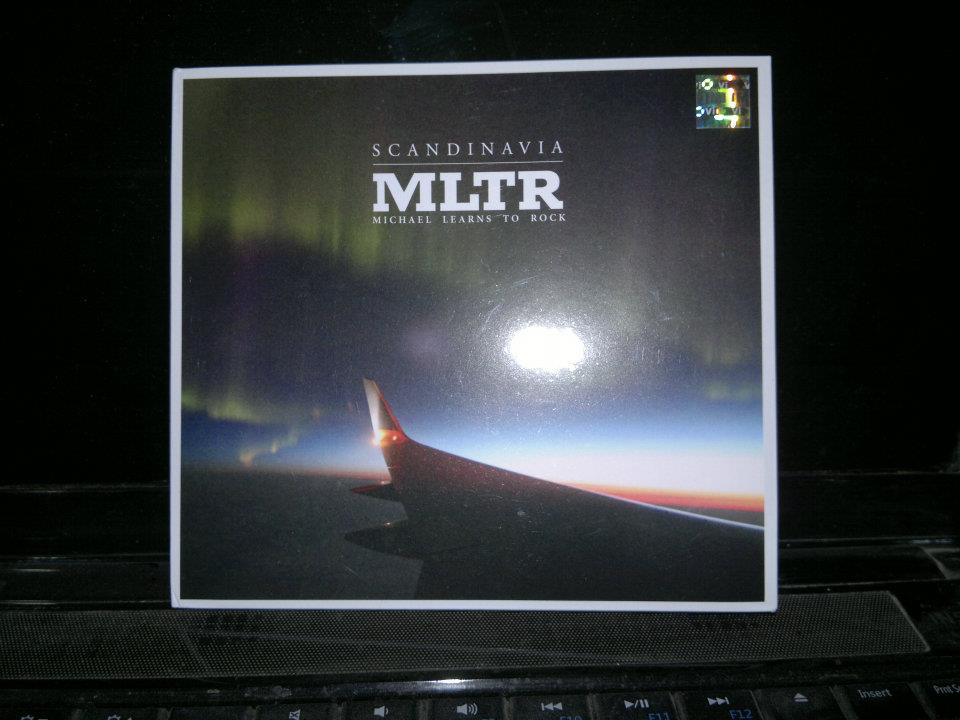
‘Scandinavia’ is the freshest sound to have come from the MLTR stable of music. I remember Mikkel insisting that MLTR were trying to re-find the 90’s MLTR sound. Well, let me tell you, they didn’t quite do that, but they did something different – so different it has come as an immensely positive surprise! The guitar work is elegant and occasionally, pleasantly boisterous, which shows Mikkel has been sweating it out a lot. In MLTR’s personal history, ‘Scandinavia’ will become a by-word for experimentation and freshness. The sound is introspective here, retrospective there, ambivalent now, vivacious then – a very beautiful mish mash of varied styles and colours.
However, if you are looking for Jascha’s trademark accent, inflections and huskiness from the previous albums, you will not find it here. Rather, Jascha has let himself free here and given it a personal touch, employing the accent you would hear from him during normal conversation.
I would pick these tracks as the best -‘Any Way You Want It’ for the classic MLTR rock-ballad touch, ‘Hanging On’ for the soothing feel, ‘Shanghaid In Tokyo’ for a completely new and peppy MLTR exploration of rock music & ‘Renovate My Life’ for some awesome guitar-work. In a somewhat typical MLTR practice of recent times, ‘Space Commander’ and ‘Crazy World’ represent the dance/disco genre on this album, albeit with some interesting lyrics and catchy embellishments. ‘Please Forgive Me’, ‘Heaven Is My Alibi’ and ‘Icebreaker’ are musings on relationships, with deep lyrics and finally, ‘Scandinavia’ is MLTR’s tribute to their homeland, told in the form of a kind of a coming-back-to-home narrative.
Having said that, listeners with a discerning aural ability and varied choice of bands, would be led to see strains of Coldplay’s ‘Myloto Xyloto’ and RHCP’s ‘I’m With You’ albums in this. All in all, a good, memorable package. A new personal benchmark for MLTR!
P.S. : MLTR’s quest for re-invention also extends to the booklet cover, unique for an MLTR album.
Eager to get away from the humdrum of our job, my colleague Amit and I, decided to make a weekend getaway to Jaipur.
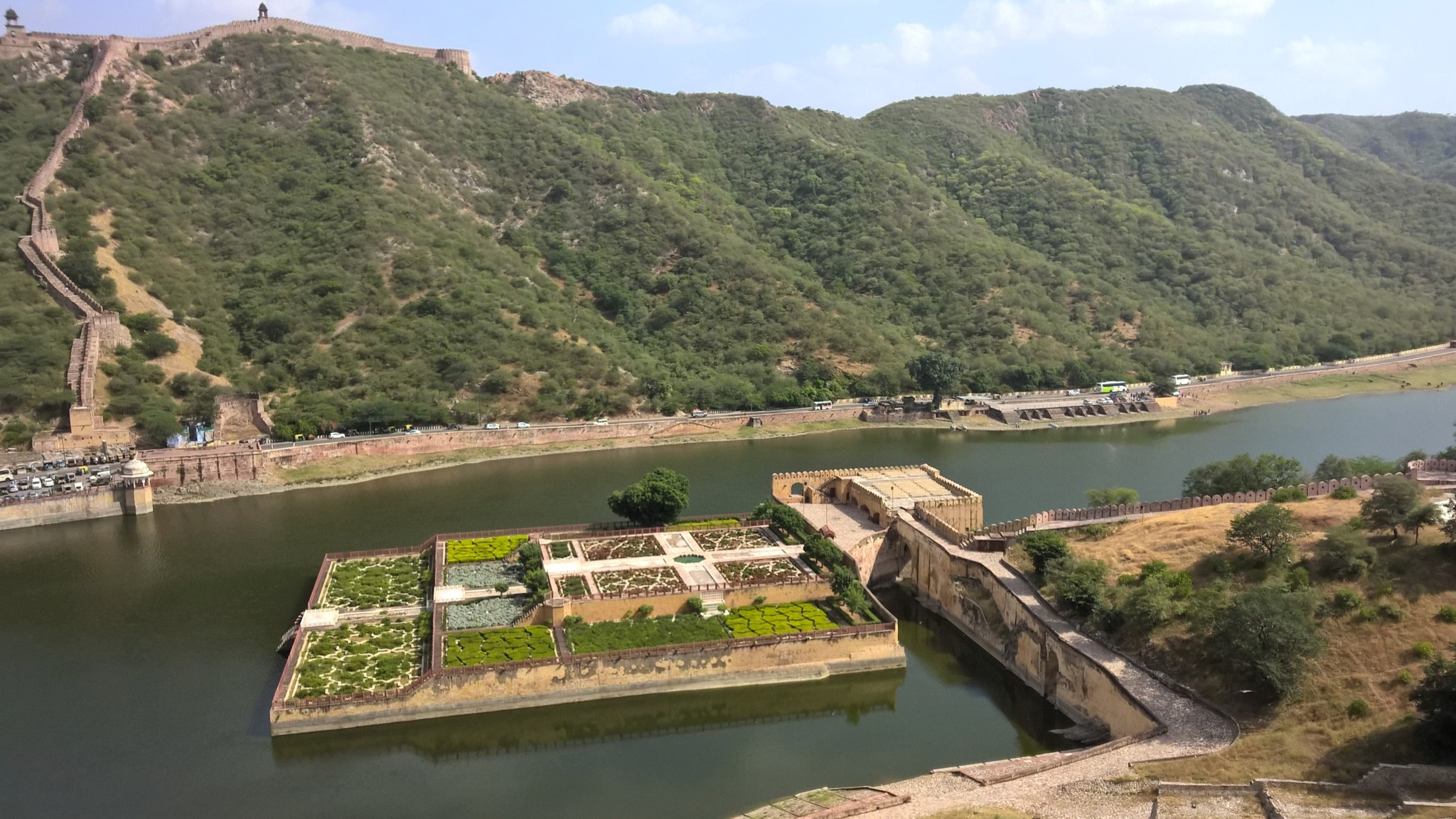
This being my third visit to Jaipur and Amit’s first, I drew from my previous experience, and we booked a day-long package with an auto-rickshaw driver, who took us to Hawa Mahal, Jantar Mantar, Amer fort, Jaigarh fort, and finally, to Nahargarh fort. Later, in the evening, we got a taste of Rajasthani culture and cuisine at Chokhi Dhani.
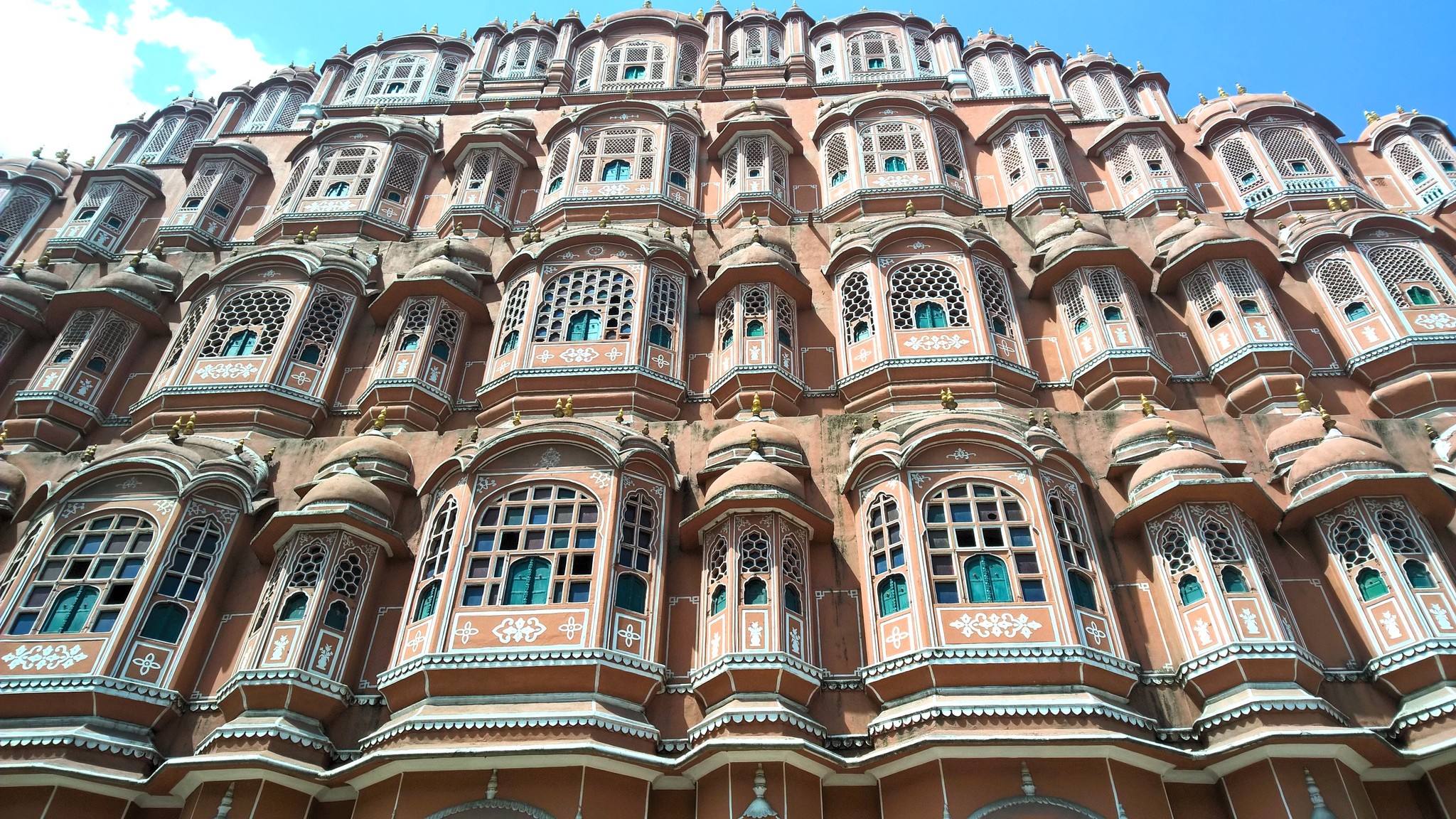
Hawa Mahal, Jaipur
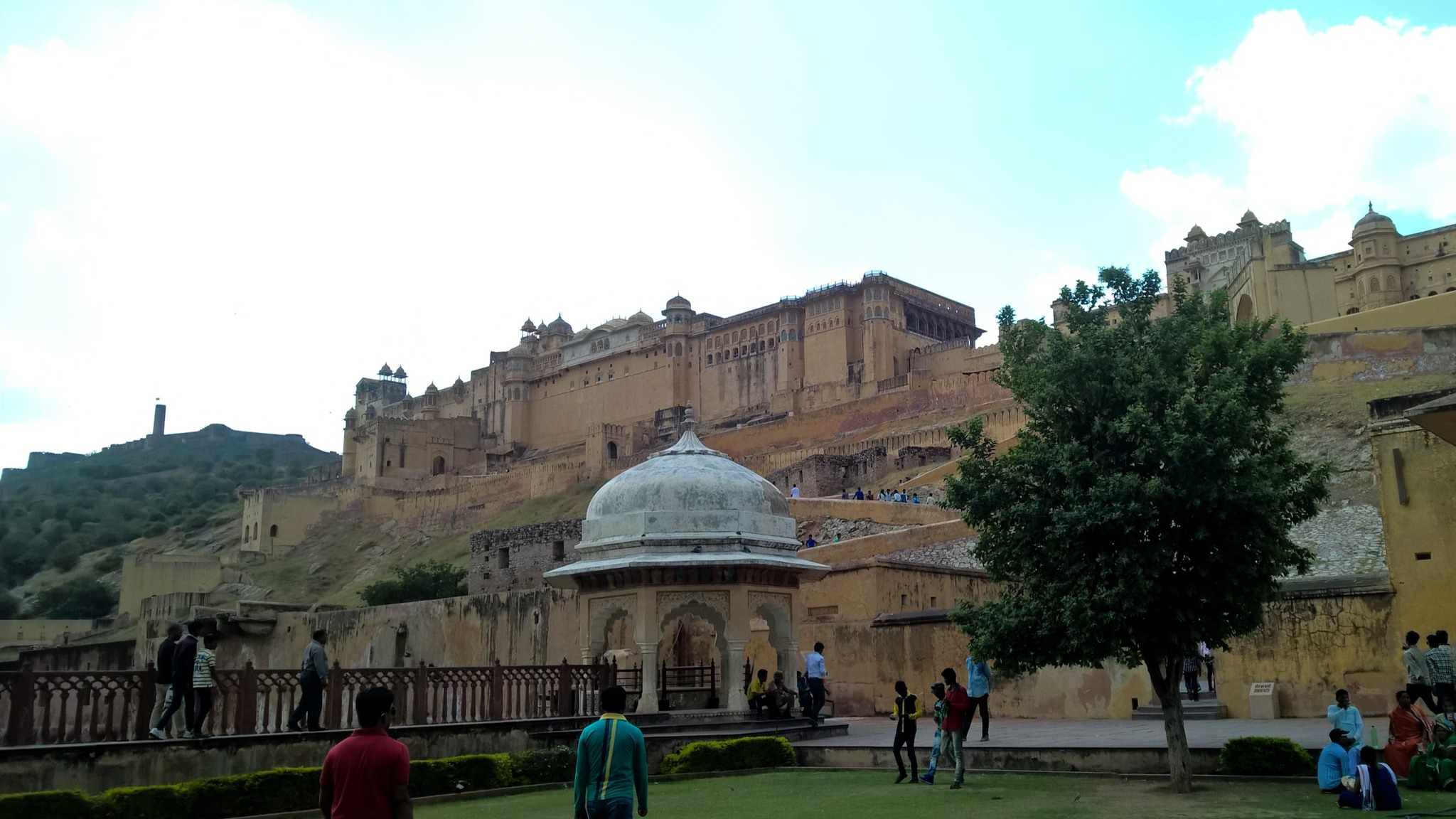
Amer fort, JaipurSaffron Garden, Maota Lake, Amer
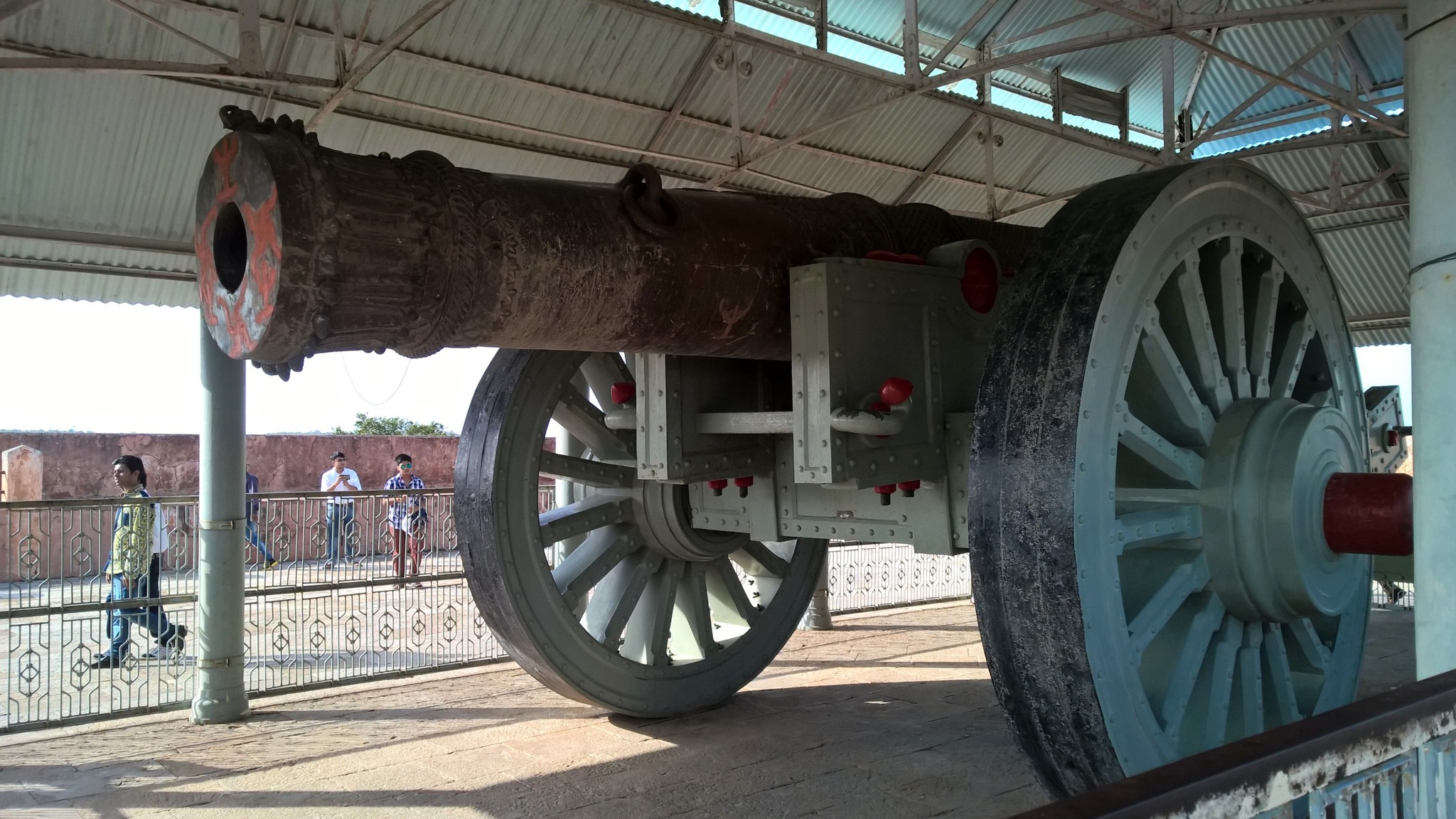
Jaivana cannon, largest cannon in the world at its time of manufacture in 1720 AD, Jaigarh fort
At the roof of Nahargarh fort
Now, where do we go to the next day? I really wanted to go to Sambhar Lake, but not able to find any information on how to reach there, we considered other places, which is when I remembered Mandawa, from two movies released a couple of years ago, namely, P.K. and Bajarangi Bhaijaan. It turned out Mandawa could be reached by public transport, complemented by a bit of local transport.
So, the next day at 8 AM, we set off by public road transport to Mukundgarh. As we passed Sikar, and then, Nawalgarh, I was fascinated by the set-ups of the towns – lying as disjointed clusters in the midst of the semi-arid landscape, with not much construction found along the road connecting the towns. The road cutting through each town was flanked on both sides by houses with their facades aligned, albeit in a jagged manner, with other houses on their respective side of the road. The houses, mostly painted yellow or white, wore an old world charm, transporting you to at least a hundred or more years back.
Getting down at Mukundgarh, we got around to looking for conveyance to Mandawa, when a strange-looking vehicle drew up alongside us. It was an auto-rickshaw which was decked up with fancy colourful decorations, with even more decorations on the inside, and covered with a canopy that formed a closed compartment! We were so intrigued that we hopped into the fanciful auto-rickshaw without even haggling.
As we advanced on the road to Mandawa, we saw the landscape gradually becoming more and more arid, and as we got nearer to Mandawa, we could see on both sides endless expanses of undulating sandy flats with a few sprinklings of low trees and shrub, even as villages each comprising just a handful of huts greeted us from time to time. Soon, we saw a bigger cluster of houses, and were welcomed by an arched gate on a wall that seemingly enclosed a town inside – Mandawa was here.
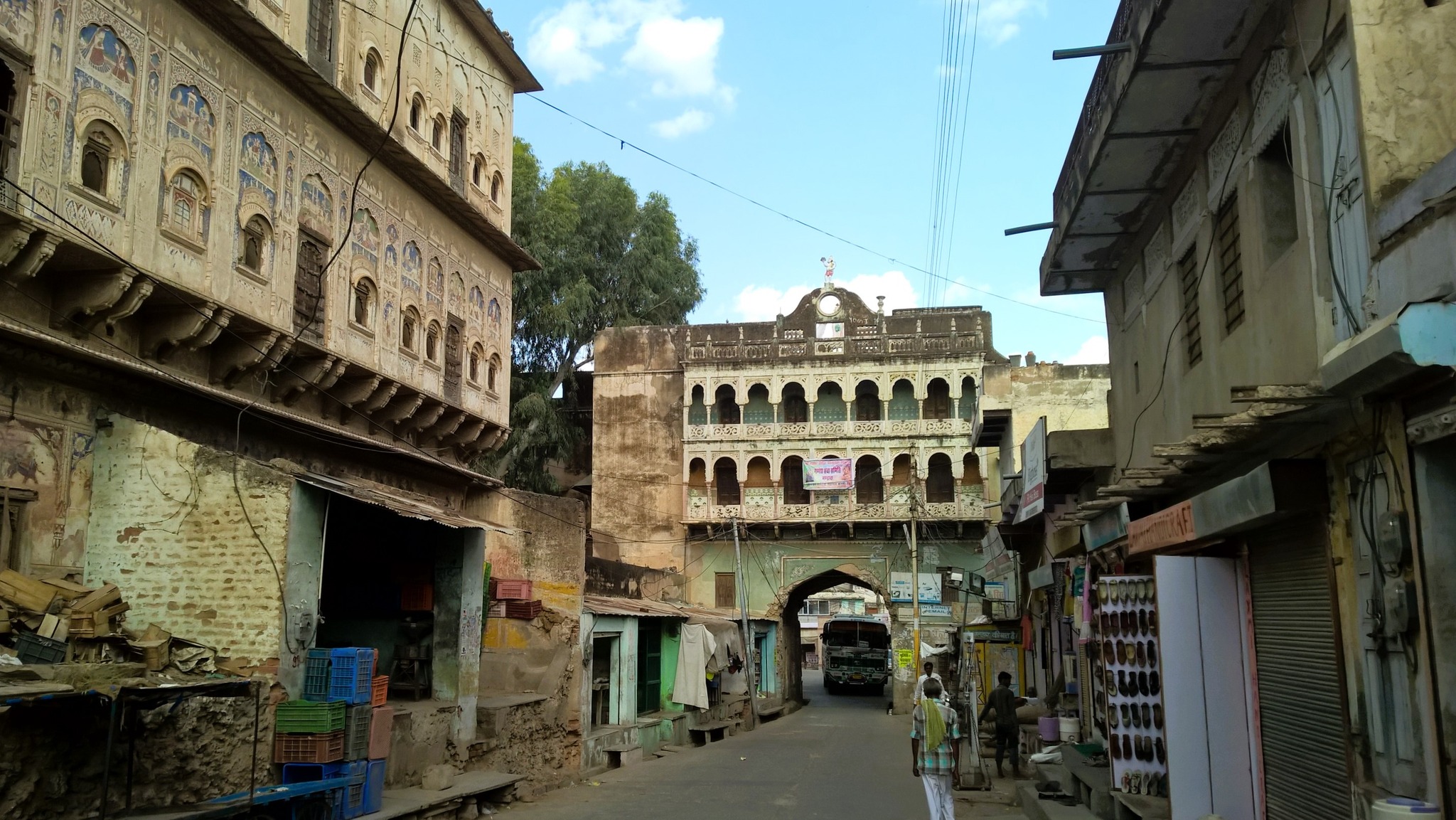
As we entered the gate, we were ushered in by two arrays of verandahs of the buildings abutting either side of the narrow road. Some buildings hosted shops, some others were residences, and some were merely the entrance to a larger building standing behind the front row.
Entrance gate, Mandawa
Before we could get a hang of the place, we entered a bylane that apparently led to the Mandawa castle, but failing to locate the gate, we kept walking, past many havelis, until we reached an open area somewhere adjacent to the castle. We saw a shanty serving Maggi instant noodles and tea, and decided to first fill our tummies, while scratching our heads as to how really to explore the place, in the absence of a guide or any prior knowledge.
This is when appeared a boy – someone we would later refer to as Chhutku – barely 8 years of age, with disheveled hair, dressed in crumpled, undersized clothes, who sensing we were the touristy types, offered to show us around, for a price, and kept insisting on it until we had finished our meal. Partly to humour him, and partly impressed with his enterprise at such an early age, we relented.
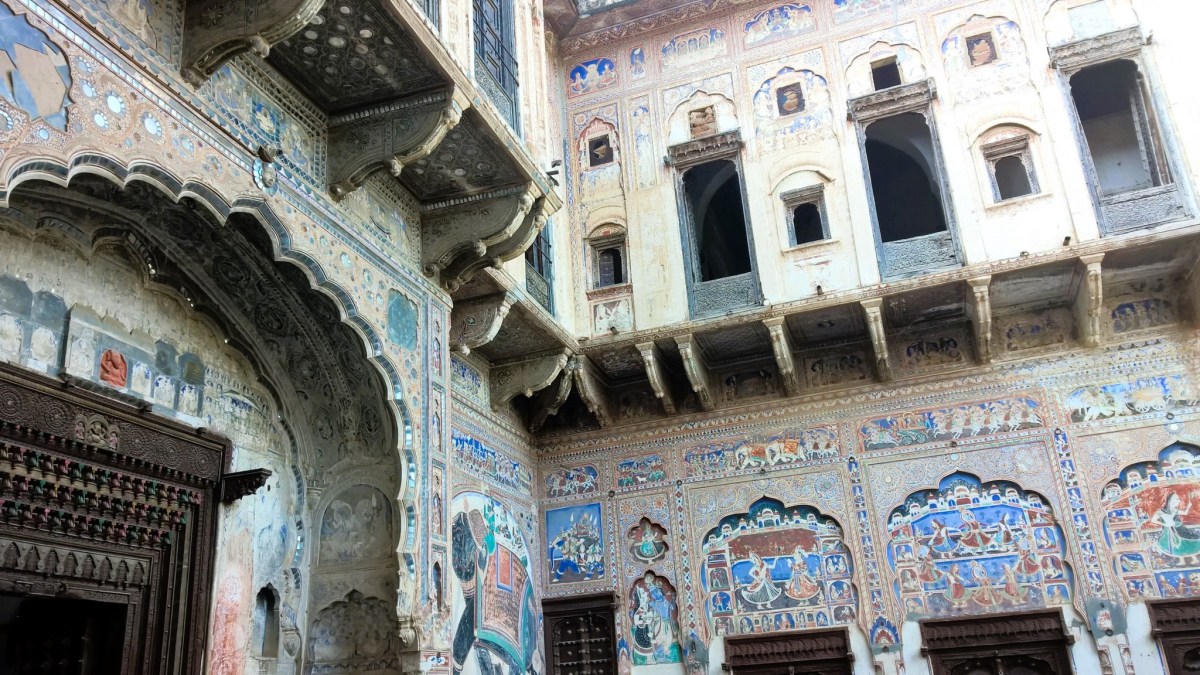
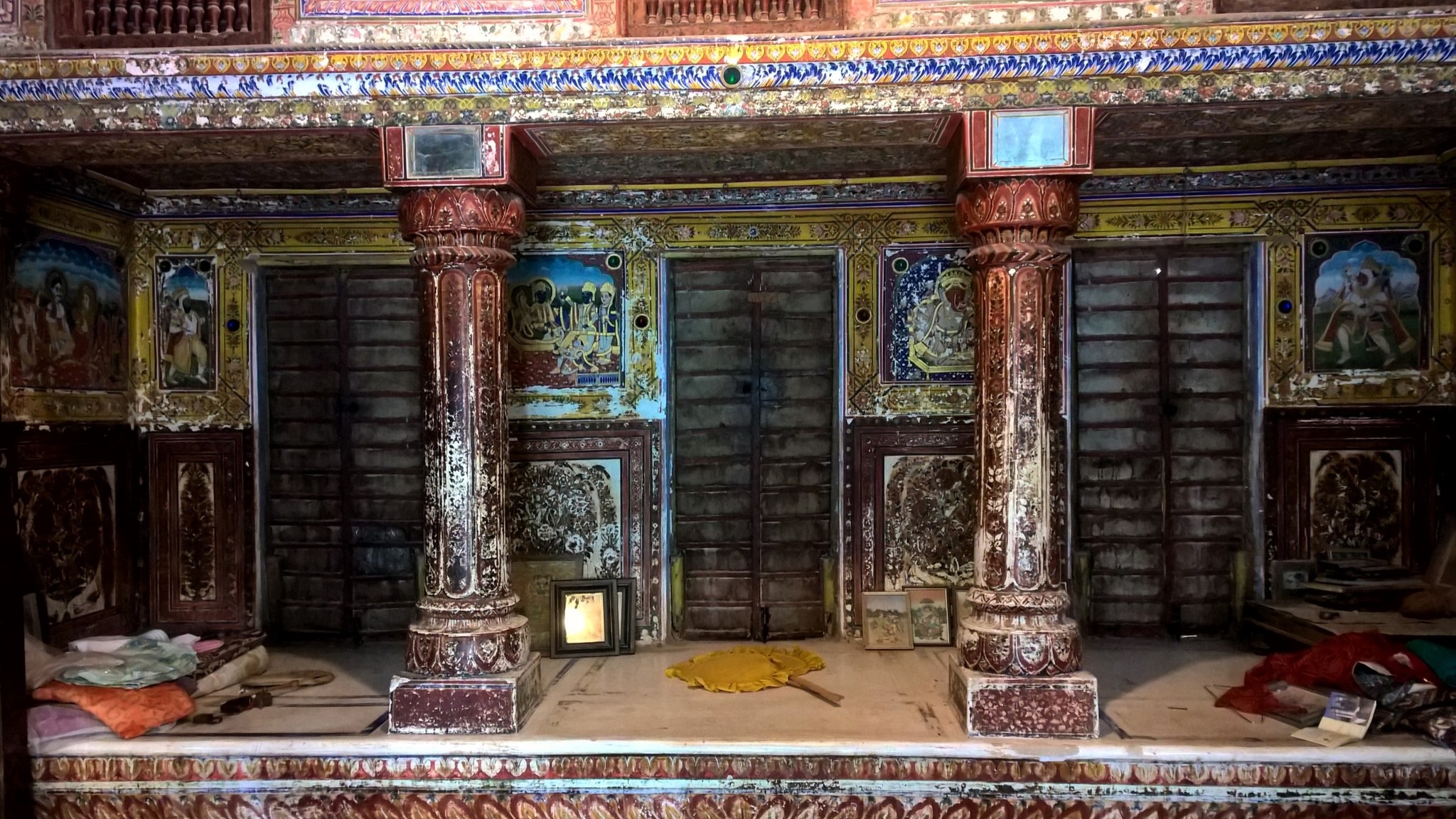
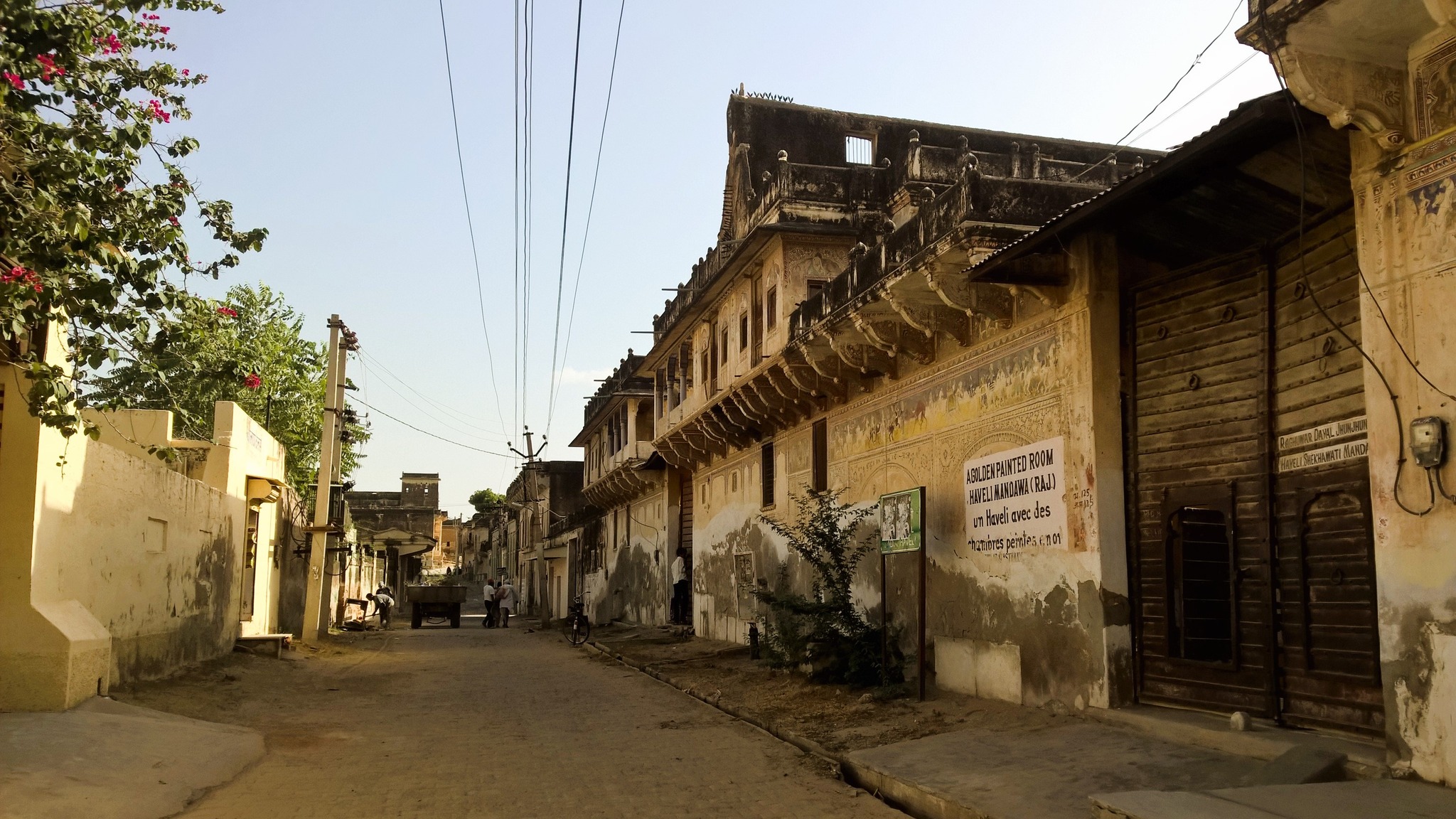
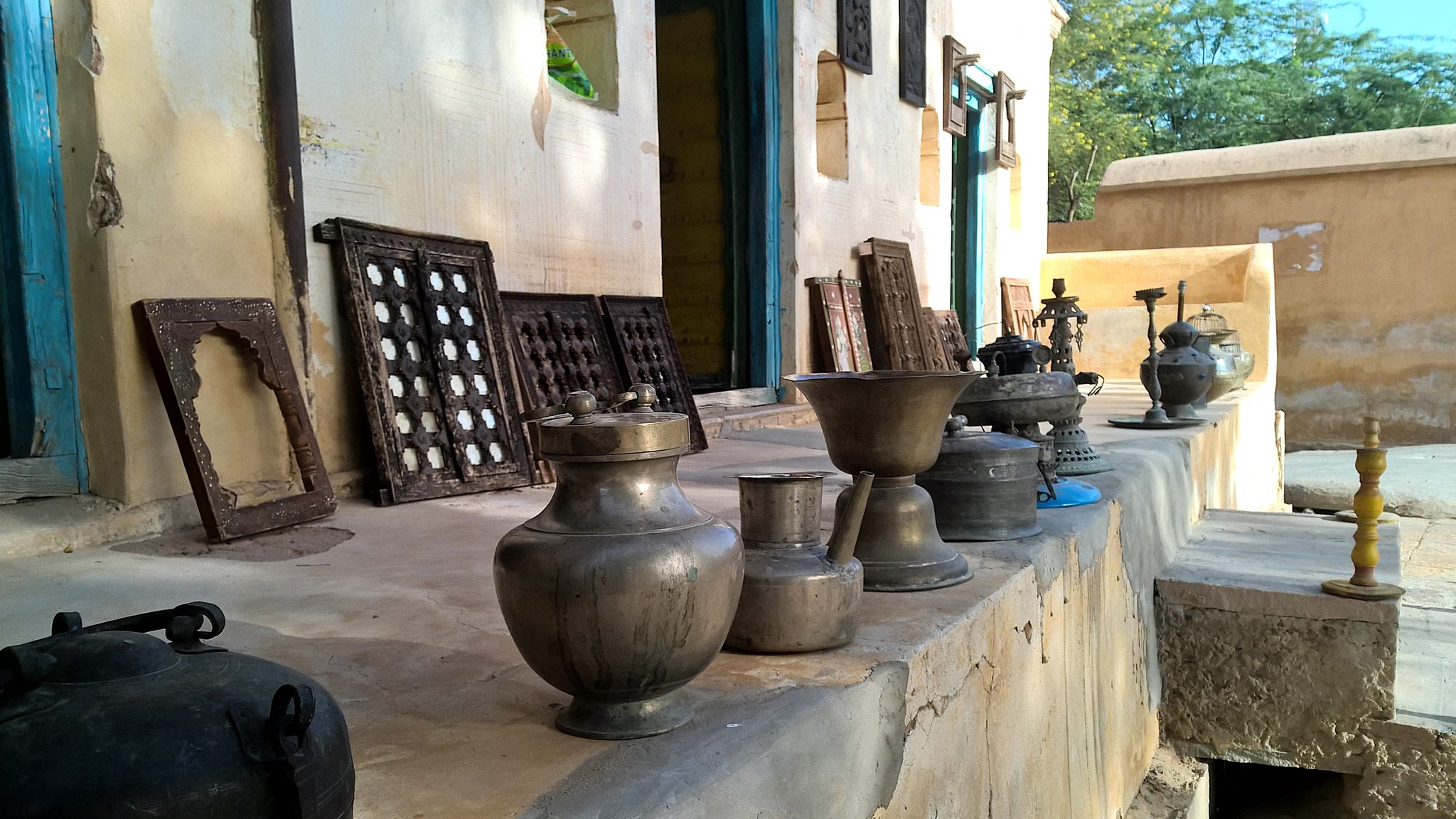
So, courtesy of Chhutku, we saw a handful of havelis, with their painted facades, part covering the balconies jutting out and peering over the street, and part forming the front wall proudly strutting their evocatively painted visages, all but weathered by time. One particular haveli, Jhunjhunwala Haveli, aptly nicknamed the Golden Haveli, houses a room with intricately painted golden-coloured decorations, along with artifacts from a time gone by – giving us a glimpse of the lives and times of the merchants that built and lived in the lavish residences.
Frescoes on the inside of a haveli in Mandawa
Jhunjhunwala’s Golden Haveli, Mandawa
A typical Mandawa laneArtifacts from the past, Mandawa
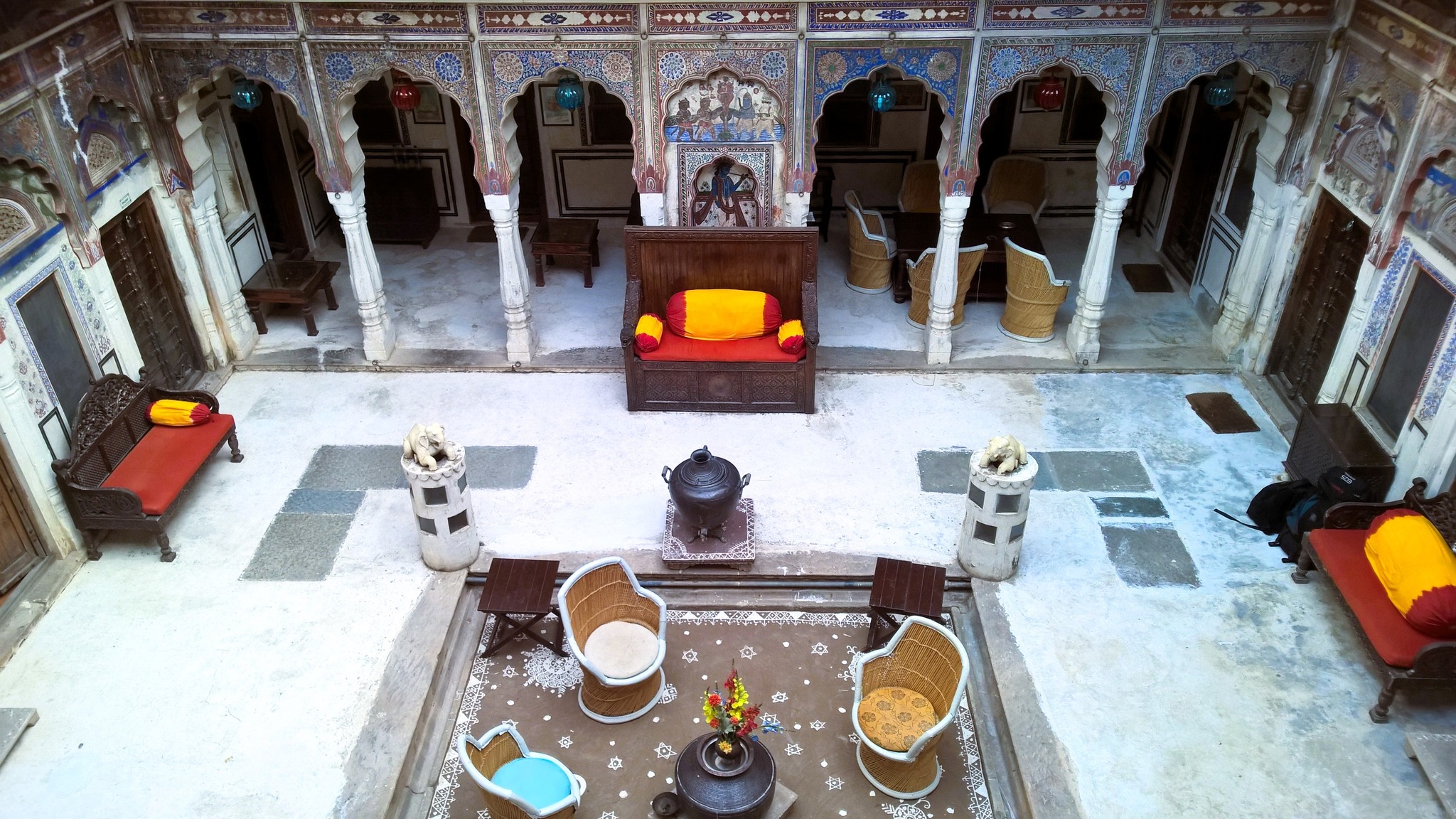
The inner courtyard of the Mandawa Haveli, now turned into a hotel
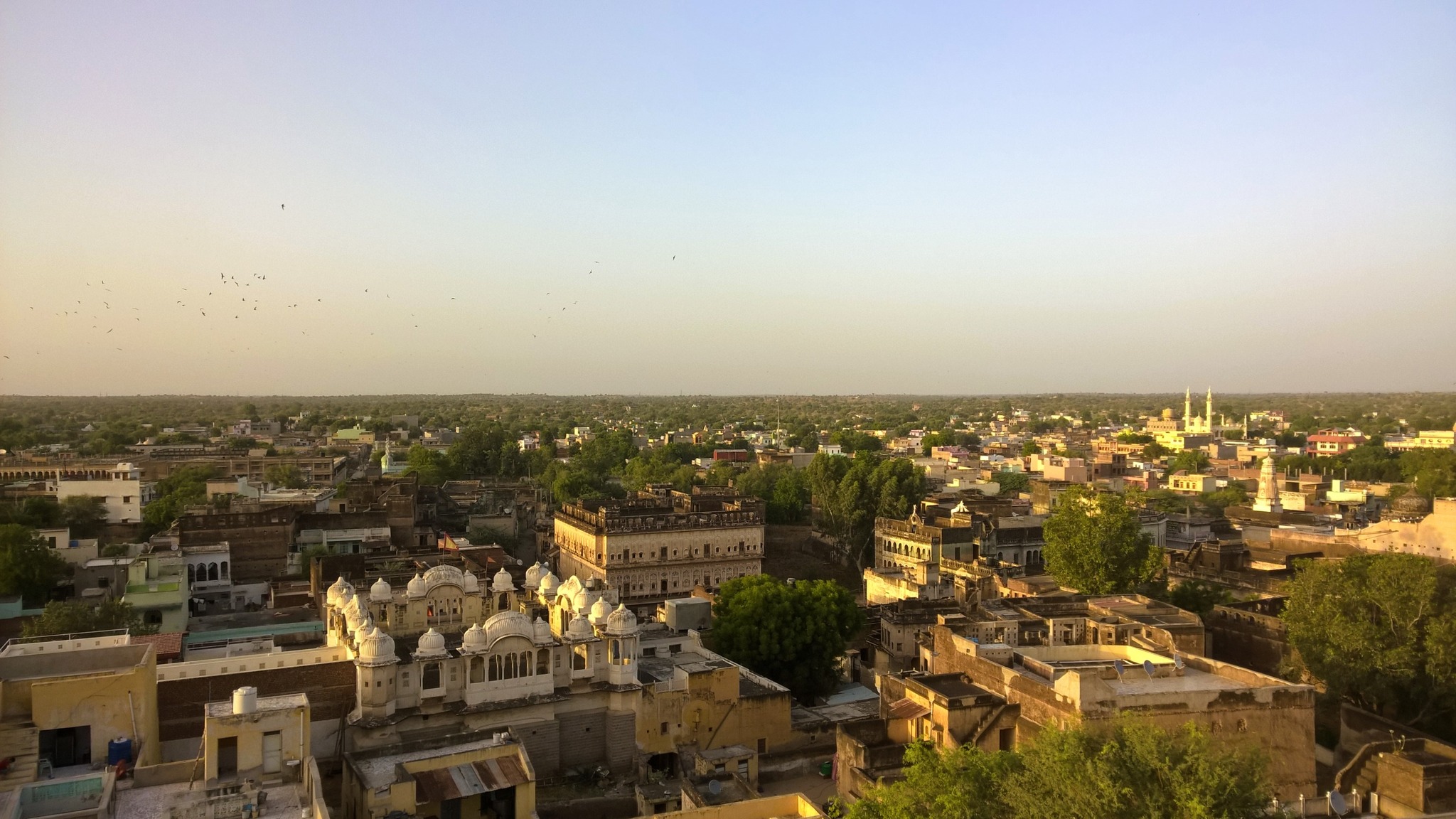
After the tour of the havelis, Chhutku bid us adieu at the Mandawa Castle, where we learnt the castle had long since been operating as a hotel, but was also open to tourists in lieu of a hefty fee. Nevertheless, we took the opportunity to see around the castle, get views of the town and the countryside from the rooftop, and take pictures around the sprawling swimming pool.
Entering the Mandawa Castle precincts
Skyline of Mandawa and beyond
At long last, darkness fell, and it was time to confront the dilemma of whether to stay the night or return to Delhi – it was resolved when we learnt that there was a 10 PM public road transport bus running directly to Delhi. Following dinner at a Tripadvisor-recognized restaurant, we boarded the bus, still not having got a bearing of where exactly we were located with respect to Delhi.
By 5 o’clock in the morning though, when I opened my eyes as we entered Delhi, I was still hungover from the overwhelming and intriguing air of the quaint town that stood astride the trading routes of the past. Although located amidst the barrenness of the desert, the unique vantage point of the town in those times ensured that its mien and ambience remained anything but barren.
Having done one solo trip every year for the last four years now, and with almost half the year already passed, I decided to schedule this year’s solo trip on my birthday in early July, and booked a train ticket two weeks in advance to Abu Road by Rajdhani Express, to see Mount Abu, a place lying on my wish list for a long time. In the week leading to my birthday which was on the coming Saturday, my friend from college who lived near Rewari, called me up asking about my birthday plans, and I invited him to join me. So, booking a waitlisted ticket on the same train, he boarded the train at Gurgaon railway station, from where we shared a single berth till our destination.
Getting down at Abu Road around 5.30 AM, we caught a public transport bus for Mount Abu. As we ascended through the hill road, we were immediately swimming in a cover of green, with an abundance of date palm trees dotting the roadside. As we gained height, I saw, through my sleepy eyes, that we were submerged in the infinite clouds of mist or actual rain clouds, which was it I am not sure. As we approached Mount Abu town, trying very hard to keep awake, I was taken in by the sight of ponds surrounded by denser forest. The many times I forced myself out of my sleep to see the scenery outside, I was reminded of my the scenery on the way to Ooty and Kodaikanal on my college trips.
At Mount Abu town, after quickly checking in to a hotel room, we set out for a South Indian breakfast at the city centre. Then, renting a scooter, we set out on the tour, the planning for which my friend entirely left to me on account of it being my birthday. So, we started off with the famous Dilwara Jain temples, the temple that had been synonymous with Mount Abu for me since I was in school, where I had read about the temples in textbooks. The Dilwara Temple complex comprise five primary temples made purely from marble, with two dedicated to Adinatha, the first tirthankara, and the other 3 dedicated to Neminatha, Parshvanath and Mahavira, were built in between 1026 AD and 1582 AD, and serve as an important pilgrimage for Svetambara Jains.
Entrance to the Dilwara temple, photography inside the temple premises is not permitted
Next, ascending further up the hill road, negotiating mumerous hairpin bends, passing by ponds and patches of forests, we reached Achalgarh. At Achalgarh, climbing up a stony road by foot, we reached the marbe-built Shri Vishnu Jain temple, which also provided breathtaking views of the Aravallis. From there, we rode further up to Guru Shikhar, where we climbed the long flight of stairs to reach the highest point of the Aravallis at 1722 metres. Nearby is the Mount Abu Infrared Observatory (MIRO), which is visible from Guru Sikhar and nearabout, along with green cover on all the nearby peaks and troughs of the Aravallis.
View from Achalgarh fort
View of the Mount Abu Infrared Observatory (MIRO) from Guru Sikhar
Turning back towards Abu, we stopped whenever some view or location caught the eye, the first such stop being at Lover’s Point, from where we got a picturesque view of the Aravallis nestling the Javai Lake. Then descending a little below after manoeuvering a few curves, we reached Javai Lake itself. Rolling further down, we came upon a water-filled fissure on our right side, where getting down, I sat on the rock for a while experiencing an extraordinary state of calm. A little further, we took a short detour to reach the Mini Nakki Lake.
View of Javai Lake nestled in Aravallis, from Lover’s Point
A chance discovery in between Lover’s Point and Javai Lake
The stop that we made next was at the remarkable Trevor’s Tank, an artificial waterhole, tucked away in the Mount Abu Wildlife Sanctuary, which we reached after taking a kilometre-long diversion. Carved on the side of a barren rocky hill to breed crocodiles by a British engineer after whom it is named, the tank is surrounded by native flora including an abundance of cacti and ferns. The location of the tank could serve both as a picnic spot with family as well as a retreat for some solo contemplation. A trek up the hillock also provides a wider view of the picturesque tank. While this place may not be on most sight-seeing itineraries of Mount Abu, I highly recommend a detour to Trevor’s Tank.
View of Trevor’s Tank
View of Trevor’s Tank through the ferns
View of Trevor’s Tank from the adjacent hillock
As we neared Abu town, I made a quick but steep and long climb up 360 steps to see the temple of Arbuda Devi, a form of Durga, after whom Abu town is named. It being 6.30 PM, by the time I descended from the temple, we rushed to the Nakki Lake, located at the heart of Abu town. Swami Vivekananda lived for a while in Champaa Caves on its bank, and Mahatma Gandhi’s ashes were also immersed in its waters. On the hillside, which gives excellent views of the town as well as of the Aravallis, there is also natural rock formation resembling a toad, aptly named Toad Point – interestingly, the same rock looks like a tortoise when viewed from another angle from afar. After watching the sunset from the banks of Nakki Lake, I retired to the hotel, where my friend who had skipped the trek up the Nakki Lake hillside, joined me.
Evening falls on Nakki Lake
Toad Point on the hill beside Nakki Lake
The toad looks like a turtle from another angleChampaa caves where Vivekananda lived
Sunset on the Nakki lake
With our whirlwind Abu tour coming to an end, we pondered about how we would get back to Delhi, as I had not booked a return ticket, and had reckoned I would be easily able to get a bus back to Delhi from Udaipur, which was the nearest city to Mount Abu. As it turned out, there were only a couple of buses plying from Mount Abu to Udaipur, the earliest being at 8.30 AM. Thus, the next morning we were headed to Udaipur, again passing through the mist, delighted by views of the hillside shrouded by clouds at eye-level. Sights of streams and ponds ensconced in thick vegetation or surrounded by palm trees, were the icing on the cake.
Floating through the clouds…on a bus, on the way down from Mount Abu
Reaching the base of the Abu hill range, the bus still passed through the lower ranges of the Aravallis, especially as we approached Gogunda, where the sight of the yellowish sides of the hill which had been cut through to make way for the roads, triggered some sort of a reaction in my brain. That is the exact moment I knew I would want to have more of the Aravallis – these sights combined with the images of the flora I had seen back on Mount Abu, and the previous year in Jodhpur, supplemented by memories of the hill passes at Haldighati, struck a chord somewhere in my heart. What was more, the Aravallis propped up the fantastic forts that I had taken a penchant for over my journeys to Rajasthan over the last four years.
****************
So, for the third year straight, I found myself in Udaipur. I drew up a quick itinerary for us as it was my friend’s first visit to Udaipur. Starting off with a tour of the City Palace, we headed to Sajjangarh Palace, a monsoon palace whose construction was started by Maharana Sajjan Singh in 1884, atop a hill overlooking the Pichola lake. The marble palace is an ideal getaway from the humdrum of the city below, and also affords panoramic views of the city and its lakes, along with picturesque views of the Aravalli hill range behind it. We wrapped up our half-day sojourn at Udaipur with a boat-ride on the Fateh Sagar Lake.
View of Sajjangarh Palace
A portion of the palace as seen from the courtyardView of Aravallis through a window
View of Udaipur city, Fateh Sagar lake (left) and Pichola lake (right) from Sajjangarh Palace
A boat ride on Fateh Sagar lake
Following dinner, we took an overnight sleeper bus for Delhi, concluding a most memorable birthday weekend. I also found a new love – the Aravallis.