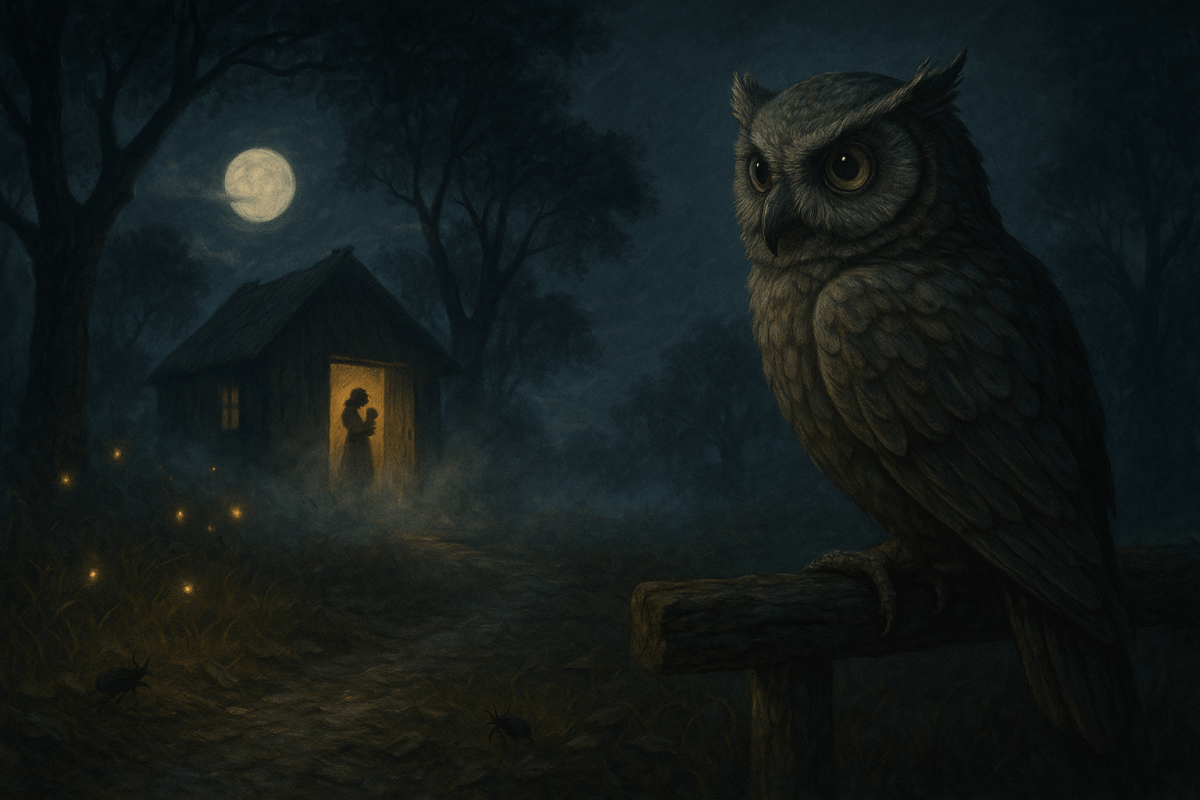
Uncle Owl with wizened head Stared long and hard with abyss eyes, Dark ’twas – the hour of the dead, As dew dripped below fireflies, Quiet answered to crickets’ cries.
Creak of a door broke it all, Mist quivered to yellowy gleams- Leaves rustled beneath the footfall, That slid along the earthy seams, Clambering up the wooden beams.
Uncle Owl with abyss eyes Spied stoic as a stone each night What the night’s forces did reprise, Without fail, to moans of delight And chuckles bursting from inside.
‘Tis been the story all along, The strange visitations meanwhile, Have turned his hair grey since long, But what transpires in truth inside Has left him none the less senile.
One gunshot ended it all, Uncle Owl fell limp to the ground; There he lay right at the footfall, With frozen image on eyes round- Of baby to Mother firmly bound.
Darkness was her cover, And silence, just a close friend, The winds ever drove her, By the night’s gloomy bend; Some say they spotted her, But they are not really sure, What spirit rode with her, Is still to them all obscure.
Nay, she wore no white gown, But the colours of the storm, And she wore one wide frown, Scarier than is the norm; She whizzed away through town, Her gaze met nobody’s eyes, Those that tried she ran down, With a stare colder than ice.
Mysterious, how she looked, At the night with face so red! What deep in her mind cooked, What paths she proposed to tread? Suspicious, when she looked, At people talk so unsure, She trusted none, nor brooked, None’s ill-advised overture.
(I say : )
Darkness is your cover, With your silence standing out, The winds drive you ever, They only speak roundabout, They swirl, they twirl, like tides, But reveal not who you are, What spirit in you rides, Remains a mystery so far.
Now, you should see my heart, Racing, as the aura spreads, My eyes are aching hard, Tracing the ends of the threads; You whizzed away past me, Really not meeting my gaze, Though I try I don’t see, How you manoeuvre this maze.
Mysterious, why you look, With fire burning in your eyes, Mysterious, how you look, Beneath graveness’ disguise; Mysterious, what you think, Inside caverns of your mind, To each mysterious thing, The answers I want to find.
It was half past one in the night, and Abhineet, a lonely silhouette of a figure with his half-empty, slightly worn mini-backpack slung from his shoulders, ambled straightly along just below the sidewalk. The constant clacking of his thick-soled hiking boots was only intercepted by the drone of the occasional vehicle whizzing past him.
Only minutes ago, he had stepped out of the multiplex, with the imagery of John Wick Part 2 swarming in his head. In fact, he had wondered, ‘What would John do if he needed to get somewhere and there was no public transport? Perhaps, John would break into someone’s car or snatch a motorcycle from an unsuspecting rider…if he had to get somewhere in a jiffy.’ Abhineet’s life did not warrant such urgency, though, at the moment. Nor did his monetary situation encourage the desire to hail a cab. After a brief evaluation of his options, he had decided to set by foot.
The road that ran through this part of South Delhi was bright but wore the desolation of a countryside highway. On his left, the string of malls shone like pearls, by the courtesy of the high masts standing tall on their spacious courtyards, whereas on the other side, the outlines of the Khirki Village rooftops formed a jagged boundary separating the cold concrete below from emptiness merging into the skies above.
Not that the smoggy air afforded a view of the stars, though, and soon, the fusion of matter and light fading into black seemed to resonate with what he felt inside. As he eyed the trajectory of the tip of his own shadow, cast unusually longer due to the distance between the streetlights, he felt taller than he really was, and his chest instantly swelled with pride at his sense of self-reliance.
This pride, he reckoned, was justified, for his self-reliance had been driven by years of living alone – if he was allowed to overlook the fact that his daily supply of meals was serviced by a hired cook. Often though, when his pursuits, however vacuous, came to naught, he would lug his backpack on his shoulder and set off on solitary wanderings with no motive but to float in the comfort of his own company.
One such solitary wandering had led him just two months earlier to Khajuraho, where a scooter-ride fuelled by a mixture of the sense of self-reliance and perhaps, a tinge of arrogance, had ended in tragedy. Limping, in fact, almost dragging a nearly disjointed shin and a shaky knee, and drowning in a mire of painkillers, he had made his way back to his modest tenement in Safdarjung Enclave in South Delhi. Needless to say, his recuperation, including the solitary painfully wobbly visits to the doctor, was a vindication of his belief in his own abilities.
No wonder, then, that on this day, Abhineet felt no need to depend on hires. After two months of religiously taking his medicines and performing knee-strengthening exercises, tending to his wobbly leg, he felt sufficiently prepared to be walking to his place, no less than seven kilometres away. He knew in his heart how he had managed to shake off any outward indication of his recent affliction, and the thought of it infused his stride with a haughty confidence. Moreover, two decades of living away from his hometown had perhaps instilled the right amount of freedom in him to do as he fancied – even if that meant walking alone in the middle of the night with only a modicum of life in sight around him.
Suddenly, the tell-tale whir of a vehicle grew on him from behind. He immediately knew it was a tuk-tuk. The pitch rose until he could feel the vibrations wrought by the machine behind cause the hair on his arm to flutter, and he was instantly reminded of the tyranny of the tuk-tuk drivers, especially at night. ‘There comes another leech’, he thought. He decided he would let the tuk-tuk pass, for, he had to live up to his notion of self-reliance. Besides, would not the tuk-tuk man be the typical ‘looting’ type who spared no opportunity to fleece him, given the time and desolation around?
He sensed the tuk-tuk slowing, and he knew he had to steel himself so as to ignore it. As the tuk-tuk rumbled past him, he saw from the corner of his eye the driver taking a long hard look at him, as if soliciting, even as the vehicle’s speed slackened.
‘Oh, man, not what I wanted at this time!’, he muttered under his breath. He wanted to march on, reinforcing the steely resolve he had sought to maintain. ‘Keep moving, dude! I am not falling prey to your extortive machinations, at least, not tonight.’, he thought. By then though, the tuk-tuk had stopped about twenty yards ahead – clearly, waiting for Abhineet to catch up.
‘Where to?’, the driver asked Abhineet as the latter drew level with the front partition of the tuk-tuk where the driver sat. Now, despite what Abhineet had been thinking before this moment, he found himself responding to the driver, ‘Safdarjung Enclave.’ Perhaps, it had suddenly dawned upon him that the real reason he had been meaning for the tuk-tuk driver to leave him alone was not so much about him wanting to reach home without anybody else’s help as it was about not wanting to be fleeced by a ‘greedy’ tuk-tuk driver.
Even so, the math circuits in his brain went into overdrive, quickly computing the price he would be willing to accept to pay. Tuk-tuk drivers were notorious for quoting at night prices that were astronomically higher than the fare the meter would eventually have thrown up. ‘If he refuses to charge by the meter, I will not pay a single paisa beyond Rs. 100.’, he told himself, fully expecting the driver to quote twice that much. Within seconds, he spoke tersely as if ordering the driver, ‘Go by the meter, else I am off.’ ‘Hop in’, the driver said. Upon boarding, Abhineet noted that the meter already showed a fare, but since it was merely worth only a couple hundred metres, he let slide the fact that the driver did not reset the meter.
And so, the tuk-tuk glid along, leaving behind hospitals and metro stations, closed shops and shut restaurants, a mosque and a gurdwara, passing now under a flyover, and flitting then past a shopping complex, when before long the wide roads made way for less wide ones which in turn led to lanes so narrow, made even narrower by parked cars, that only one vehicle could pass through. He was finally inside his own territory.
Abhineet had been eyeing the meter all along and the moment the reading reached the figure he had computed earlier, he asked the driver to stop, even though he lived a couple of lanes ahead. Hopping out, he drew out his wallet to pull out the exact amount of money he had had resolved to pay all along, when the driver said, ‘Sir, it’s okay.’
Abhineet looked quizzingly at him, and inquired, ‘Why?’ The driver responded, ‘Sir, actually I was on my way home to Chhatarpur which is in the other direction, but then from afar I had been observing you limping for what must have been a mile. I figured you were in trouble – I cannot accept money for helping a fellow human. Take care, sir, and try to avoid the outdoors this late at night.’ Abhineet stood there, his eyes transfixed on the rear of the yellow canopy strung over the green frame of the tuk-tuk with a banner of a prominent politician pasted on it, receding into the distance.
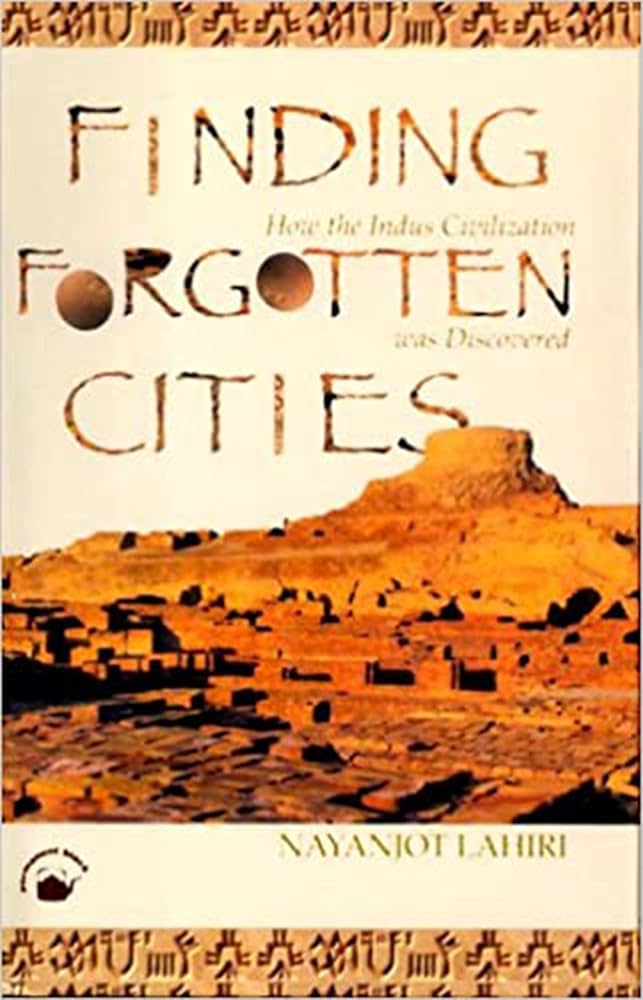
Finding Forgotten Cities is an exhilarating account of how Harrapa and Mohenjo-Daro were discovered and findings were pieced together to advance the case for the Indus Civilization for the first time in 1924, with ample attention given to all the major characters that played an indispensable part in the story.
From this account, the Britishers that were at the forefront of the Archaeological Survey of India (ASI), especially John Marshall himself, the Director General of the ASI during the discovery and, in fact, for a good part of the first quarter of the 20th century, seem to emerge as unlikely heroes, but for whose love and passion for the antiquities of India, the beauty and significance of portals to India’s past may have been lost to the sands of time.
At times thrilling, and at times exuberant, the narrative unfolds like in a novel, with interesting detours into circumstances within which the ASI had to work. I just wished there were more details on some of the people besides Marshall and Rakhaldas Bannerji. Also, modern colour photographs would have helped paint a more vivid picture. Sometimes, the narrative while being pegged in a certain year went forwards and backwards too often, thereby causing me to lose the base year.
Nevertheless, being enamored with the Indus Civilization since my childhood, I finally had the opportunity to be transported back to a time where I could be a fly-on-the-wall even as the ancient cities I was fascinated with were getting uncovered.
Highly recommended for history lovers in general, and Indus Valley Civilization aficionados, in particular.
Alighting from the Haryana Roadways bus at Hansi, 20km before Hisar, my first reaction was one of regret. It was already 6pm and I was circumspect about the situation I had gotten myself into owing to my mad uncontrollable urge to venture into the Harappan Civilization clusters in and around Hisar. But then I fired up Google Maps and walked towards the Hansi Fort. And am I glad I did!
Earlier that day, I had ditched the India-Australia World T20 Cricket final 10 overs in, when it became clear that India were going to be decimated. And still reeling from the after-effects of finishing the book ‘The Lost River: On the Trail of the Sarasvati’, I had packed a few bare essentials and taken a bus to Hisar from Gurugram bus-stand, with no itinerary in place, except for one pointer – get as far into the purported Sarasvati Valley as possible.
The only trouble was – I did not know how to get there. A colleague from the Hisar region had earlier dissuaded me from venturing solo into that area. In fact, he did not know about the Harappan sites around Hisar. It also didn’t help that there was little material on the internet pertinent to tourists addressing these Harappan sites.
So in Hansi as I walked towards the fort through the city’s old-fashioned streets, and passed through the Barsi Gate, I pacified myself visualizing Prithviraj Chauhan’s troops rolling in. The Fort would have been closed by 6pm as per Google – still, something kept me clambering up the hilly incline to the entry point of the fort, where I realized there was no closing time, and there were most certainly no closed gates. With the sun already down, I entered the final gate and presently came upon the fort enclosure set upon the plateau atop the hill. As the few remaining visitors retreated in the twilight, I started surveying the scattered structures.
By the time I was done, it was pitch dark and not a single soul was in sight. With my heart pounding, but my blood awash with adrenaline, I was leaving a subterranean long hall-like structure with nothing but darkness inside, when I chanced upon silhouettes of 3 people sitting near the roof of the structure. If I had any survival instincts intact, my first reaction should have been to flee. But I decided to approach them to inquire about the structure. And as it would turn out – all I had to do was ask!
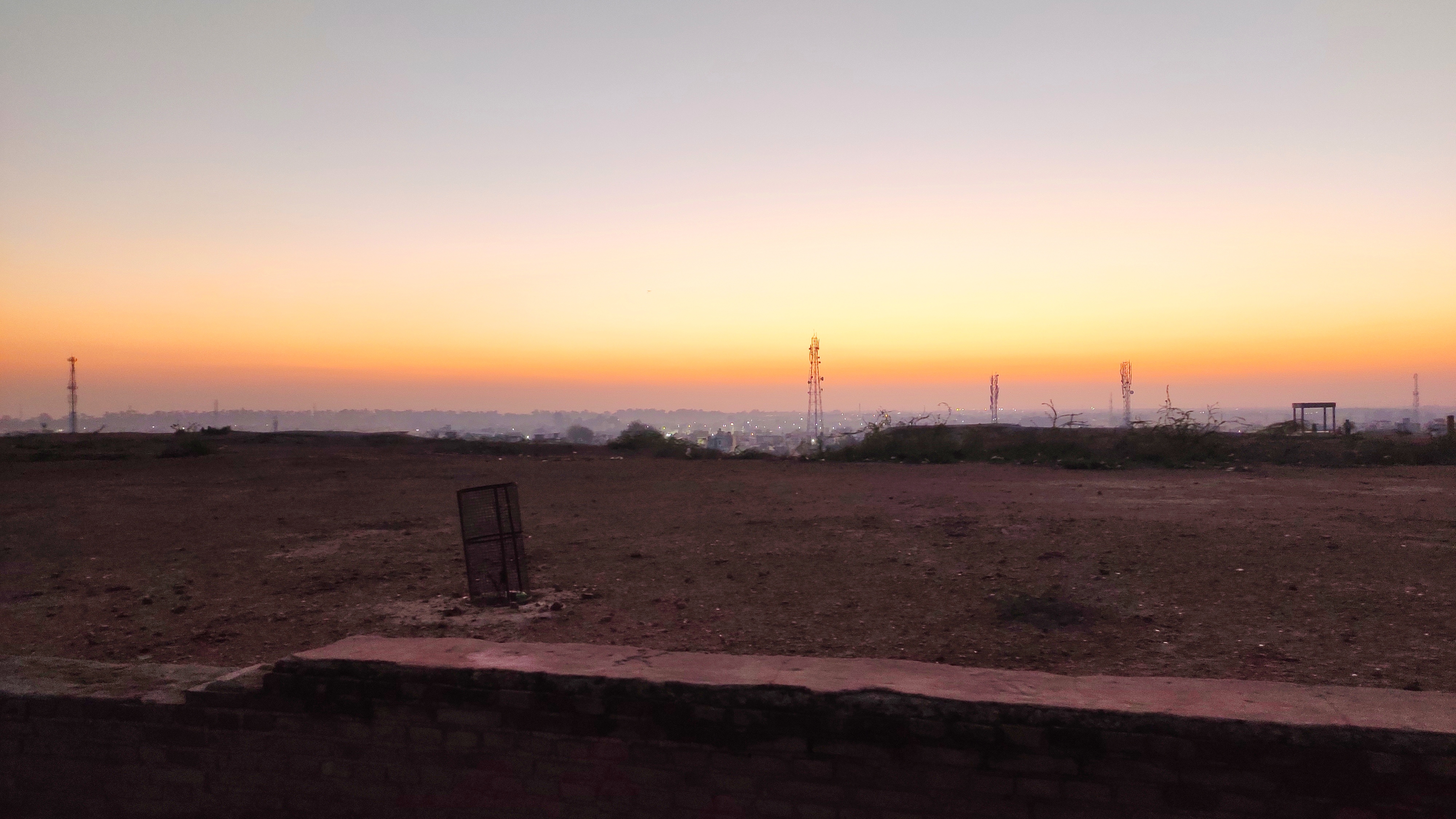
A view of the city from atop Hansi fort in the quickly engulfing darkness
They told me the structure was an erstwhile horse-stable, and as we spoke about the fort, they asked me as to what brought me to Hansi. I explained I had landed in Hansi since it would be the nearest hub to the Harappan sites, which I had been keen on exploring for a long time. One of these persons, who I learnt was from the Tehsil office, was so impressed with my motive that he assured me it was quite easy to reach these sites, especially Rakhigarhi, and he promptly gave me the phone number of a Mr. Ram Niwas, a Rakhigarhi resident no less! and local Tehsil official. He suggested I call him before I reached there.
So with an apparent lead in hand, I left the dark confines of the fort, illuminated with renewed hope of realizing my dream of setting foot on a Harappan site. I checked into an inexpensive lodge in front of the bus-stand, got little sleep from anticipation of the next day’s events, and woke up late! As I was stepping out after having a cheap quick breakfast, I beheld a bus headed to Jind already leaving the bus-stand exit. I ran in parallel to the driver’s window, asking in a scream if the bus was going to Narnaund. The bus slowed down, and I scurried around the front side of the bus and hopped onto it.
In 30 minutes, I was at Narnaund, where the diversion to Rakhigarhi originated. I called up Mr. Ram Niwas and in a short conversation comprising sentences alternating between pure Haryanvi from his end, and Hindi from mine, I only deciphered that he would indeed meet me at Rakhigarhi. I hopped onto a Scorpio that was carrying passengers headed to Rakhigarhi, and following 20 minutes of riding on a well-laid road, squeezed amidst the village folk, I was standing at the main cross of Rakhigarhi village.
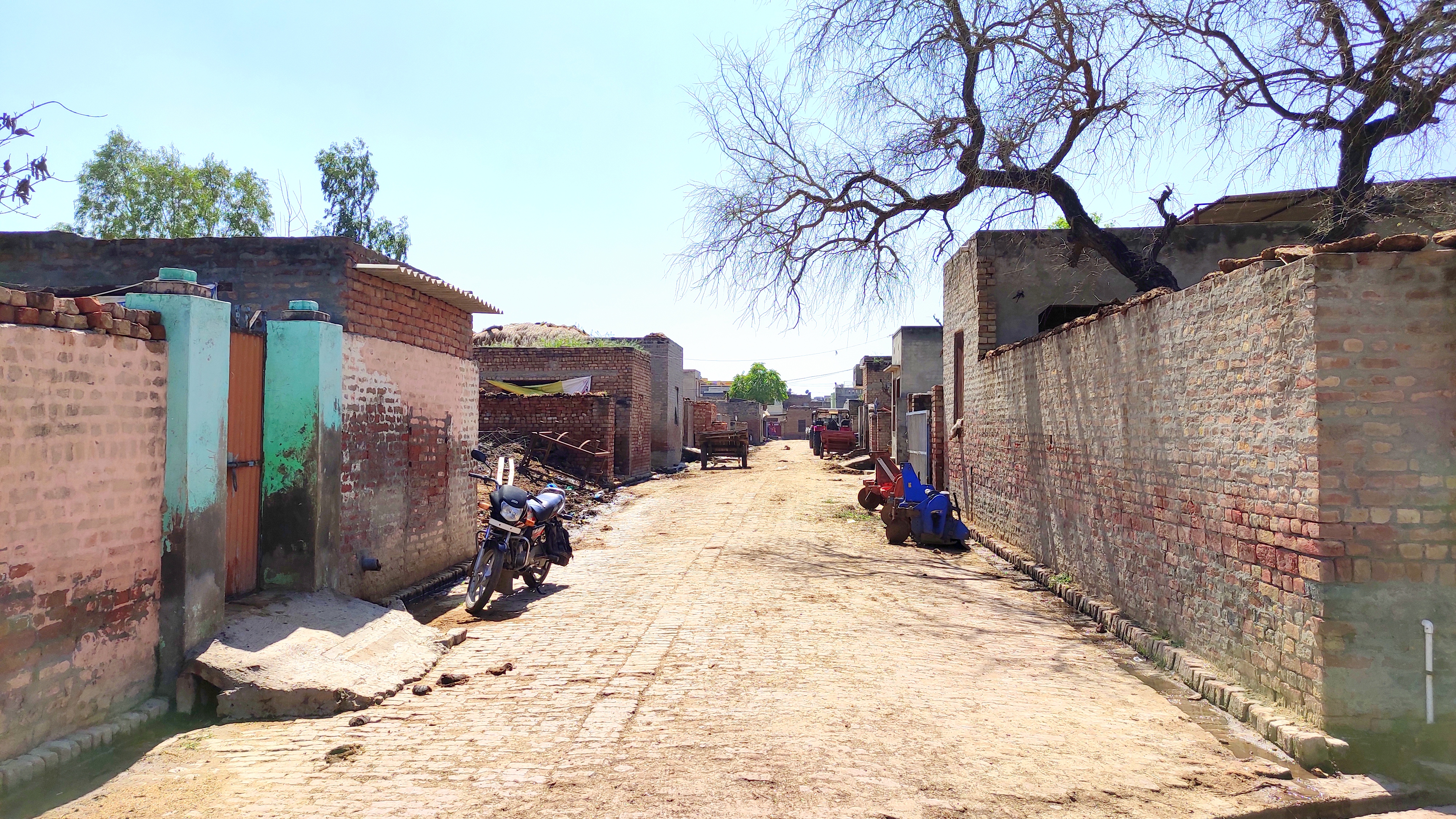
Thereupon, Mr. Ram Niwas appeared on a motorcycle. He was nothing as I had imagined. Ram Niwas ji is a lanky white-mustachioed soft-spoken elderly gentleman, somewhere in his late 50s or early 60s. After exchanging pleasantries, I rode pillion with him towards his home ensconced somewhere within the rows and rows of brick-walled houses. The brick-laid streets for the most part cut each other perpendicularly, and in places, were slushy from puddles of rainwater and patches of cow-dung. On some walls, cow-dung cakes hung drying in the sun. Neat open drains lined both sides of all the streets we traversed.
One of the wider typical Rakhigarhi streets
The route we took headed to the north, went up an incline and then sloped down, and I wondered aloud if we were on one of the Rakhigarhi mounds, to which Ram Niwas ji answered in the affirmative. As we rode further down the slope I could see two huge mud mounds before me, one straight ahead and another to its left, with iron fences delineating each from the other and from the village streets. Turning to the east for a short distance, we turned south again into a lane which again went up an incline and suddenly diverted towards the left and opened up again to reveal a couple of havelis large enough in comparison to the basic box-shaped brick houses below, of which one belonged to Ram Niwas ji.
In his quaint unadorned drawing room that opened directly into the lane, we had tea and introductions to other members of his family. Ram Niwas ji laid out the plan for the day – he would show me around all the mounds and the upcoming museum on his motorcycle, and get me to speak to somebody who would then be able to identify the mounds from the pictures I showed him. And then I would have to have lunch! To my perfunctory remonstrations, his gentle yet firm Haryanvi-laced reply was, ‘khaana toh khaana padega (lunch will need to be had).’
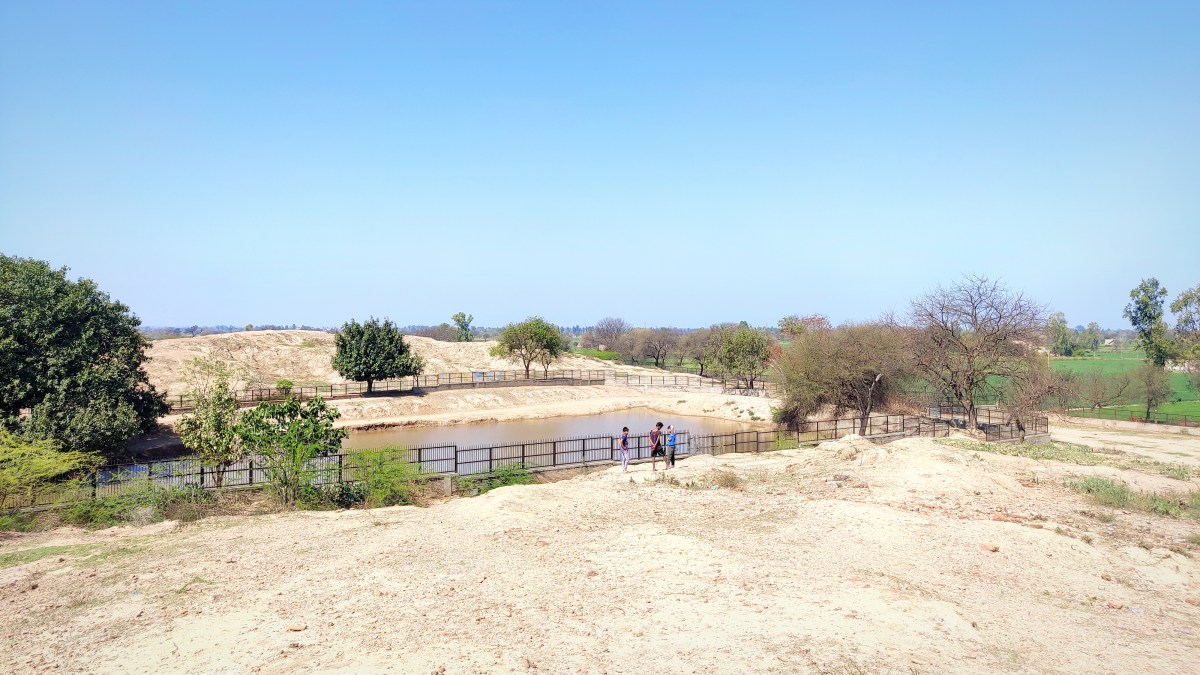
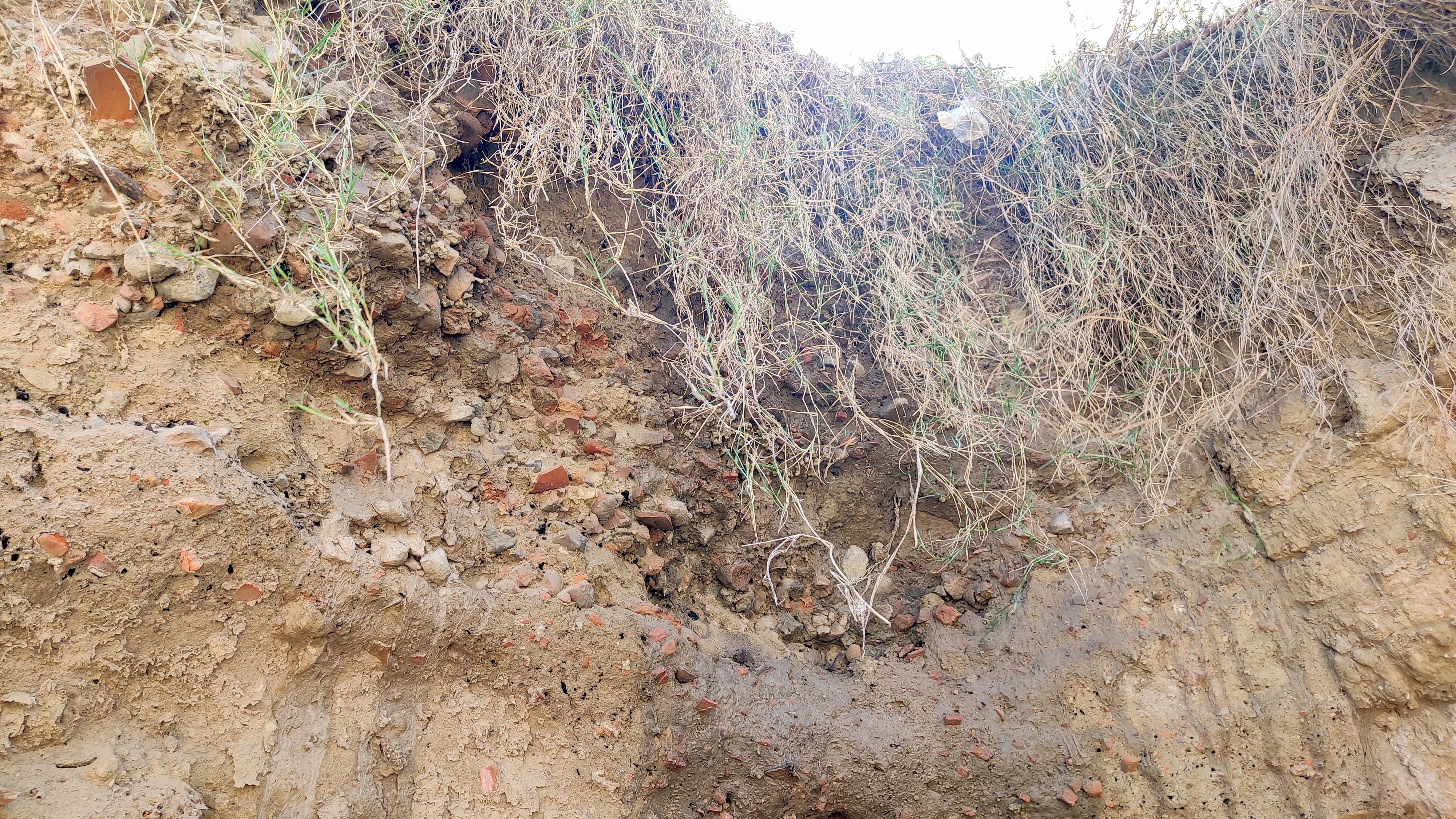
And so we went first to a mound (RGR-4) on the east side of the village where a street had been carved from one of its sides revealing the brick lining of an old Harappan structure. Taking pictures, we proceeded to the two mounds I had spotted earlier. We rode up the mound on the left first (RGR-2) upon which tall shrubs were growing and children were playing. I alighted and was taken aback by the continuous layer of pottery shards and little portions from bricks strewn across the whole surface of the mound. The mound must have been about 40m by 20m. Excavations done on this mound had been back-filled with mud on top of polymer sheets to enable easy stripping for display or exposure of the excavated parts in the future.
Old and new co-exist near this excavation on the side of Mound RGR-4Bricks of a Harappan-time structure revealed on RGR-4
I ambled across the northern side of the mound soaking in the energy of the place, transported to a day in the lives of our ancestors who inhabited the innards of the metropolis I was standing on at present. I zeroed in on a day sometime in 2500BC, where I walked through paved streets bustling with traders and carts rumbling along loaded with earthenware, and the air imbibing the fragrance of burning wood and food getting cooked in earthen ovens in the nearby brick houses. There I stood transfixed on the luscious grain fields down below, spread to the farthest my eyes could fathom, wondering if such fields stood at the same place back then or if they were now standing on metres and metres of silt deposited over more structures underneath. Ram Niwas ji told me the famous Rakhigarhi skeleton was dug up from somewhere amidst those fields.
Standing on Mound RGR-3 and looking at Mound RGR-2
Ram Niwasji with shards of ancient pottery
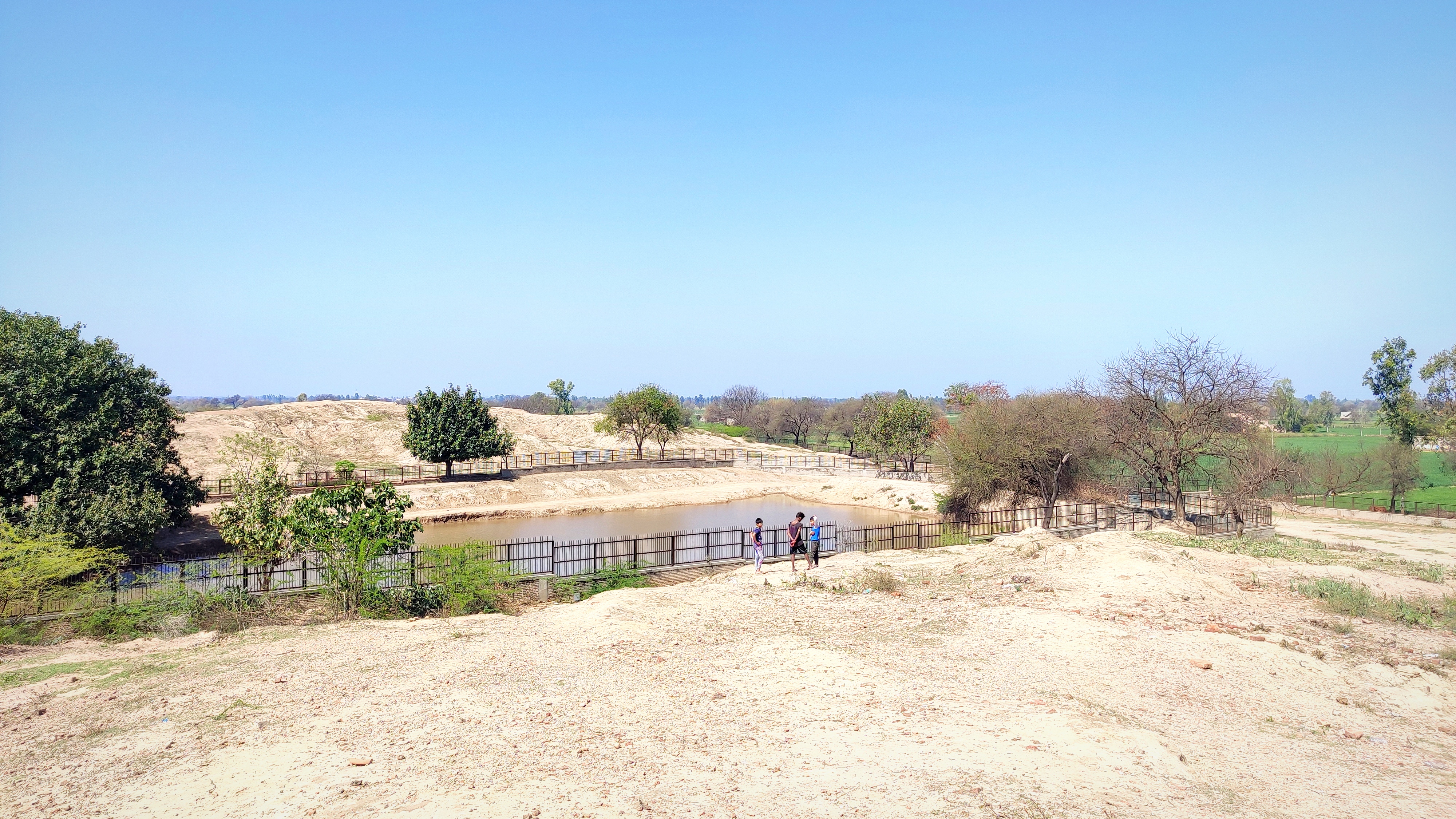
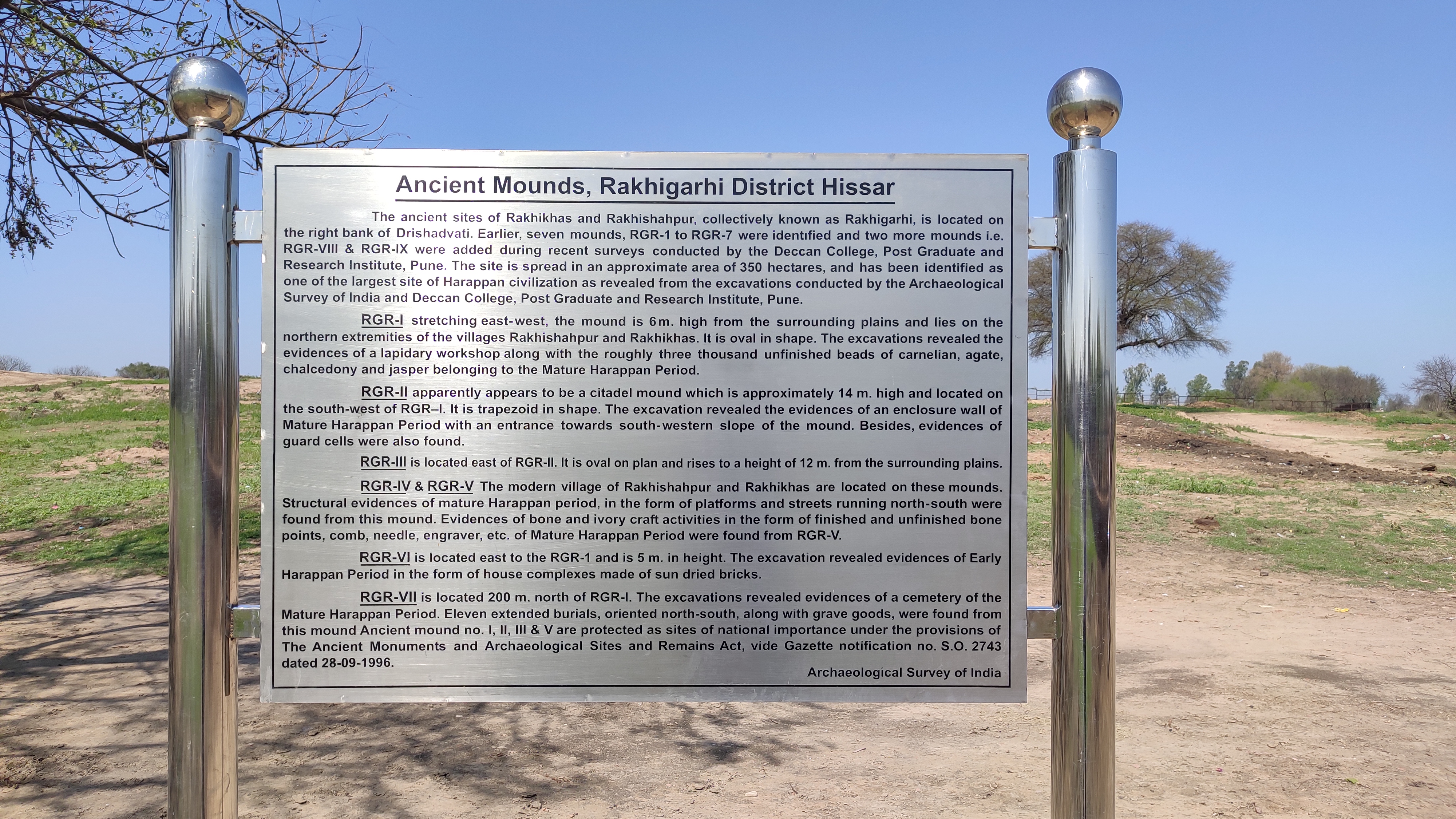
The mound to the east (RGR-3) was separated from the mound I was standing on, by a small pond of clear water. I walked my way to the top of RGR-3 where a small blue-coloured structure dedicated to a Pir saint stood. This mound too had pottery shards strewn all across its surface. We then rode further east to the mound (RGR-1) that had been excavated first. The same pattern of pottery shards and brick pieces strewn across the surface repeated, with the mound too having been excavated and covered up. It had other visitors besides us – a handful of Red-naped Ibises!
Signage at RGR-1, the first mound to be excavatedAn avian visitor – a Red-naped Ibis!
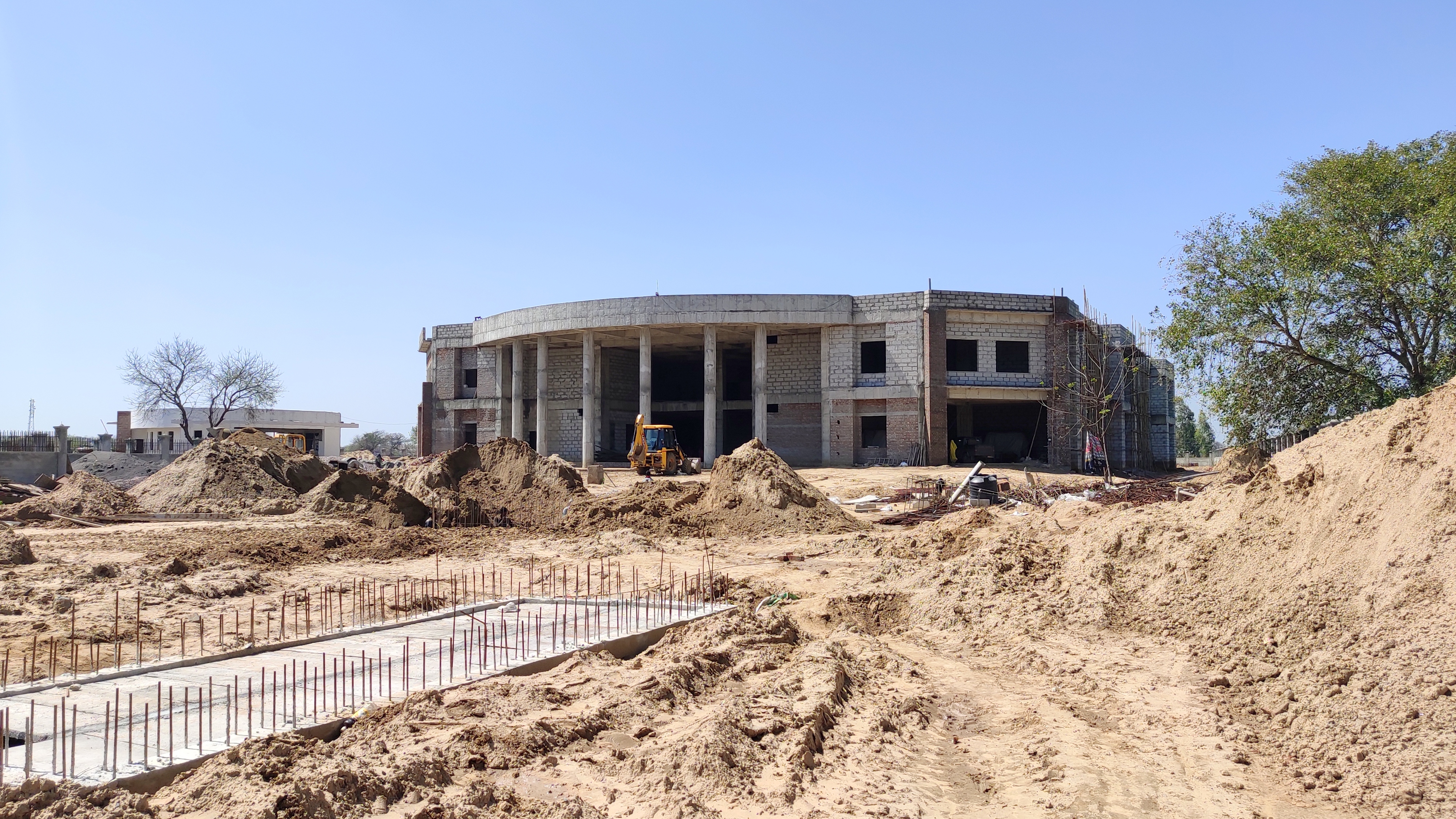
Moving further east and then turning to the north past a couple of clear-watered amply filled ponds, we got to the sprawling Rakhigarhi Museum, which is still under construction and is expected to be up-and-running in 2 to 3 years. Locals believe that once the Museum comes to life, and a settlement has been reached between the villagers and the Government with regards to the rehabilitation of locals whose houses are built on two major mounds, Rakhigarhi would be a major tourist hub.
The sprawling Rakhigarhi musuem under construction
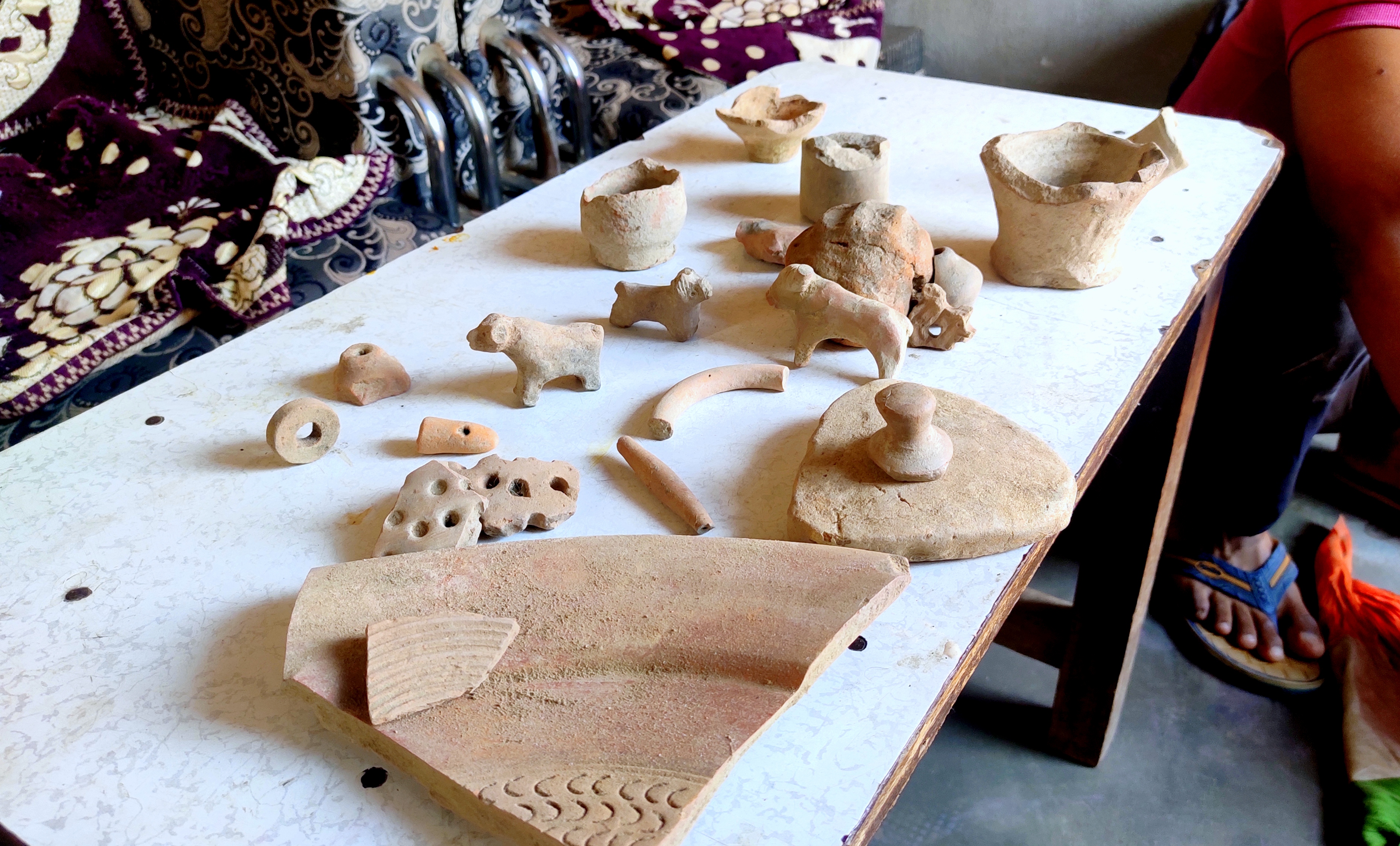
It was already 2 hours since we had been riding around, and once back at Ram Niwas ji’s place and after having a spartan yet filling meal of chapatis and raita, another surprise awaited me! Ram Niwas ji’s younger son, in his early 20s, took me to one of the rooms where a waist-high iron chest lay huddled in the corner. From there in, he extracted a cloth wrapped into a pouch and opened its knots to reveal several relics gathered from the mounds – terracotta toys including miniature animals such as the bull and the dog, pieces of pottery of different styles and a seal! He went on drawing out relic after relic – this cloth pouch being the figurative gift that kept on giving – until I asked him to stop. My glee upon being able to touch these pieces from the past knew no bounds – money couldn’t buy the preciousness of the objects I held in my bare hands!
Treasures from Harappan times – terracotta figures and earthenware
At last it was time to bid adieu. Ram Niwas ji vehemently refused to accept some money I offered as a token of my appreciation. I touched his feet and got into his car with his son, who dropped me back at Narnaund. From there as I retraced my way back to Gurugram through Hansi on a local bus on the wide smooth highway, I could not help but smile at the sight of the seas and seas of wheat and mustard fields lining both sides of the highway. Whenever I saw a mound-like elevation, I wondered if there were cities of the past buried underneath. Maybe I used to live in one of them.
Just in time for Christmas, the family set off on another ‘hidden gem’ heritage trail inside Odisha. This time we explored the Diamond triangle comprising three hill-based Buddhist hot-spots which flourished between 7th and 13th Century AD, namely Lalitgiri, Ratnagiri and Udayagiri.
The three locations set in low but sparsely populated hillsides or hilltops prove without doubt to be the most idyllic backdrop for a life of material detachment and quiet contemplation for the Buddhist monks. Consistent with Kalinga’s nature of acceptance and tolerance of all religious and spiritual dispositions, these spots display the syncretism of both the Mahayana and Hinayana schools of Buddhism.
Lalitgiri
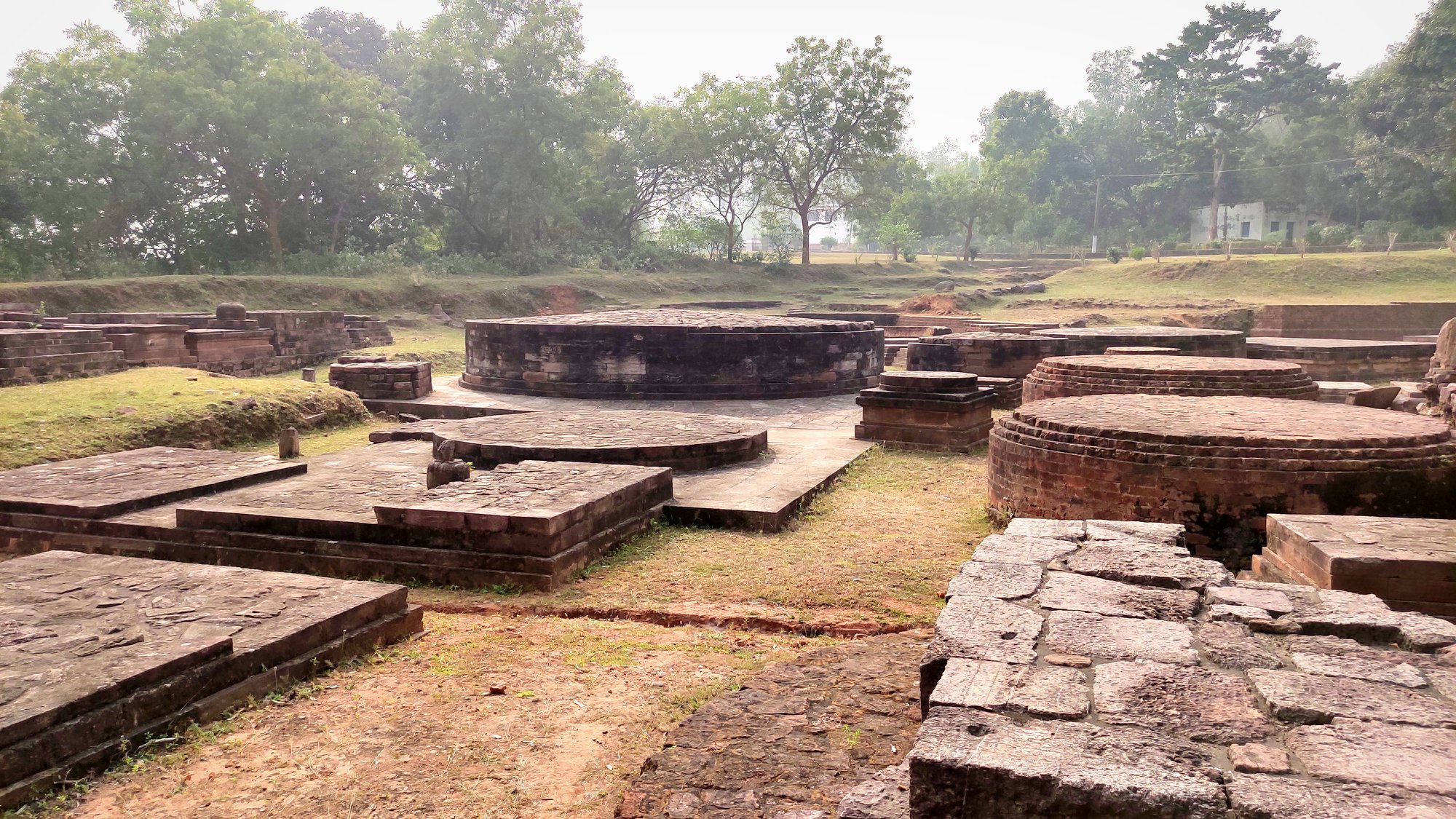
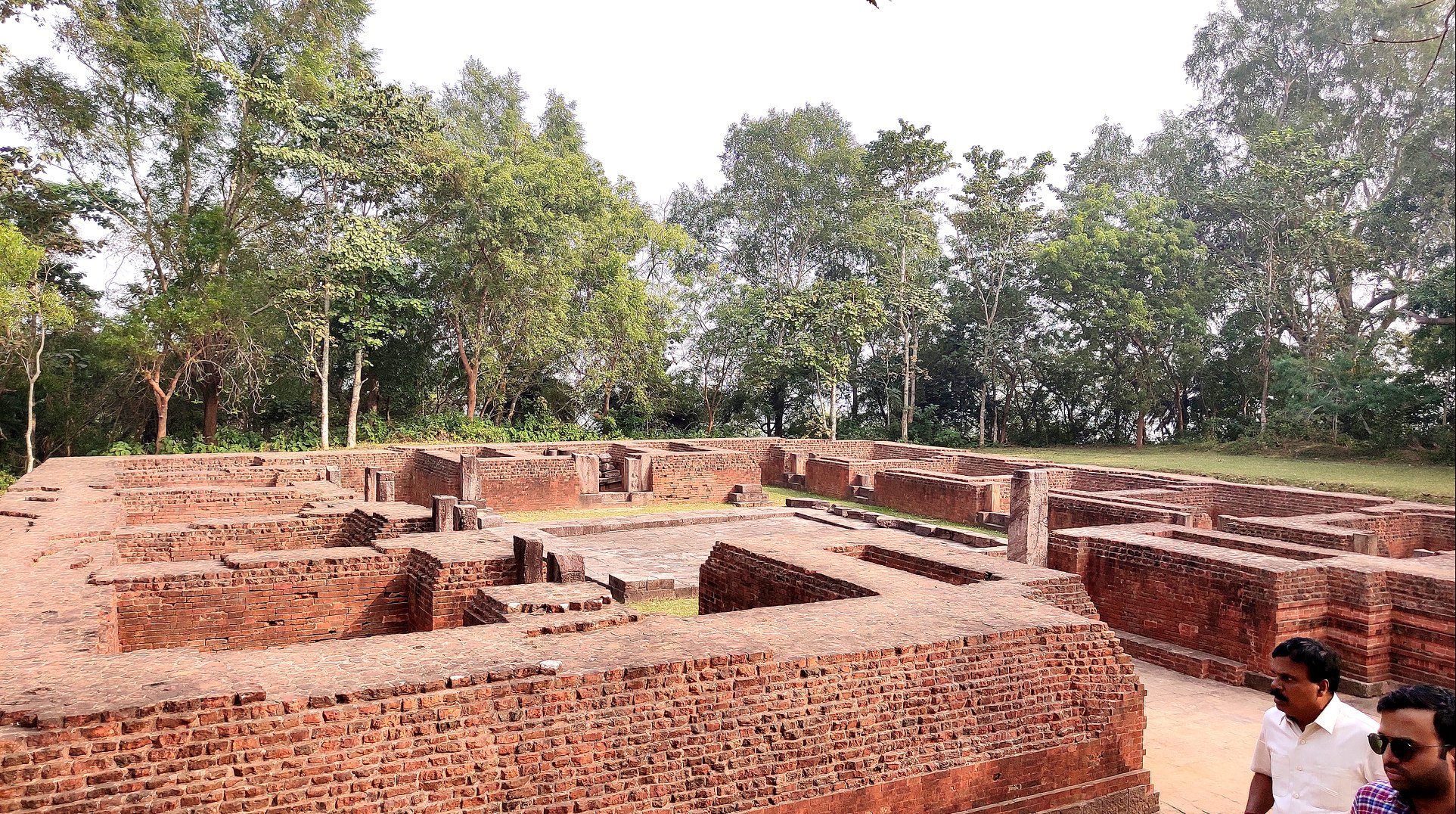
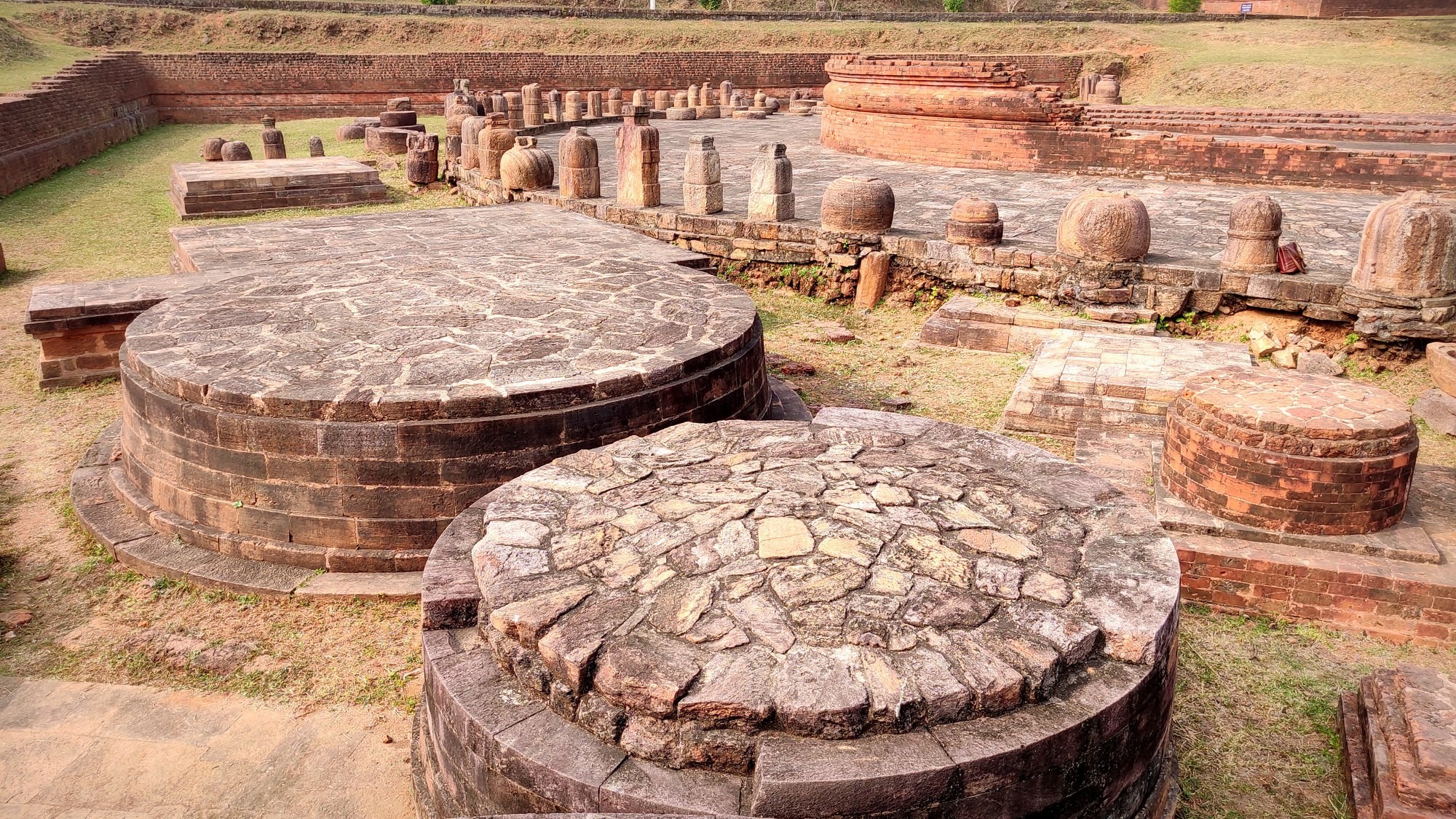
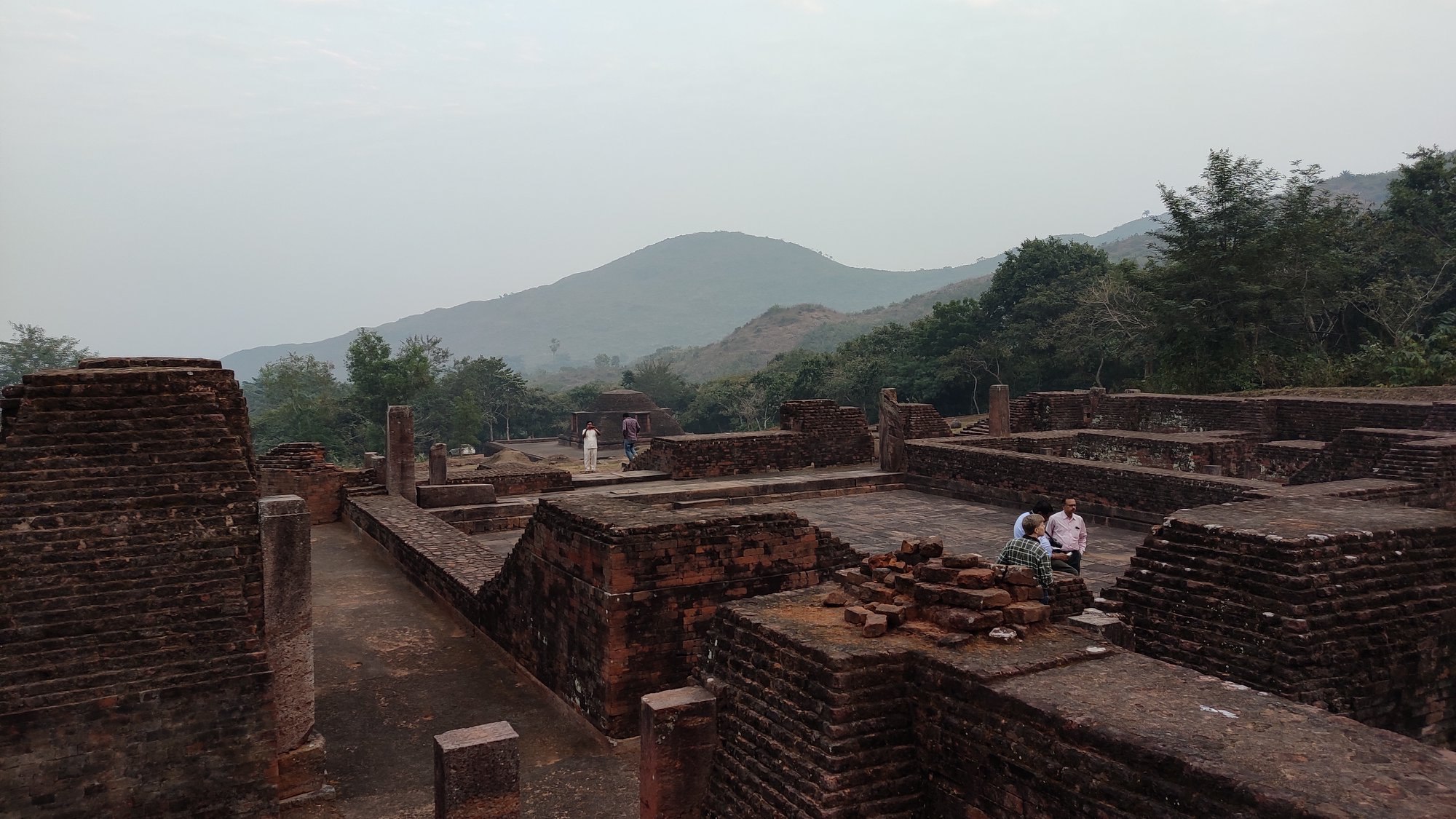
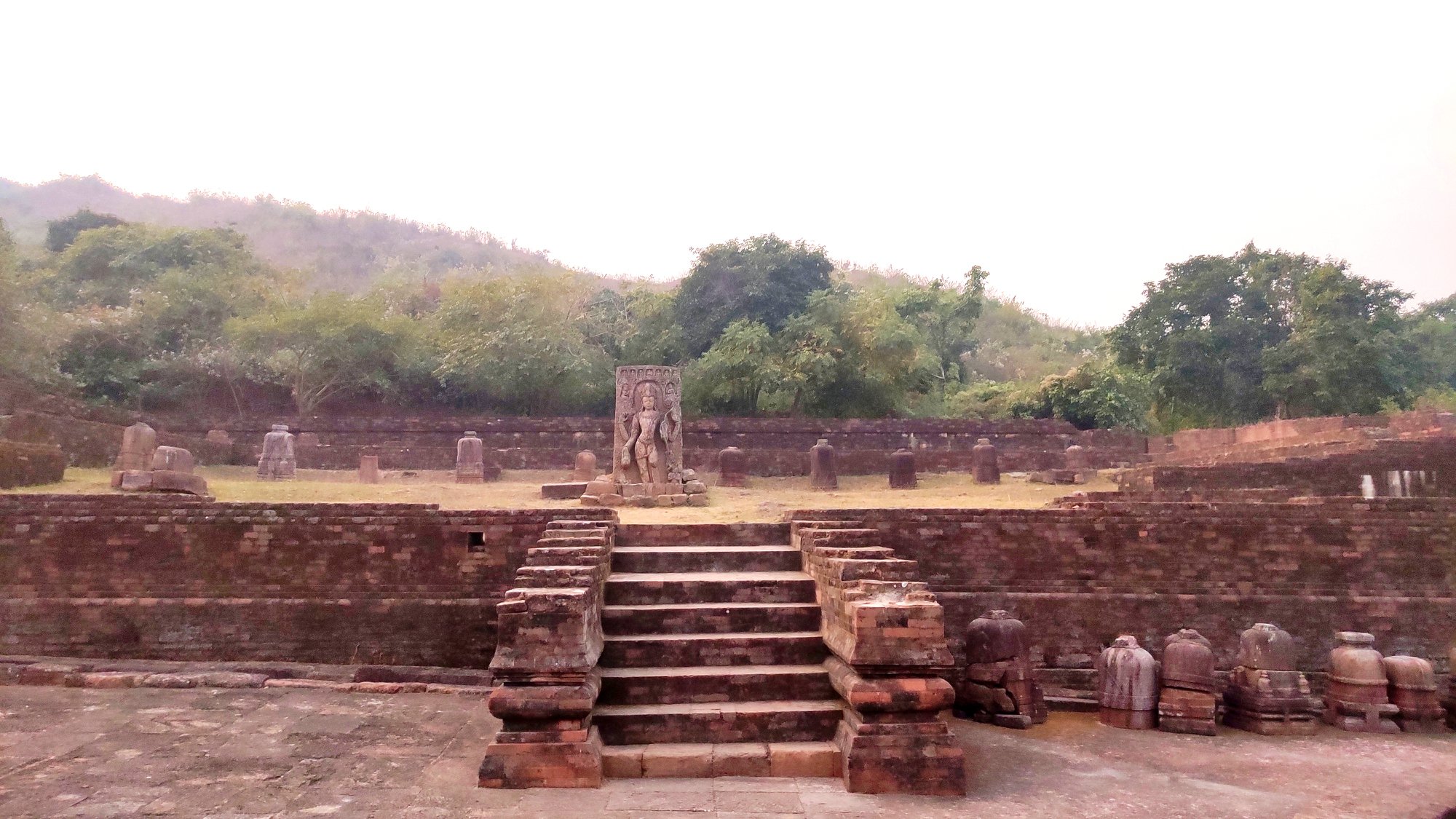
Starting off at around 9AM from Bhubaneswar, we first reached Lalitgiri around 11 AM via the Chandikhol-Paradeep road. After a walk up the hill on the wide metalled road, we first came upon the Archaeological museum which we deferred for seeing on our return from the trail. Walking further, we came upon multiple structures: Viharas (monasteries) in ruins – the monasteries dating from 9th to 11th century contained rooms, a chamber for holding a Buddha status – and a 6th-7th century Chaityagriha (prayer hall) with a stupa in the middle and several votive stupas strewn around.
Glimpses of the many monuments and surroundings at Lalitgiri
At the furthest end of the trail, atop another small hill, lay a lone relatively larger stupa, where two rare stone caskets containing relics of Buddha were found. The casket, made of khondalite, itself housed three smaller concentric caskets made of steatite, silver and gold respectively, with the innermost gold casket contain a piece of Buddha’s bone. These relics as well as well multiple sculptures, including those of the Buddha and Tara, are now displayed at the museum. All told, Buddhism is said to have prevailed at this site right from the post Mauryan period, i.e. 3nd century BC to 13th century AD.
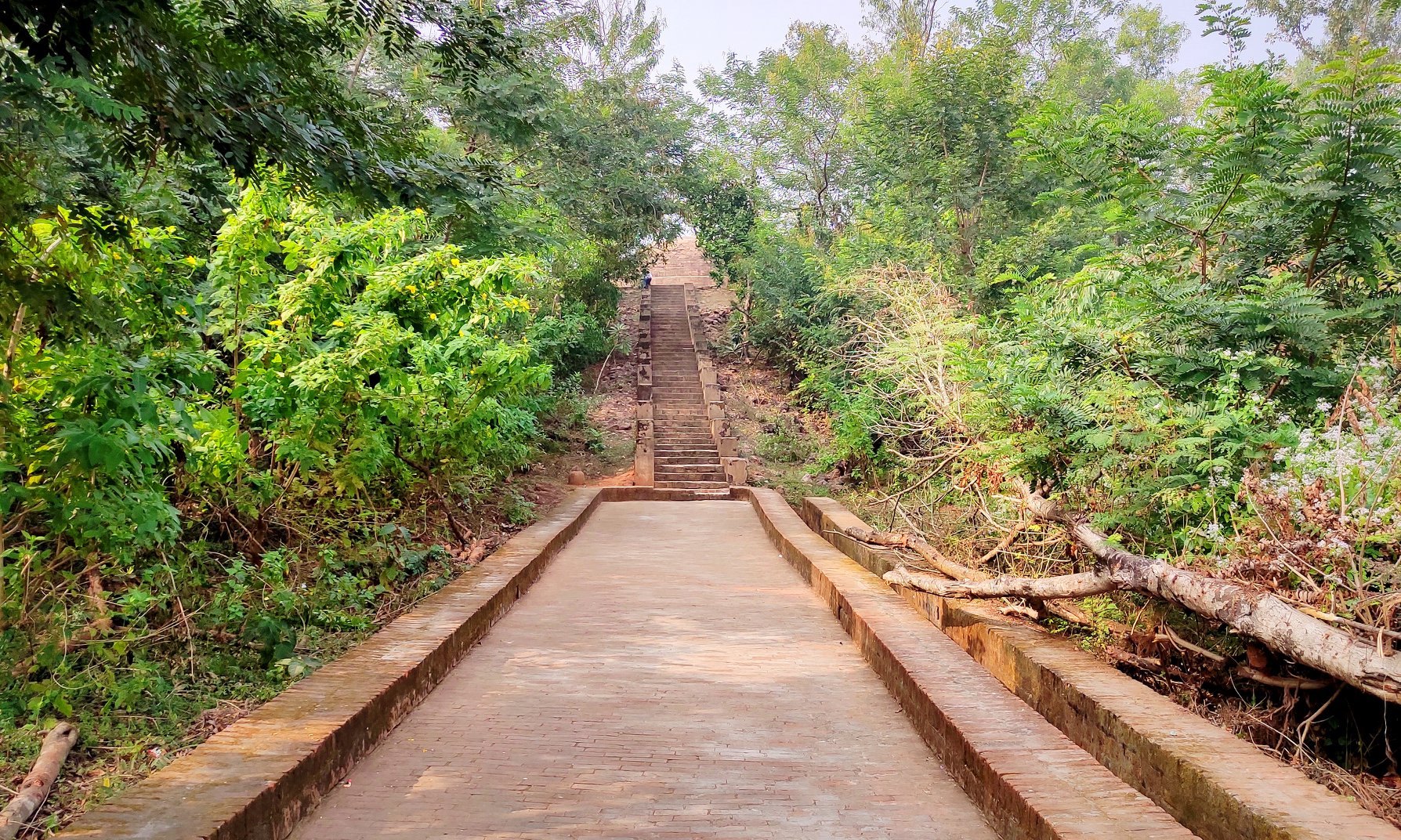
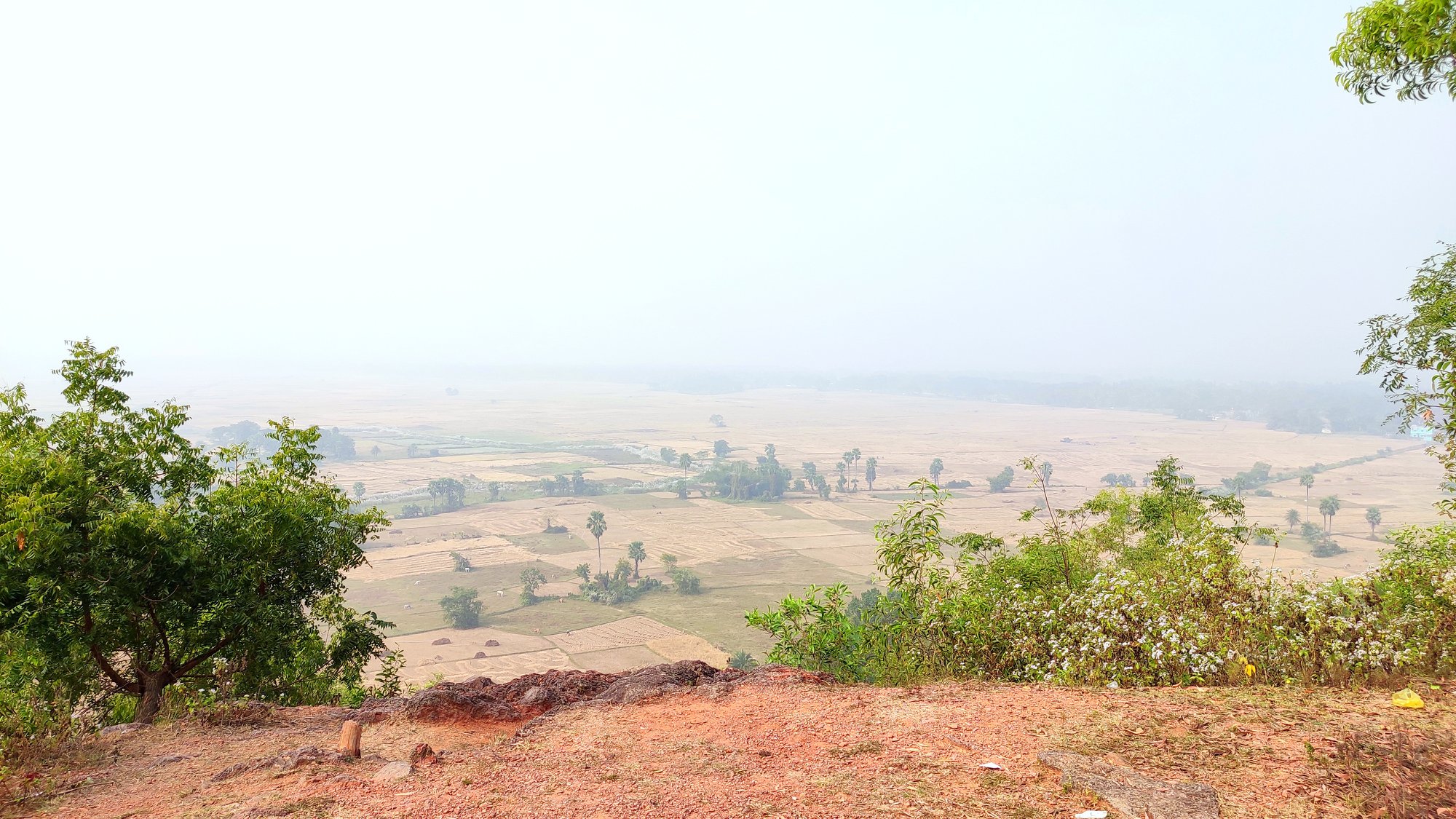
Approach to main stupaView of countryside from beside stupa
The main stupa where Buddha’s relics were found
Ratnagiri
Leaving Lalitgiri around 12.30 PM, we crossed the Brahmani river and reached Ratnagiri around 1.30 PM. Ratnagiri looked unique due to fact that the road to the monasteries and stupa lay in a pass between two crests of the hill, flanked on both sides with neatly manicured lawns. Here, we decided to first see the museum, where many relics and artifacts found at the site are displayed. However, what interested me more was the additional information displayed in various sections about the history of the evolution and dissemination of Buddhism and of other Buddhist sites in India.
Approaching the Ratnagiri hill
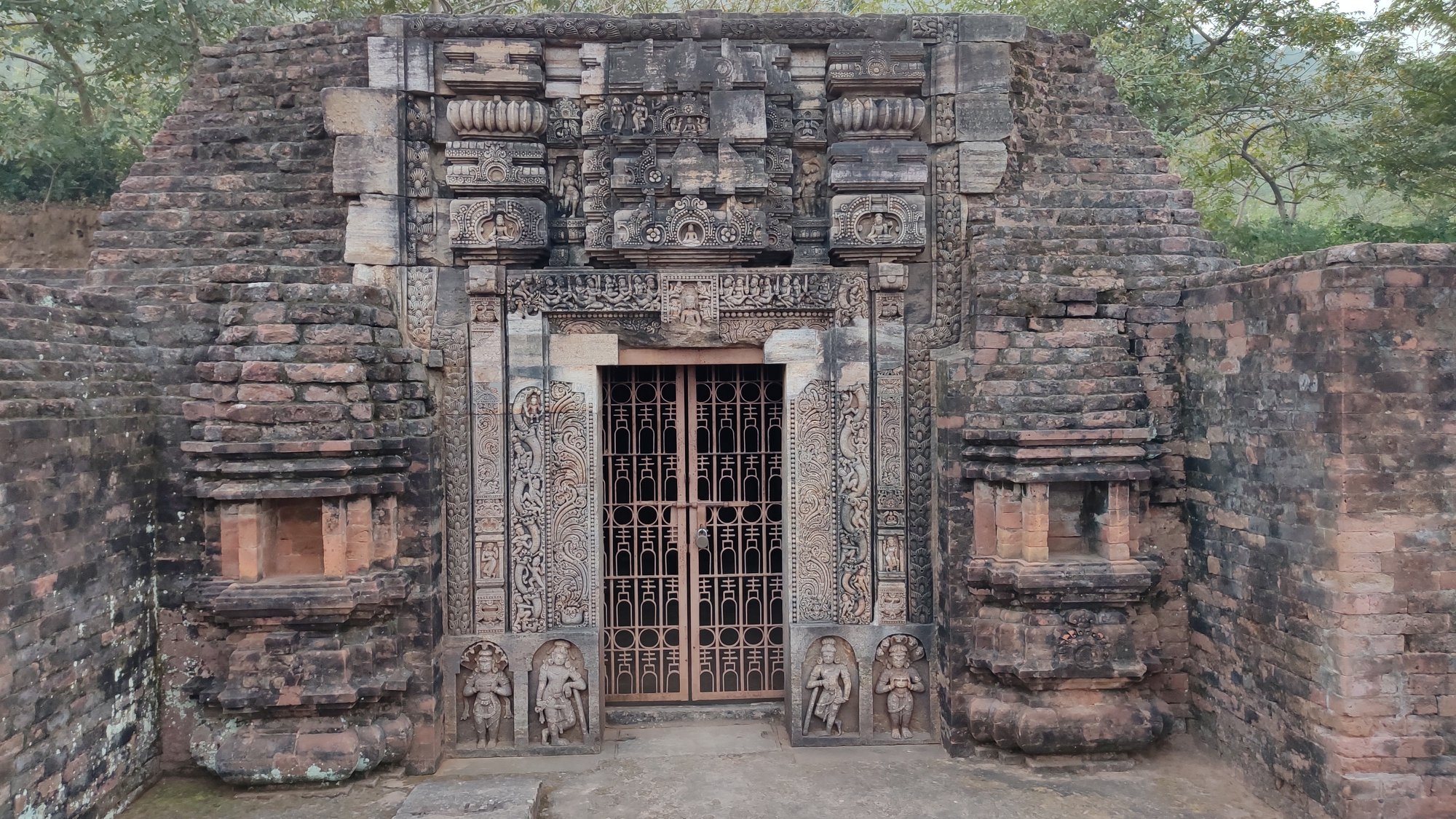
The exquisite entrance of a monastery at Ratnagiri
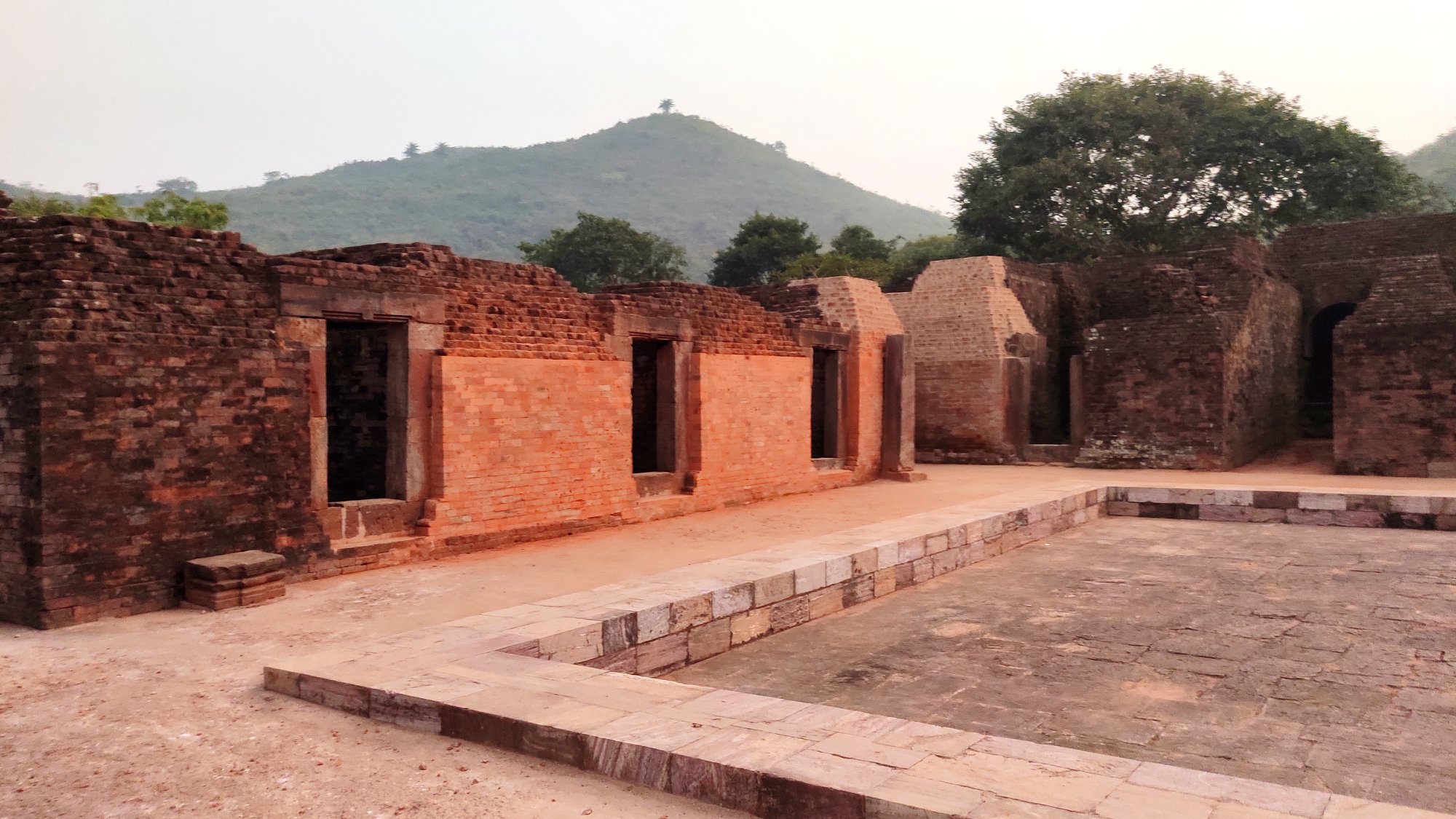
Inside the monasteryInside the monsateryGlimpses of monuments and surroundings at Ratnagiri
Walking up the hill, we were wowed by the iconic elaborately carved stone doorway at the entrance of the largest of the 3 monasteries, which could be dated to the 8th century. This monastery has a large courtyard with rooms surrounding the same, and a shrine for the statue of Buddha, at the wall farthest opposite from the main entrance. Besides this monastery, there are 2 smaller monasteries, and a 9th century stupa, surrounded by smaller votive stupas. Beyond all these structures, is the Mahakal Temple, built over an earlier stupa, and recently relocated to its current location by the ASI.
Udaygiri
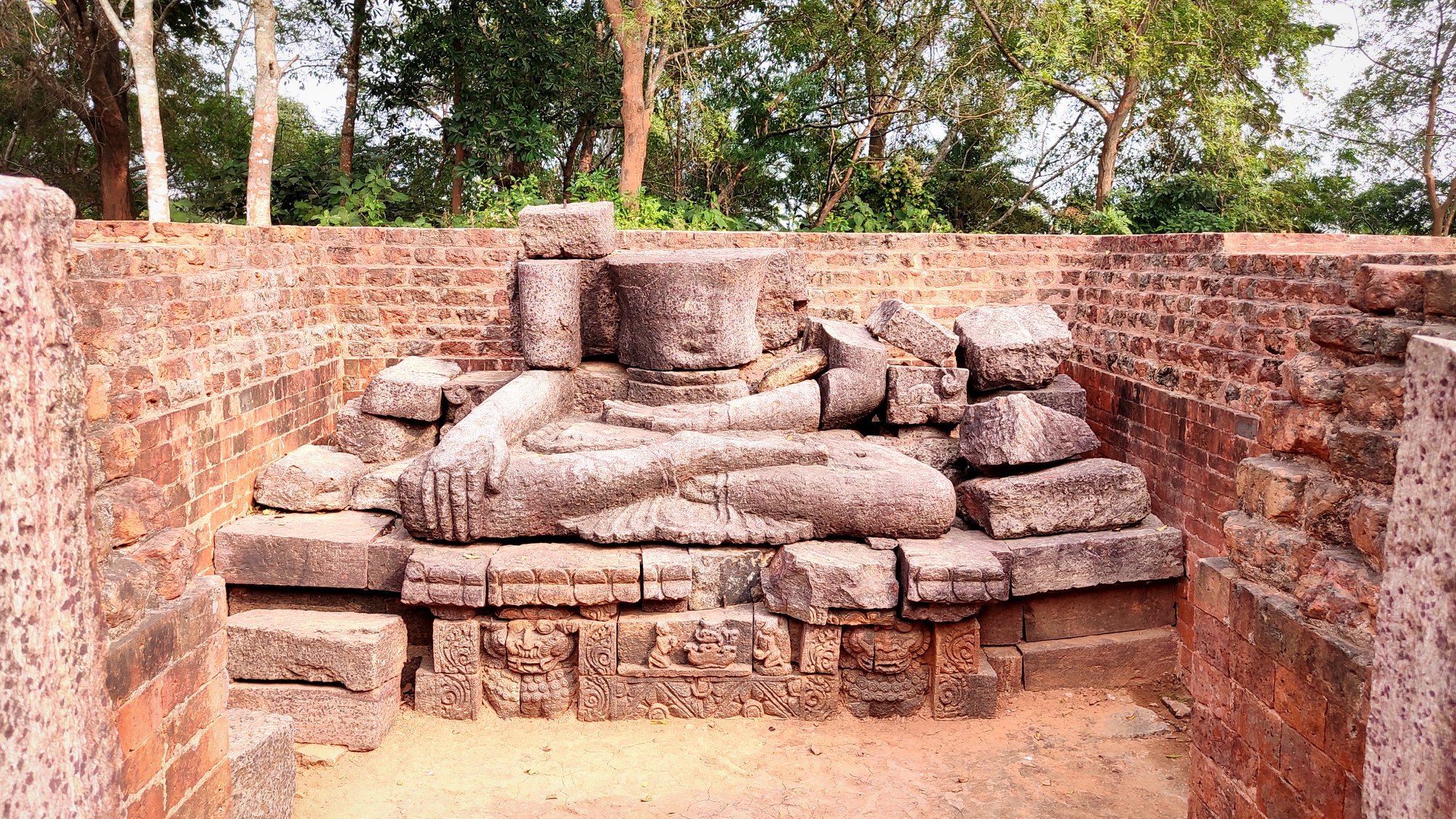
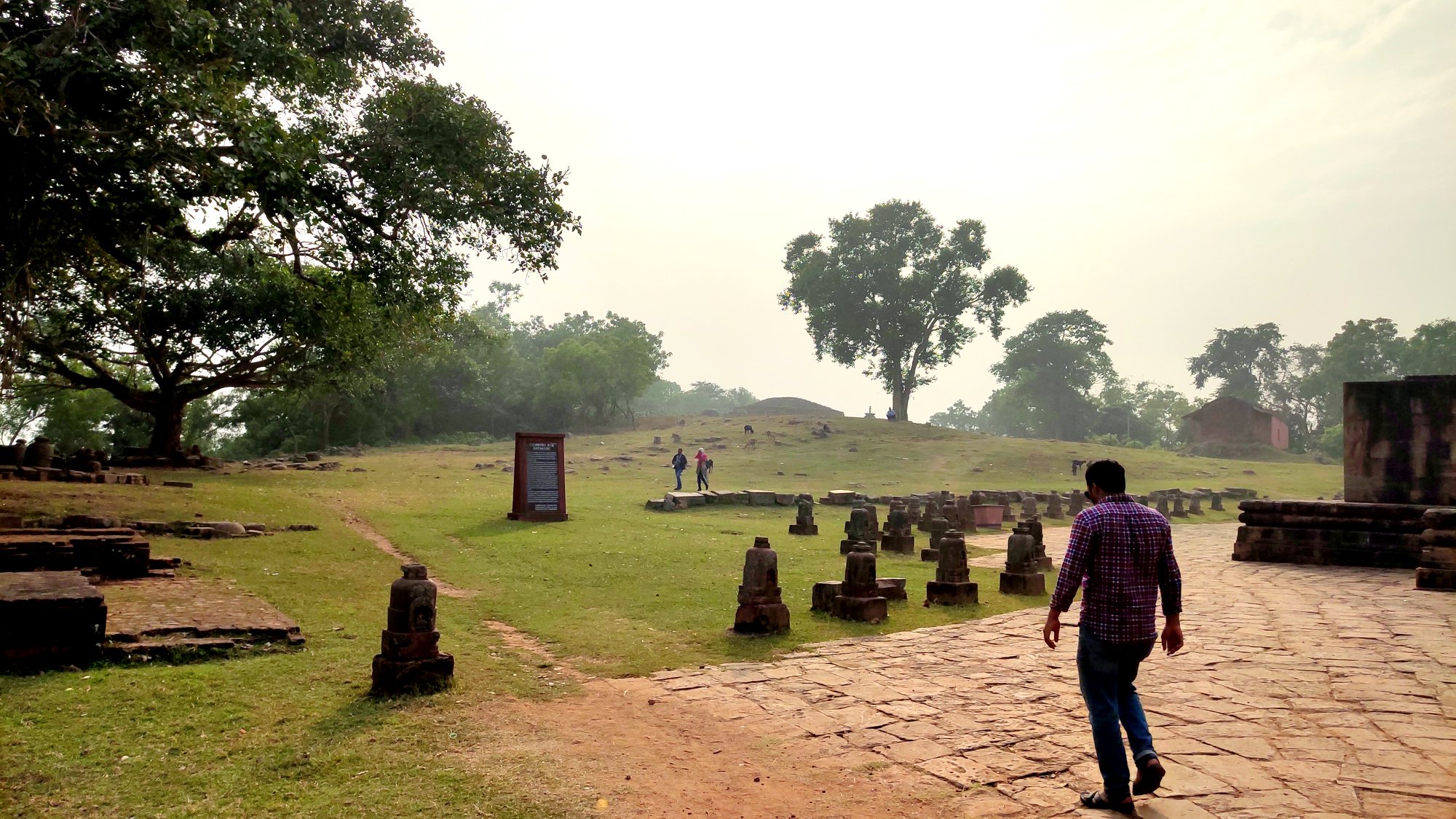
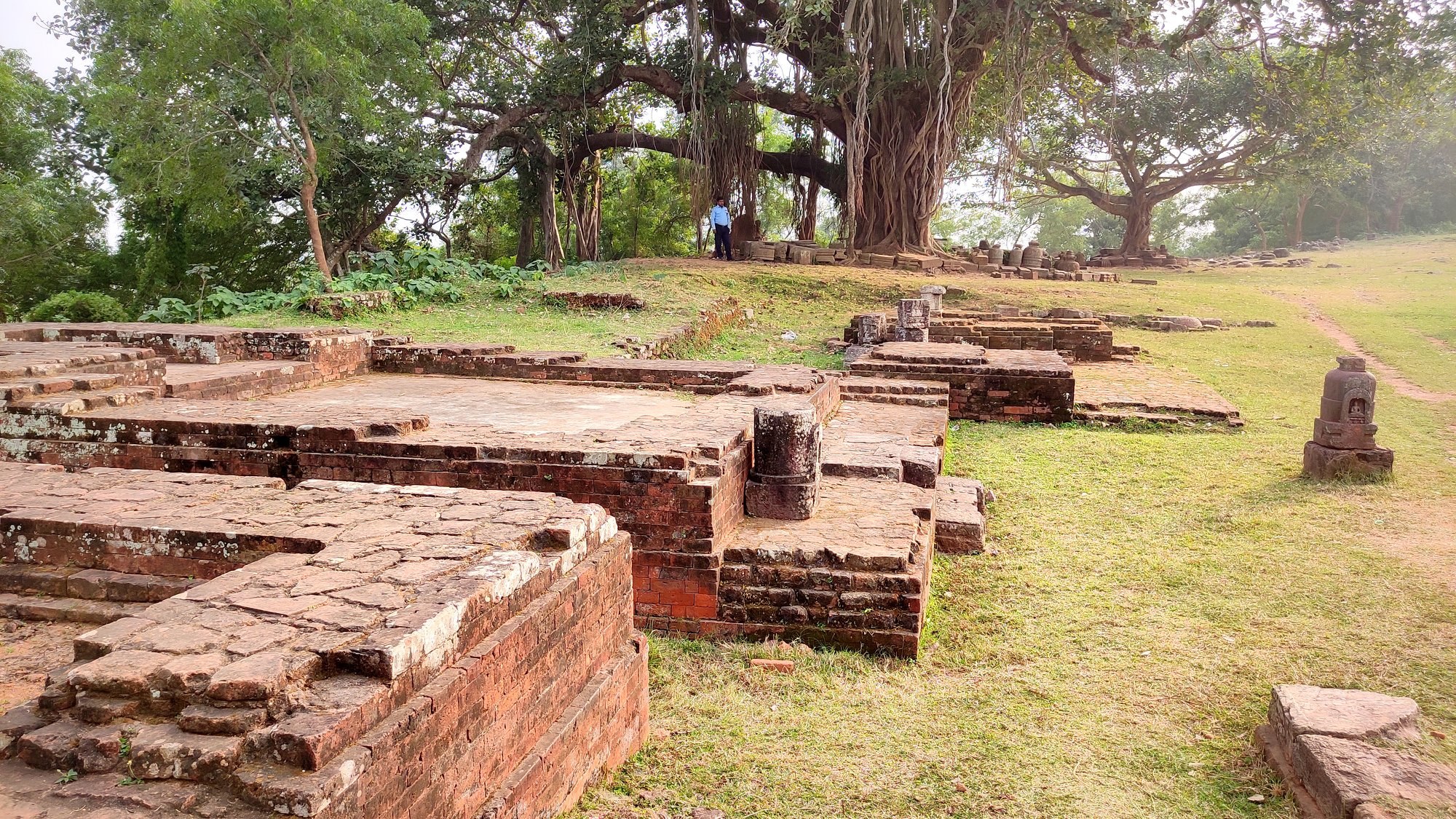
After a light meal in lieu of lunch, we crossed the Brahmani river yet again and reached Udaygiri around 4PM. Udaygiri seems, out of the three sites, to be the site with the least attention paid to maintenance. The two monasteries are far-flung not only from each other but also from the entry gate, and can be accessed after walking quite a bit through jungle. Here too the monasteries with statues of Buddha, lay in ruins.
Glimpses of the many monuments and surroundings at Udaygiri
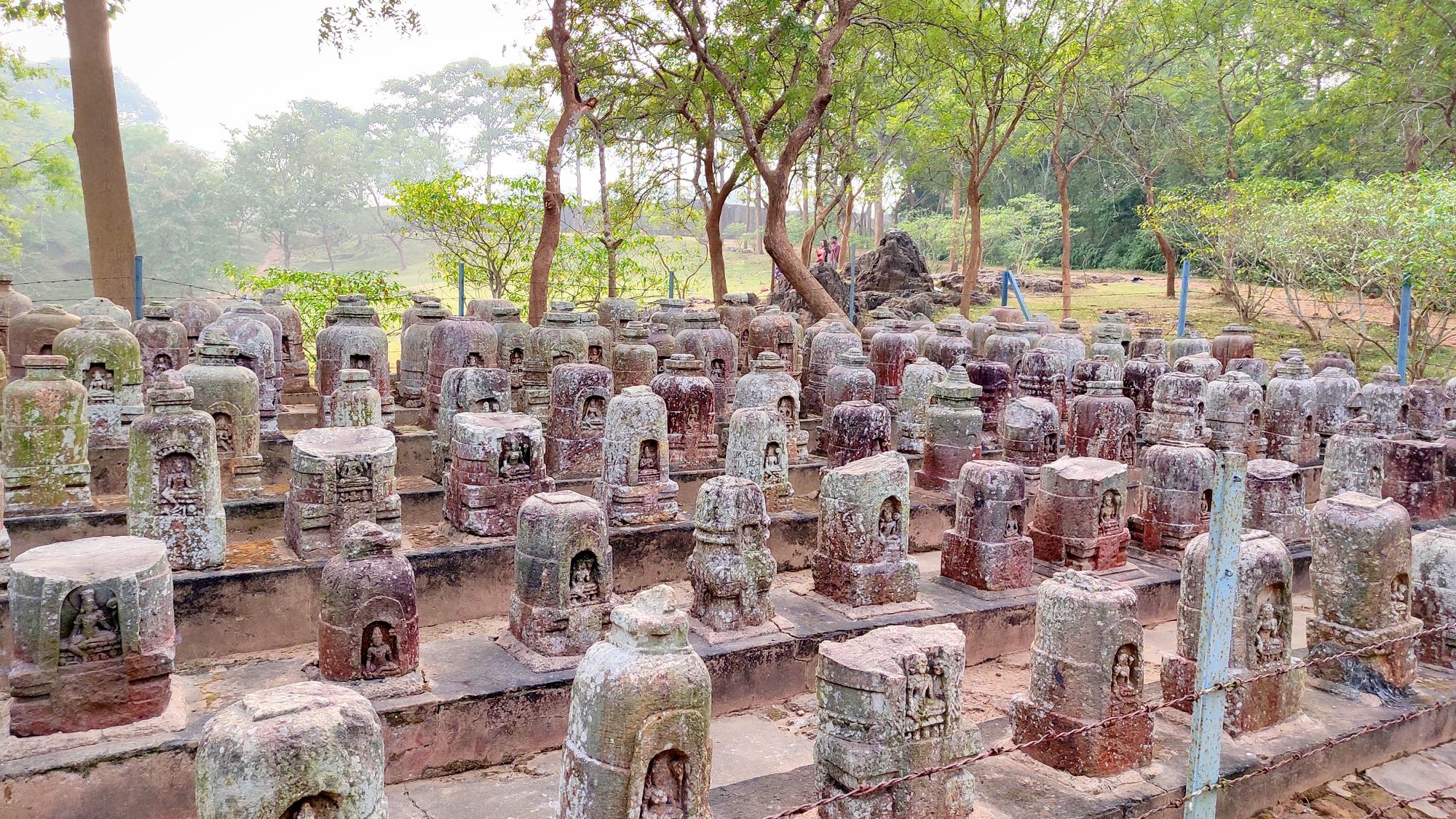
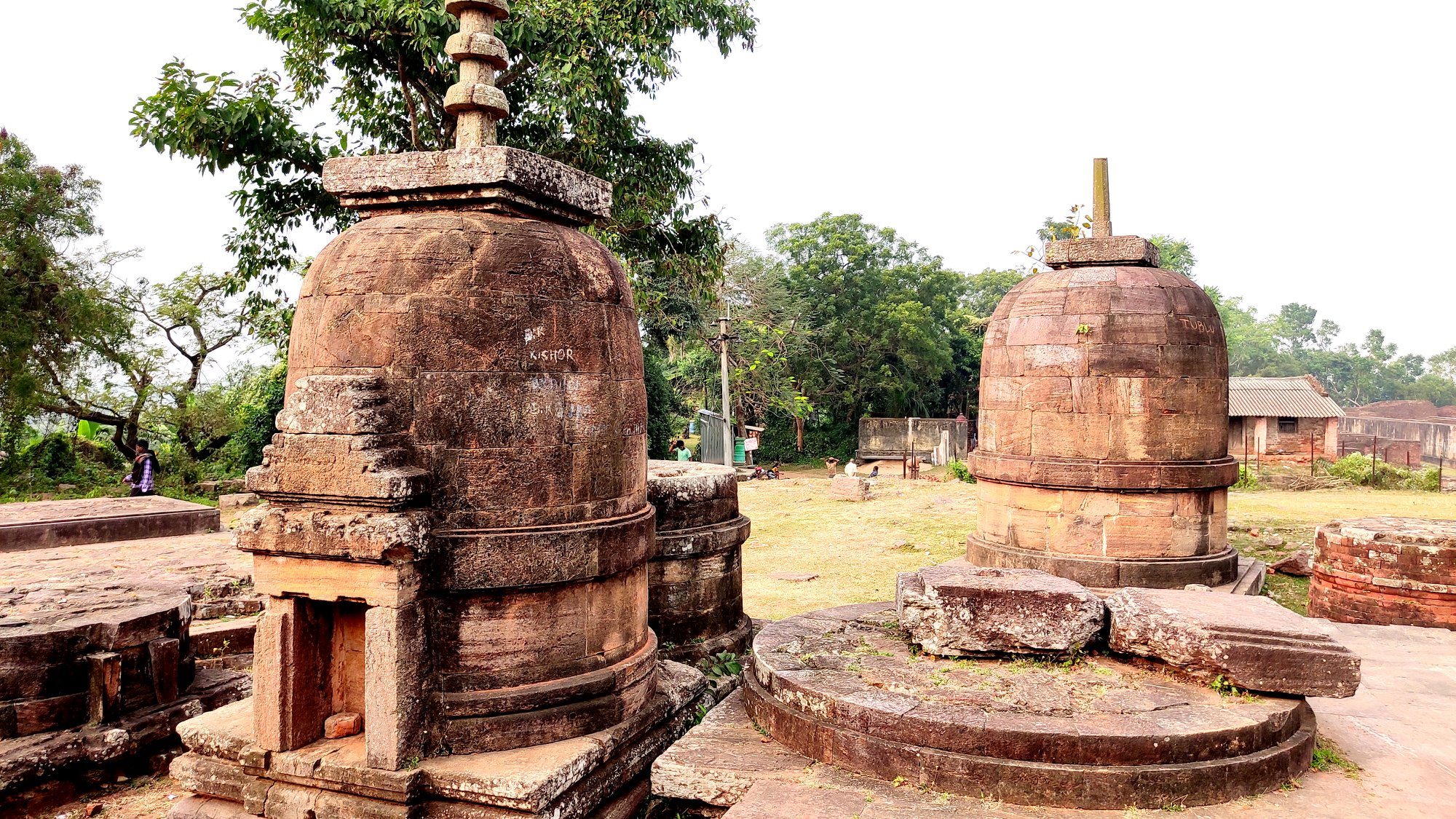
Adjunct to one of the monasteries, lies a chaityagriha with the main stupa, with several smaller stupas surrounding it – the stupas are dated between 1st and 12th centuries. Several stupas, including votive ones stand beside the other monastery too. Of note is a stepped well near the second monastery, the depth of which we could not gauge because it was already dark.
Votive stupasA well
Walking back through the forest as darkness falls
By now, it was already 5 PM, and given that it was peak winter, we were faced with the prospect of walking back through the jungle in pitch dark. Nevertheless, what is a family that does not bravely maneuver difficult paths! So, using our mobile phones are torches, we navigated our way through the narrow path cutting through the forest, making the least of sounds lest we attract undue attention from the wildlife. By 5.3o PM, we were back at the entrance, and were soon headed back to Bhubaneswar, after successfully completing the day-long Diamond Triangle trip.
Despite spending the first half of my life in Odisha, it was only last weekend that I finally got the chance to trace the pearls of heritage hidden along an innocuous but highly-fabled river, reduced now to a rivulet, called Prachi.
Centuries ago, the Prachi river along with its valley, was host to a flourishing civilization that not only prospered on trade with Southeast Asia (Bali, Indonesia etc.) thanks to its ‘sadhaba’ (sailor) sons but also reveled in art & architecture of the highest order, being home to some of the most skilled artisans & sculptors. At the same time, the region was also a melting pot for the seamless chronological prevalence of Jainism, Buddhism, Shaivism, Shaktism & Vaishnavism leading to a syncretic religious fervour.
Some accounts date the region’s earliest artifacts to even before the Indus Valley Civilization. Yet the currently standing vestiges of the civilization dotted along the valley afford us a peek only into the period from 7th century AD to the 15th century AD. Nevertheless, these bear fine witness to the cultural richness of the erstwhile Kalinga, being some of the finest representatives of the distinctive Kalingan temple architectural style.
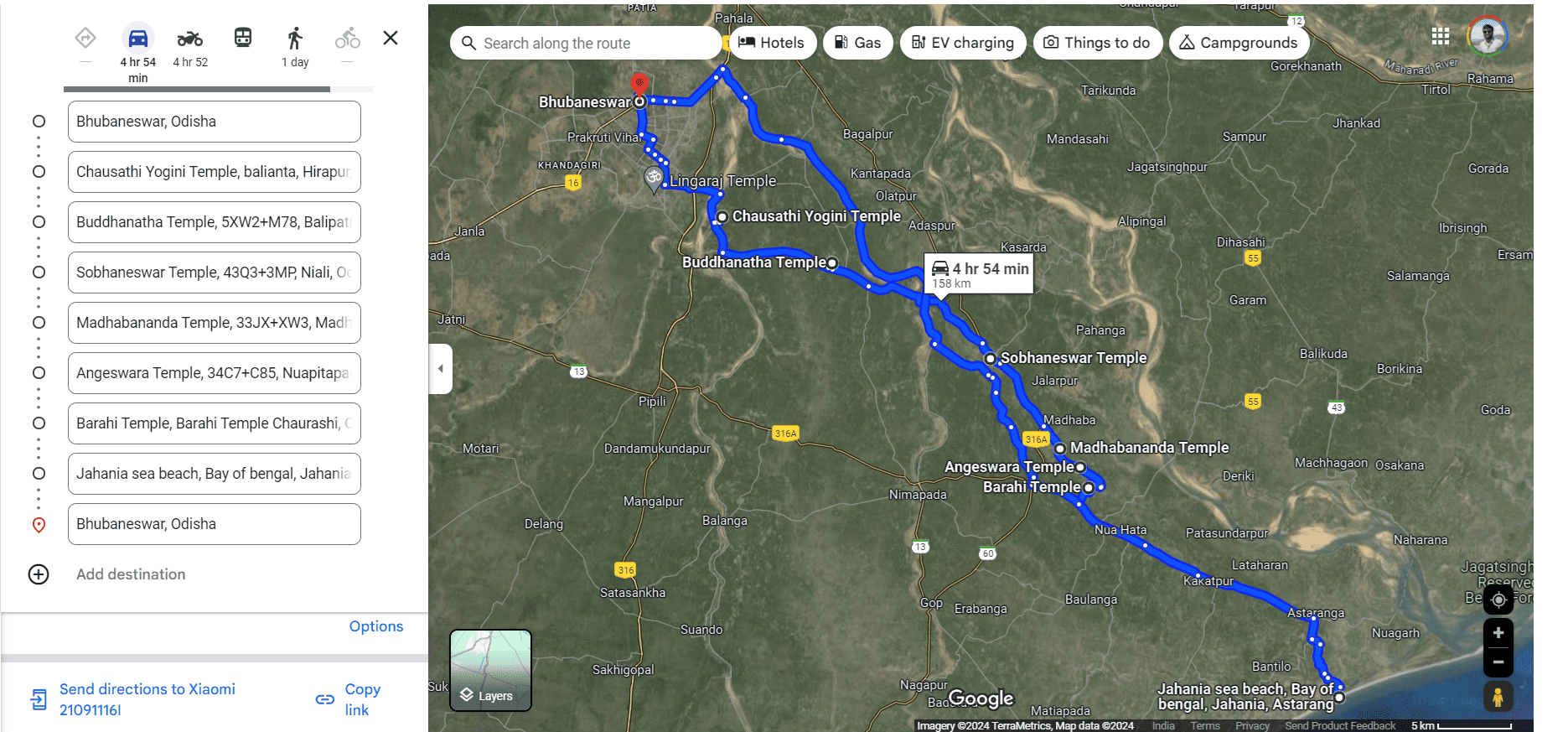
Trail on this trip covered the following places: Chausathi Yogini Temple (Hirapur, Bhubaneswar), Buddhanath Temple (Garedipanchan, Balipatna), Sobhaneswara Temple (Niali), Madhabananda Temple (Niali), Angeswara Temple (Pitapada), Varahi Devi Temple (Chaurashi), Mangala Temple (Kakatpur) and Jahania Beach (Astaranga).
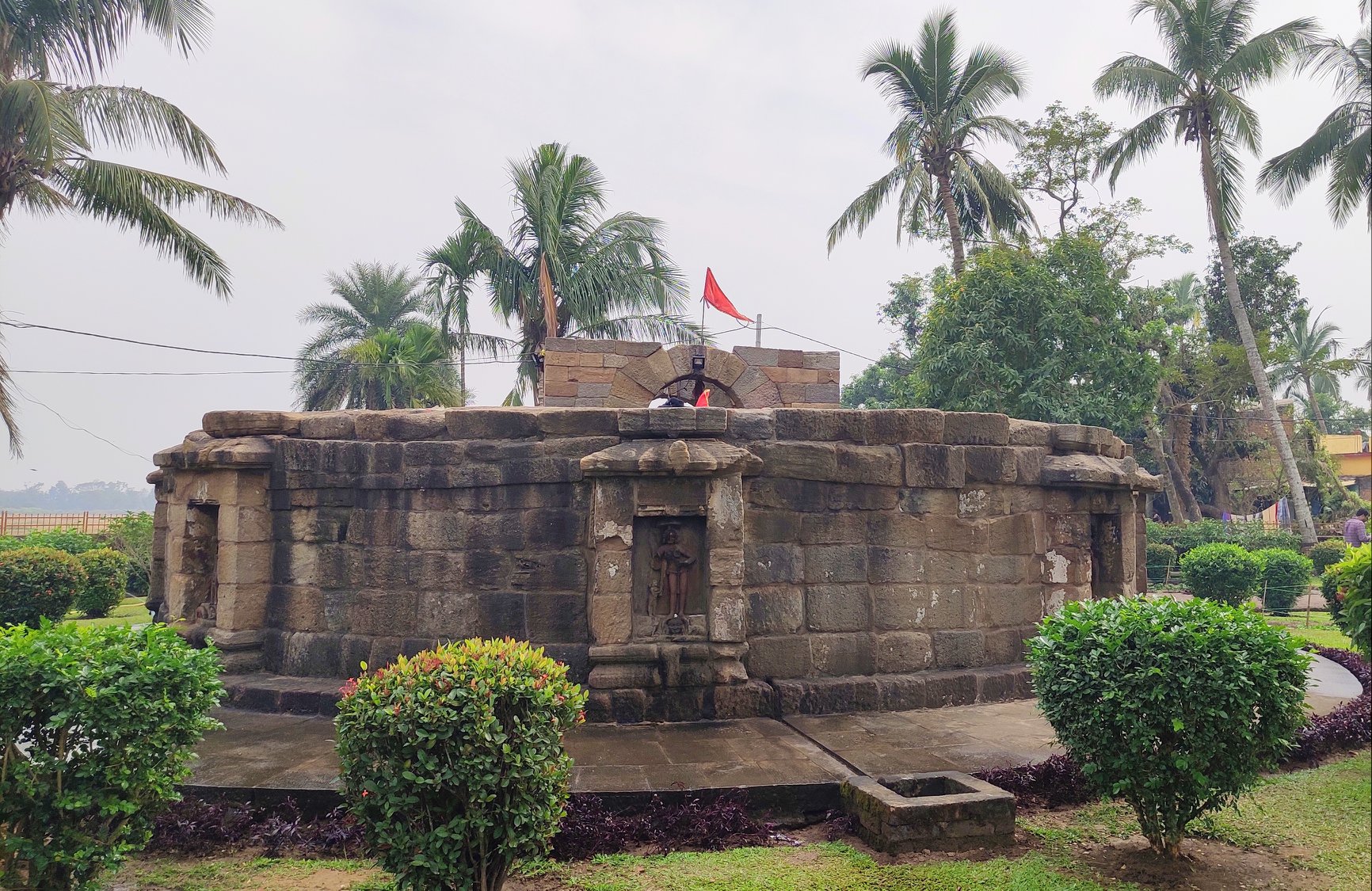
We first stopped at the 9th century AD Chausathi (64) Jogini Temple, the tantric temple built in circular fashion, at Hirapur just at the outskirts of Bhubaneswar. The legend behind the temple, according to priests, goes: Goddess Durga took the form of 64 demi-goddesses in order to defeat a demon. After the fight, the 64 goddesses (Joginis) asked Durga to commemorate them in the form of a temple structure. Accordingly, 56 idols line the inner walls of the structure with the remaining 8 carved on the 8 sides of a central square platform (altar).
(left) Chausathi (64) Jogini Temple. 9th Cent. AD. (right) Idols lining the inner side of the wall
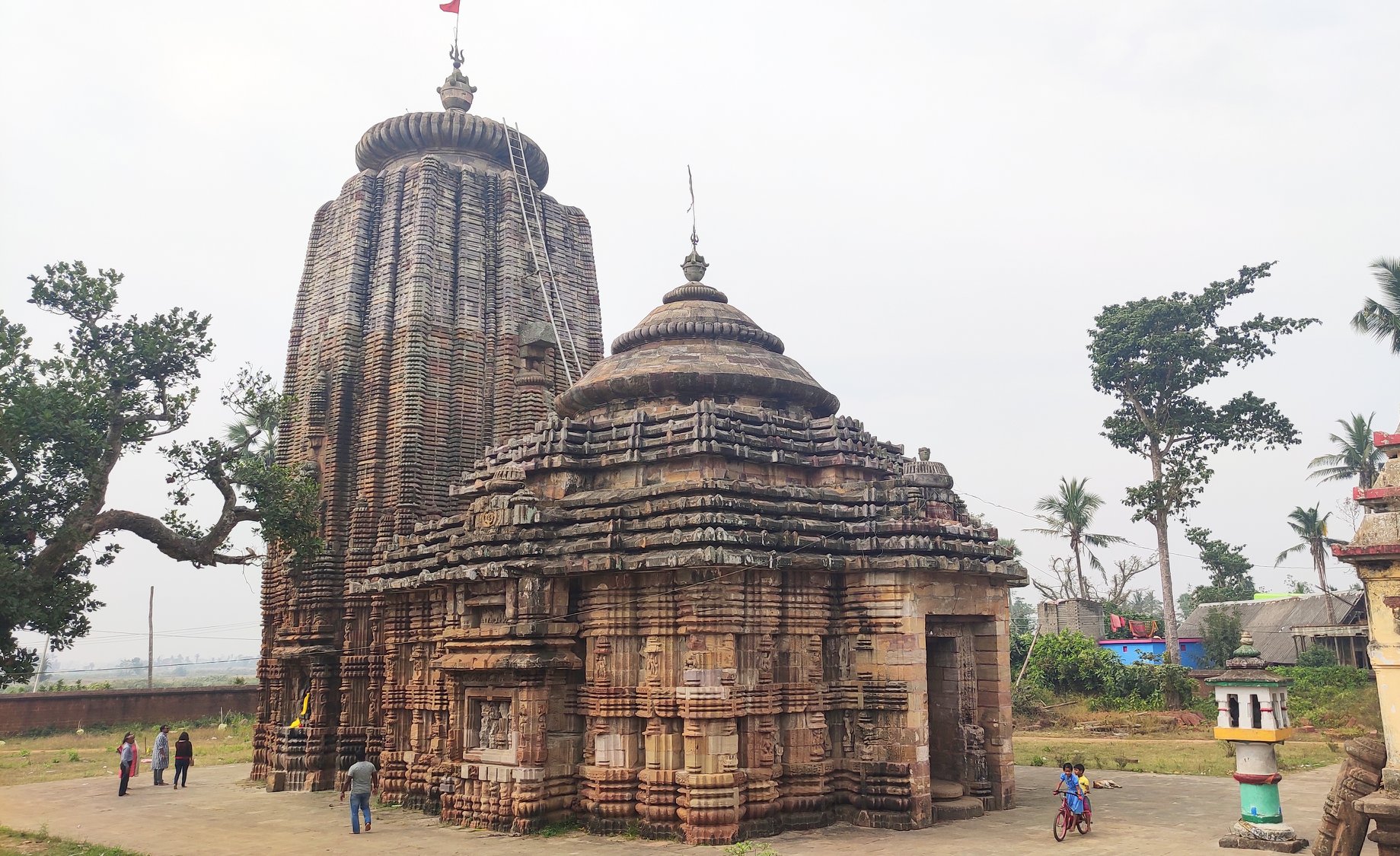
Next stop was Buddhanath Temple, an 12th Cent. AD. Shiva Temple, located in Garedi Panchana, 11km from Hirapur . The temple is said to be built on tantric principles, and was apparently also a Buddhist monastery at some point of time.
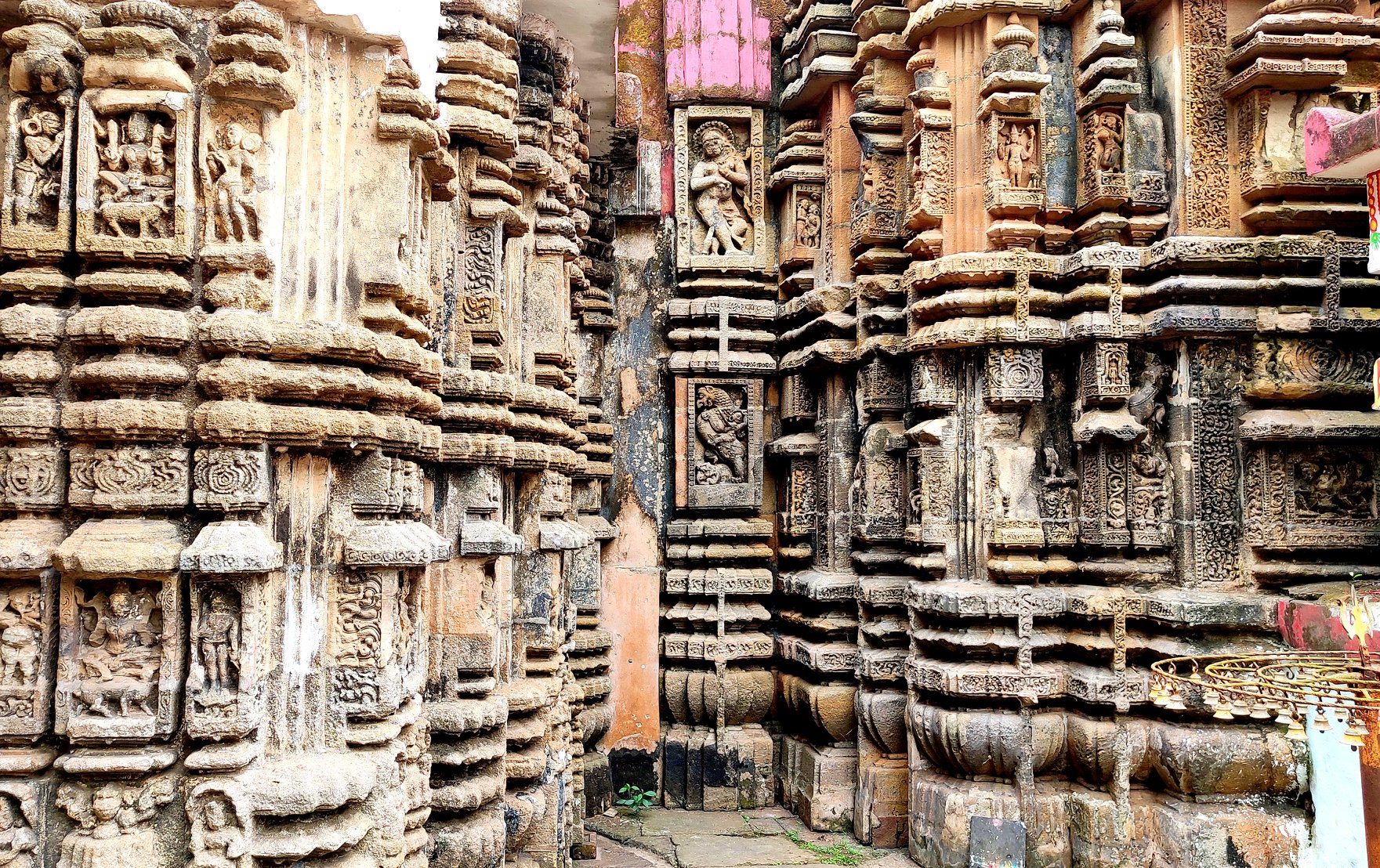
(left) The Buddhanath Temple (right) Example of Kalingan stone art on the walls of Buddhanath temple.
15km further away, lies the Sobhaneswara Temple, another 12th Cent. AD, temple at Niali, of which only the lower half survives from the original structure, with the upper half being restored by later kings. Consequently, the lower half provides another demonstration of the intricate stone art of Kalingan artisans.
Glimpses of the intricate stone art of Kalingan artisans on the Shobhaneswara temple walls.
Next stop was the Madhabanada Temple, built in the 13th Cent. AD, located at Madhaba. Said to commemorate Madhaba (Krishna) located near the site where Jayadeva, the author of the famed Geeta Gobinda, is purported to have worshipped Madhaba.
Madhabanada Temple. 13th Cent. AD. Said to commemorate Madhaba (Krishna) located near the site where Jayadeva, the author of the famed Geeta Gobinda, is said to have worshipped Madhaba.
Just a couple of km away, lies the Angeswara Temple, a 10th Cent. AD. Shiva temple, which is probably one of the few surviving brick structures from the era.
(left) Angeswara temple (right) A snapshot of the Prachi Valley countryside landscape outside the temple, not very far from the sea either.
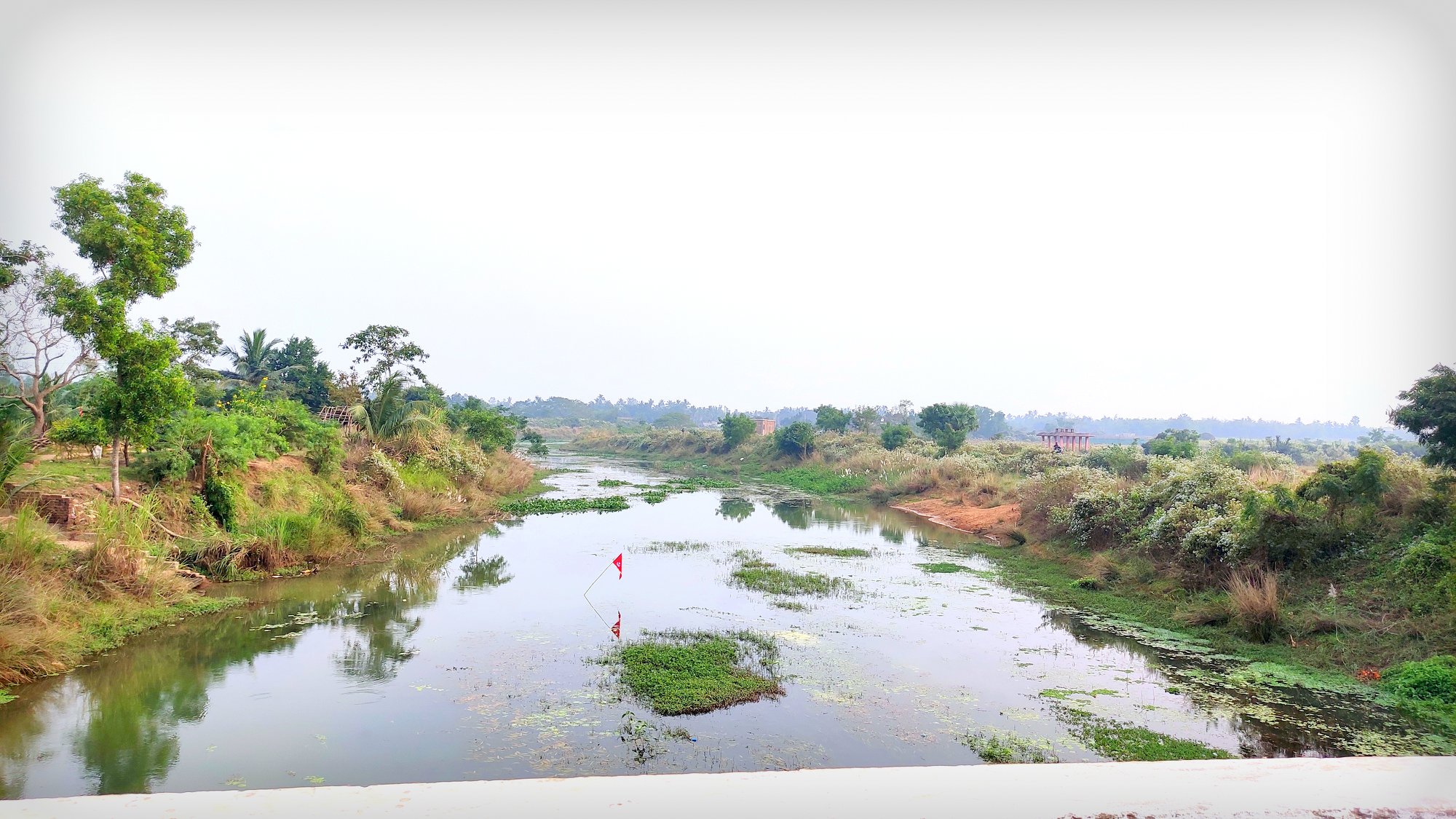
As we proceeded from Angeswara, we finally made rendezvous with the river whose valley we were exploring – the Prachi river today is a pale shadow of the splendour attributed to in historical records.
A glimpse of the sacred Prachi river, now almost reduced to a trickle.
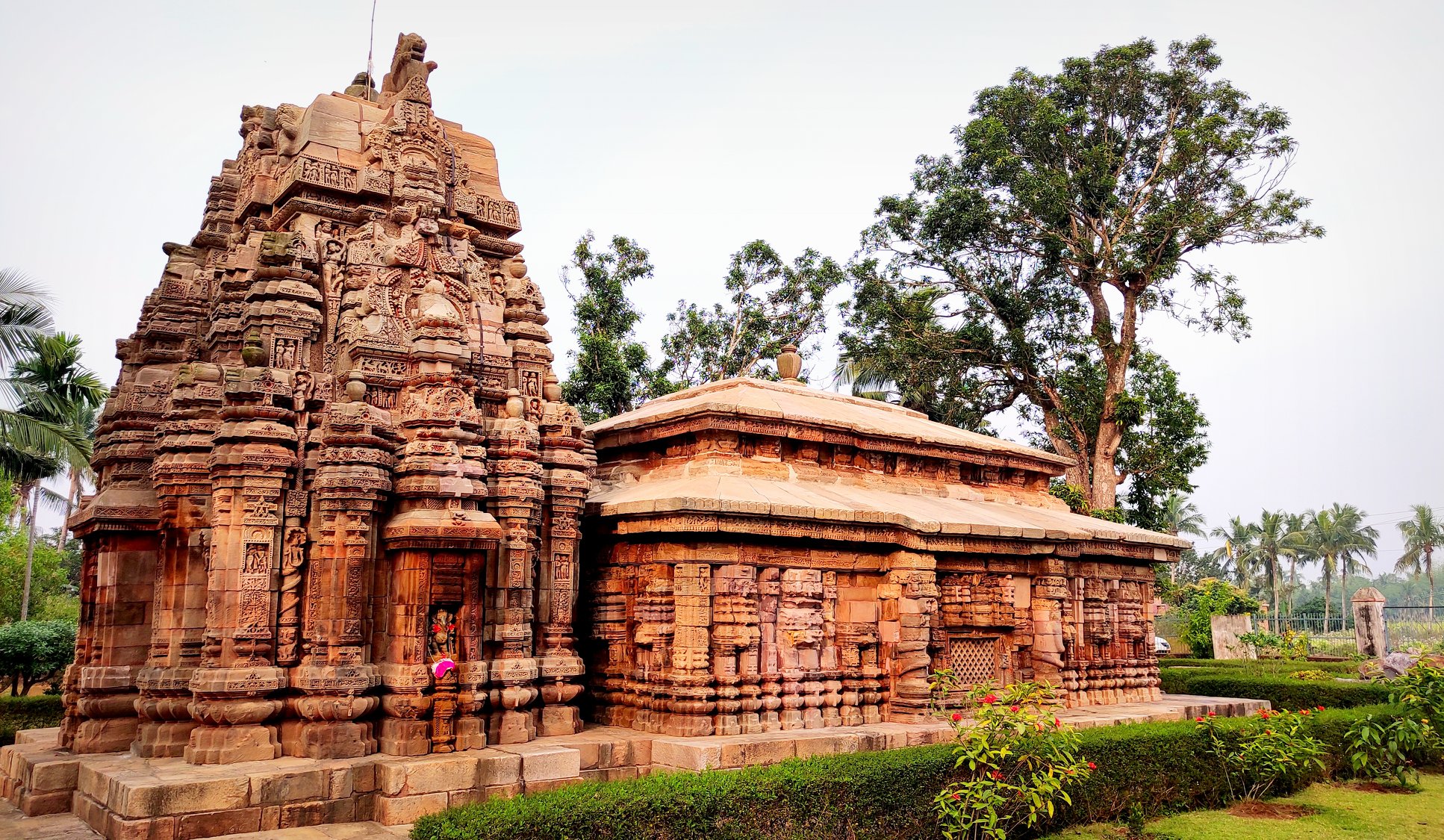
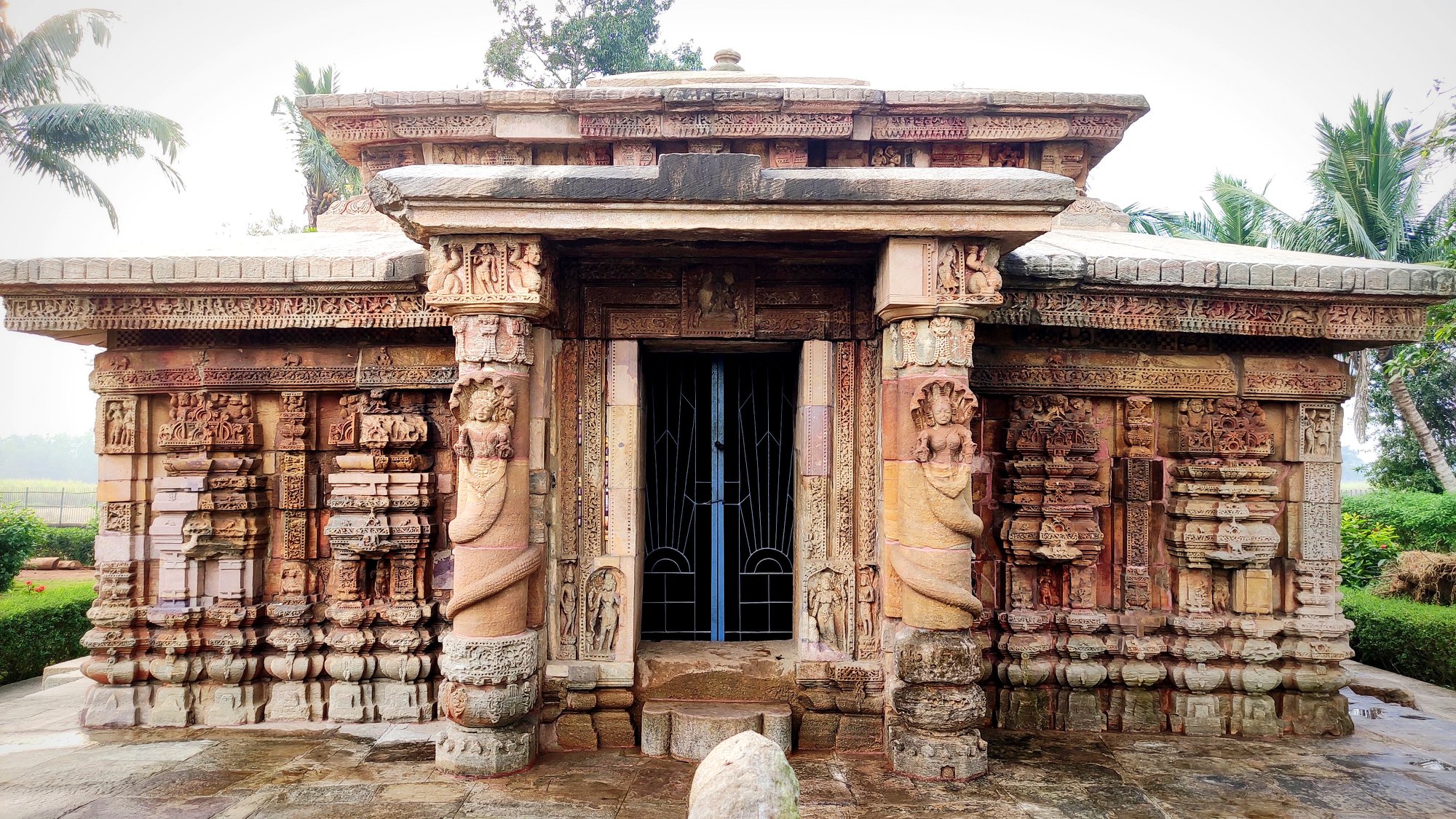
4 km further from the Angeswara temple, is the Barahi temple, a 10th Cent. AD temple dedicated to Maa Barahi, the shakti form of Baraha, the boar-form of Lord Vishnu’s incarnations. This temple incorporates Khakra style, a variation of of Kalingan temple architecture, reminiscent of Mahabalipuram temples.
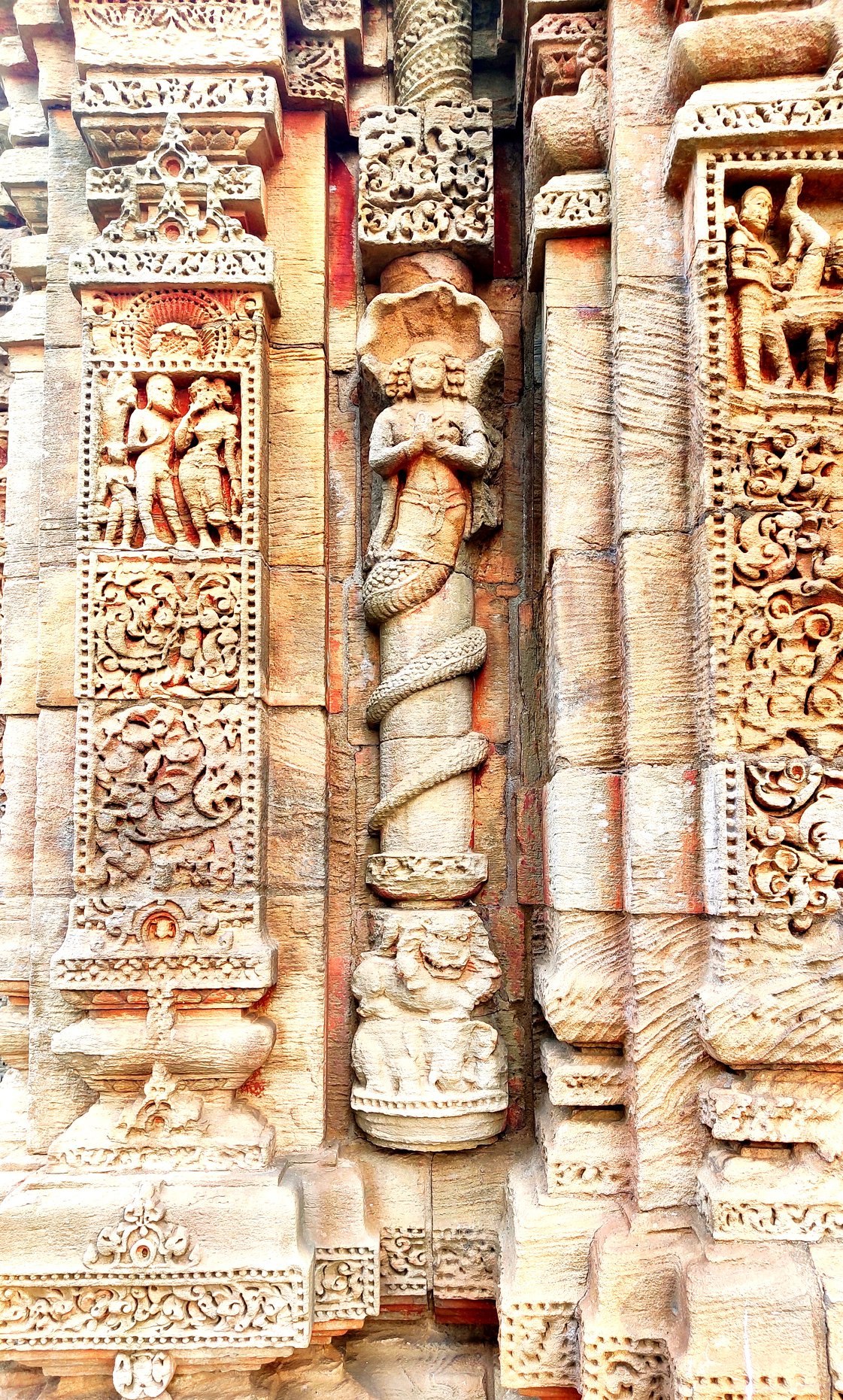
(left) Barahi Devi Temple (right) Front view of the Varahi Devi templeA motif on the Varahi Devi Temple wall representing ‘Adisesa’ – hooded serpent shielding upper body of human with folded hands and lower body of a serpent on the columns and pillars
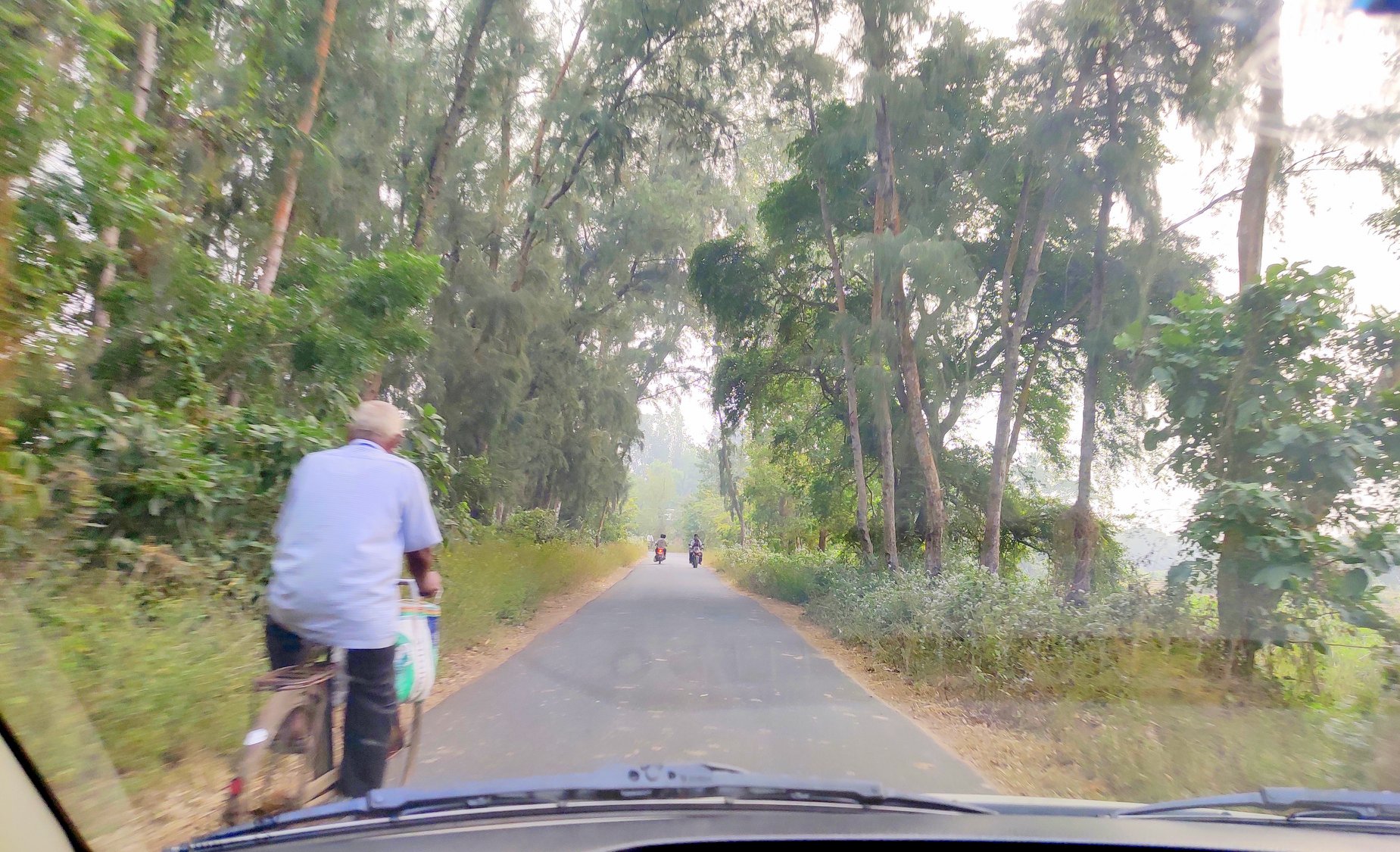
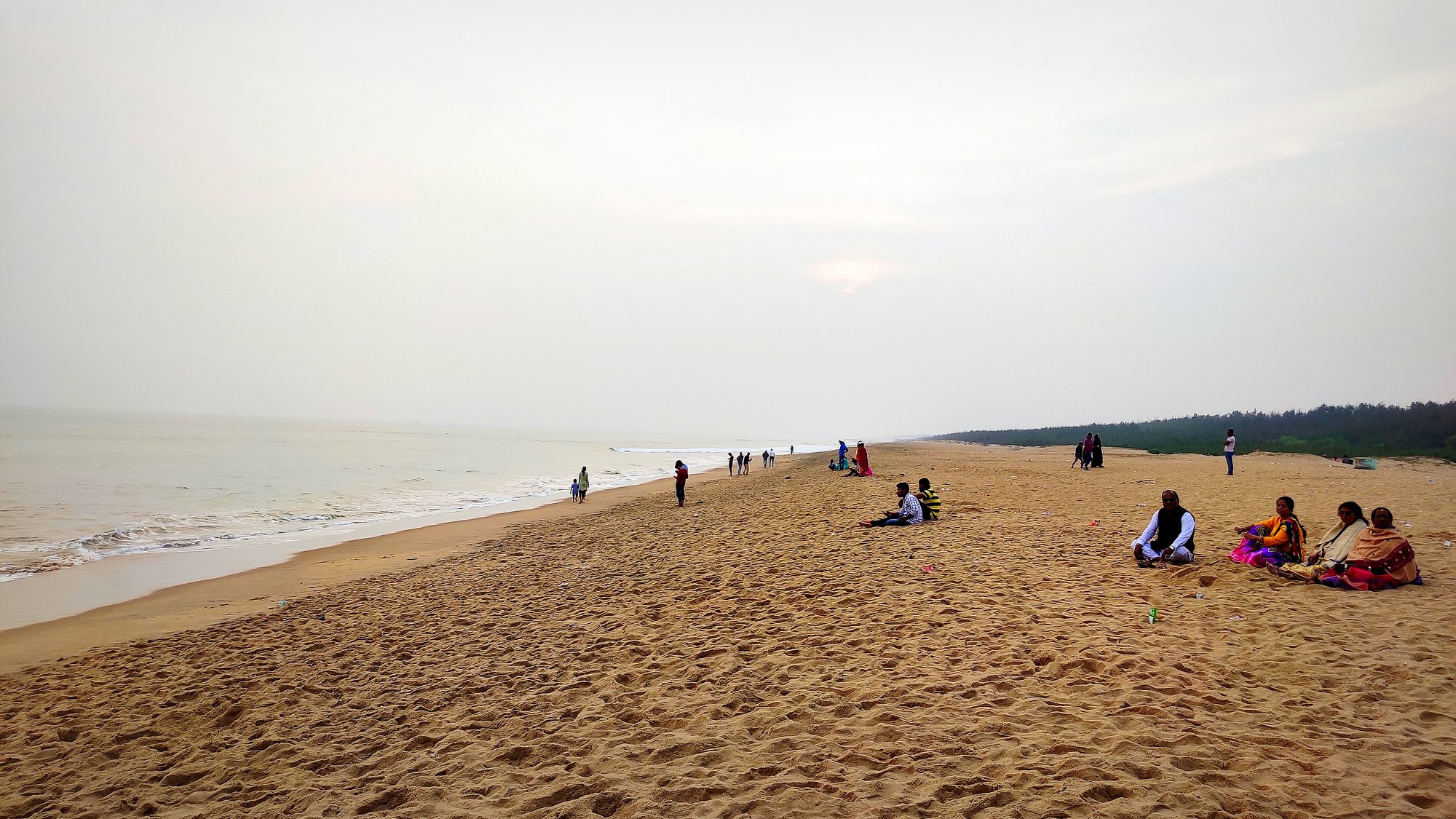
Moving on from Barahi, we reached a crossroads at Charichhak, and were faced with two choices – take a right turn and see a few more monuments from the Prachi Valley or take a left, to the sea. With the evening about to descend, we chose the road leading to Astaranga, which has an adjunct beach at Jahania. Astaranga, literally, of the seven colours, seemed to be a fitting finale for this trip, as it sat upon the mighty Kalinga Sea, which the Kalingan sons traversed to spread the Kalingan glory far and wide.
(left) Road leading to Jahania beach from Astaranga town. (right) Jahania beach
How to reach You have to invariably take private transport and follow Google maps, since many of these sites are not on a major road. Alternatively, you could join some of the day-long heritage walks organized from Bhubaneswar by a few heritage enthusiasts.
Ruminating over fond memories of my previous excursions to the Thar, I realized that it was time my family members also got a taste of the desert, and so materialized my family’s first tryst with the Thar – and my third – in the end of November 2019. We took the Mandore Express from Gurgaon railway station, where we had to execute the train boarding with rocket-science precision on account of the train stopping only for 2 minutes, and reached Jodhpur at 8 AM next morning.
Day 1: Jodhpur and Mandore
We checked in to the Om Heritage hotel that afforded an excellent view of the Mehrangarh fort from its rooftop. The plan for the day, drawn on the experience of my previous sole trip to Jodhpur, was set, and so, the first thing we did was hire for the whole day one of those large auto-rickshaws that could accommodate all five of us, and headed over to the Umaid Bhawan Palace. Our next stop after that was at Mandore Garden, the place that had me mesmerized in my previous trip to Jodhpur.
Mandore, the seat of the Gurjara-Pratiharas in the 6th century AD, later became the capital of the Rathores before Rao Jodha shifted to the newly-founded city of Jodhpur. At Mandore, we first walked through the lawns and saw some of the temples and royal cenotaphs, and then visited the Government Musuem. From there, walking up an incline, we crossed a dammed mini-reservoir, and reached the ruined Mandore fort located on the top of a hill, getting a panoramic view of Mandore. After an hour and half well spent, we had our lunch in Mandore, and proceeded to Jaswant Thada on our way to Mehrangarh Fort.
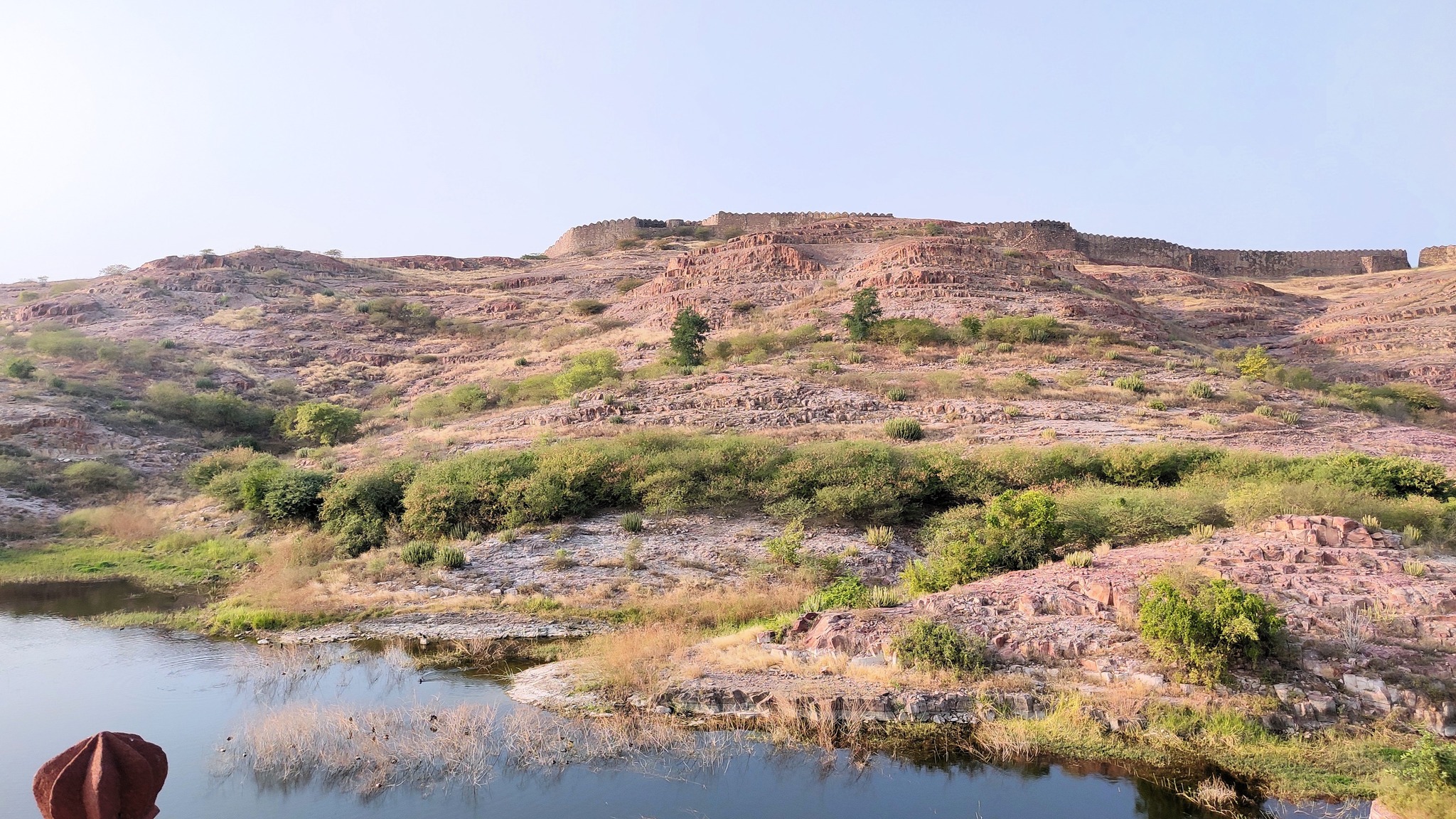
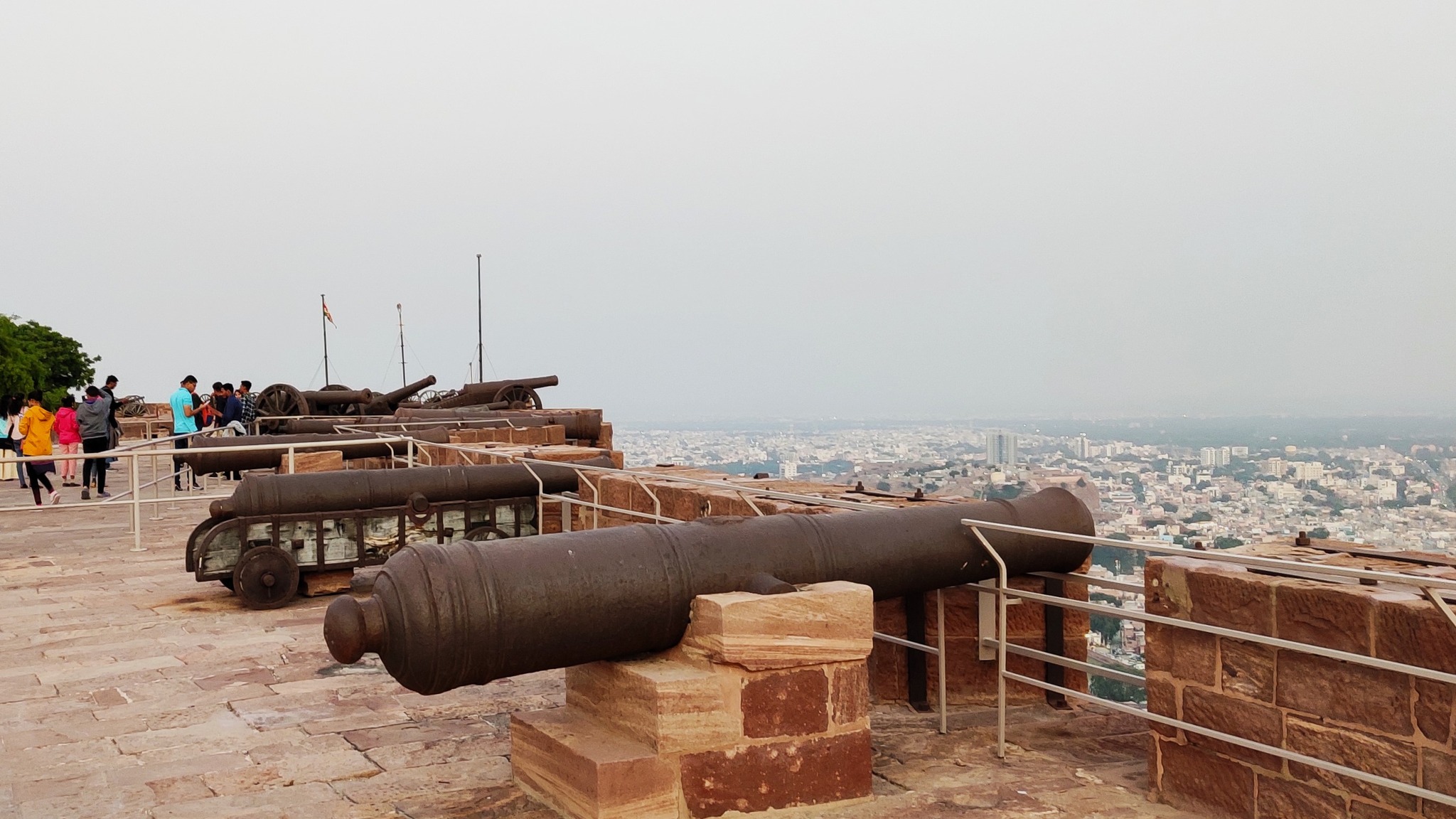
The Jaswant Thada itself is located on the top of a flat red-coloured rocky hill which is barren, only punctuated with water pools, and has the scenic backdrop of the Mehrangarh fort on one side. Next up was Mehrangarh fort, which we reached at 4.30 PM just in time before the gates closed for entry. Taking up a guided tour, we gawked at the imposing palaces and exquisitely done interiors, before ending the tour at the raised long platform lining the fort wall the end of the fort where the cannons stand. We were then back in the hotel to have dinner, and prepare for checking out next day to proceed to the next leg of our trip.
Mehrangarh fort as seen from the rooftop of Om Heritage Hotel
At Mandore Garden, on the outskirts of JodhpurLandscape around Jaswant Thada, JodhpurPalace in Mehrangarh fort, JodhpurCannons at Mehrangarh fort, Jodhpur
Day 2: Exploring Jaisalmer city
The next morning, we started at 8.30 AM by the Innova car we had booked for the remainder of the trip. We passed through Balesar, as the land became progressively arid, with it becoming more distinctively barren and sandy as we approached Pokhran. By 2 PM, we had reached Jaisalmer and checked in at Hotel Heritage House, a hotel modelled as a typical Jaisalmer-style haveli. After a quick lunch at Shree Jee Restaurant, we went to see Patwon ki Haveli, actually a cluster of five small havelis, of which the most famous is the one in the front called Kothari’s Patwa Haveli.
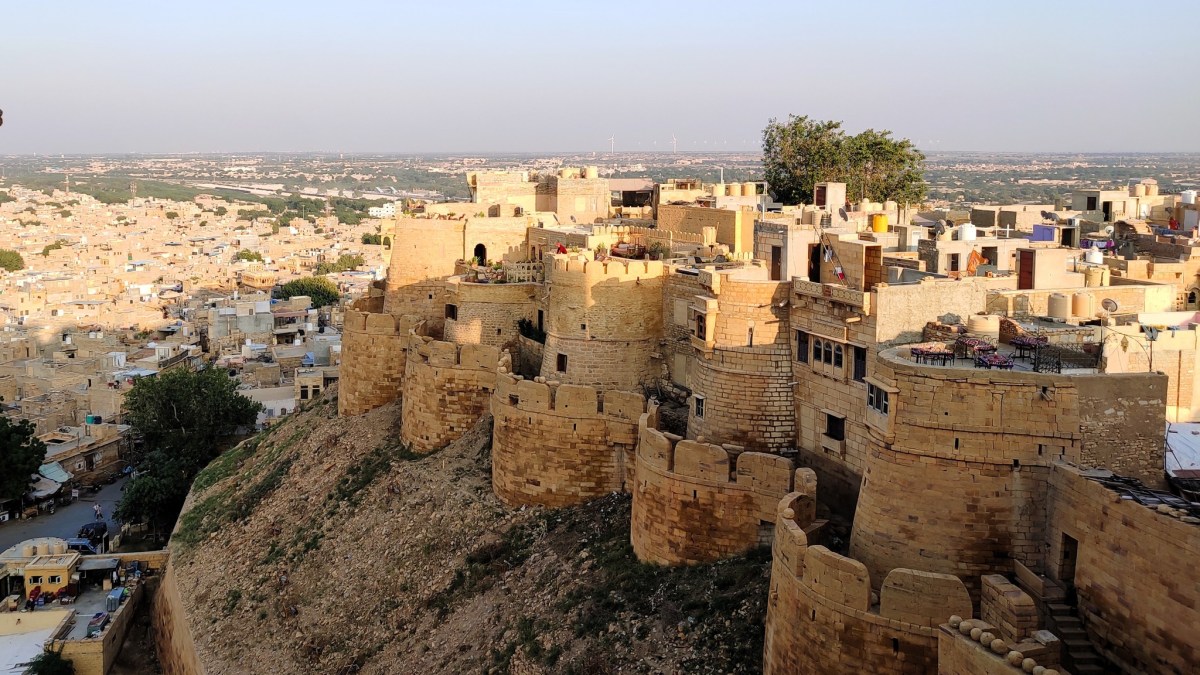
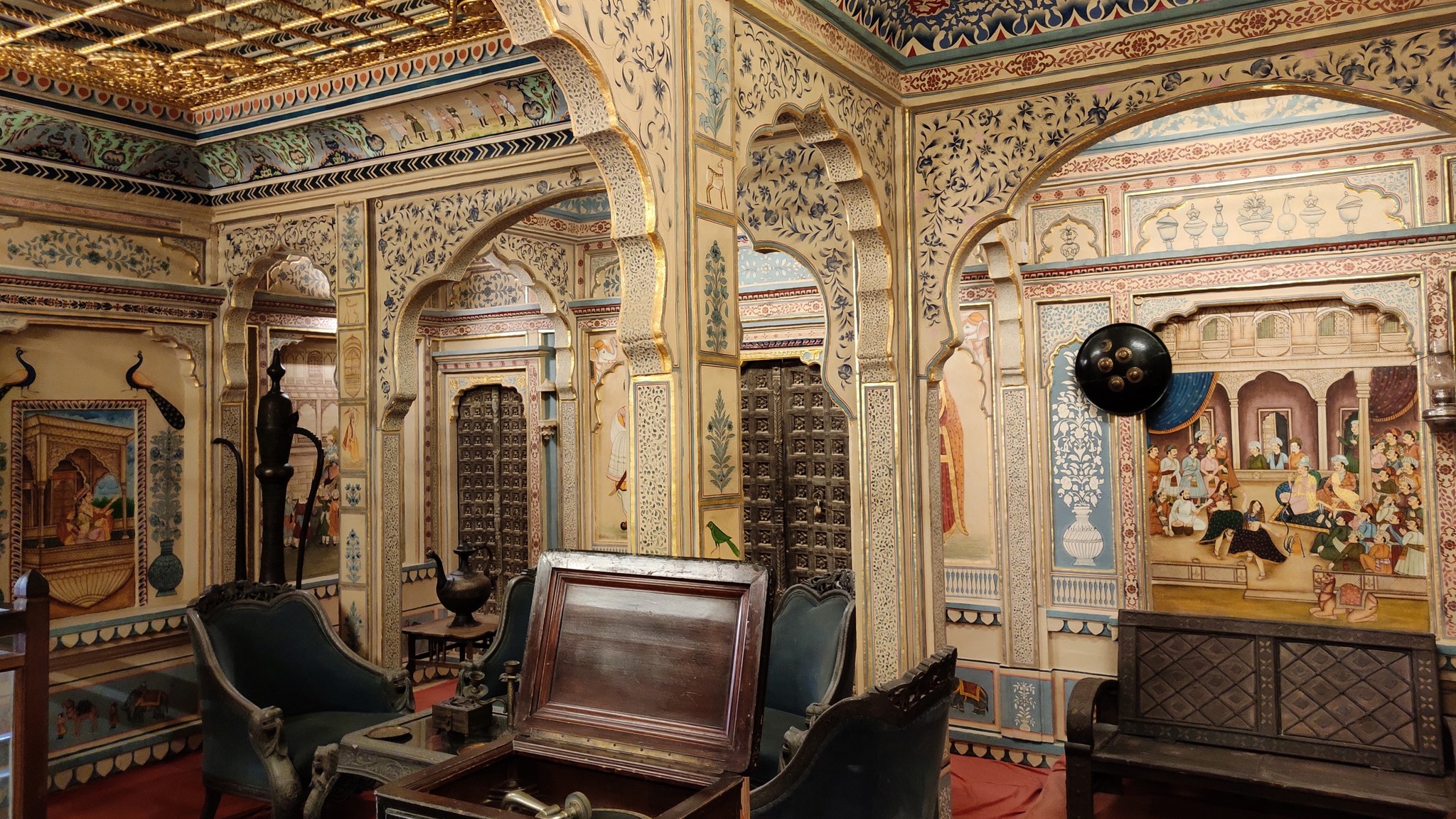
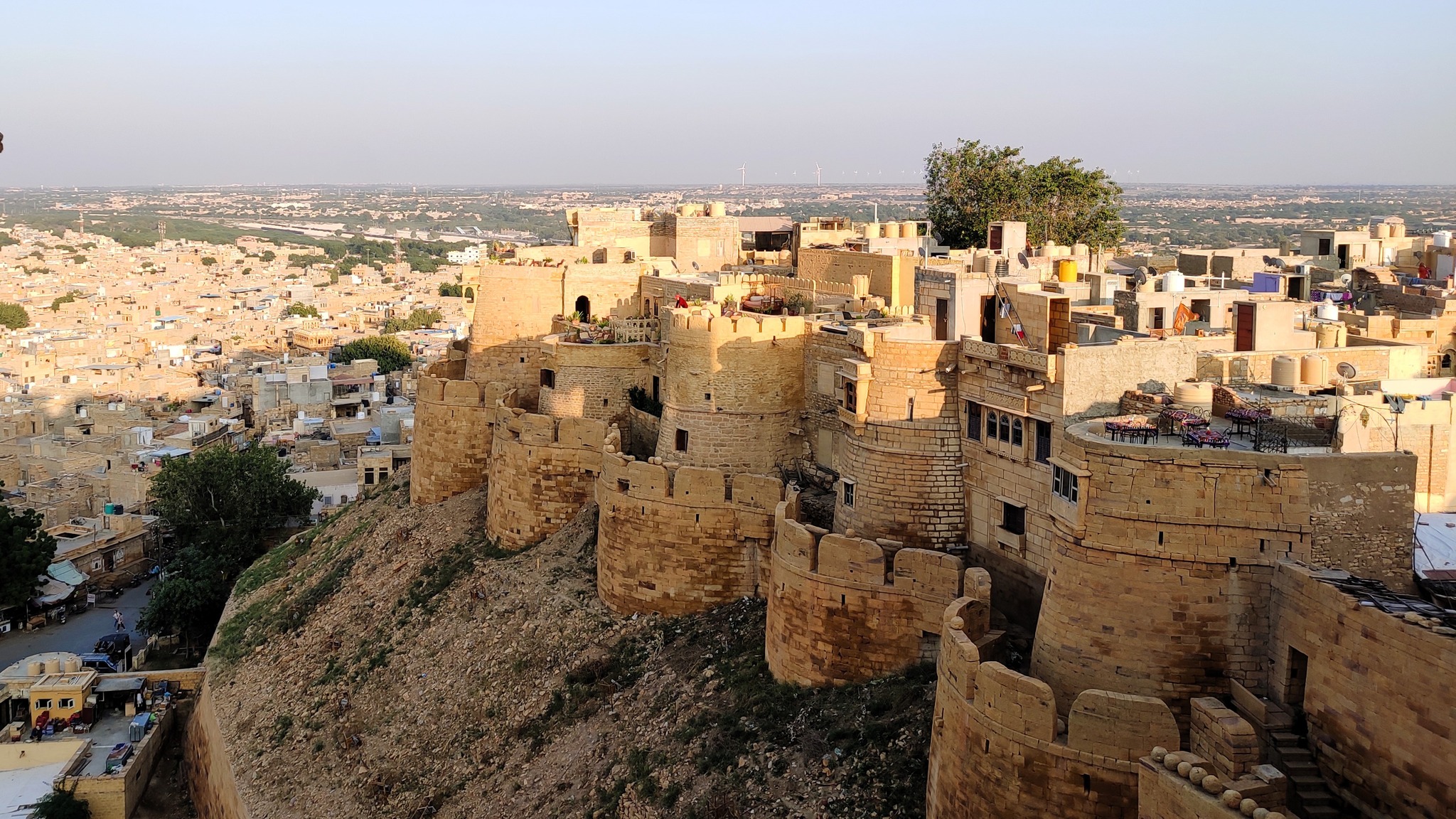
Patwon ki Haveli was constructed over 50 years, starting in 1805 AD commissioned by Guman Chand Patwa, a trader of jewelry and fine brocade. The haveli is typified by latticed balconies carved out of sandstone but seeming as if carved from wood, ornate wall paintings, exquisitely carved pillars, and extensive corridors and chambers. After seeing the haveli, we proceeded to Jaisalmer Fort. At Jaisalmer fort too, we took a guided tour through the main palaces, hearing stories of the past, getting transported to the times when these were inhabited by the royals.
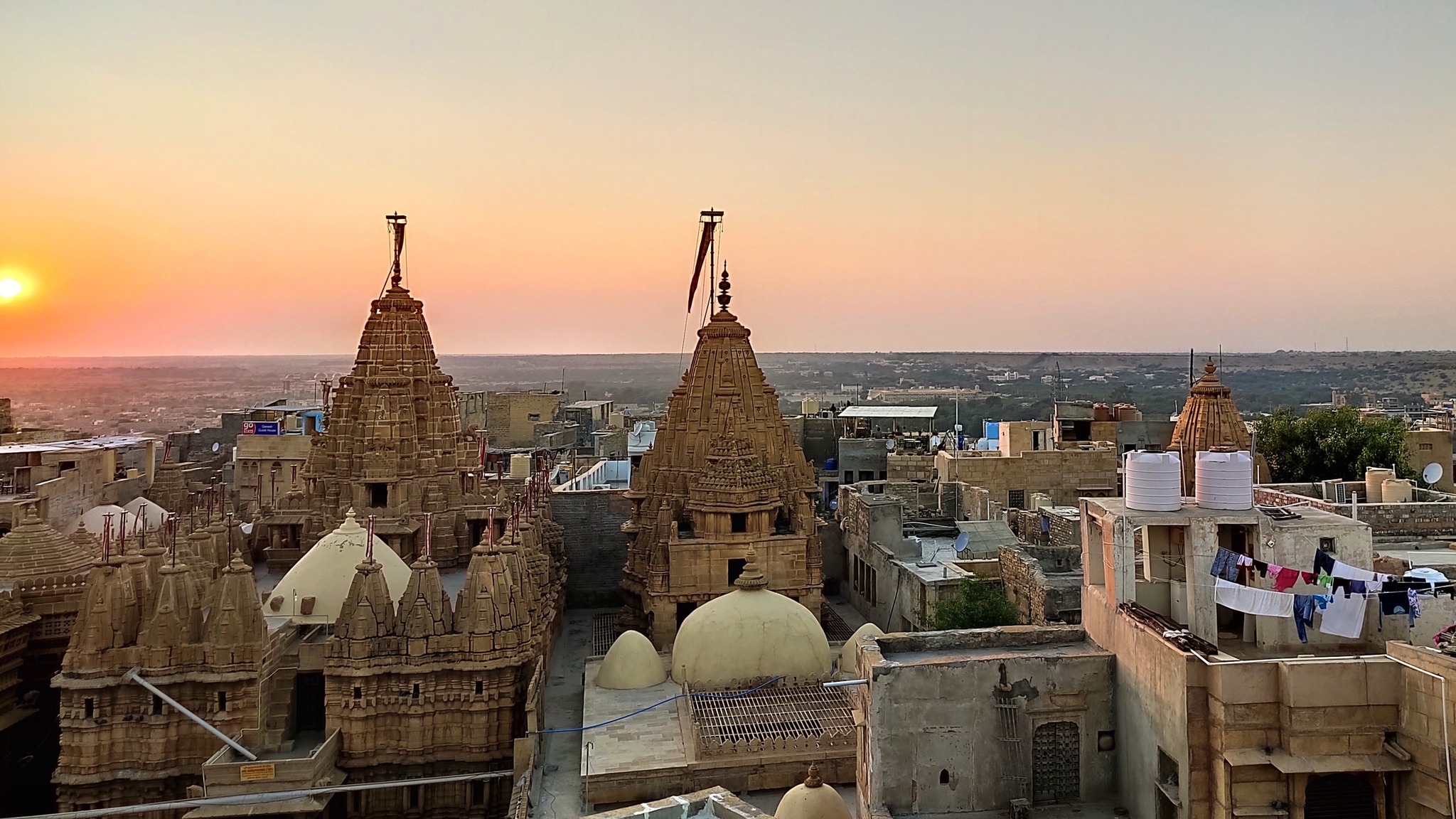
Later, we walked through the streets outside the palace, passing by and entering the street on the left side of the Lakshminathji temple. Just 100 metres in, we came upon the Baa ri Haveli, which we entered out of curiosity and were treated to interesting tidbits of the Rajasthani culture by way of of the artifacts on display, such as sculptures, furniture, toys, handicrafts etc. As we reached the terrace of the haveli, we saw the sun setting in the horizon marked by a long sandy ridge running in the distance outside the city limit, while twin spires of two temples stood in the foreground right in front of us.
An ornately decorated and painted hall in the Patwon ka Haveli, Jaisalmer
View of fort walls from the balcony of a palace in the Jaisalmer fort
Sunset view from Baa ri Haveli, Jaisalmer fort
Soon after, we had tea and snacks at a roof-top restaurant hugging the fort wall while enjoying views of the city and the barren landscape beyond it. Back in the hotel, we retired to bed after dinner in anticipation of our outstation trip from Jaisalmer the next day.
Day 3: Off to the Border – Ranao, Tanot and Longewala
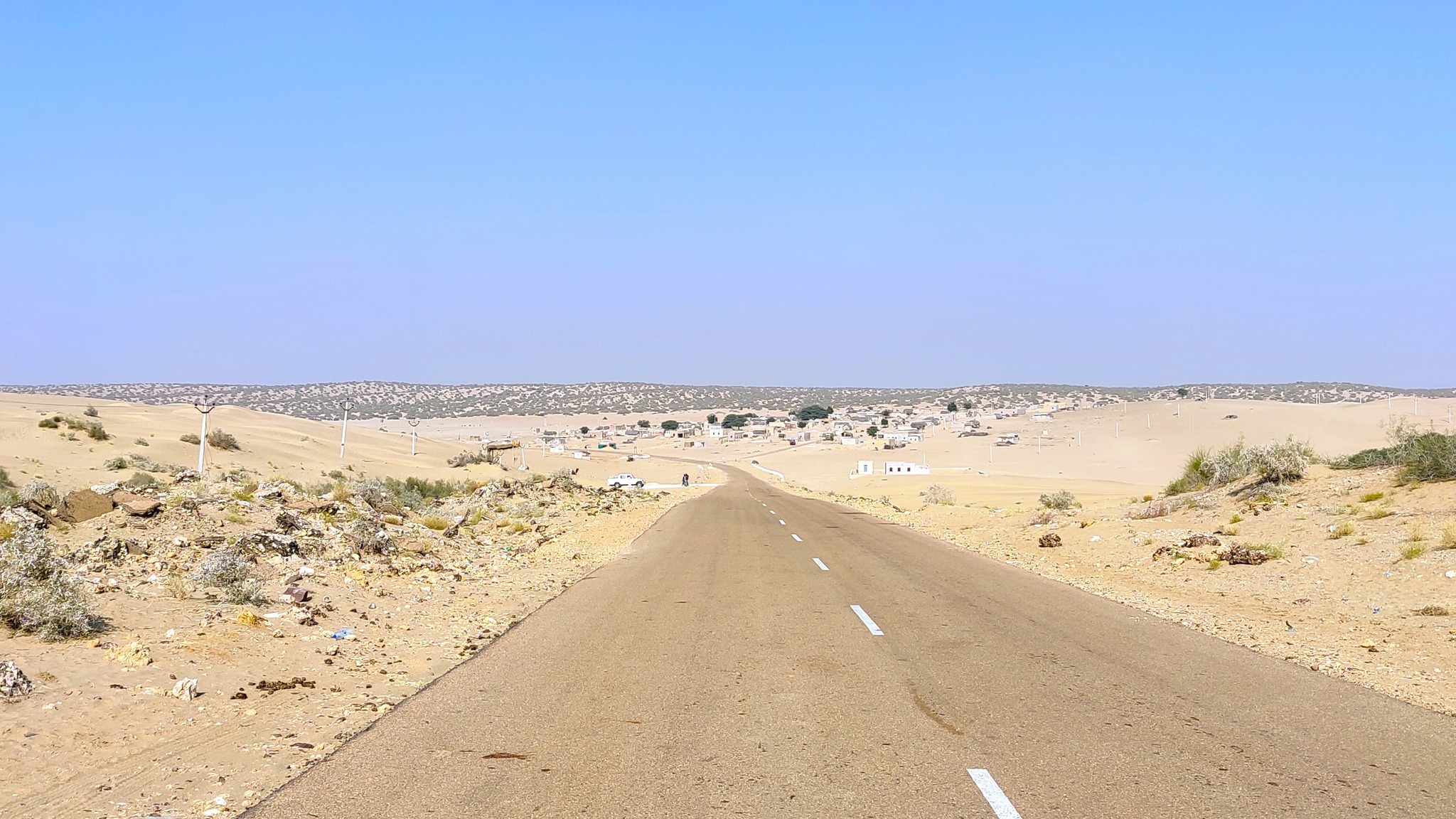
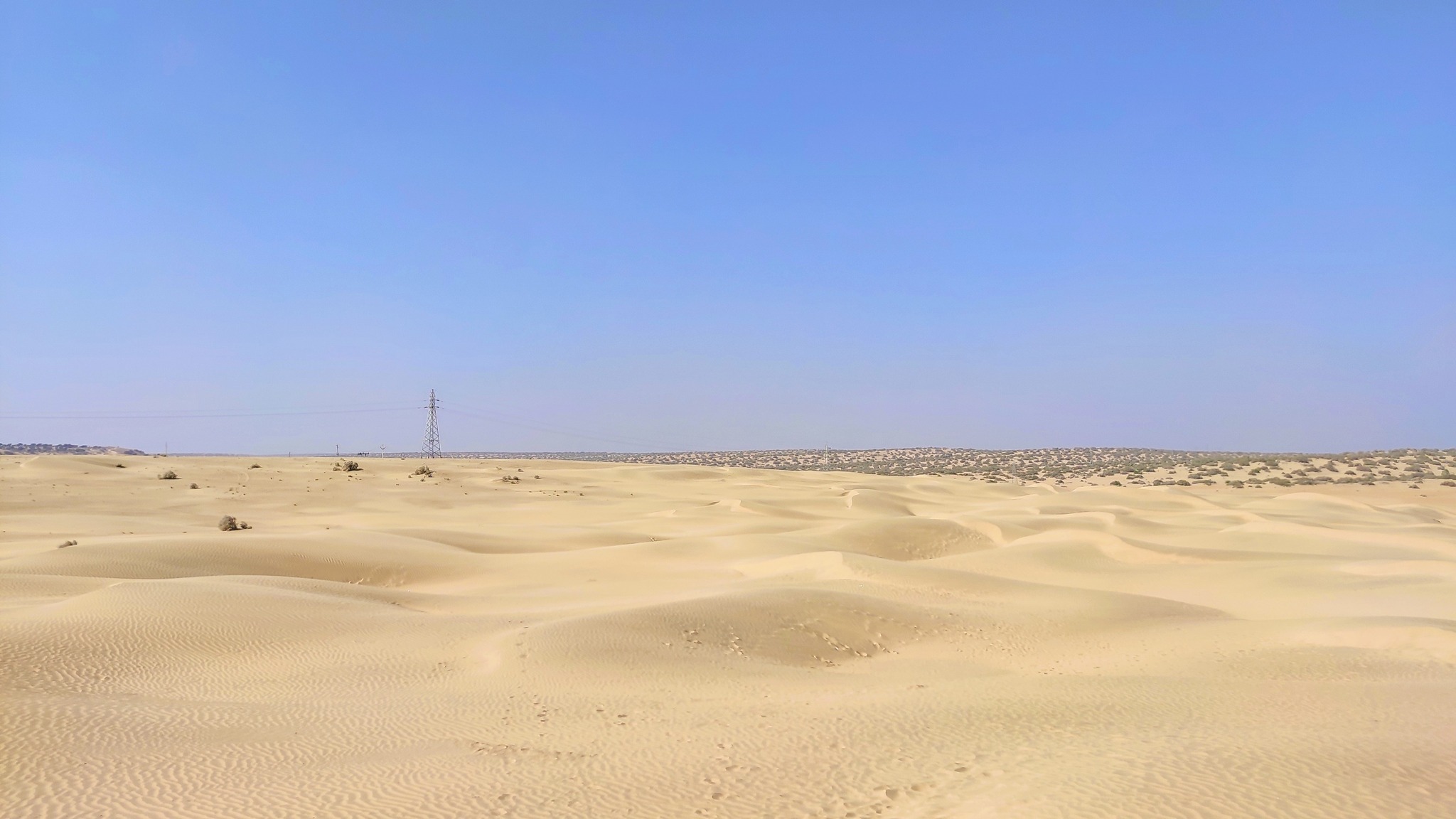
We started lazily next day, checking out of the hotel at around 11 AM and proceeded towards Tanot, stopping at places to get down to admire the desert landscape, and taking pictures of the landscape and of ourselves. By 1 PM, we reached the location that had left such a lasting impression in my mind the last time that it was the primary reason I was so excited about the trip, keen to show it to my family too. Yes, the place was Ranao, and it lived up to its promise and how!
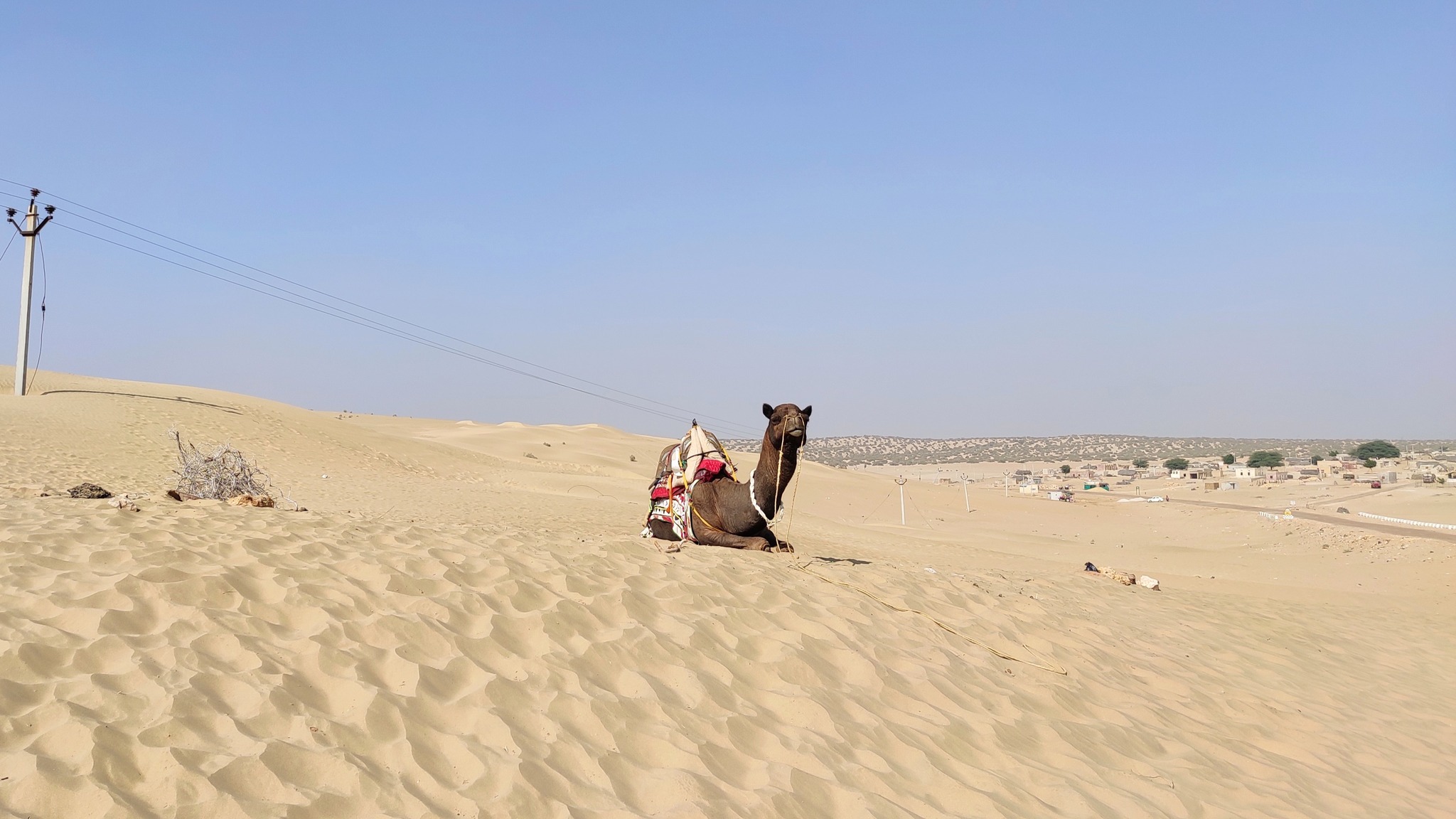
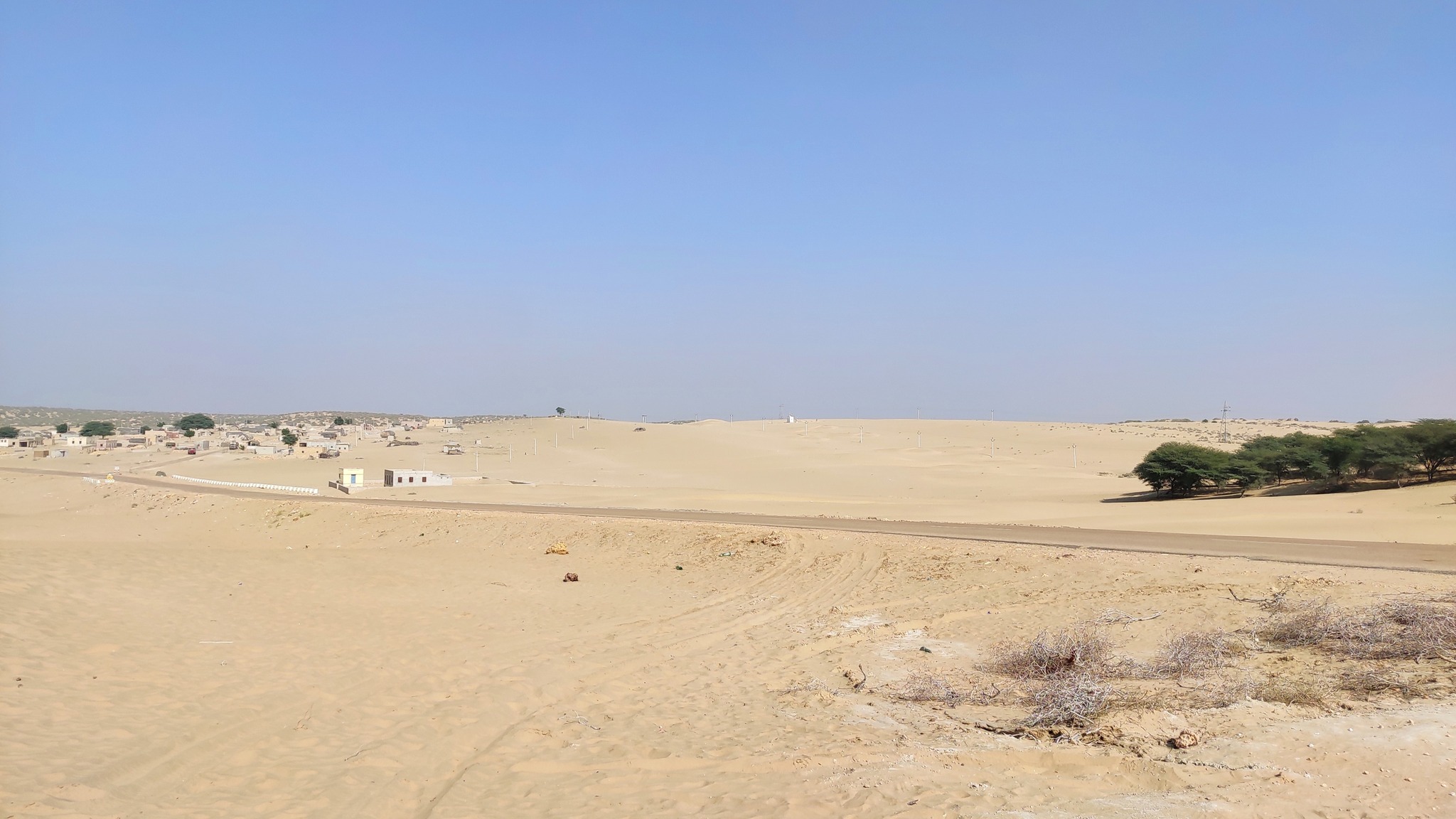
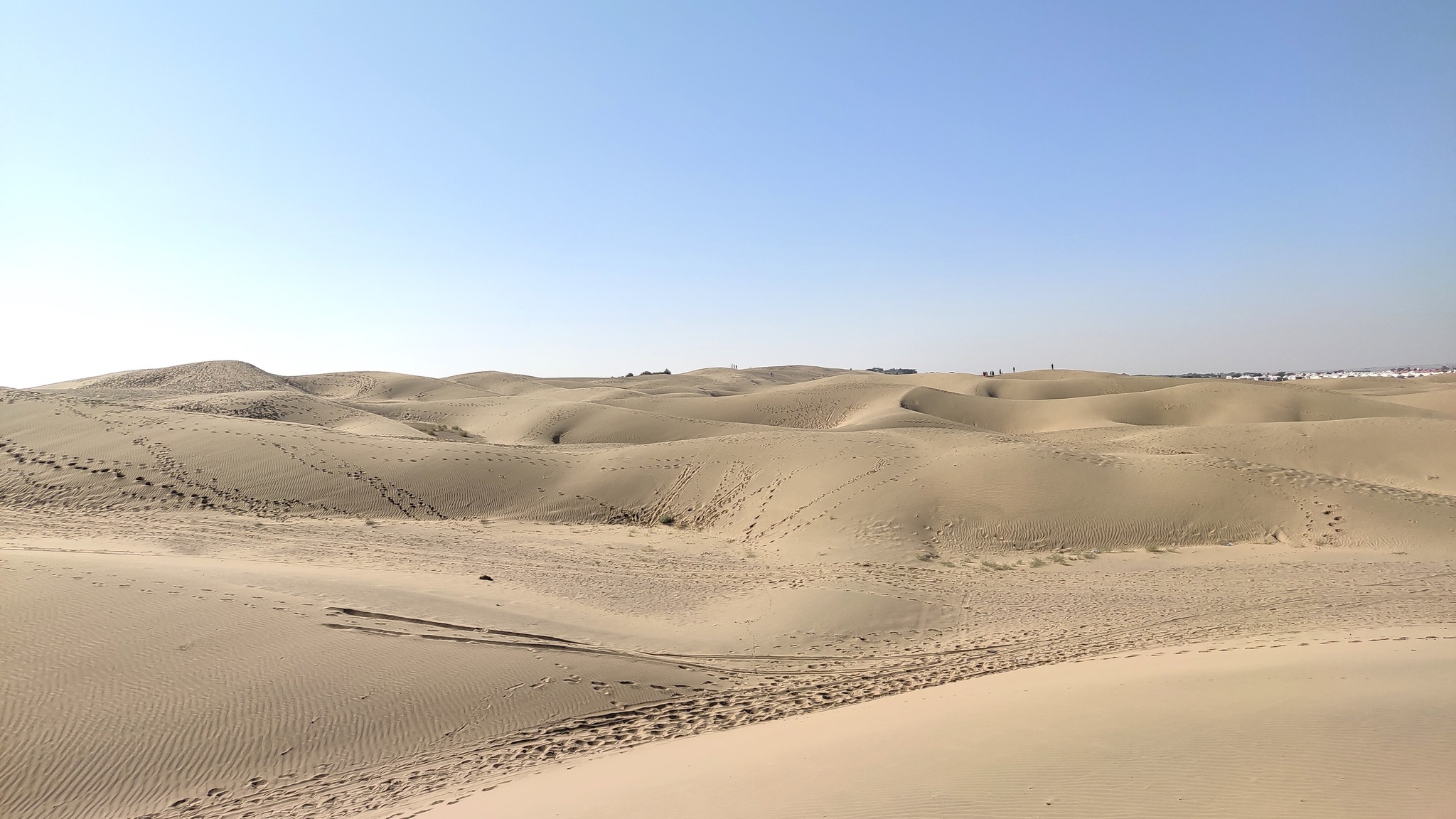
We got down at the decline before the road reached the lowermost point of the depressed stretch reminiscent of a river bed, and ventured into the sand dunes lying on the side of road, taking pictures. As we began to move on, and were almost reaching the bottom of the ‘bed’, we were hailed by a person standing beside a Bolero pick-up, who offered us a paid session of dune-bashing as well as a tour of the vestiges of the Indo-Pak war. We readily agreed, and were amply rewarded with an enriching experience as we wandered through the sands going up and down the dunes. Further, we checked out the numerous bunkers, and sat on the sands partaking of the views of the oceans of sand.
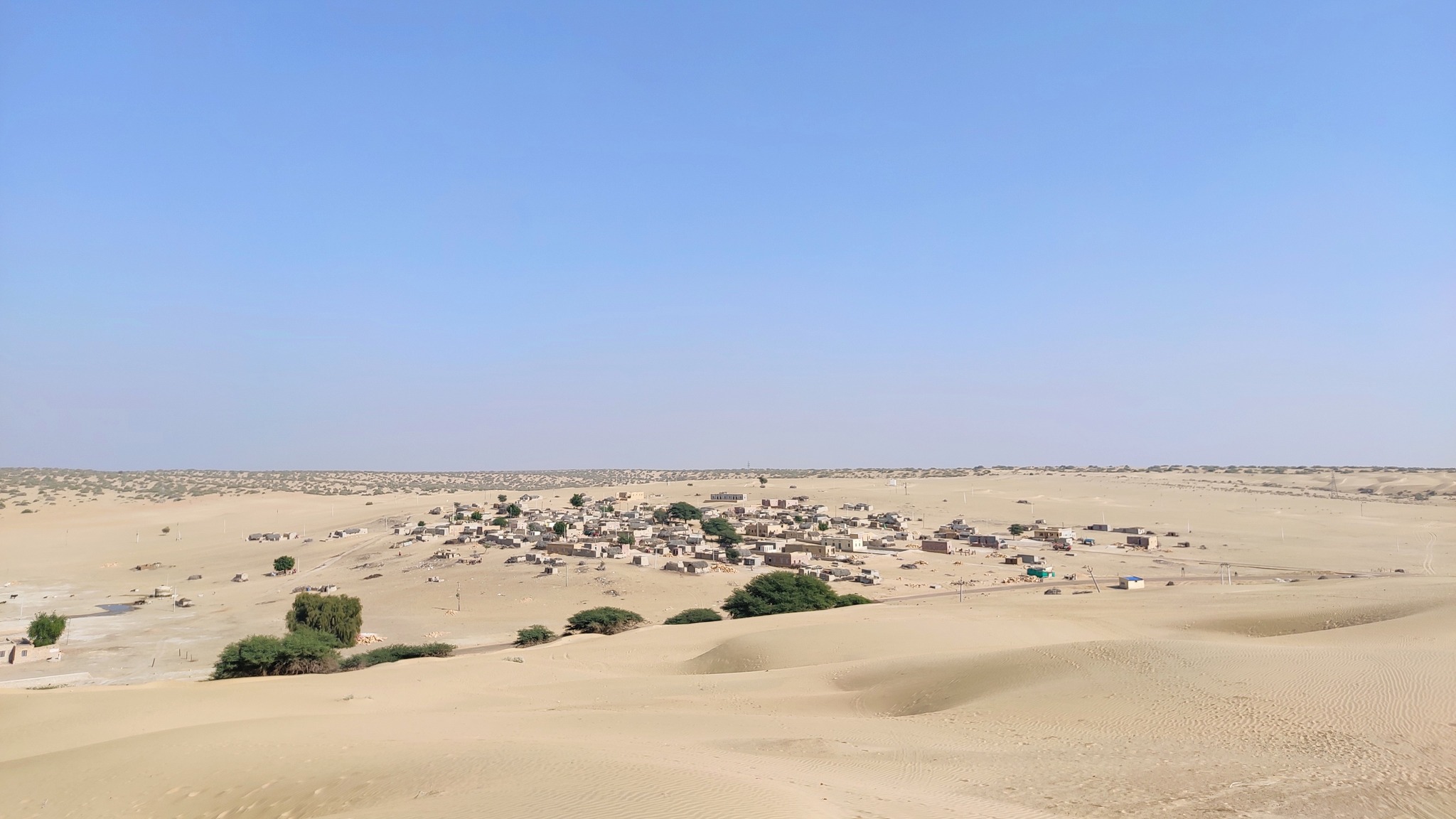
Ranao village lies in the dried ‘river bed’
A camel lounges about at RanaoA little further in the sand dunes
Deep in the sand dunes area in Ranao
A view of Ranao village from another point on the ocean of sand dunes surrounding it
Finally, even though not content, in the interest of time, we left Ranao for Tanot which we reached by 3 PM. There, having a light meal, we proceeded to Longewala moving alongside the Pakistan border, reaching at 4 PM the War Memorial where we could spend just a little over half hour as evening was fast approaching. Thereafter, we headed back in the direction of Jaisalmer, reaching Sam Sand Dunes around 6.30 PM by when darkness had already fallen. We checked in to the Vinayak Desert camp, our stay for the night, where after seeing the folk art programme and a Rajasthani buffet, we went to sleep.
Day 4: Back to Jopdhpur through Osian
Early next morning, I woke up specifically to see sun rise from behind the sand dunes, barely catching the marvellous sight. A little later, we had breakfast, and then checking out from the camp around 10 AM, proceeded to do some camel-riding near the sand dunes. After that, we were headed to the last site of our Jaisalmer leg, the ruins of Kuldhara, which was as fascinating to me this time as it was the previous two times I was here. I was glad to see the family was enamoured too.
Sunrise as seen from the Desert camp at Sam Sand Dunes
Morning at the Sam Sand Dunes
View of the ruined village from a restored building in Kuldhara
By 12, we were back again on the road headed back to Jodhpur, through a different route than the one we took for the outward leg from Jodhpur. Around 2.30 PM, we stopped at Phalodi to have lunch, and by 4.30 PM, we were at Osian. Osian, dubbed an oasis in the Thar, was a major religious centre of the Gurjara-Pratihara period dating from the 5th to 12th century AD, and had been a trading centre from well before that, at least from the Gupta period onwards. Today, the ruins of Jain and Hindu temples from that period stand witness to its glorious past. The Oswal community is said to have originated from Osian.
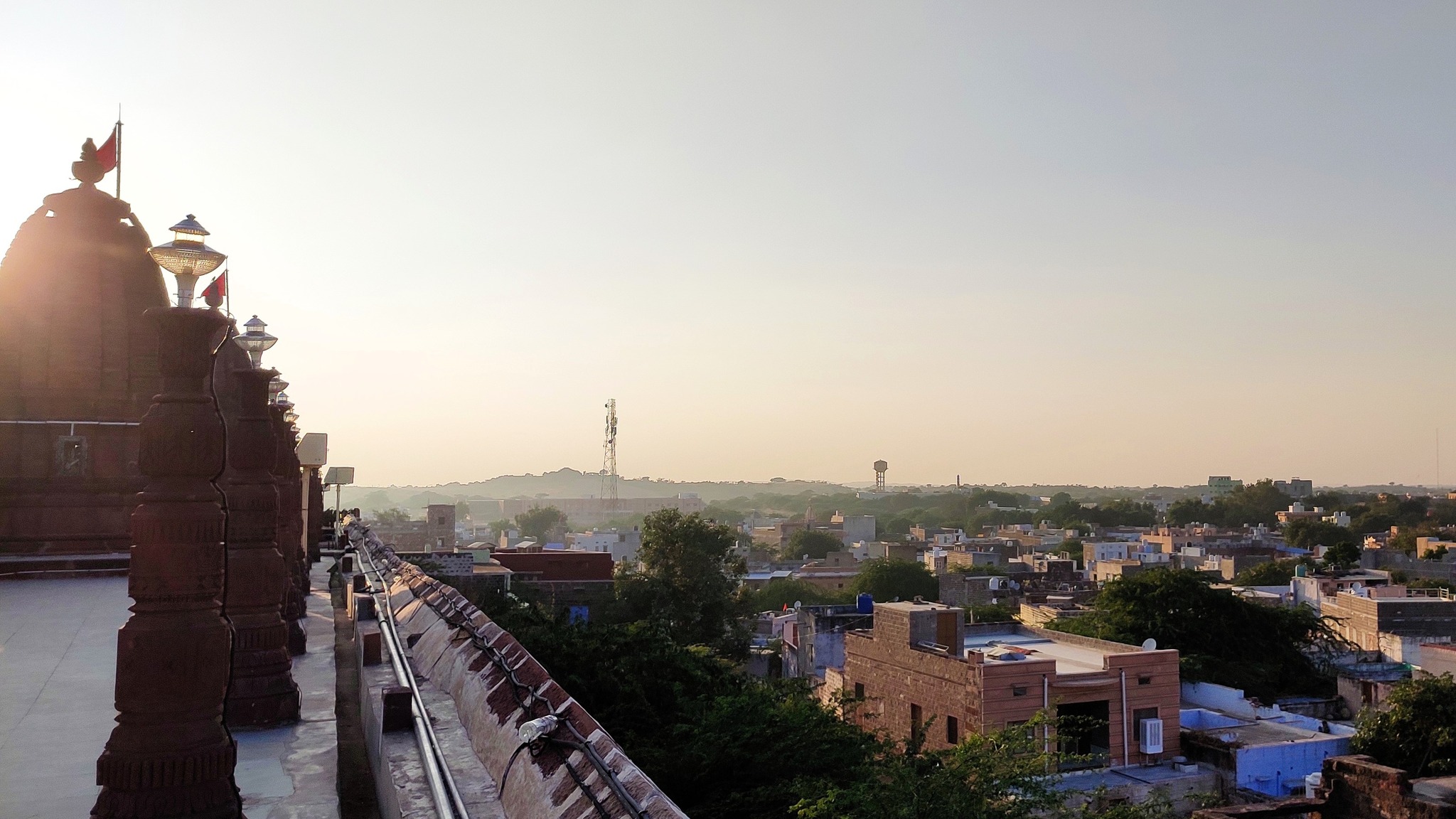
At Osian, we visited the Sachiya Mata temple – Sachiya Mata being the town deity, who as per Jain legend is the form of Chamunda that was turned vegeterian by Acharya Ratnaprabhasuri in 457 BCE. As a result, Sachiya Mata is worshipped also by Jains, and the temple itself has many Jain features. From the temple which is situated on a hillock affords a panoramic view of the landscape beyond the town, including the sand dunes located on the outskirts of the town. Apart from the Sachiya Mata temple, I managed to get a glimpse of a few other temples, including the ruins of the Harihara temple, Vishnu temple and Sun temple that were located on or in the vicinity of the main road.
View of Osian town and beyond from Sachiya Mata temple premise
A ruined temple in OsianA ruined temple in Osian
By 5.30 PM, we had to leave Osian as it was getting dark and we had a train to catch from Jodhpur. We caught the 8.30 PM Mandore Express from Jodhpur and reached Gurgaon the next morning, still delirious from the memorable family expedition into the Thar desert.
Inspired by the experience of spending Diwali in the hills the previous year, I decided to spend the Diwali this year too at an interesting place. The place was not very hard to choose, as I had been planning to take my parents to Udaipur soon, and thought it would be wonderful to see Diwali over Lake Pichola.
Accordingly, a fortnight before Diwali, seeing a great deal for the day, for which most hotels were already booked or overpriced, I booked a room in Hotel Thamla Haveli that stands right on the bank of Lake Pichola exactly opposite the Gangaur Ghat. On the other hand, not getting tickets on the Chetak Express, the only train connecting Gurgaon and Udaipur, I improvised and booked tickets on a 2 PM train instead from Jaipur, which we would reach by bus.
Day 1: Off to Udaipur
On the day preceding Diwali, we reached our designated pick-up point at Rajiv Chowk around 6 AM, only to learn that we had left behind the food Mother had painstakingly cooked and packed for the journey. So, I rushed back home, which thankfully was only one-and-a-half kilometers from our bus-stop, to pick up the food, and was back in time to catch the bus.
Relishing the views of the Aravallis and the countryside on the way, we reached Jaipur at 12, catching the train to Udaipur as planned. This being a day train, we had the opportunity to see the landscape the railway line passed through, including the topography of areas around Ajmer, where I felt a strong pang of desire inside me to visit Ajmer sometime soon. We reached Udaipur around 9 PM and soon checked-in to a hotel near the railway station.
Day 2: Diwali in the City of Lakes
The next morning, i.e. on Diwali day, after breakfast, we checked out of the hotel and moved over to Thamla Haveli, checking-in around 11.30 AM. We were quite pleased to know that the window of our room opened to, and in fact, hung right over the Pichola lake – if you fell from the window, you drop right into the water! Then, we checked out Ambrai Ghat, which was only a 200 metre walk from our hotel and gave us an exhilarating view of the City Palace sitting across the Pichola Lake.
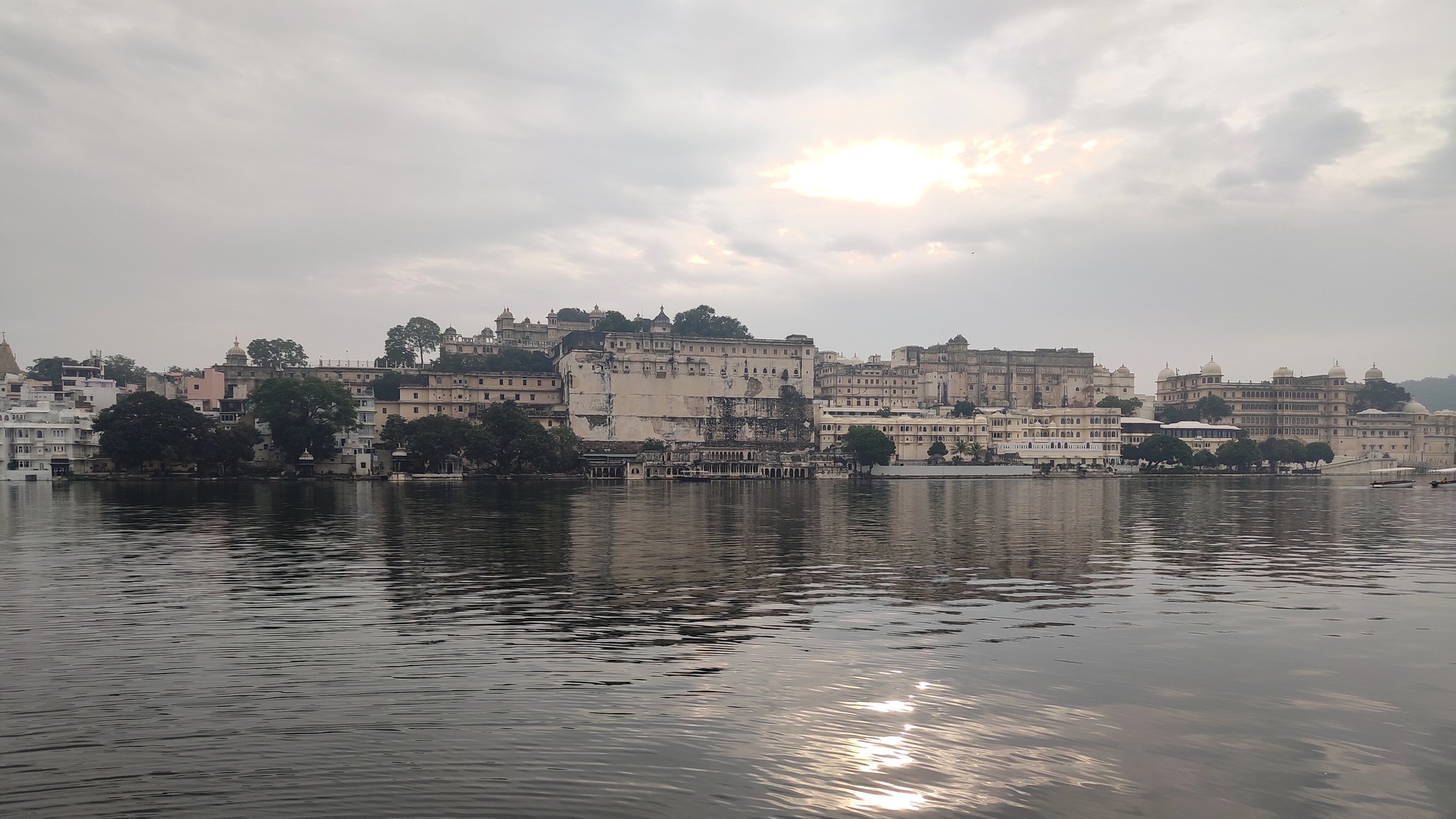
Morning at the Ambrai Ghat on Lake Pichola, Udaipur
After that, we hired an autorickshaw to show us around Udaipur the whole day, and first proceeded to Sajjangarh Palace, a monsoon palace that stands on the top of a hill, overlooking the city and the Fatehsagar and Pichola lakes. From the terrace of the palace, we also got breathtaking views of the Aravallis. Descending from Sajjangarh Palace, we had lunch near Saheliyon ki Bari, an early 18th century garden, which we visited next. Next up was the City Palace, which I was seeing for the fourth time in as many visits. We ended the day by visiting the Jagadish temple, which stands right on the road that the Palace tour exits to.
Saheliyon ki Bari, Udaipur
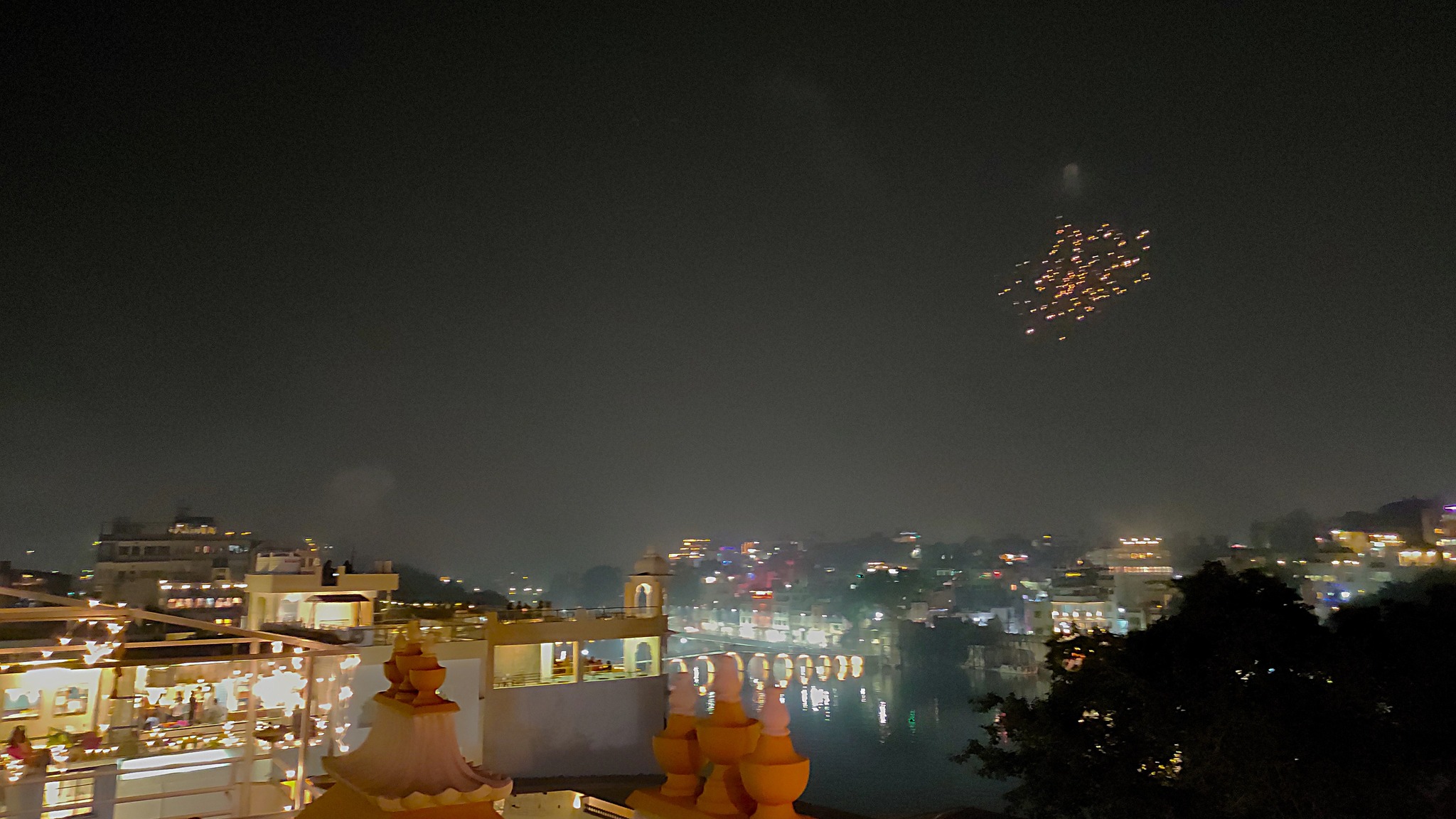
Back at the haveli, from our window we were treated to the electrifying sights that we had hoped to see – the fireworks going over the skyline across the lake, with their reflections sparkling over the lake’s surface. As we climbed to the rooftop restaurant for dinner, we were rewarded with even clearer views of the Diwali celebrations. We finally went to sleep, as Diwali celebrations drew to a close.
The city and sky are lit up on Diwali night, as seen from Thamla Haveli, Udaipur
Day 3: An Excursion to Kumbhalgarh
The next morning at 7.30 AM, we walked to the Ambrai Ghat again and were mesmerized by the views of the city palace bathing in the morning sun. Soon after, I booked an outstation Ola cab after some struggle, to take us to Kumbhalgarh. Starting at 11 AM, we drove for about two hours, mostly through the Aravallis, to reach Kumbhalgarh fort which was taking forever to appear. However, given the scenic beauty on the road, the drive was not that boring after all.
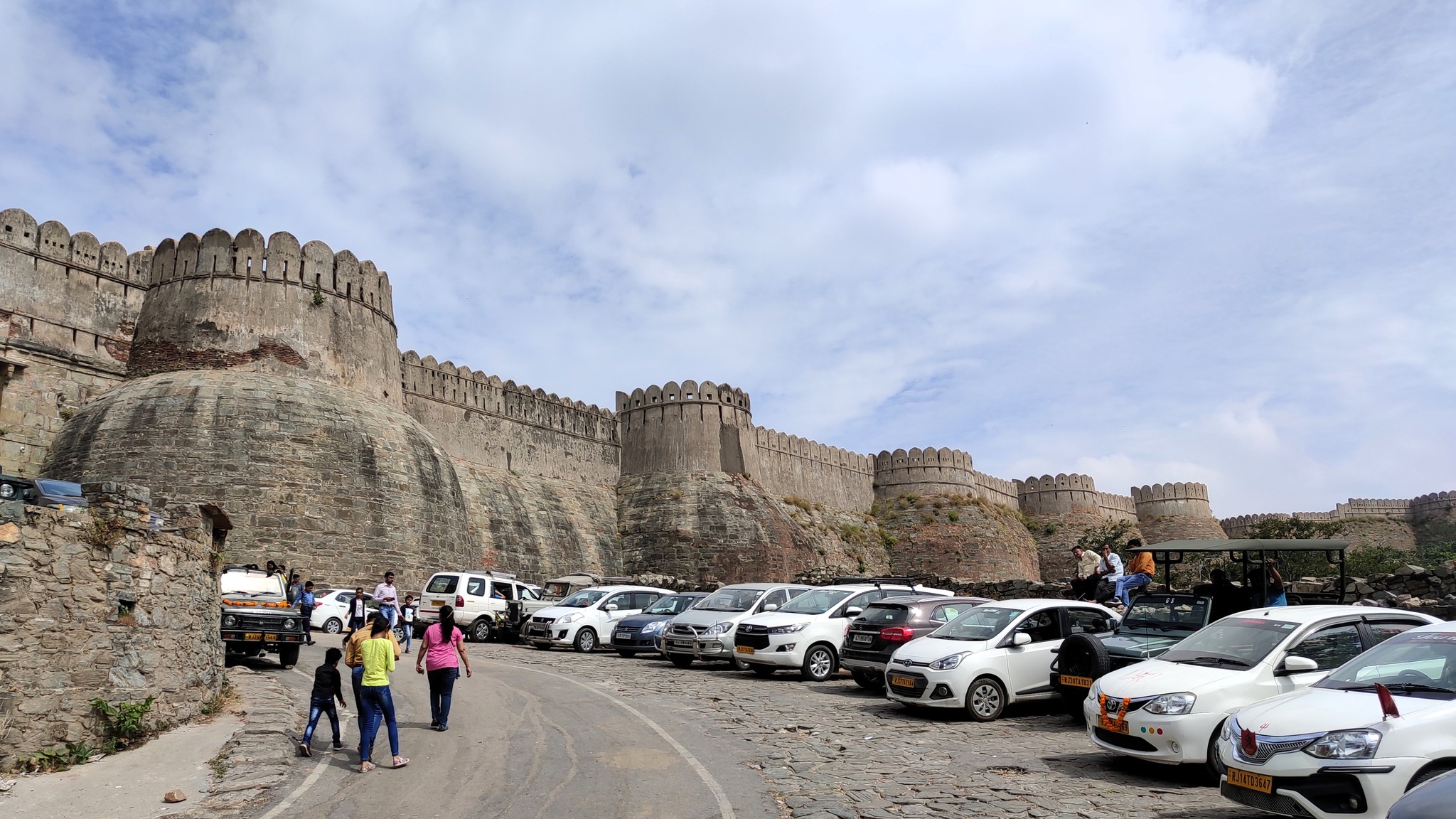
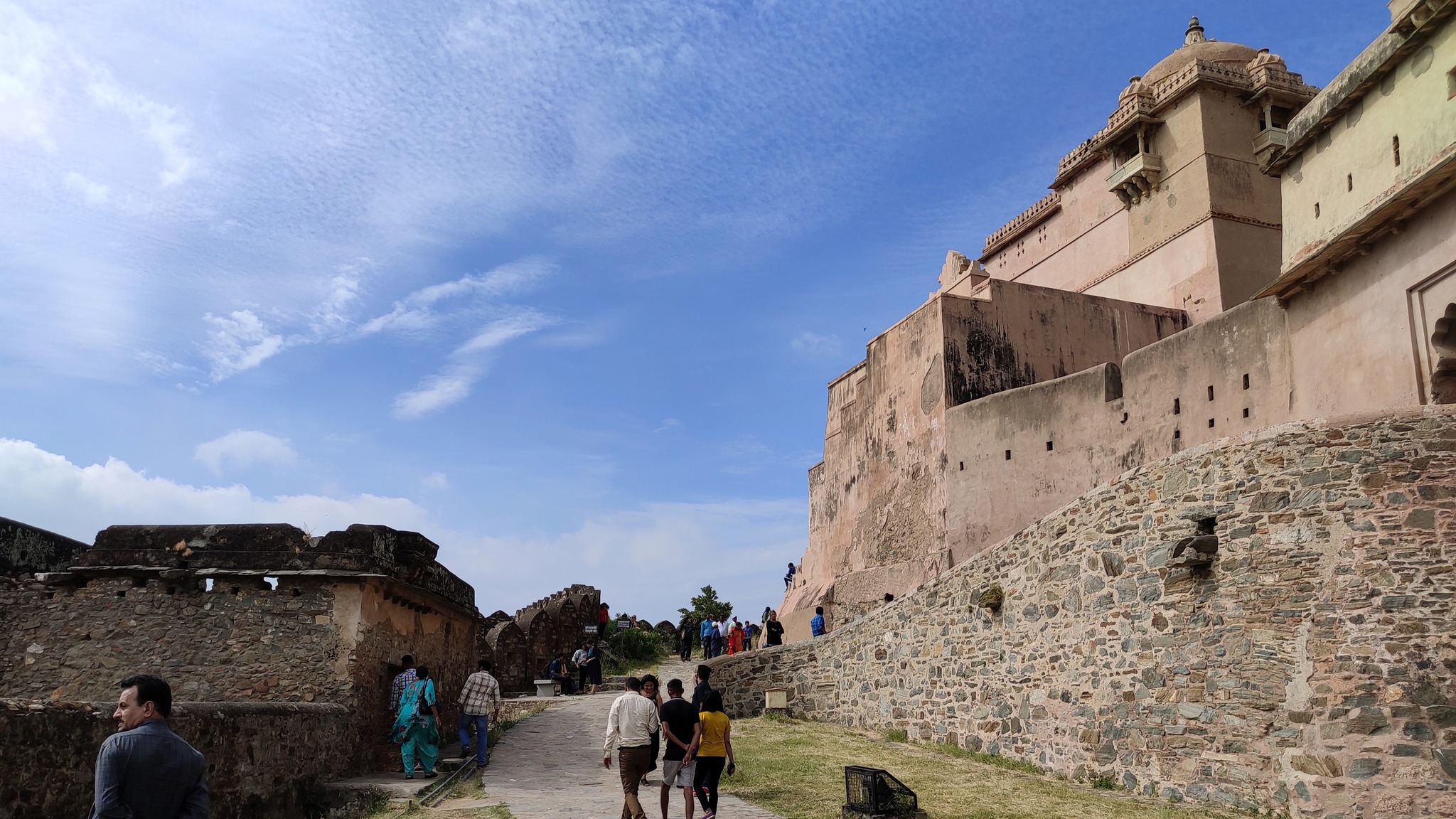
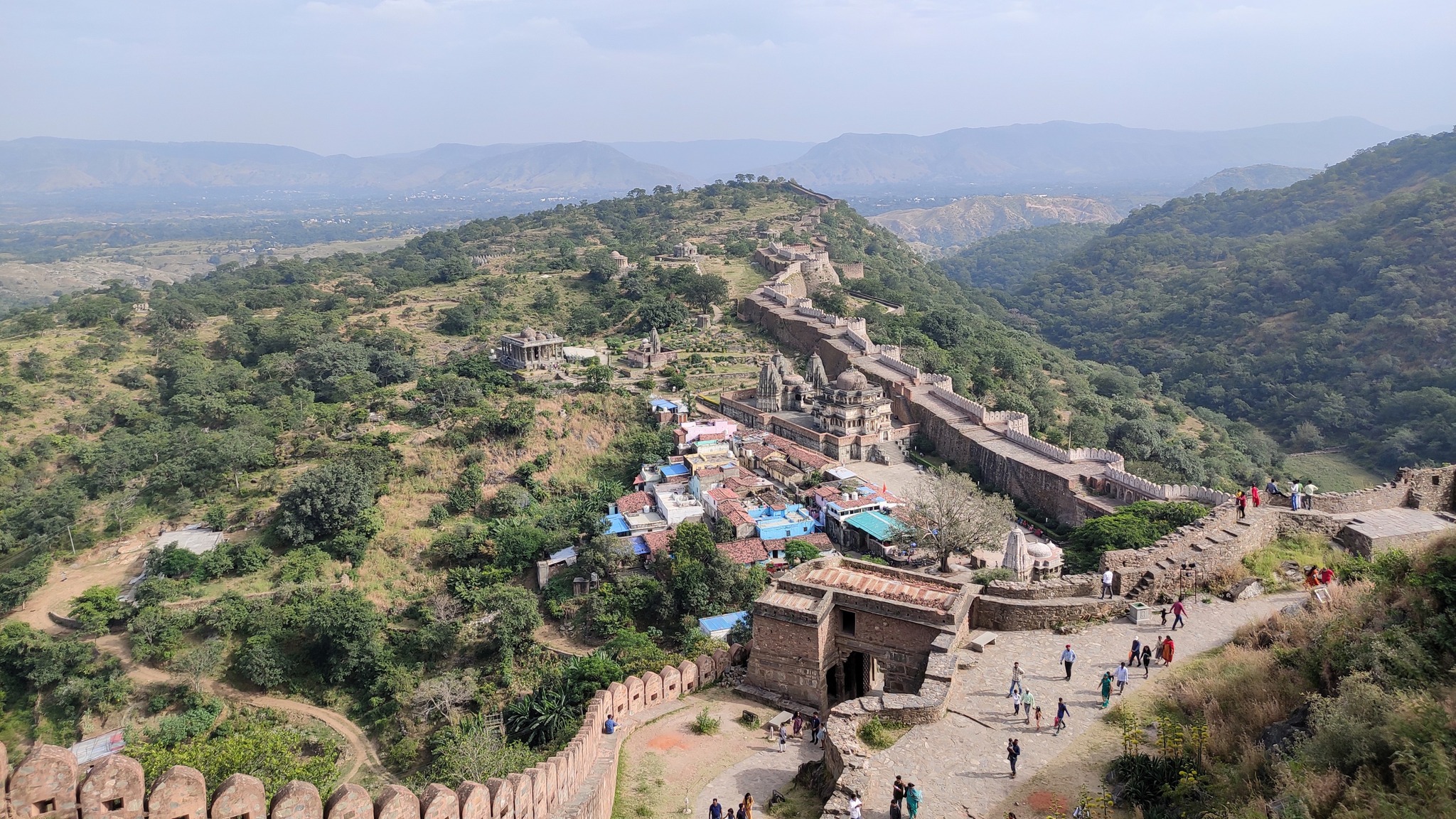
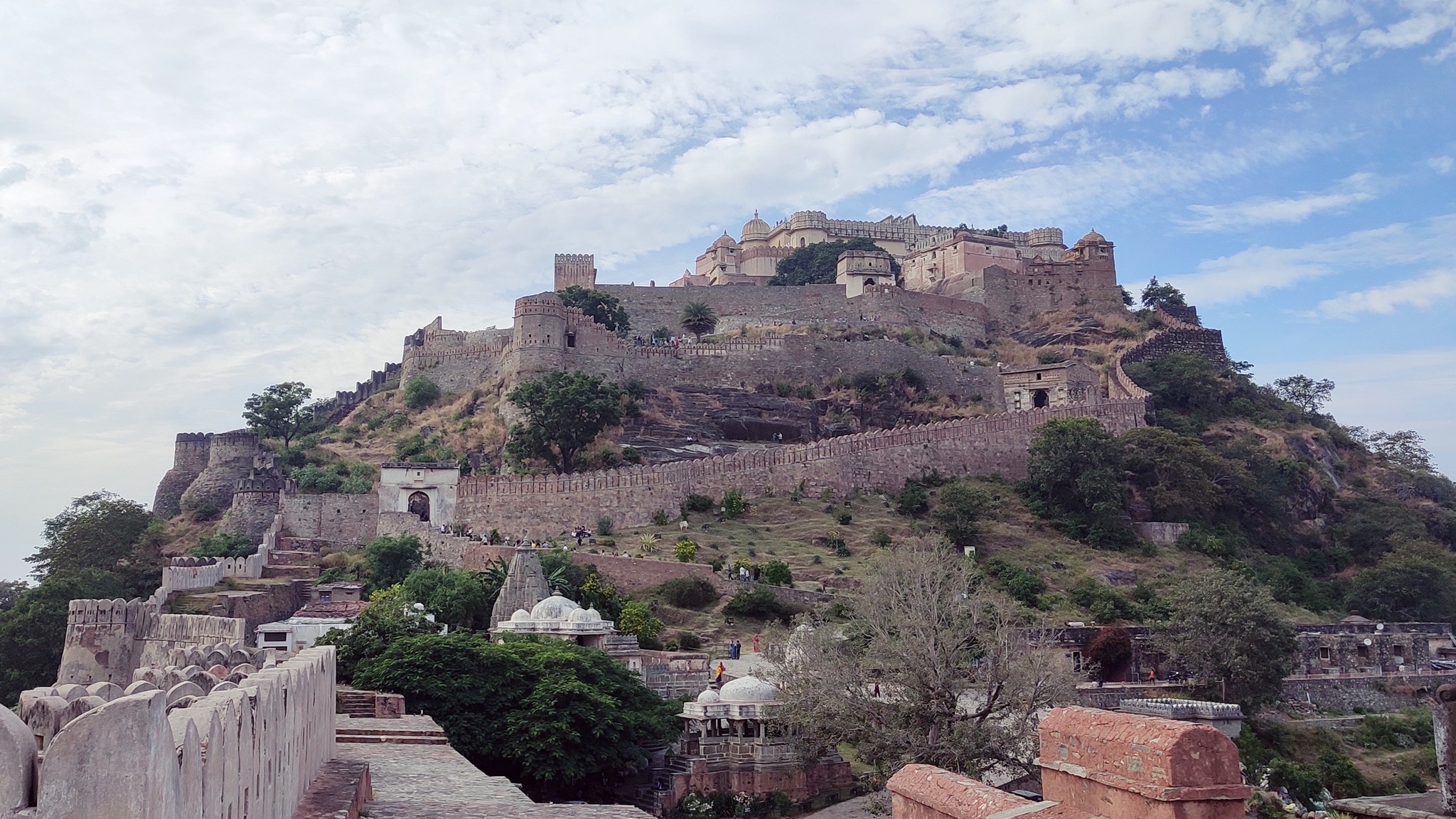
This being our first ever visit to Kumbhalgarh, we took the guided tour savouring every nook and cranny of the palaces and every bit of information dished out by the guide. From the rooftop of the Badal Mahal, we beheld the most magnificent views of the Aravallis and the Marwar plains beyond. Before we realized it, we had already spent two hours.
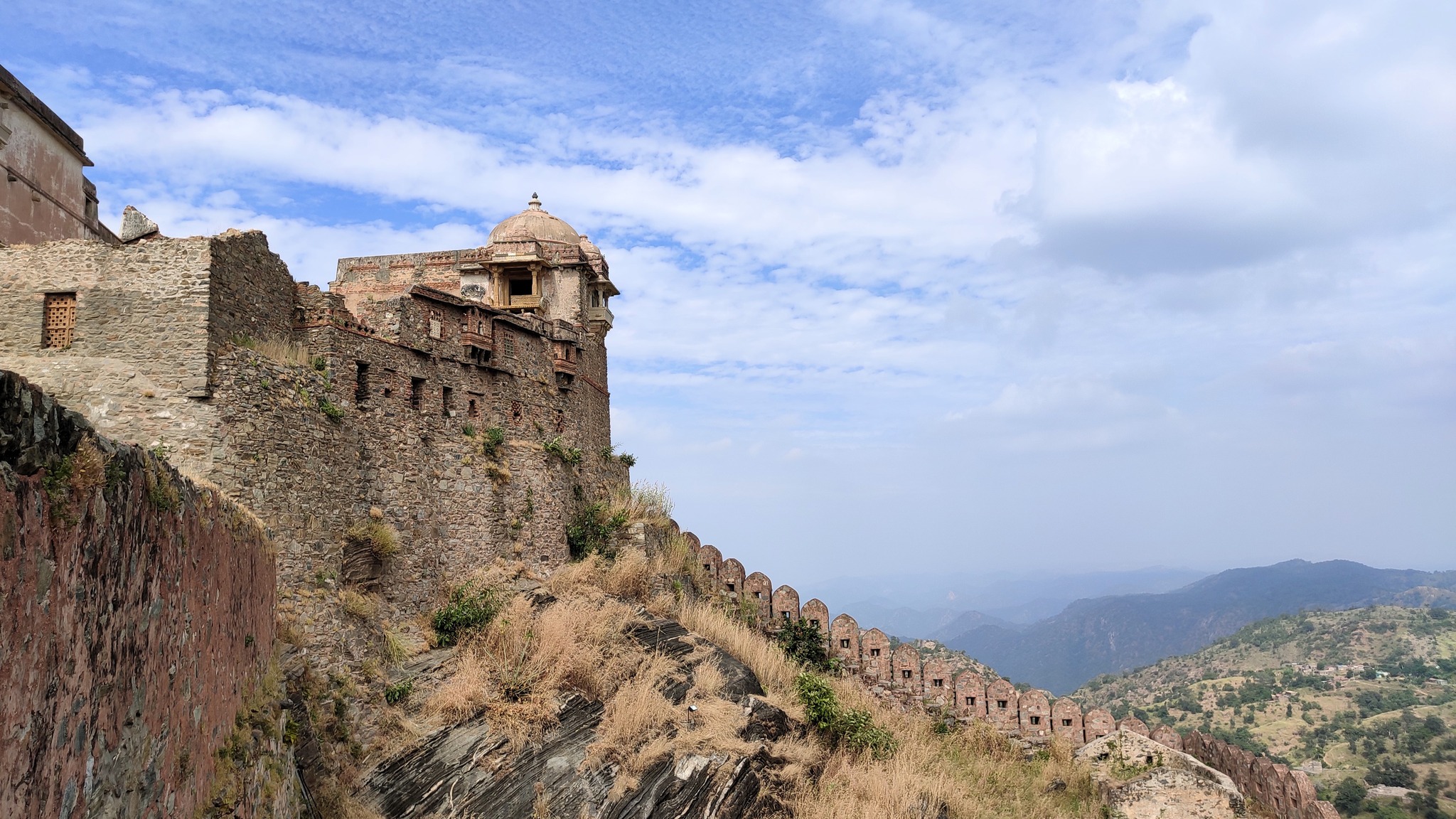
Descending from the palace, after a quick light meal at one of the shanties located inside the fort premises, we checked out the Vedi temple, and other nearby temples, and capped off the fort visit with a walk along the famed fortress wall of Kumbhalgarh, from where one gets a clear view of the palaces sitting on the hilltop.
Entering Kumbhalgarh fort
Rana Kumbha’a Palace as seen while climbing upApproach to Badah Mahal, Kumbhalgarh
Vedi temple and other temples alongside the famed wall as seen from the approach to the palace
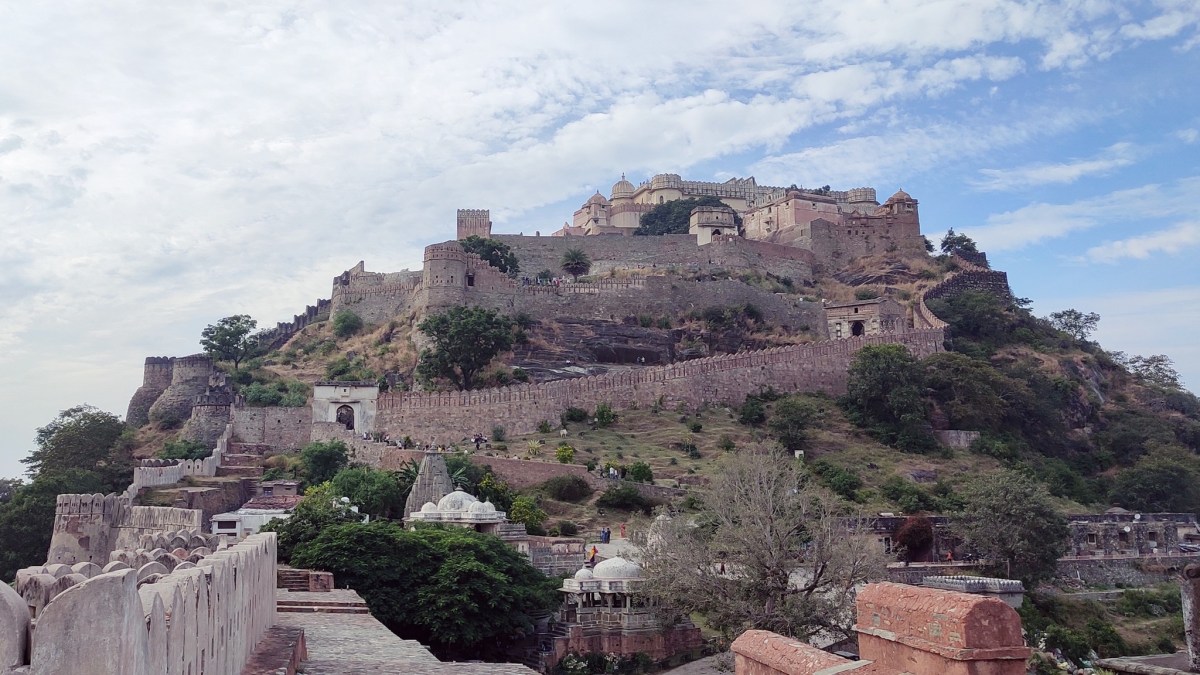
The fort palaces as seen from the fort wall, Kumbhalgarh
Glimpses of Kumbhalgarh fort
By now, it was already 4 PM, leaving us with little for the next stop on our itinerary, Ranakpur. In any case, any possibility of seeing Ranakpur was nipped in the bud shortly, when our cab driver refused point-blank to drive through the hills to the famous Jain temple, on account of the impending darkness, compounded by the fact that the temple closes by 5 PM anyway.
So, we had to leave Ranakpur for another day, another trip! Returning to Udaipur by 7 PM, we checked in to Broadway Hotel near Saheliyon ki Bari, and retired for the day after dinner.
Day 4: Exploring Nearabouts: Eklingji and Haldighati
The next day began with yet another struggle to obtain a confirmed booking for an Ola outstation cab, which I managed to get after attempting for about an hour. Given the dire circumstances, we had to leave out Nathdwara temple from the itinerary, opting instead to go to Eklingji. We finally managed to hit the road at around 10 AM, heading to and reaching Eklingji just in time for the darshan starting at 10.30 AM.
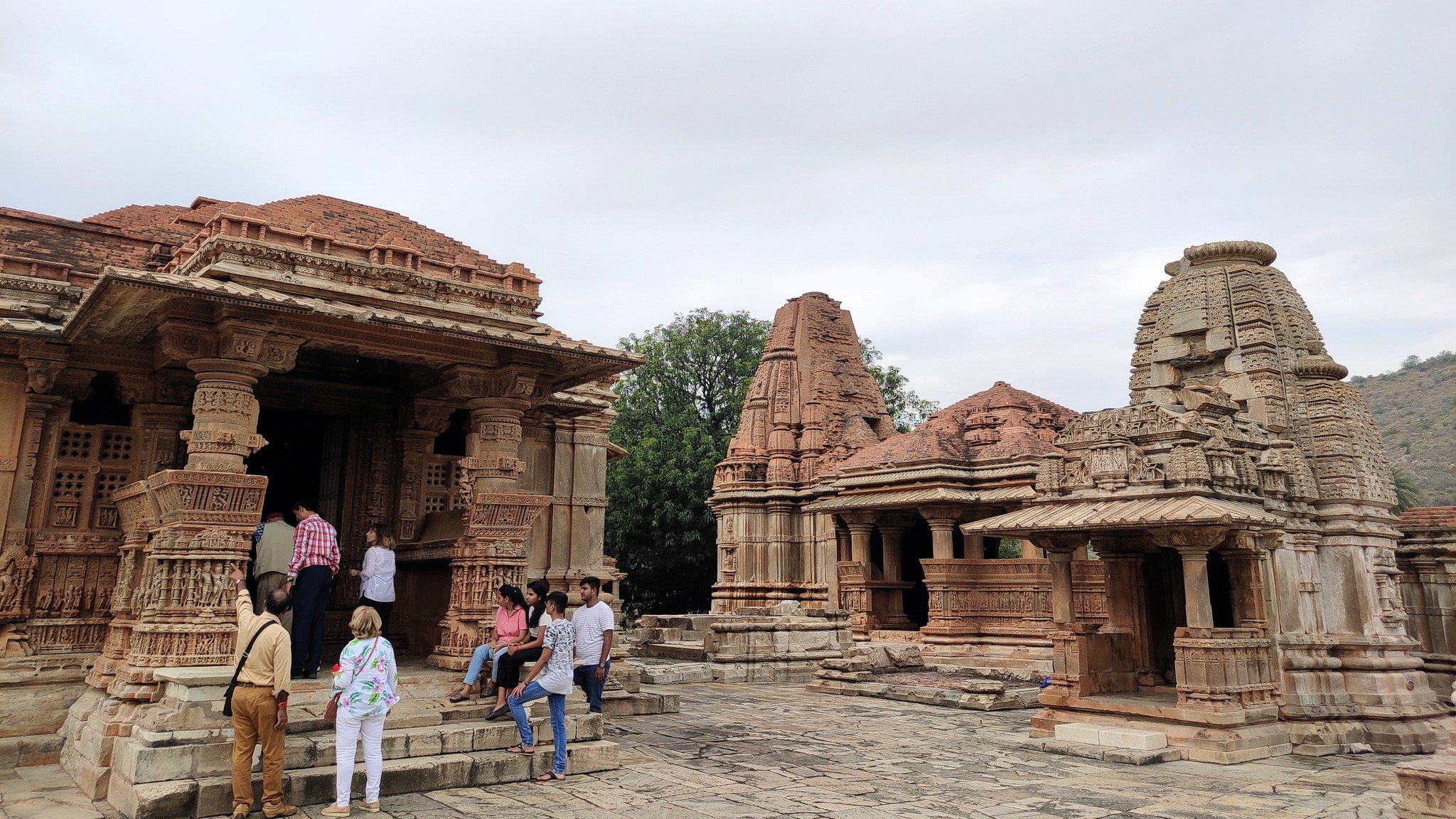
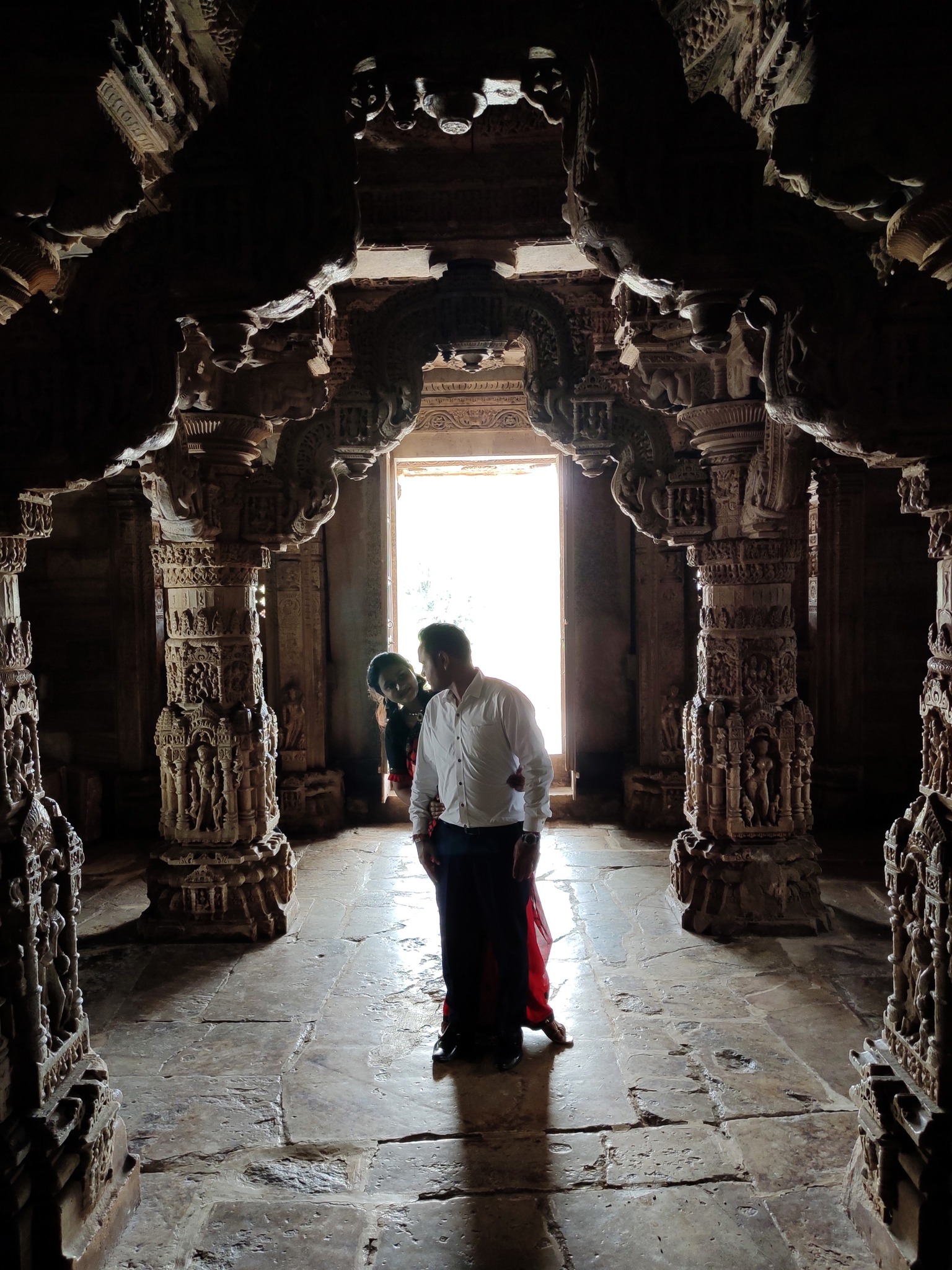
From the Eklingji temple, we proceeded to Sahasra Bahu temples at Nagda, a couple of kilometers away, which comprises a pair of 10th century Vishnu temples. The site seemed to be a popular spot for pre-wedding shoots. Thereon, we drove on to Haldighati Musuem, where we went through memorabilia related to Maharana Pratap, had our lunch, and proceeded to the Haldighati Pass. Turning back, we got down at Udaipur railway station , where we caught the 6:15 PM train to Chittaurgarh, reaching the latter after two hours.
The Sahasra Bahu temples, Nagda
A popular spot for pre-wedding photoshootsIntricate work on the temple walls
The Sahasra Bahu temples from another angle
Day 5: On to Chittorgarh
Next morning, I was back again at the place that I love most in Rajasthan – Chittorgarh, for the third time, but it still felt like I was coming here for the first time! We booked an auto-rickshaw whose driver doubled up as our guide, and took us around the fort area which in itself feels like a self-contained region, with a populated area on one side, and the remaining area covered with forests, including a deer sanctuary, and sprinkled with palaces, temples, towers and water tanks.
We started off with the Kubhashyamand Meera temples, then rode over to Vijaya Stambh, then saw the Jauhar kundand Samadhisvara temple. For there, we moved to the to Kalika Mata temple, and then Rani Padmini Palace. Then taking a wide curve, we switched to the other side of the hill, where we saw the fort’s main entrance gate, Suraj Pol, while also being treated to a breath-taking view of sparsely populated valley below. We then went over to a handicrafts shop, where we bought some scented silk fabric items.
By 1 PM, having completed one full round around the periphery of the fort, it was time leave, with a heavy heart, as far as I was concerned. Nevertheless, down in the city, we had a Rajasthani meal, and were in the railway station at 2.30 PM.
Chittorgarh fort sits atop of the flat long hill, as seen from Chittorgarh railway station
With part of our return train journey happening in daylight, we were again able to enjoy the interesting landscape, especially as we neared Bundi, where the railway line descended to the barren escarpment below. Then entering a tunnel, the train emerged out to amble along the edge of a reservoir on the other side of which ran the Aravallis. As we reached Kota, night had fallen, and when we opened our eyes early next morning, we were already approaching Gurgaon.
In end-August, we planned a weekend excursion to the erstwhile Hadauti region, centred around present-day Kota. Taking the 3.35 PM Garib Rath from Delhi, we reached Kota by 8 PM, and promptly checked-in to a hotel.
The next day, we booked an outstation Ola taxi, and headed off to first see the Kota Garh Palace standing on the edge of a canyon on the Chambal river. With origins in the 13th century, the fortified palace served as the residence of the Raos and Maharaos, the rulers of the kingdom of Kota. The ground floor is converted into a musuem, while many of the palaces are open to the public – from one of the palaces, the Kota Barrage and Kota river are visible.
The Kota Garh PalaceIn one of the rooms in Kota Garh Palace
View of the Chambal from a balcony in Kota Garh Palace
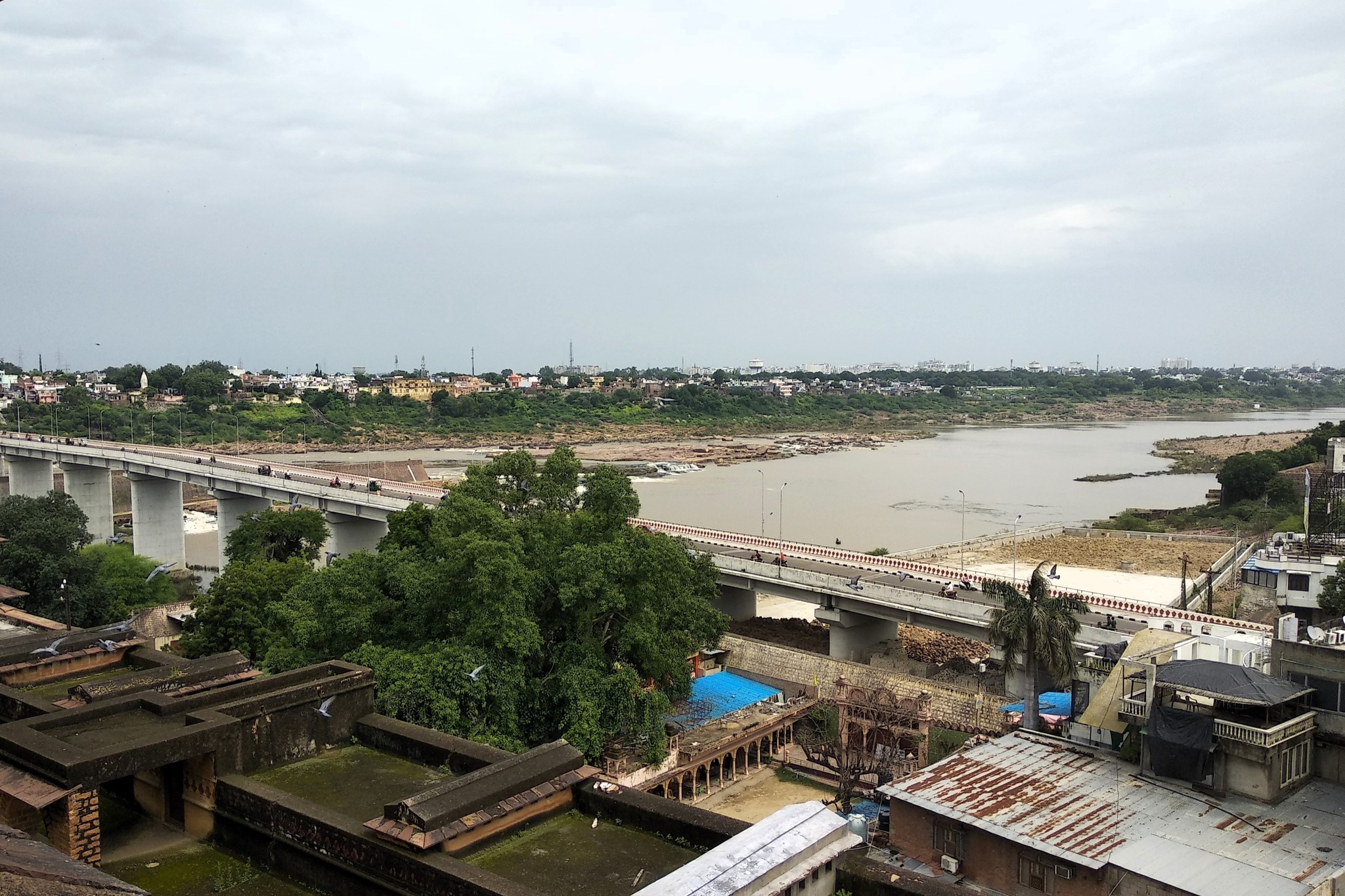
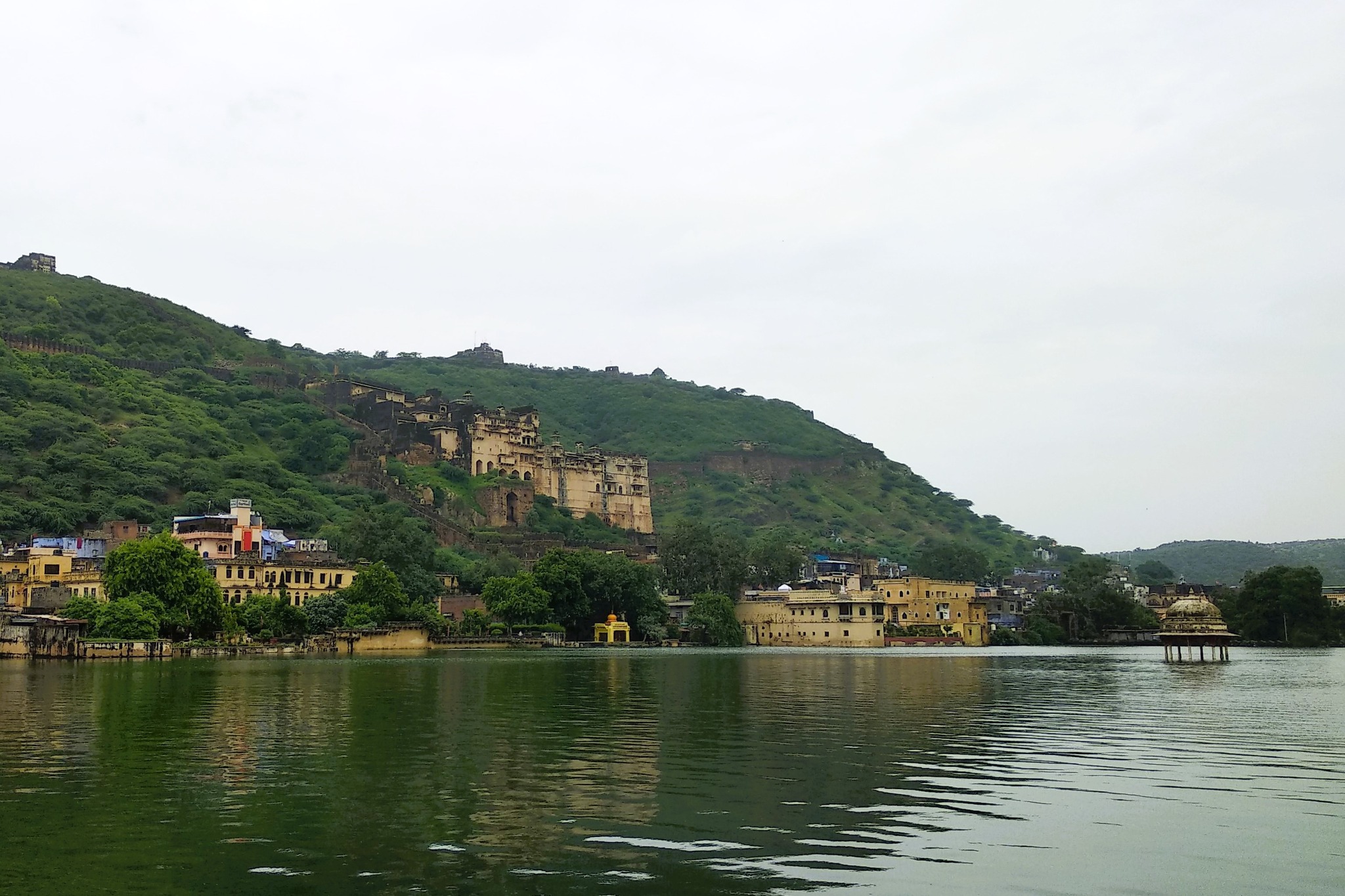
A little later, crossing the mighty Chambal river, and riding for some time, we passed through a tunnel in the Aravallis, and then climbed up a pass in the hills, before we saw a most fascinating sight of a yellow-coloured multi-storeyed structure with balconies, windows and domes etched at a height against the hillside, separated from the road by a large pond with a cenotaph in the centre.
The Bundi Garh Palace beckons from across the pond
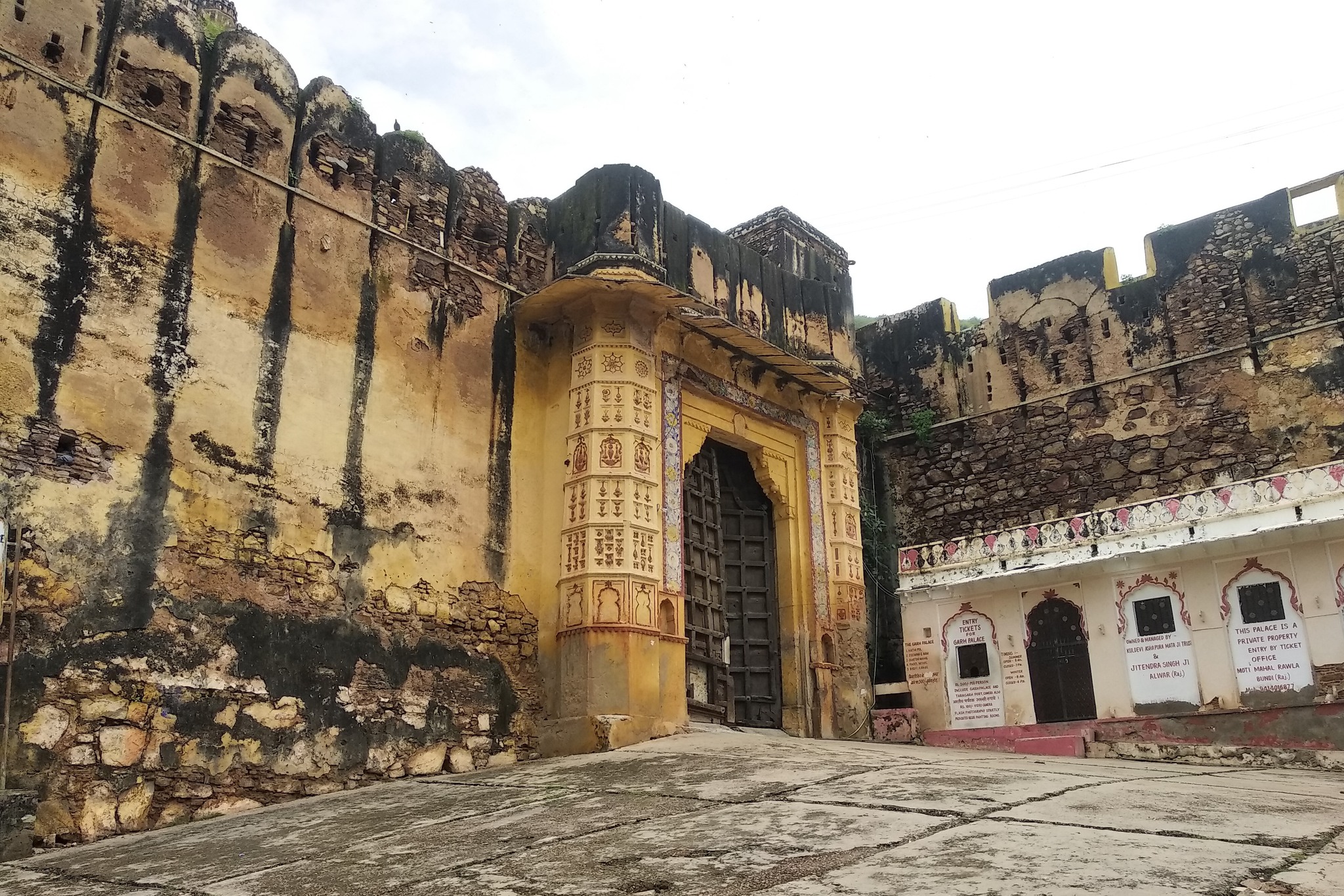
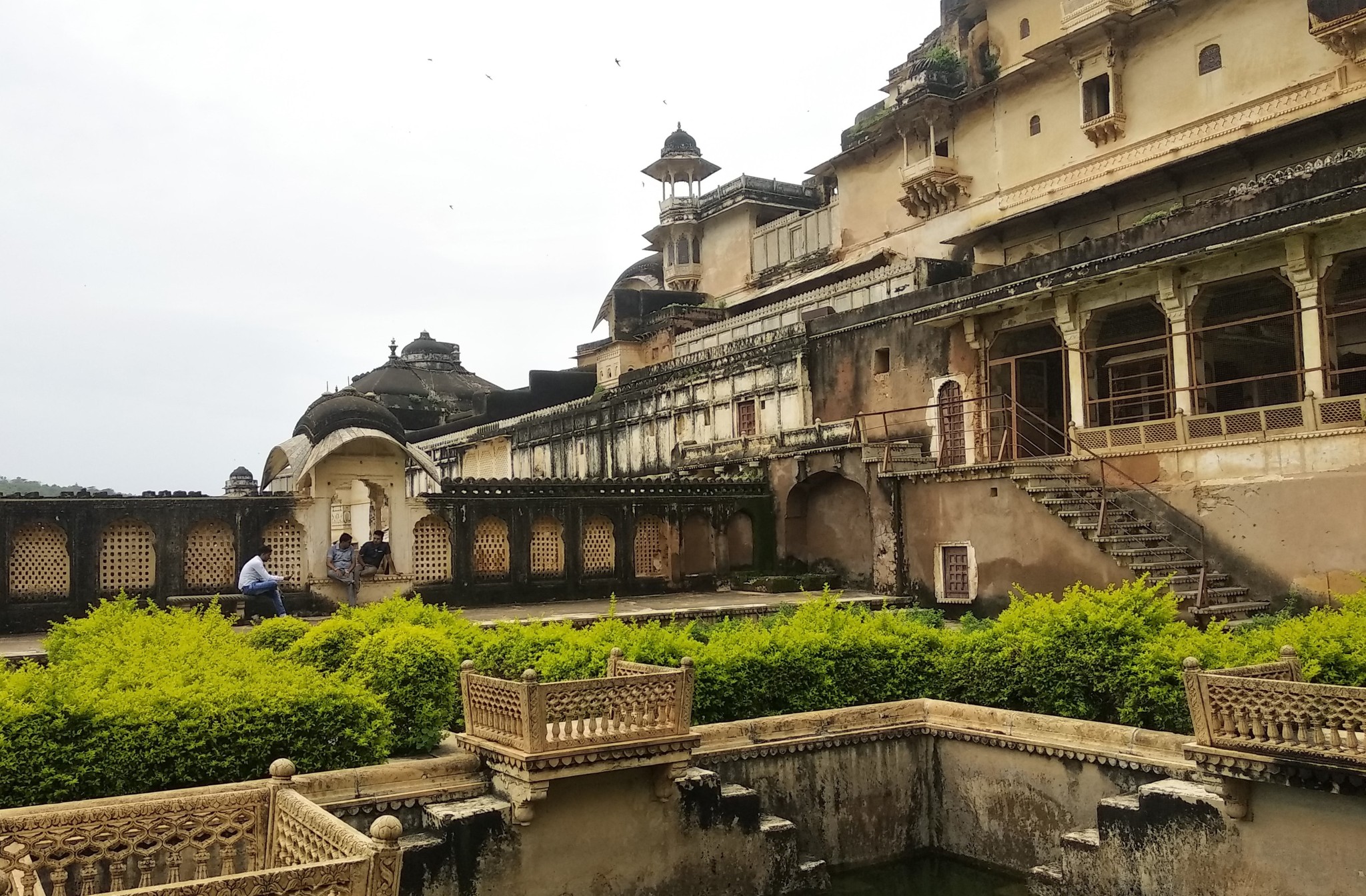
Winding around the pond, we entered the narrow lane of the village located at the foothill, and then rode up a steep incline to reach the large front gate of the Bundi Garh Palace. Soon, we were inside the precincts of the fortified palace, climbing up the winding, steep stony path, admiring the tall walls of the palace hanging on the cliff. Then, we encountered a final tall arched gate that led us into the Garh Palace’s courtyard.
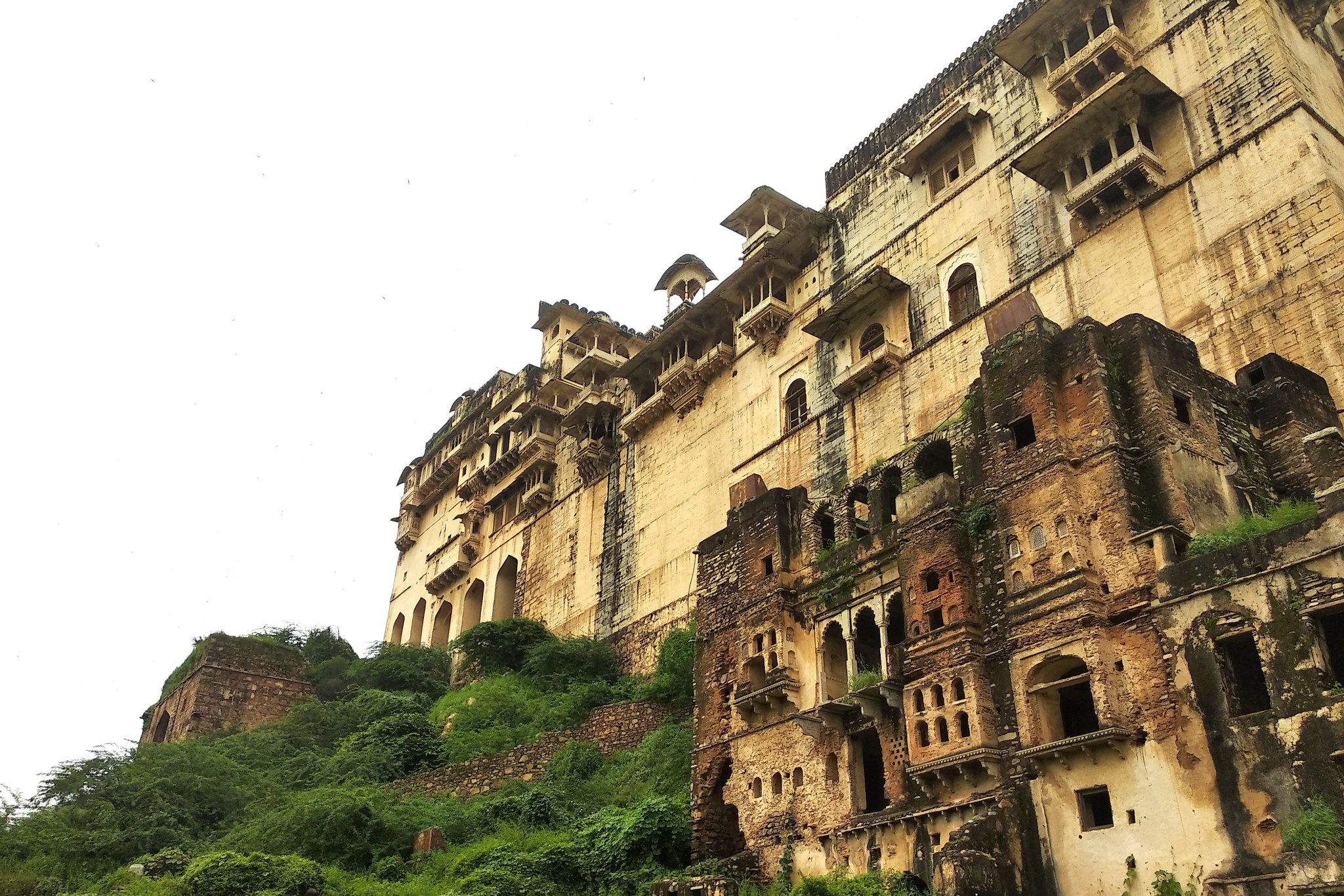
Main outer entrance of the Bundi Garh Palace The imposing sidewall of the Badal Mahal
Main inner entrance of the Garh Palace
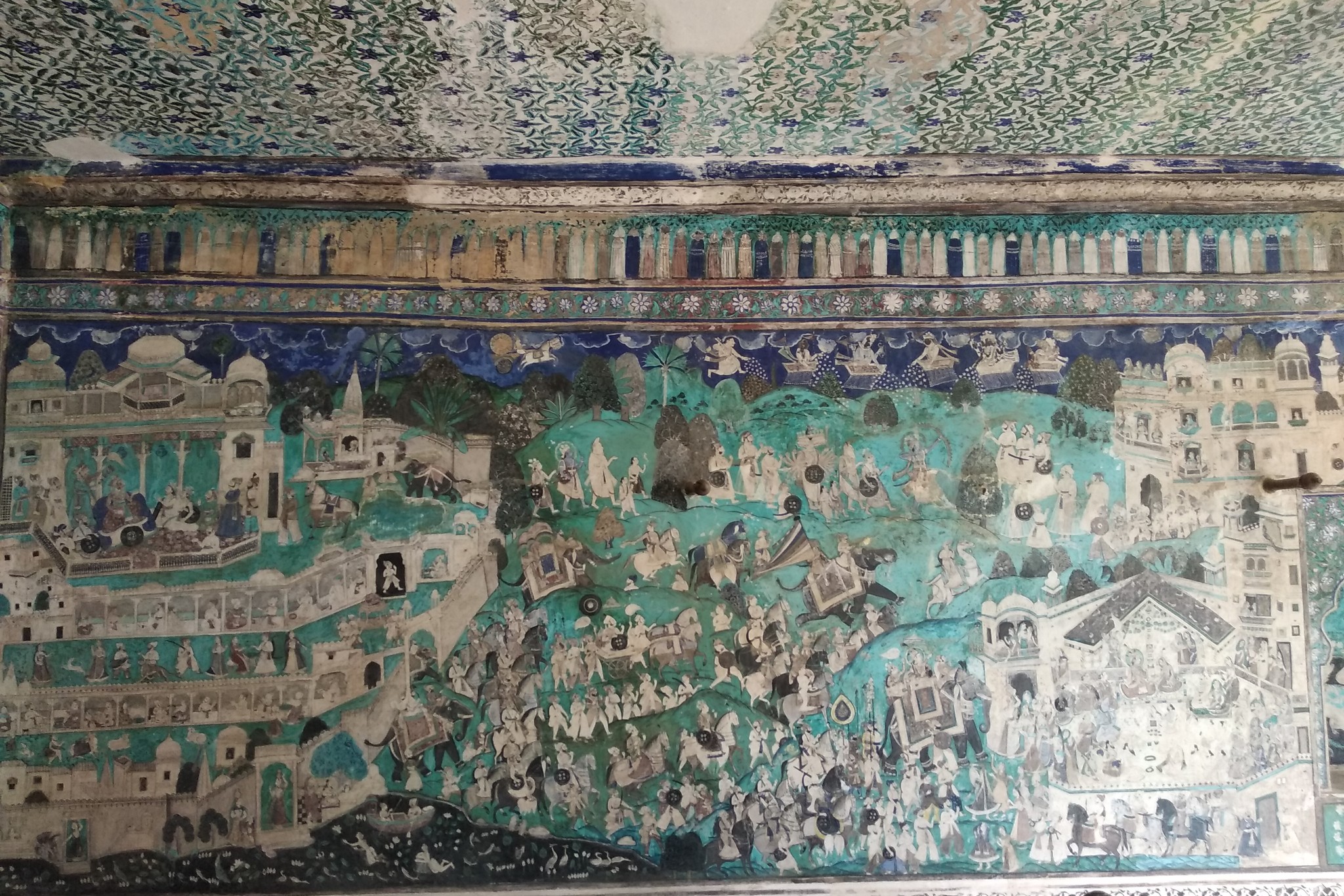
Inside the Garh Palace, we explored multiple storeys of the palace, climbing up the labyrinthine stairs, walked through the many halls and rooms, and reached the roof of the Badal Mahal which owing to it being at one of the highest points of the palace, afforded a panoramic view of the village and the pond nestled in the hills. We then walked to an adjacent structure, called Chitrasala, which houses numerous murals and frescoes.
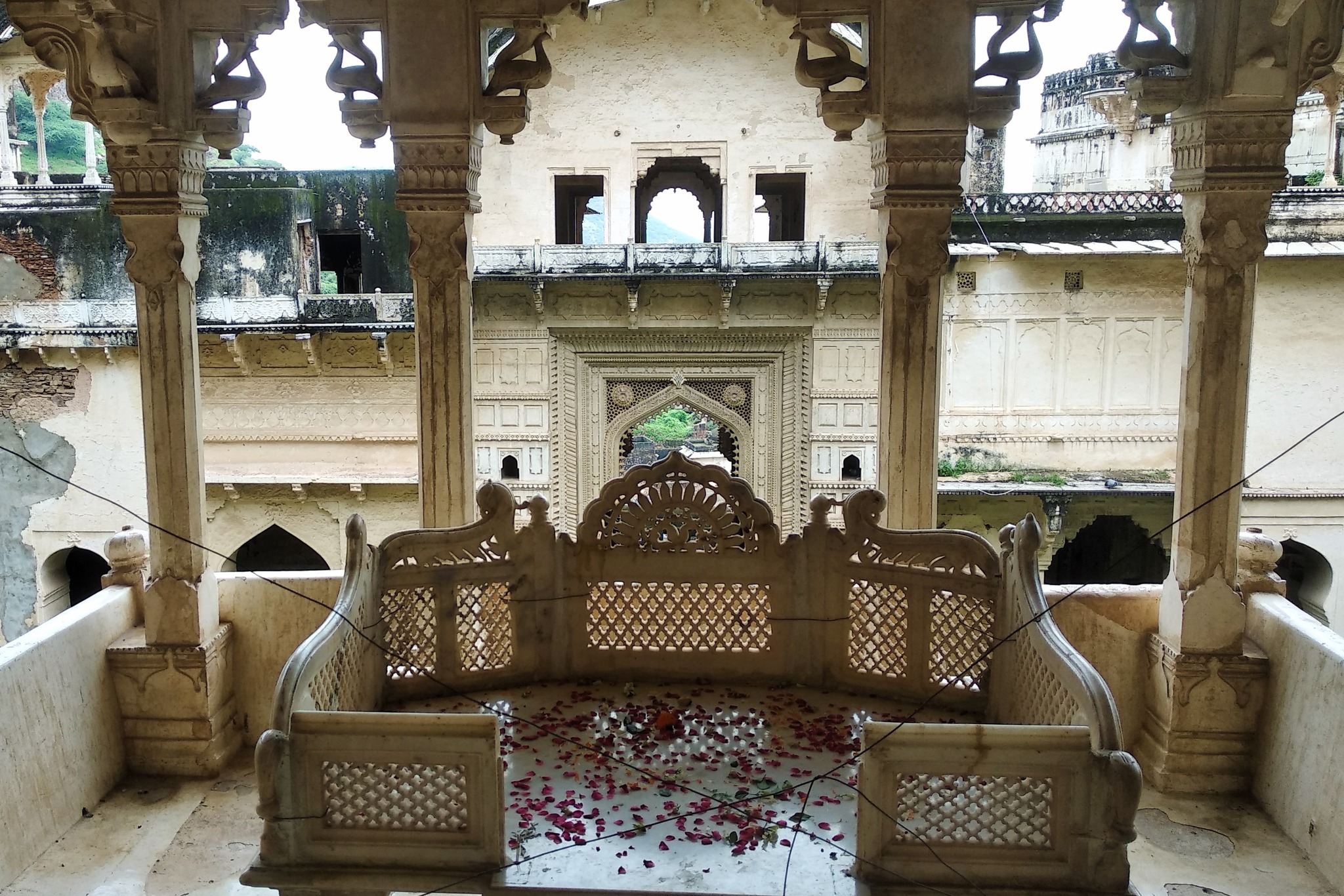
The seat where the king gave audience
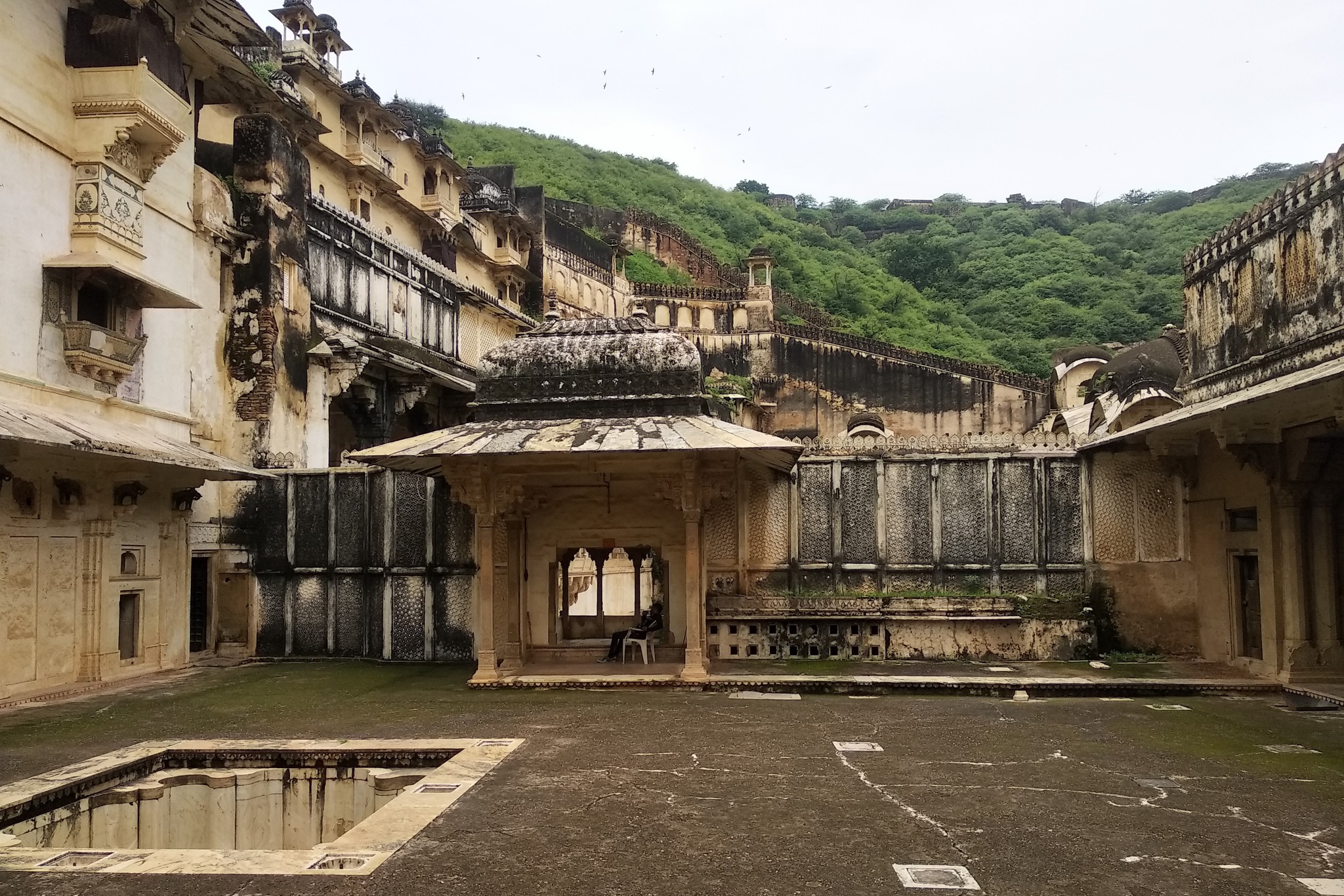
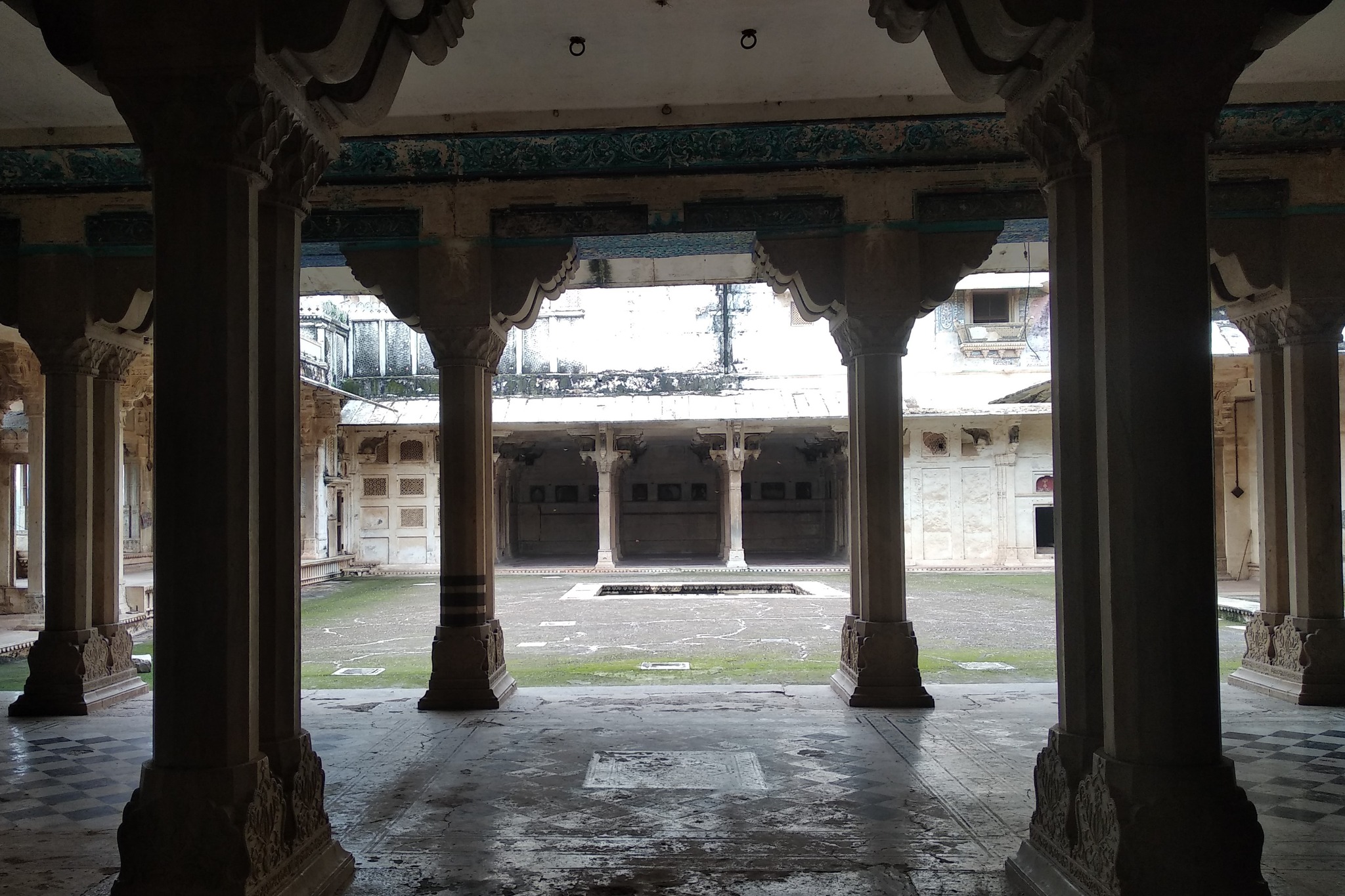
A courtyard in the Garh PalaceA hall in the Garh Palace
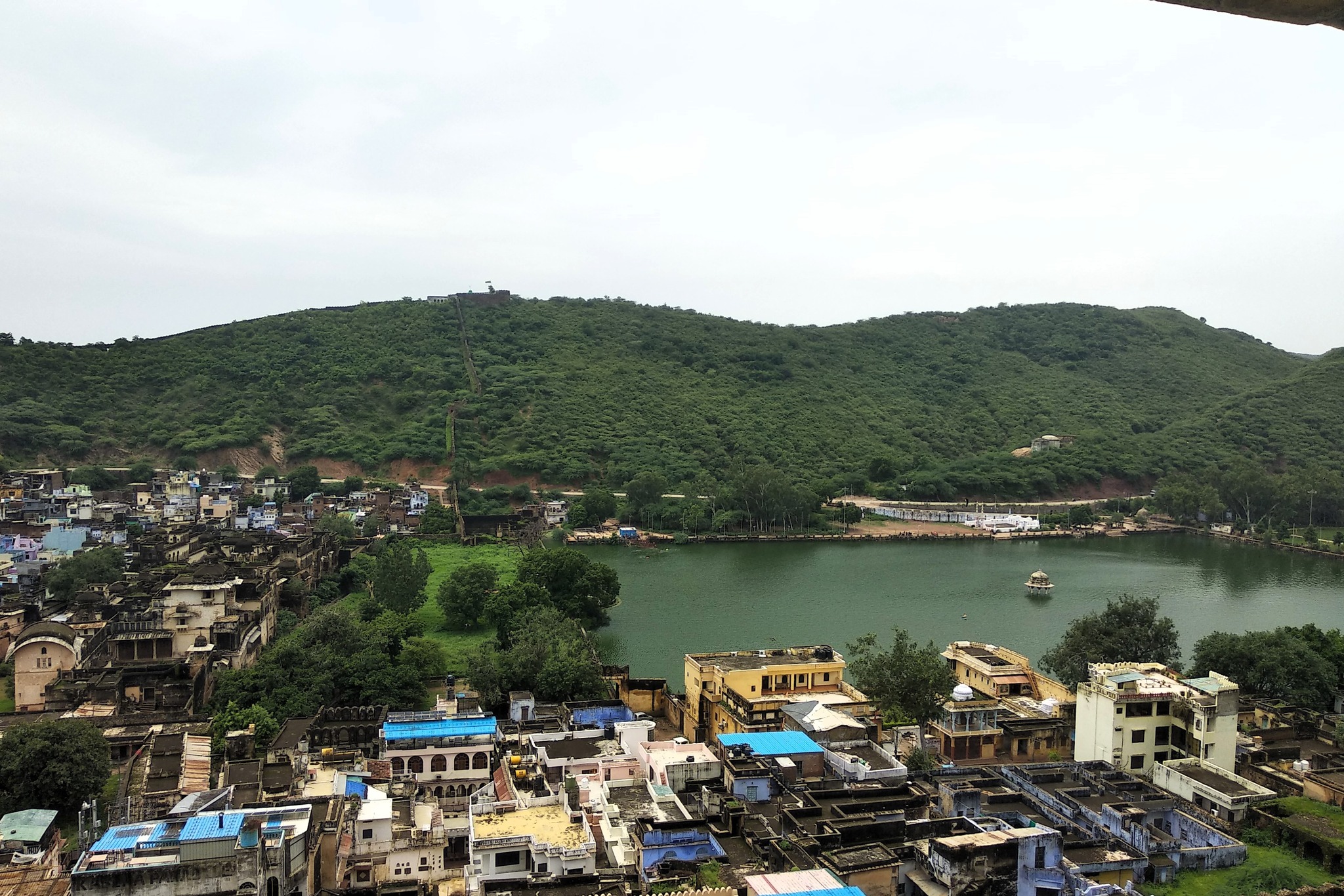
View from a balcony in the Garh Palace
The adjoining structure housing the ChitrasalaA fresco on the wall & ceiling in Chitrasala
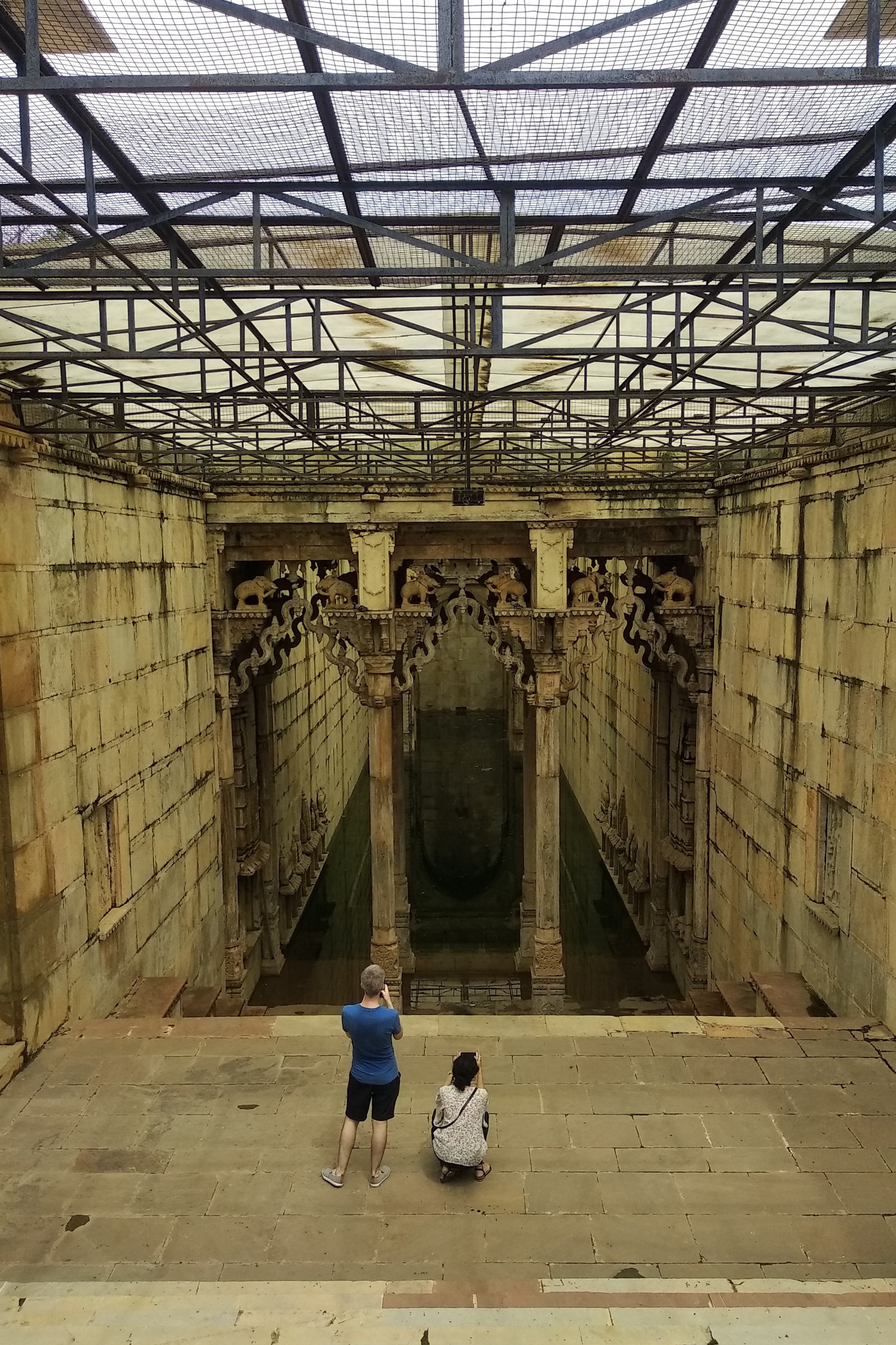
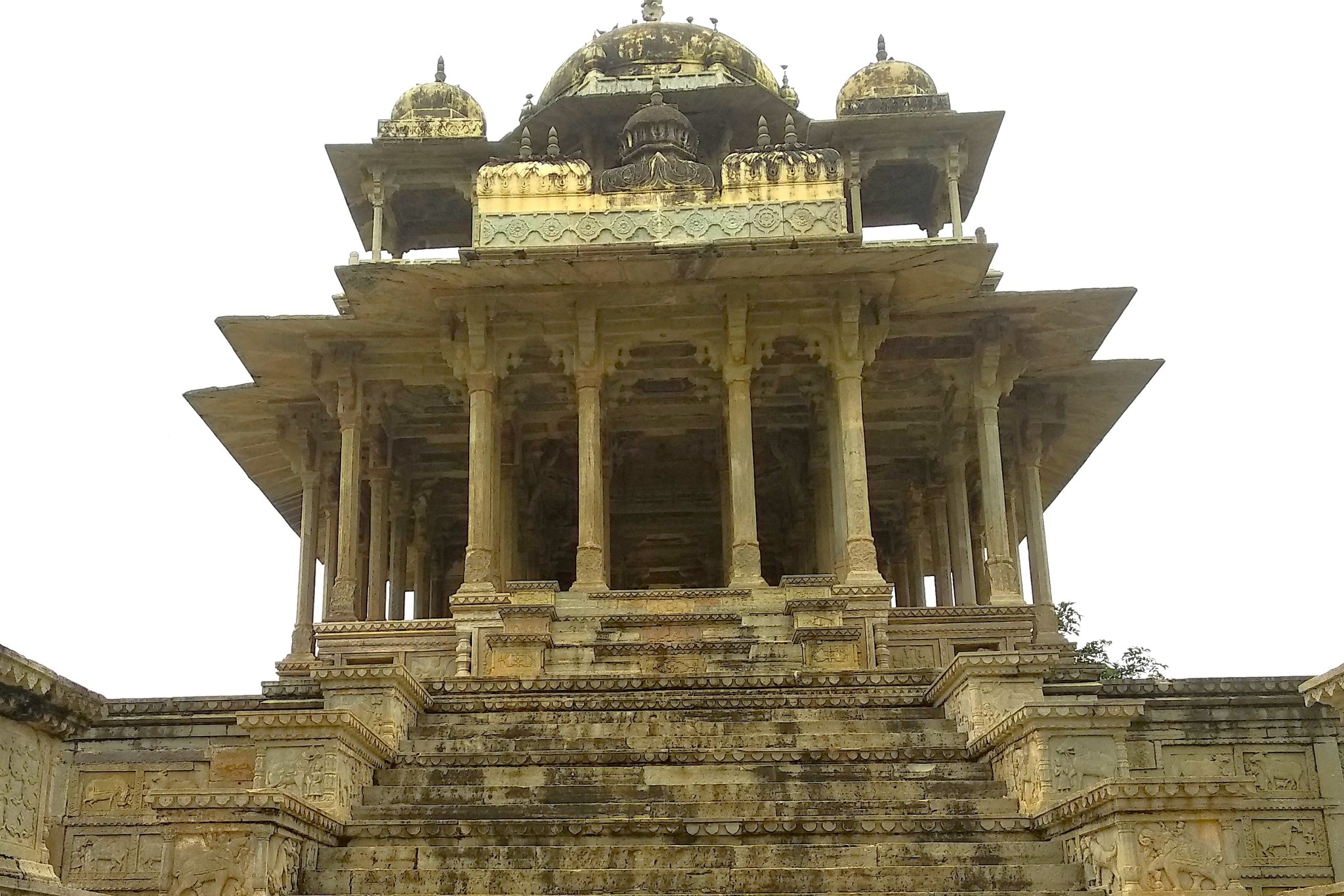
Following this, we made our way through the narrow village lanes to the more urban portion of the town, where we saw the Raniji ki Baori, a 17th century covered stepwell, that is 150 feet deep, and is fairly well-maintained and filled with water even now. Then, we proceeded to the Nawal Sagar lake, located on the outskirts, on the banks of which Rudyard Kipling spent some time in a modest but attractive bungalow. Afterwards, we saw the Chaurasi Khambon ki Chhatri or ’84-Pillared Cenotaph’, another 17th structure with a shivling at the centre of the space enclosed by the pillars.
Raniji ki Baori, Bundi
The 84-pillared cenotaph, BundiPorch of Kipling’s Bungalow, Nawal Sagar, Bundi
The next day, we woke up to rain pattering on the parapet of our window. Still, in the light rain which was for the most part a drizzle, we proceeded to Jhalawar, hurtling across the Kota plateau, and then winding across the Mukundra Hills, in pursuit of Gagron fort. From Jhalawar town, we turned northwards passing through the countryside until we could see the fort in the distance.
River crossing in Mukundra Hills, on the way to Jhalawar from Kota
Then we rolled down a slope, and came face-to-face with the Ahu river, overflowing due to the rains, completely submerging the low bridge that connects the side we were on to the hillock that the fort stands on. With no signs of the rain and river water abating, we turned back, disappointed. It being only noon yet, we figured we could somewhat compensate for the lost opportunity, by exploring some other nearby place – that place turned out to be Jhalrapatan.
The overflowing Ahu river, cutting us off from the hillock upon which Gagron fort sits
Within half-an-hour we were in Chandrabhaga and Chandramoleshwar temple complex with structures dating back to the 7th century, on the banks of the Chandrabhaga river that runs around Jahlrapatan town, and is also the site for the Chandrabhaga cattle fair held in November every year. Next, we saw the 10th century Surya (Sun) temple that is located in the middle of the town, and headed back to Kota.
Chandrabhaga Temple complex, JhalrapatanA temple in Chandrabhaga temple complex
Surya (Sun) temple, Jhalrapatan
We then took an overnight train to Delhi. If not for the rains preventing us from seeing the Gagron fort, the trip as a whole was satisfying, giving us a taste of the heritage and topography of the Hadauti region, making us want to come back again.



























 The Timber Trawler