
4-day marathon trail of 5 places: Gwalior-Datia-Jhansi-Orchha-Bandhavgarh
Just 3 months into my new job, my colleague Abhijit, who I had recently befriended, and I, decided to make full use of the last weekend of September, and impulsively booked overnight bus tickets to Gwalior, with no itinerary in place. I did have Orchha in mind, which we decided we could do by taking public transport to Jhansi from Gwalior, since Orchha lay just 15km away from Jhansi. I also hoped to see the monuments strewn around in Morena, near Gwalior, on the trip, and be back in Delhi by Monday morning.
Day 1: Gwalior
Getting down early morning at Gwalior, our first task was to find some lodging to freshen up. Soon, we were down in Naya Bazar to try out for breakfast kachoris which are quite the rage in Gwalior. While munching on the kachoris, Abhijit wondered if we could also visit Bandhavgarh National Park. While I had heard about Bandhavgarh before, a quick Google search revealed Bandhavgarh was over 500 km from Gwalior, with iffy public transport communication. Abhijit said, ‘Never mind’, and got back to snacking. I reconciled to the same, however, as is my wont, I could not stop thinking if there was the slightest chance we could work something out regarding Bandhavgarh.
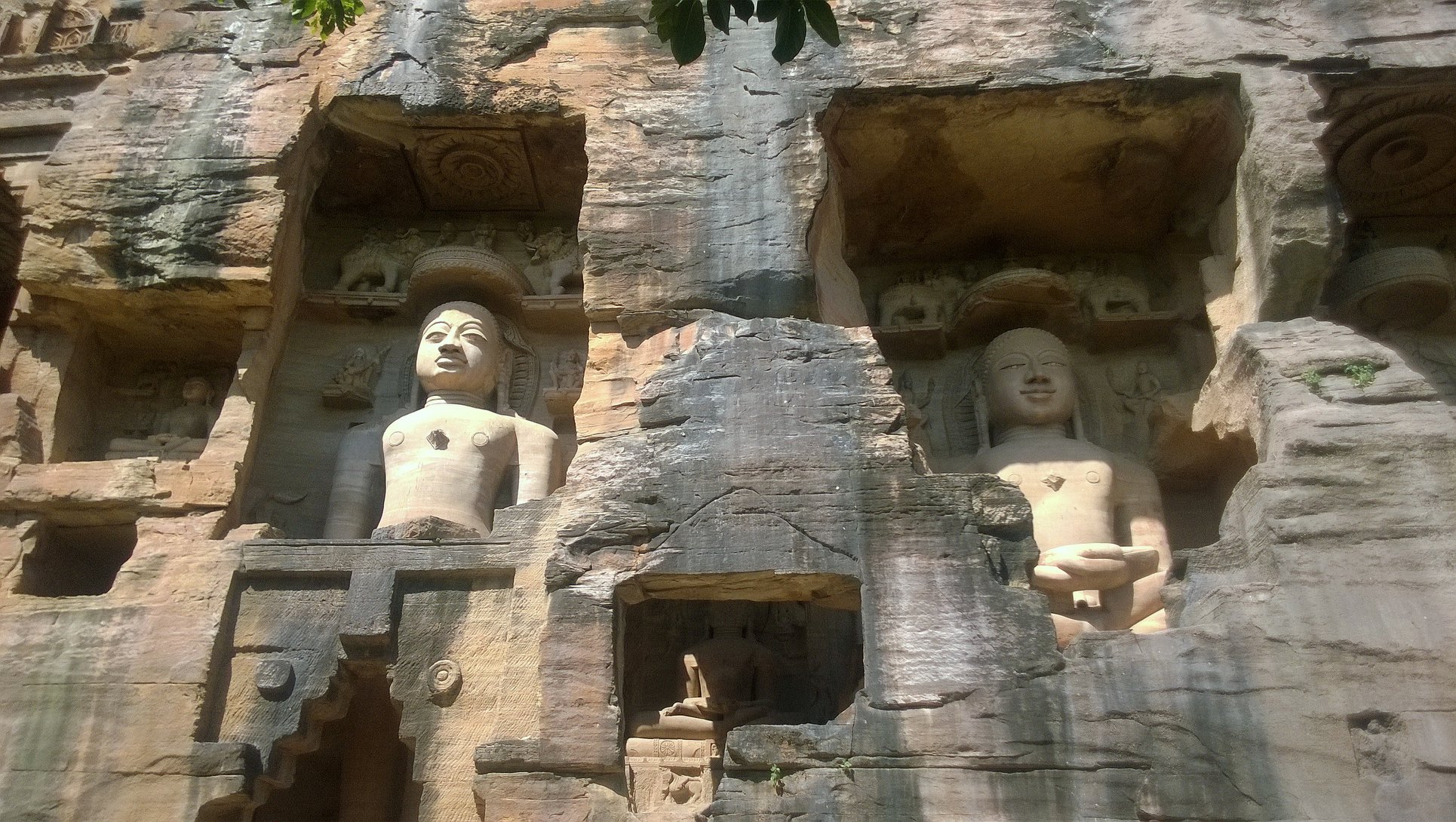
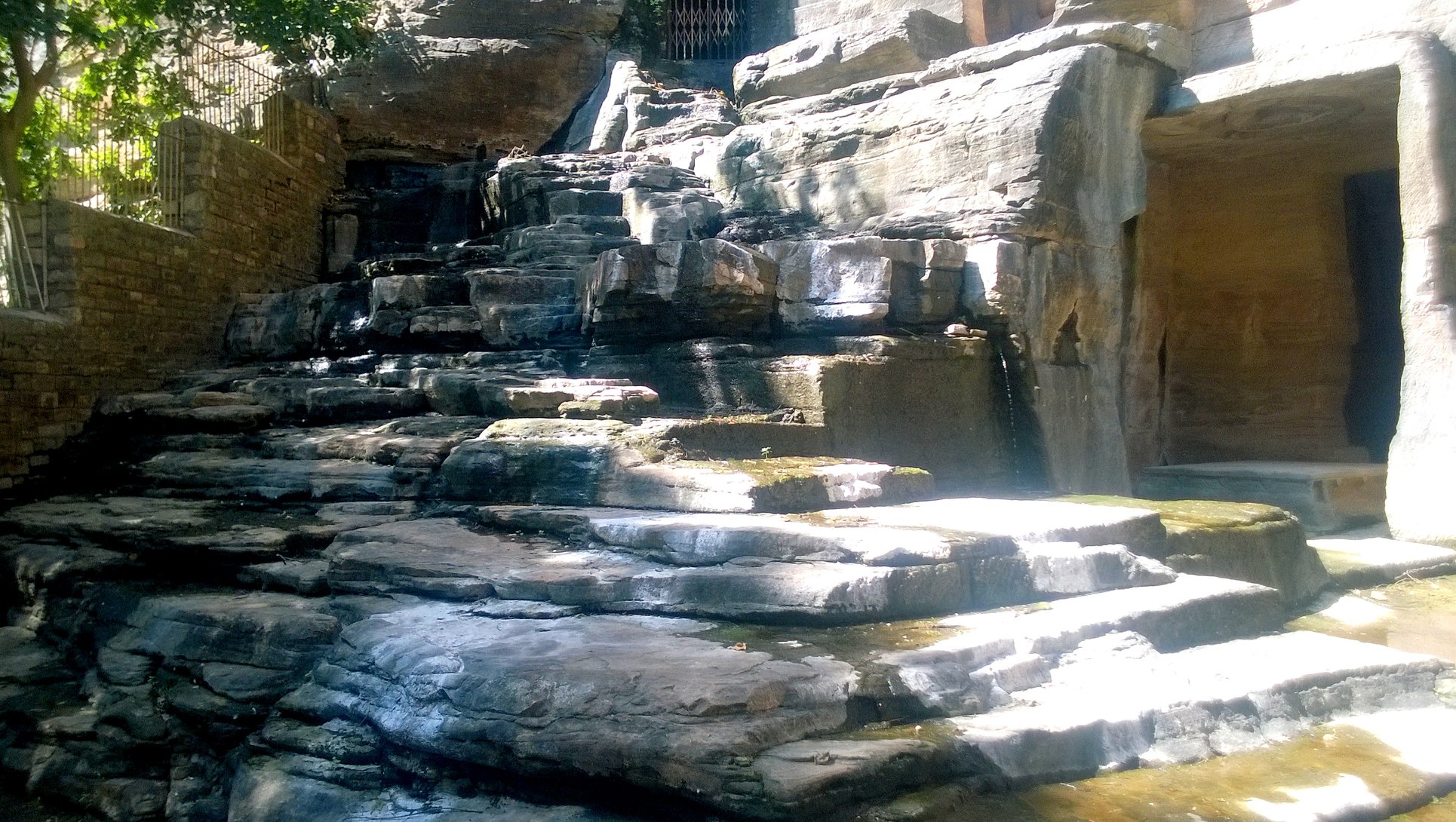
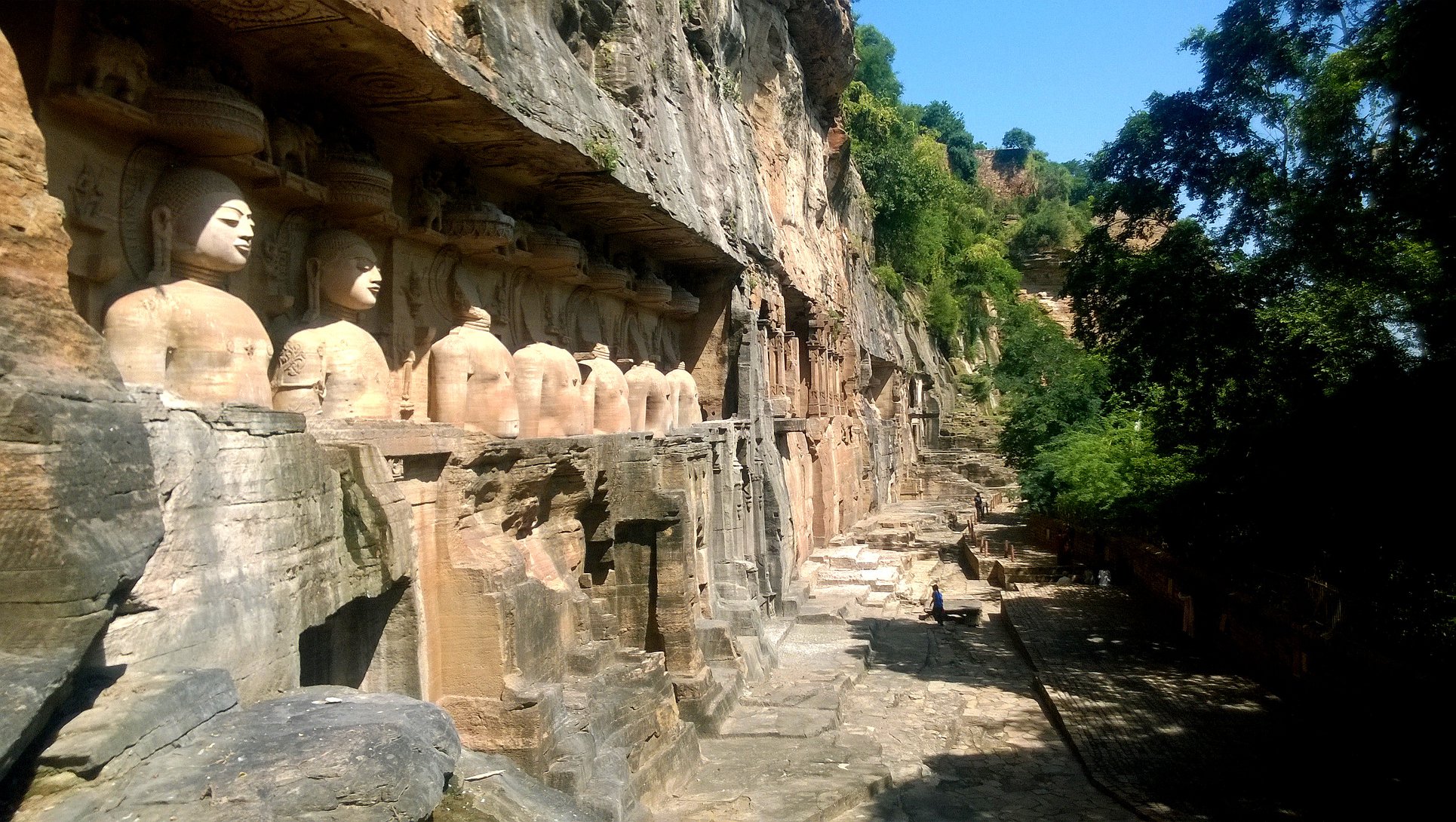
We then headed to Gopachal Parvat, where there exists groups of Jain sculptures depicting Tirthankaras in both standing as well as seating position, built in between 6th and 15th centuries. The caves themselves are accessed by walking along a stepped pathway cutting the lawns and garden maintained on the hillside. At the end of a series of statues, there is also a perennial spring emanating from the hillside. The foliage around makes it the ideal location for a peace-centred getaway from daily life.
Meanwhile, with my mind racing about Bandhavgarh, with the barest of discussions with Abhijit, I simply booked waitlisted tatkal tickets from Jhansi to Umaria, the nearest railway station to Bandhavgarh. And all this, while having no idea about what to do in Bandhavgarh regarding accommodation and the main attraction, the tiger safari, which I could see from the park’s website, was completely booked for the whole upcoming month! Anyway, this meant the end of my dream to see the monuments in Morena. Perhaps, I could compensate this by seeing the Sheshsaiya statue of Vishnu in Bandhavgarh?
Our next stop was the Gwalior fort which sits upon a elongated flat-top hill, and accessed by two paths. The autorickshaw driver dropped us at the bottom of the Kila (Fort) Gate road that approaches in the southwest side, the other road leading to Urvai gate can be used if one wishes to take their vehicle inside the fort premises. We clambered up the steep Fort road by foot, encountering first Jain caves on the mountainside, and then, the famed Chaturbhuj temple -a 9th century Shiva temple carved out of rockface, that lies on a bend on the road – noted for bearing the earliest known epigraphical evidence of ‘zero’ inscribed as the ‘0’ symbol on stone.
As we approached the gate leading to the main area enclosed by the massive walls, we finally got a glimpse of the iconic image of the blue coloured turreted wall extending into the distance. Once inside, we hired an electric rickshaw to take us around the major sightseeing points inside the fort. We first came upon the 11th century Sahastrabahu (also called the Saas-Bahu) temple, and then the 9th century Teli ka Mandir. Riding through the roads spread across the vast hilltop, criss-crossing each other many times, we got the feeling the fort premises themselves were akin to a fortified small town lying entirely on the hilltop.
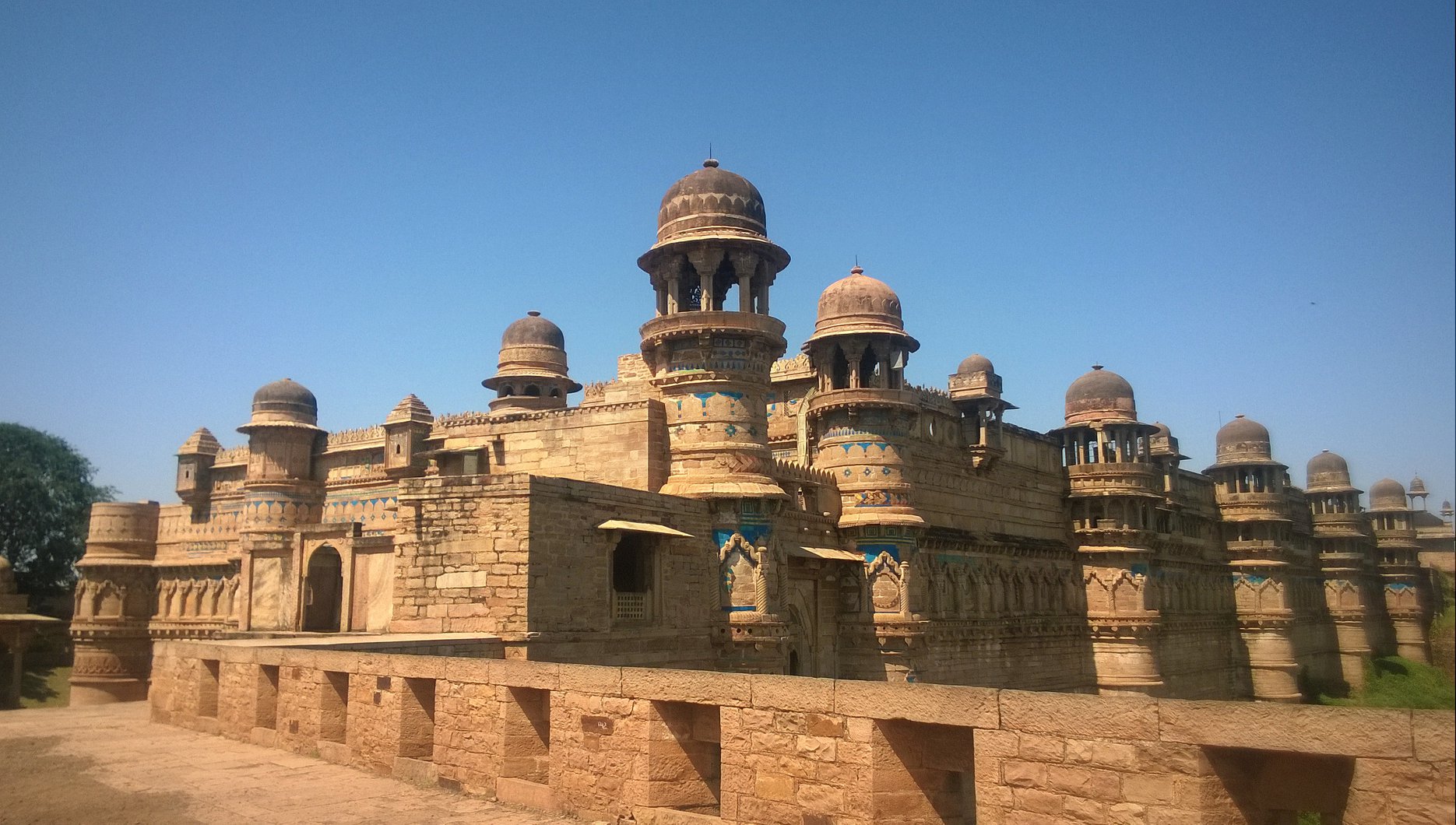

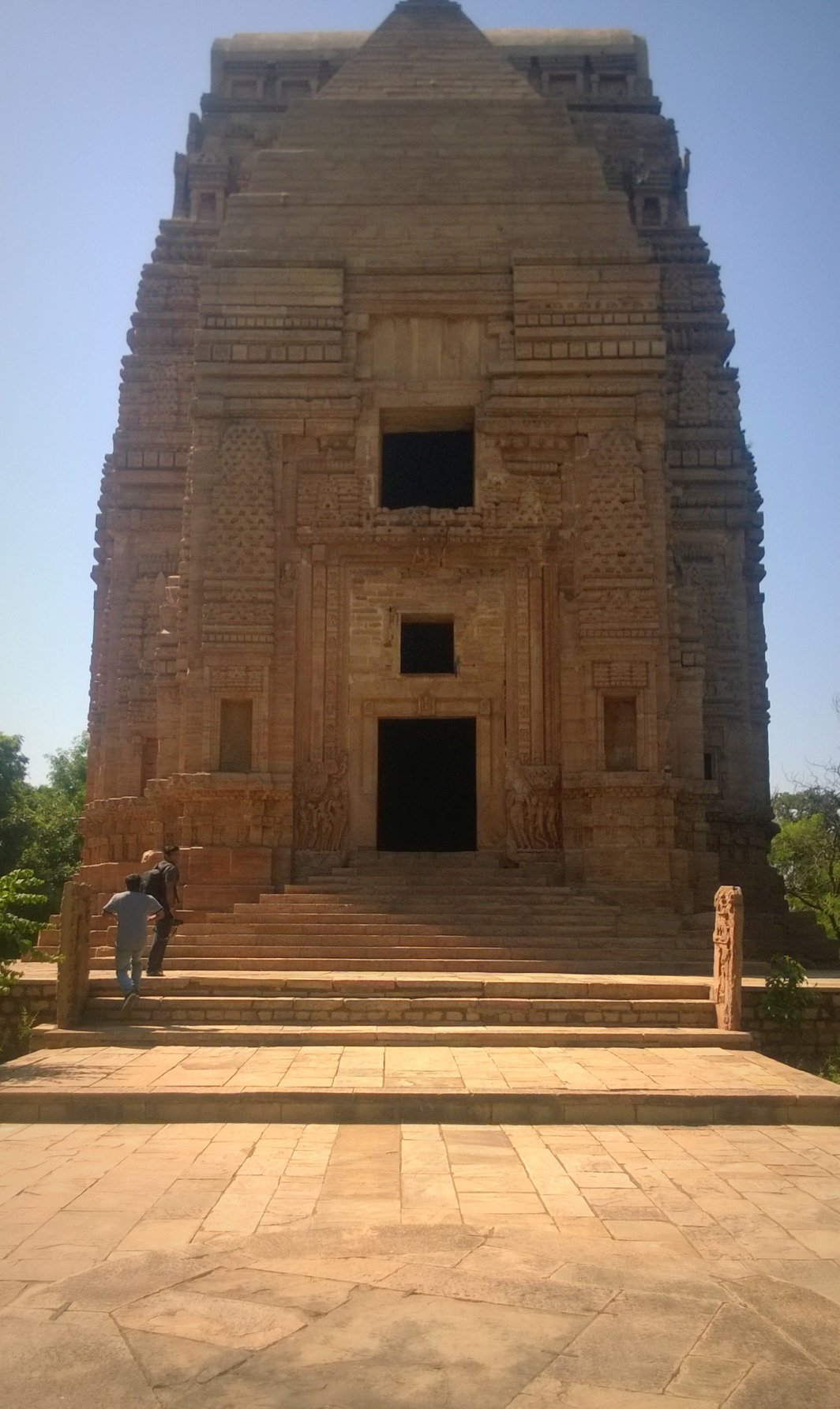
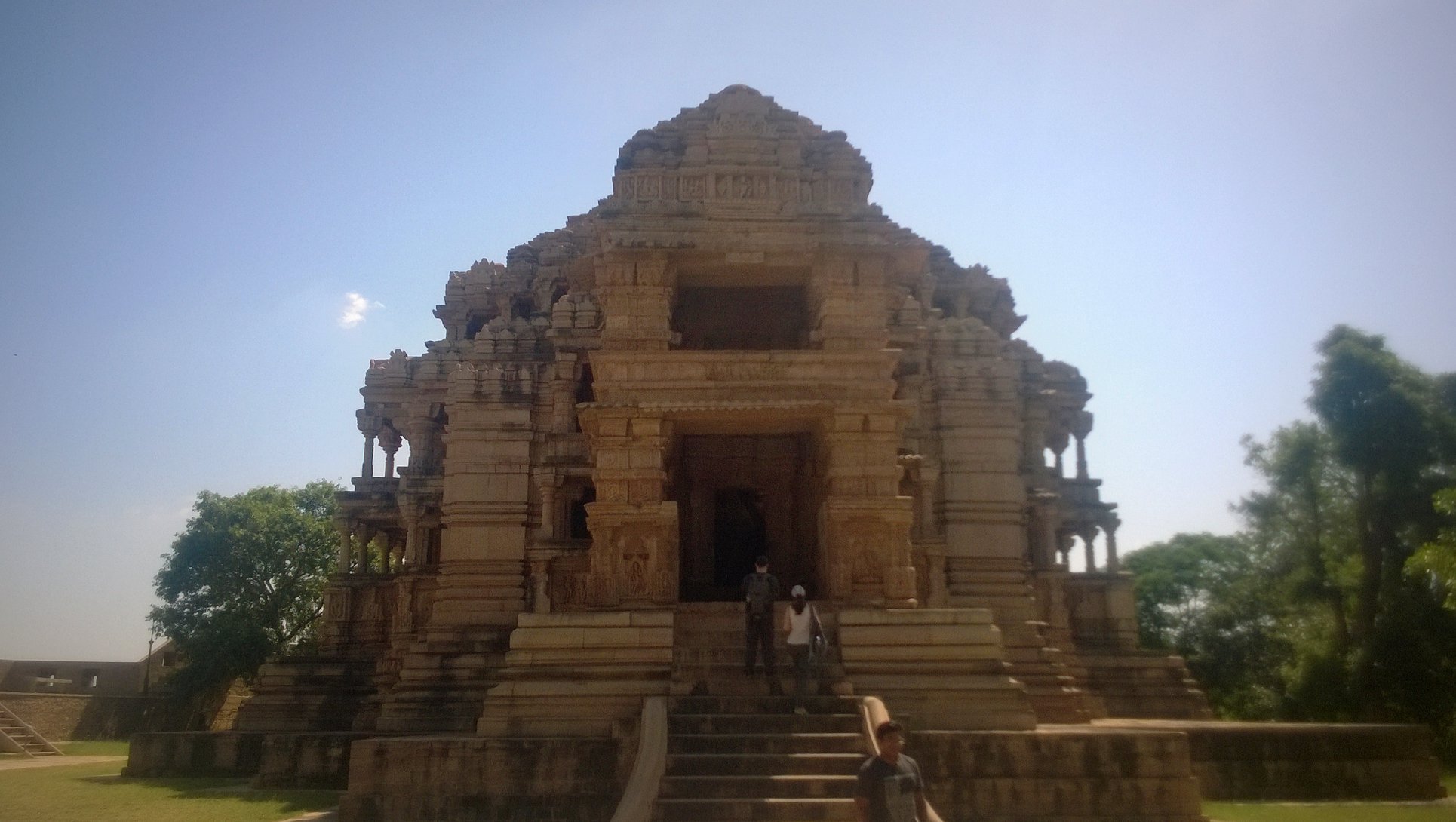
Back at the point where we had entered the main fort area, we hired a guide who walked us through the main palace called the Man (pronounced as Maan) Mandir Mahal, named after the reputed Tomar ruler Man Singh Tomar. We then walked further to the area behind the Man Mandir Palace, and saw the Jauhar tank, as well as the Jahangir Mahal. And then, on our way down from the fort along the Fort Road, we also took a peek into the Gurjari Mahal – that lies at the foot of the hill with the fort in the background – now turned into a museum containing many of the artifacts found inside the fort, and in and around Gwalior.
After a quick lunch, we then proceed by autorickshaw to the Tomb of Tansen – the favoured musician in Akbar’s court – which lies inside the compound enclosing the bigger Tomb of Muhammed Ghaus. This is where I made a point to call up my friend Priyam, who at that point happened to be living in Gwalior due to her civil servant husband’s posting. After a bit of admonishing from her for not having informed earlier, Abhijit and I were promptly invited over for dinner that night – it also happened to be her son’s birthday.

After resting for a while in the hotel, and then picking up a birthday gift, we were at Priyam’s place for some catching-up with both her and her husband Neeraj, accompanied by good food and beverages. This is where I mentioned in passing that we hoped to make it to Bandhavgarh: we had train tickets from Jhansi, but just didn’t know how we could get tiger safari bookings in such short notice. Priyam asked us not to worry, and following a few calls by Neeraj, assured us that our stay and safari for Bandhavgarh were sorted! They threw in an additional recommendation for good measure: a place called Datia, which lay midway between Gwalior and Jhansi, our stop for the next day.
Day 2: Datia, Jhansi and Orchha
We started out by road transport at 7am on the second day, and some distance before Datia, we saw a cluster of white spires on the top of a hill- this, I came to know later, is a site called Sonagiri, bearing a Jain temple cluster. Then, just around 9 am, while we were on the outskirts of Datia, as surely as Priyam and her husband had said, we saw the palace sitting proudly on top of a low hill, right from the main road that bypasses Datia town. We got down at the Datia bus-stand and walked down the to the palace.
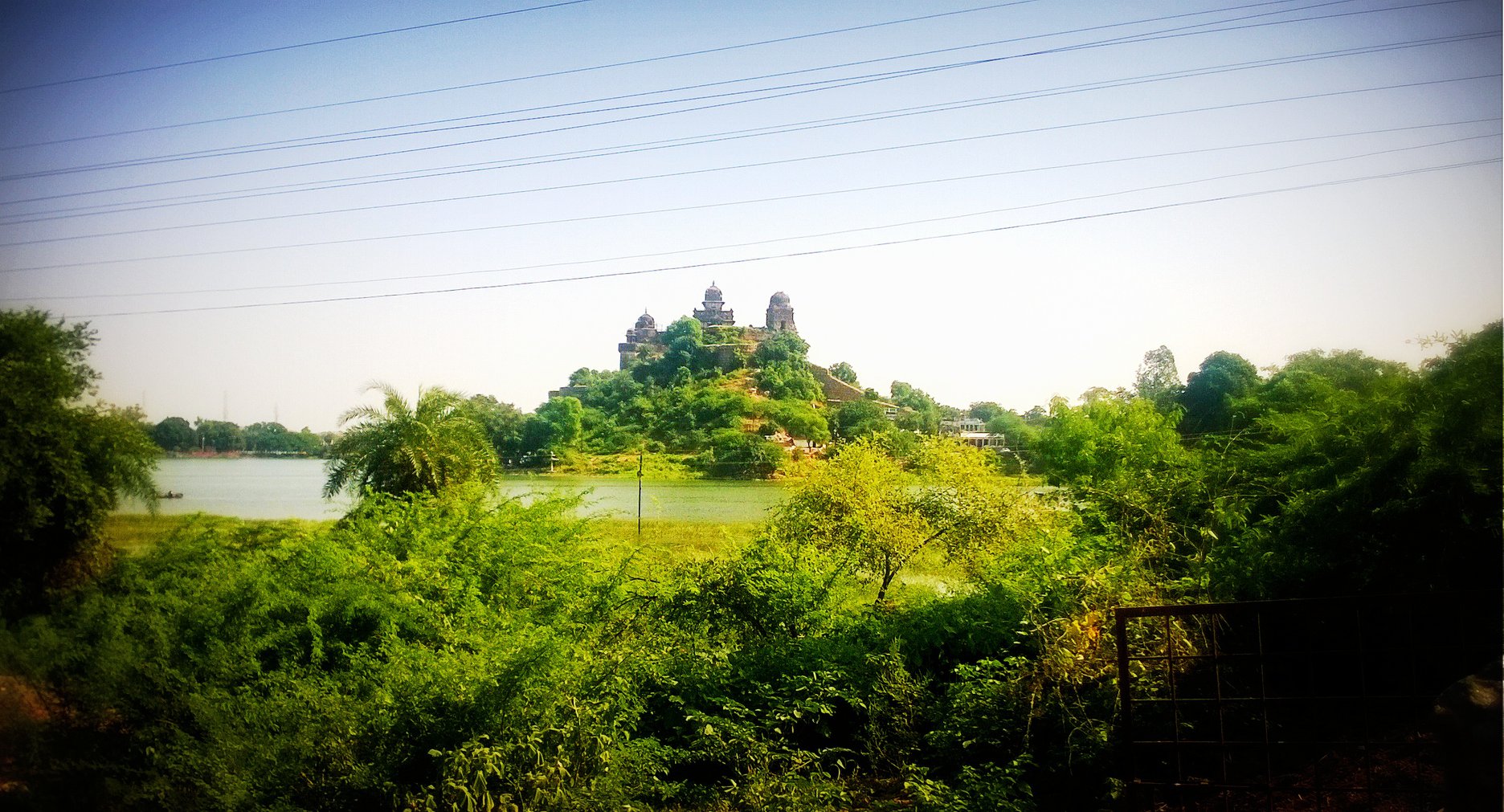
The 17th century palace, it turned out, is called the Bir Singh Palace, after its builder Bir Singh Deo, one of the most significant Bundela kings, who became a trusted acquaintance of Jahangir, and is also said to have built the Jhansi Fort. The 7-stroreyed palace itself is remarkably well constructed on a square plan, with symmetrically laid squared wings within the main square plan, each inner square having spacious rooms with overhanging balconies, interspersed with L-shaped large courtyards in the centre of the inner squares. It is easy to get lost inside the maze of stairs and pathways inside the palace.
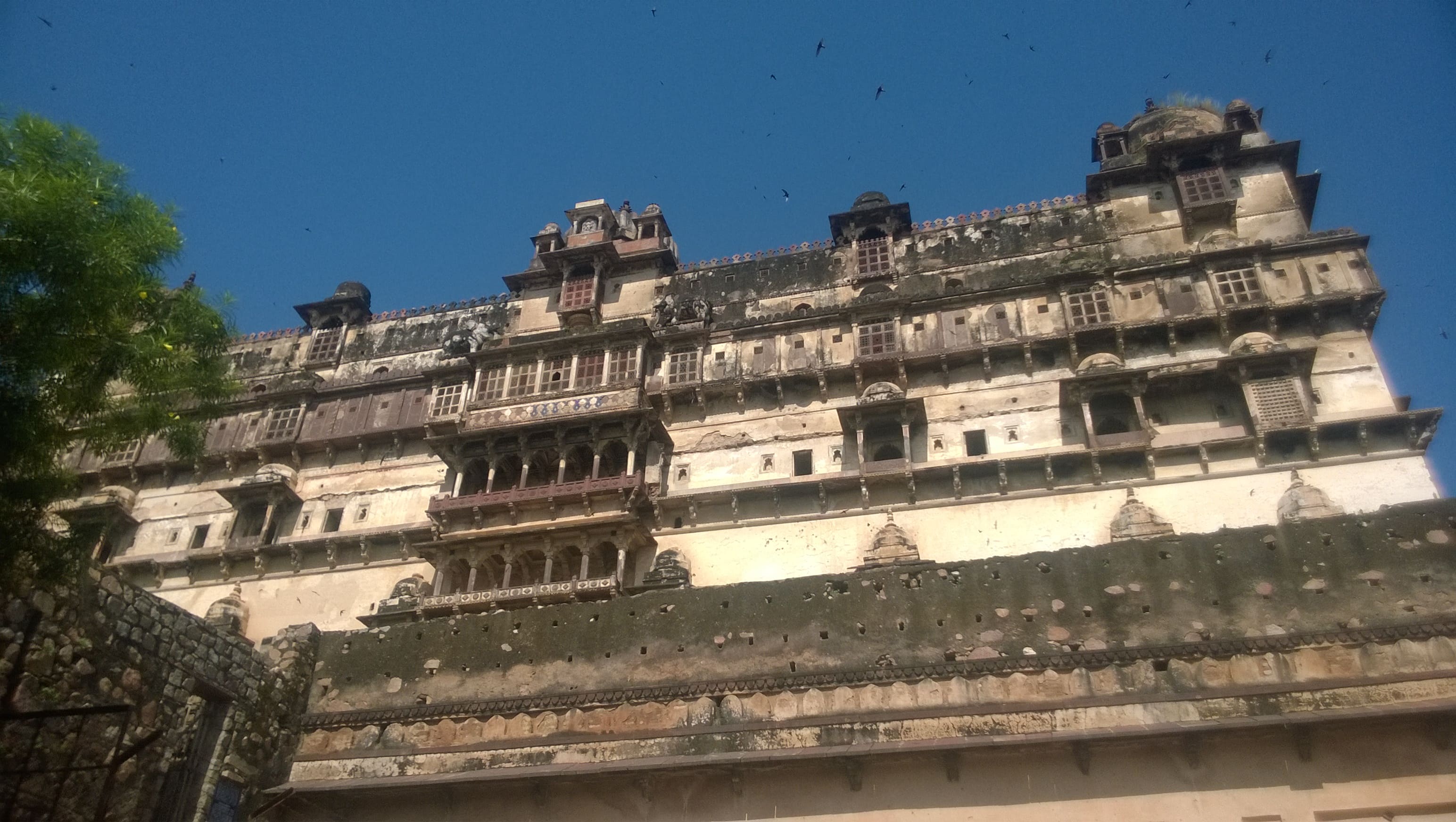
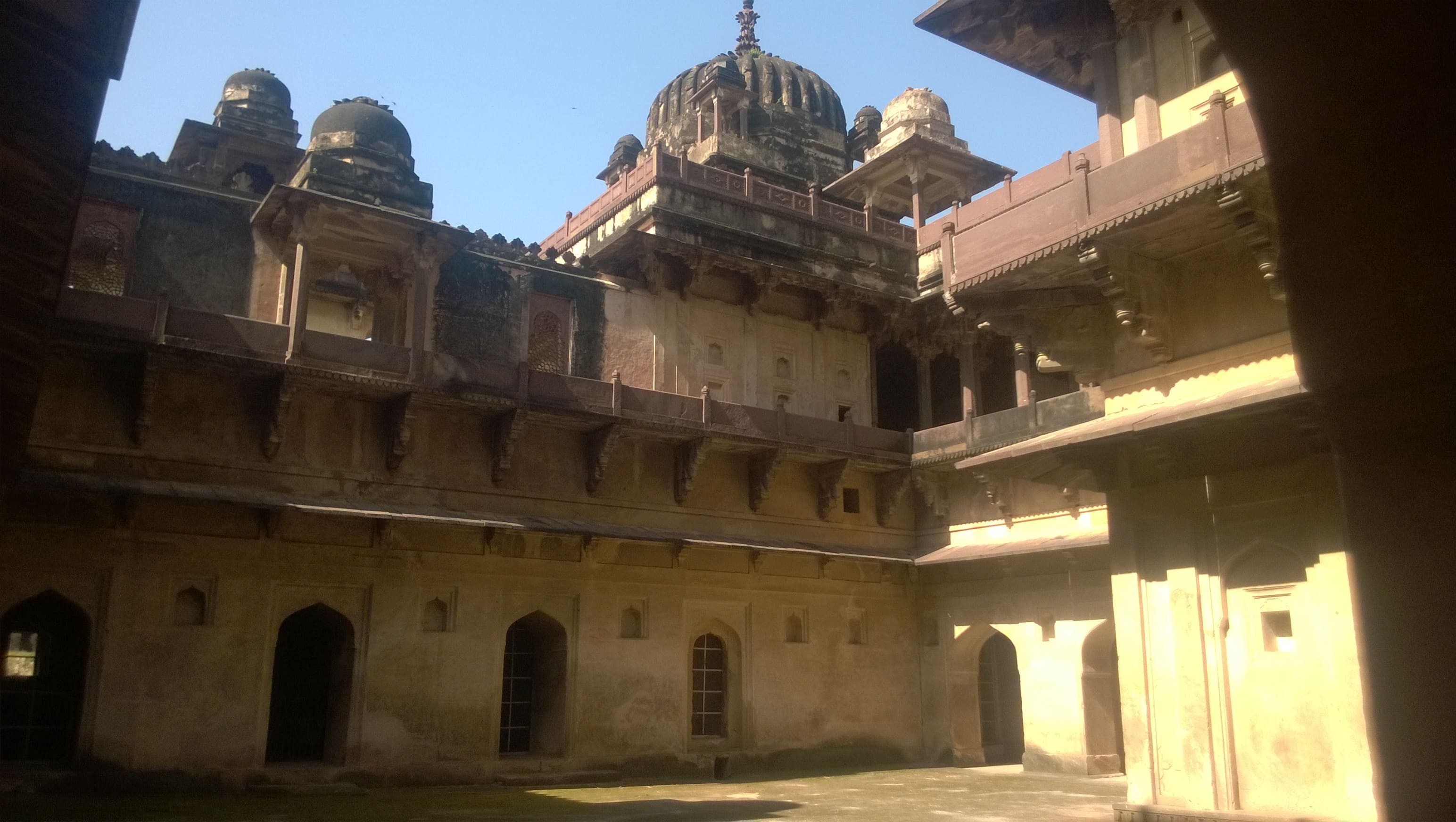
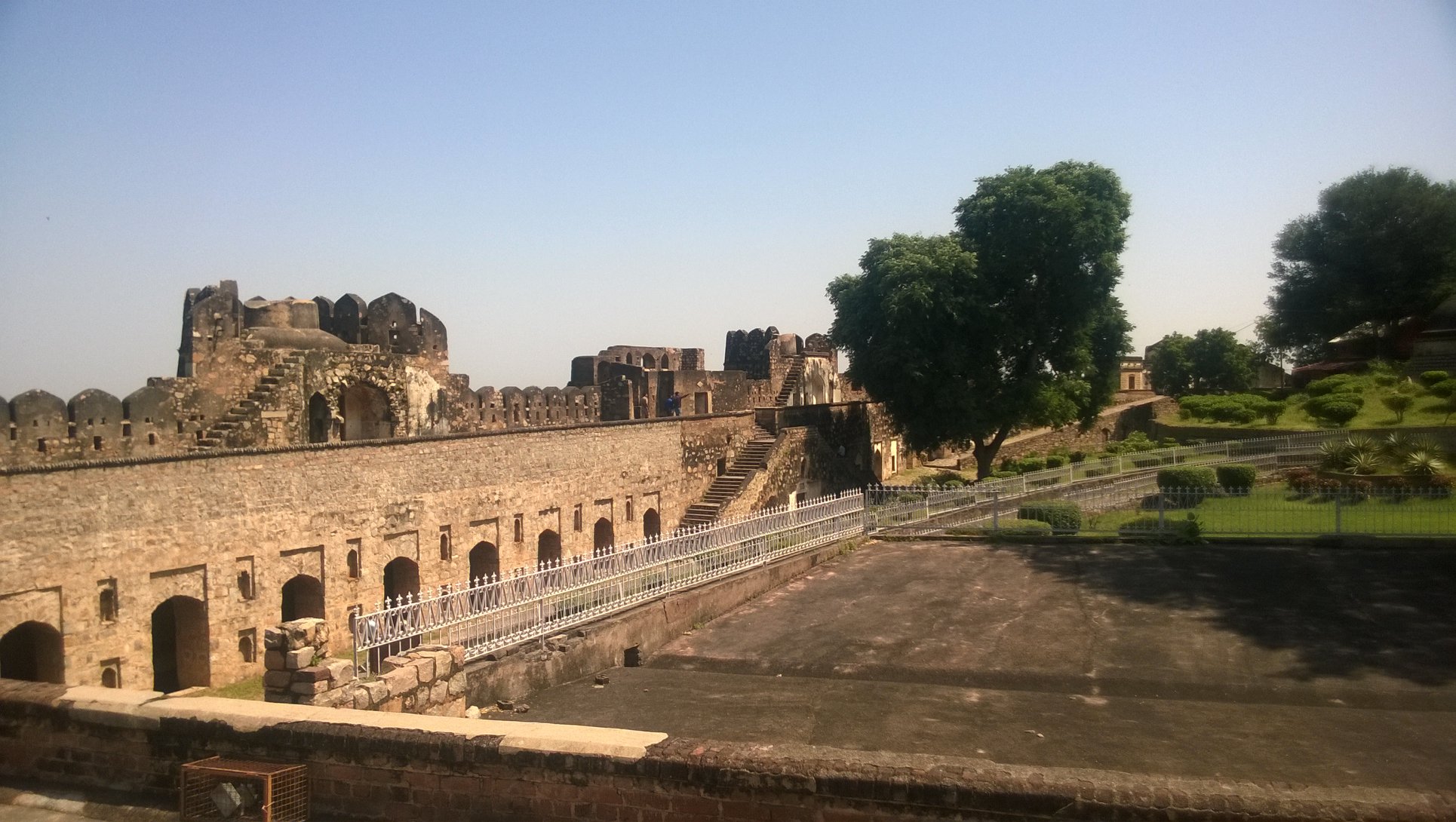
Heading back to the bus-stand, we took a bus to Jhansi, and soon found ourselves inside Jhansi fort by 11.30 AM. After seeing around the Jhansi fort, including the point where Rani Laxmi Bai along with her infant son is purported to have jumped off the fort on her horse to escape enemy forces, we hired an autorickshaw driver to take us to Orchha, which is 16km away. Soon, after a 40-minute ride through Jhansi’s streets, then through light jungle, then across a railway-line, and a tiny bridge, and a dusty track, we were in Orchha.
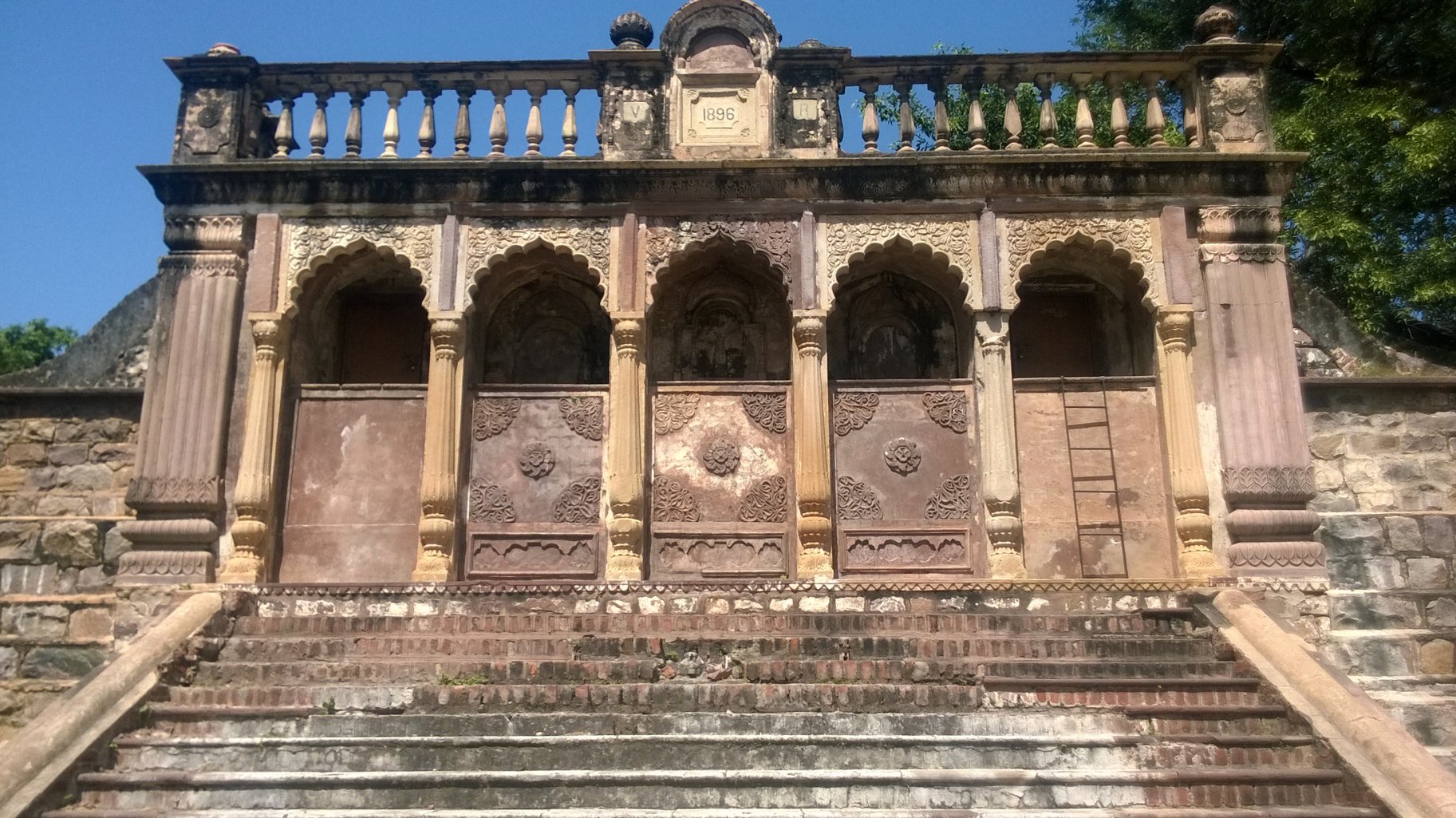
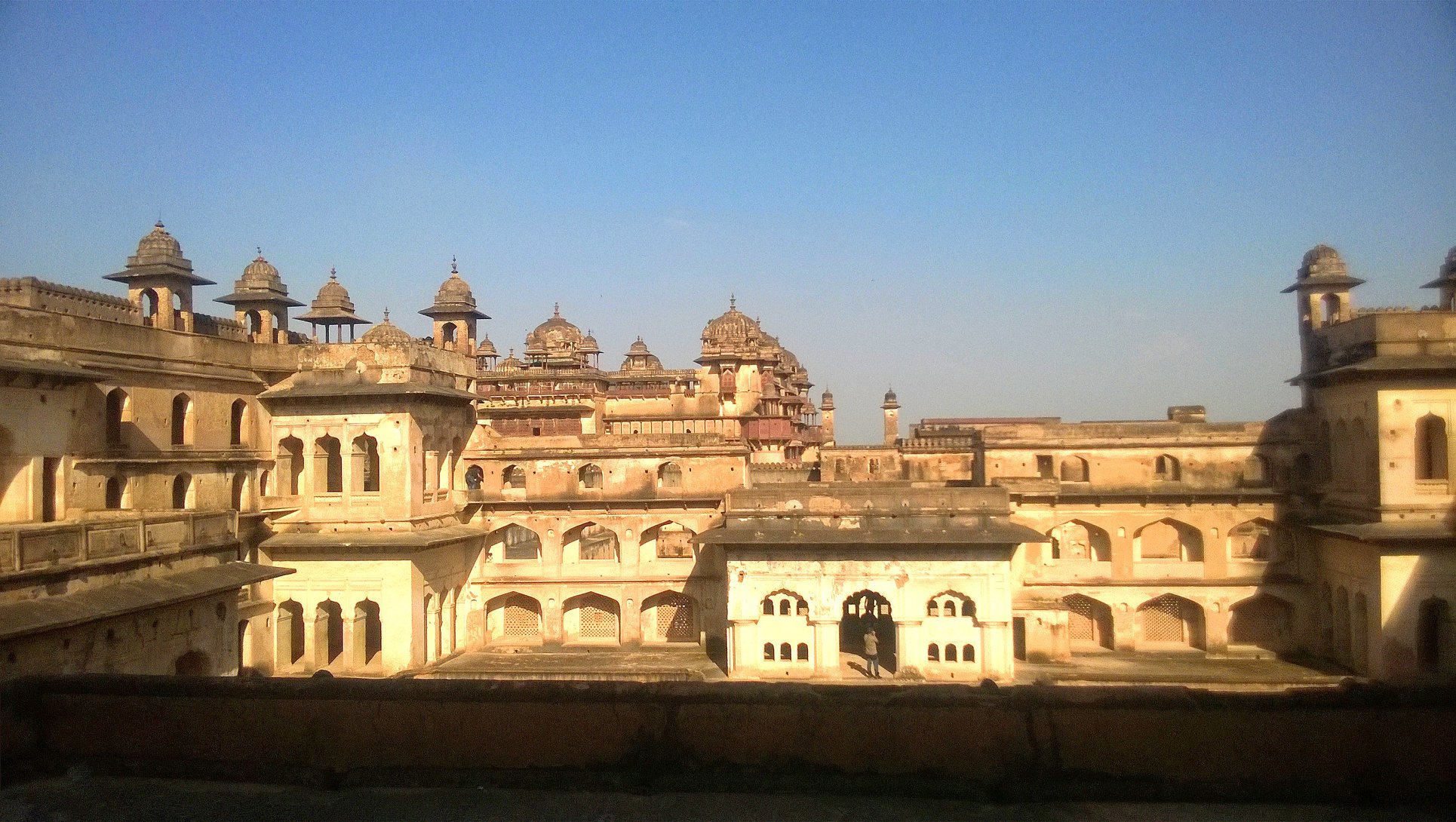
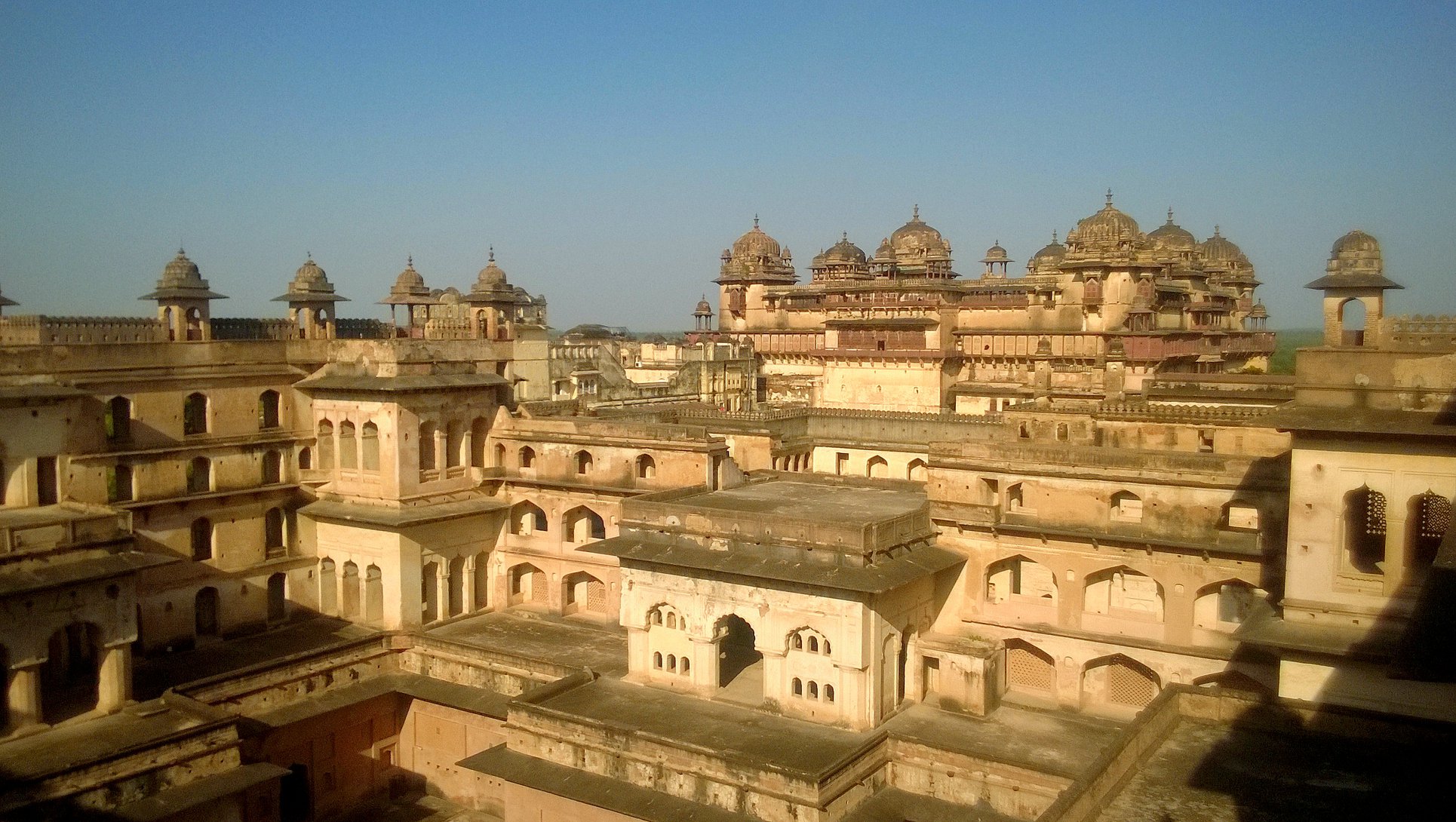
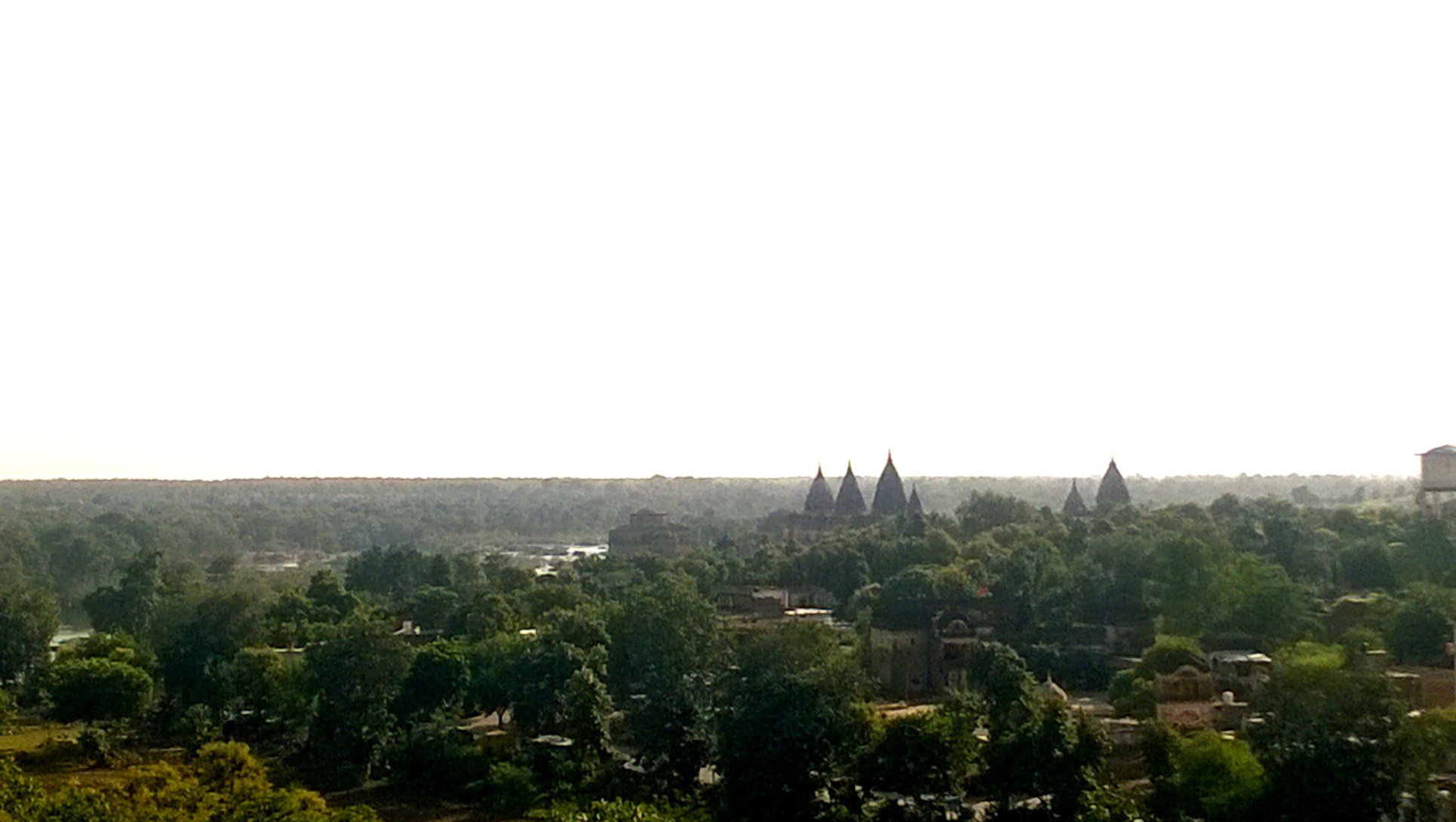
You could say the moment you stepped in Orchha that it was a special place! We were first enamoured by the sight of the Orchha Fort sitting at a height just across a channel of the Betwa river – in fact, the fort lies on the edge of a fairly large island on the Betwa river. Once inside the fort complex, we were further wowed by the near perfect 16th century palace Raja Mahal, built by Rudra Pratap Singh, the founder of Orchha. From an upper storey, we were treated to breathtaking sights of the town’s skyline as well as of the countryside. Just behind the Raja Mahal is the 17th century palace Jahangir Mahal, built by Bir Singh Deo to honour Mughal Emperor Jahangir’s first visit to Orchha.
I must interject here to make a special mention of the place that we had lunch at before we went to the Orchha Fort. Open Sky Restaurant, run by a middle aged man and his son, is a quaint place with the eating space located on the first floor of a building standing right on the main road. It serves all sorts of items across multiple cuisines geared towards appealing to the western crowd, however, the dish that we ordered simply by chance and were completely blown away by is the Brinjal Tomato Mix Rice.
Our next stop was at the conspicuously imposing and utterly inviting 16th century Chaturbhuj temple, whose multiple spires are visible from all parts of the town. The temple sits on a very high platform and has multiple storeys above the level of the sanctum sanctorum dedicated to Lord Krishna and Radha. A man stood guard at the entrance of the staircase leading to the upper floors, charging us a 5o-rupee fee for entry to what was advertised as the Bhool-Bhulaiya (maze). The so-called ‘maze’ for all its worth did provide us with amazing views of the town and of the countryside.

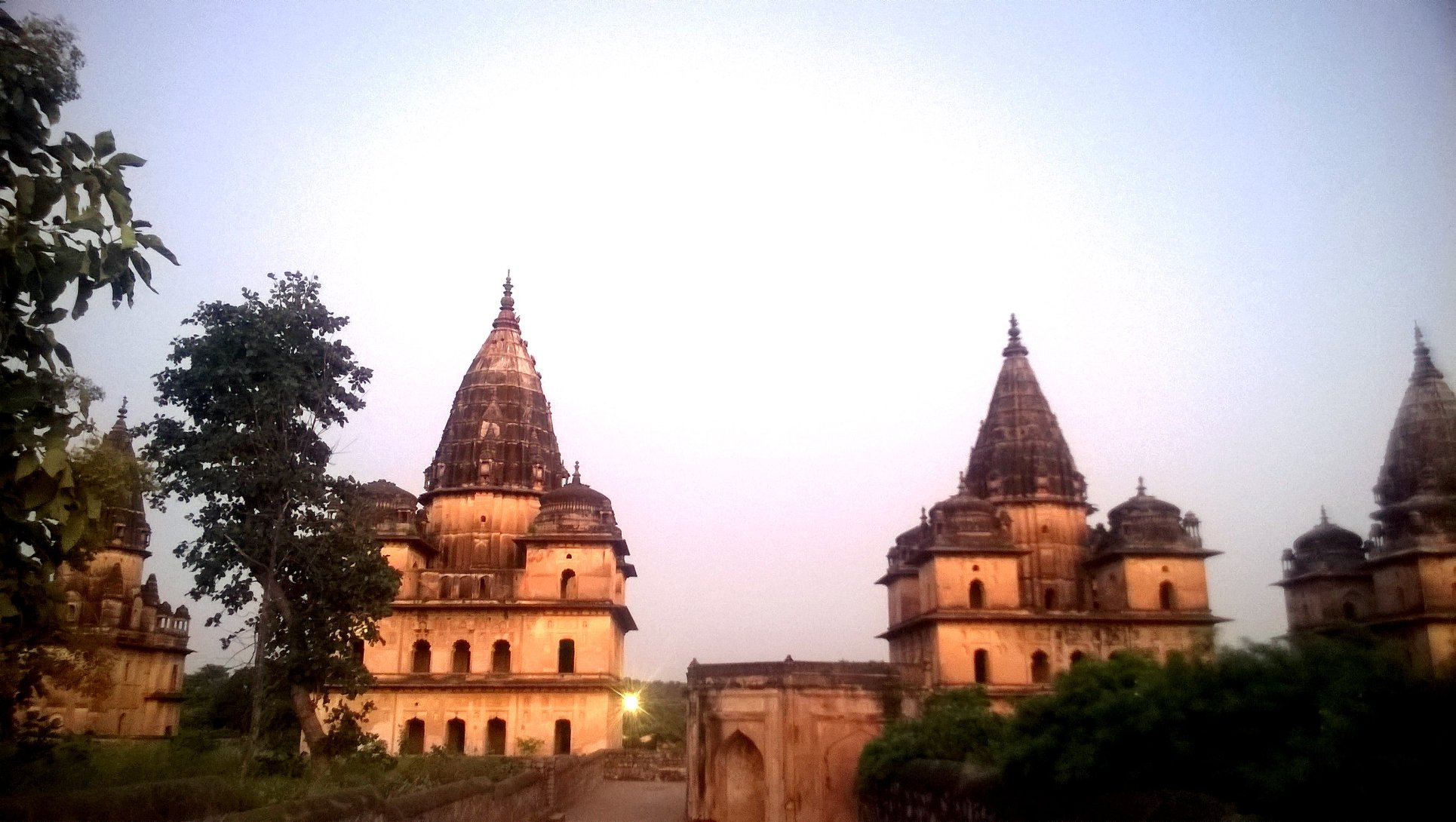
We then headed to the 17th century Laxmi Temple that sits a little farther from the town center on another low hill, and notable for the many frescoes on its inner walls and ceilings. With it now already being 5.30 PM, we headed down to the Royal Chhatris (cenotaphs) by the Betwa River. After spending some time by the riverside with the darkness already falling, and with the auto-rickshaw driver getting antsy about riding in the darkness, we headed back to Jhansi where after having a sumptuous dinner at the Jhansi Hotel, we reached the railway station to catch our 10.30 PM train to Umaria.
Day 3: Bandhavgarh
Getting down at 8AM in Umaria, our first task was to somehow reach Bandhavgarh by public transport before meeting up with Neeraj’s acquaintance, who then drove us in a Gypsy to a wonderful resort called Nature Heritage Resort. After checking in around 1o.30 AM, freshening up, and resting for a while, we made a tour of the beautiful resort. Then, following an early lunch, we headed out around 12.30 PM for the afternoon safari starting at 2 PM.
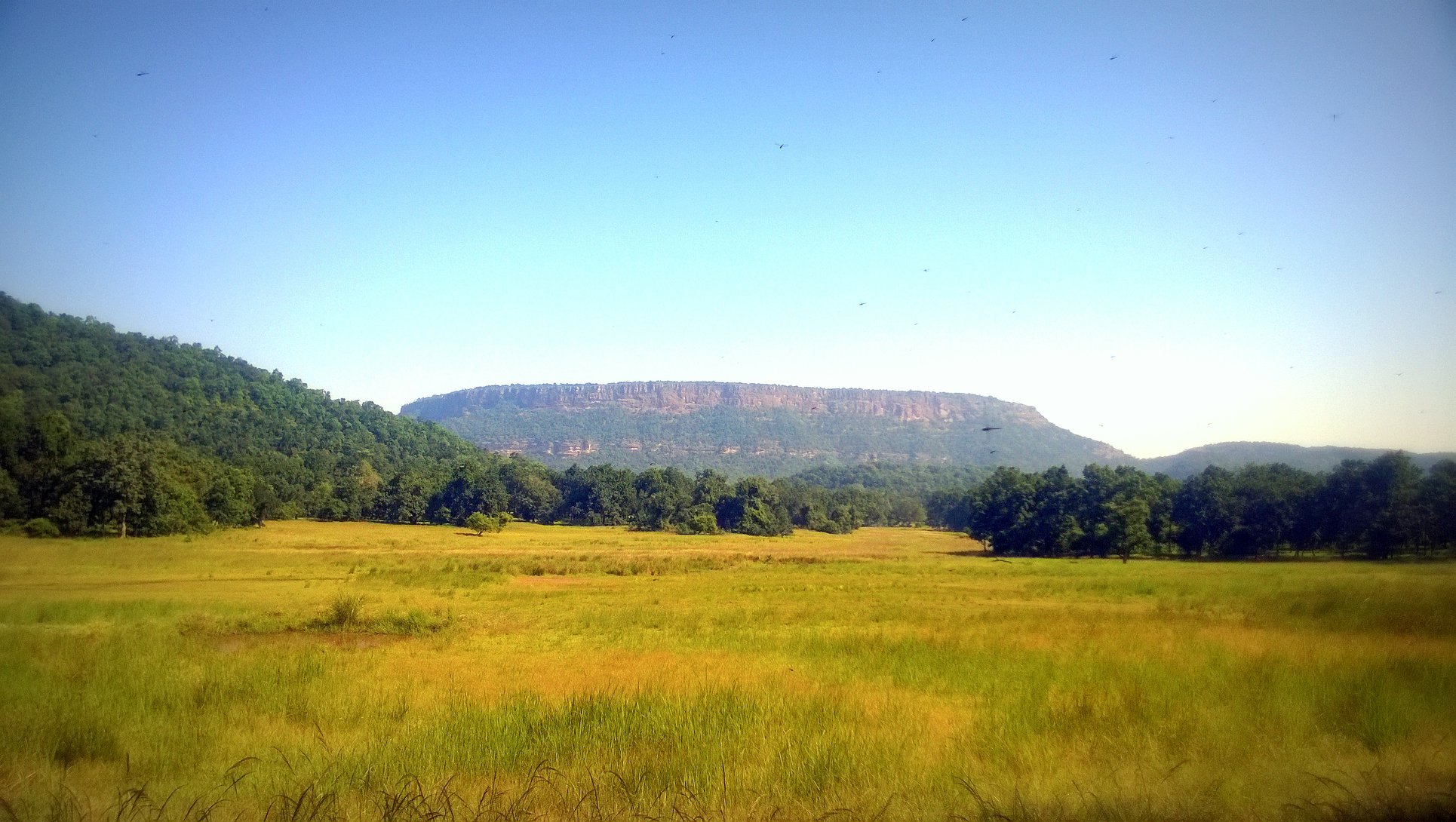
Thankfully, because of Neeraj’s prior calls, we were able to make a choice out of the 3 zones, namely Tala, Magdhi and Khitauli – Abhijit and I both chose Tala, for different reasons – for Abhijit, it was the relatively higher probability of tiger-sighting at Tala, and for me, the presence of the Seshsaiya statue! Luckily, we were able to share safari costs with another group – since, a gypsy could take up to 6 passengers in addition to the driver and the guide, and we were just two. And soon we were on the safari trail, where we first encountered the grasslands, then gradually making our way into denser foliage. In the distance stood the a long hill bearing the Bandhavgarh fort.
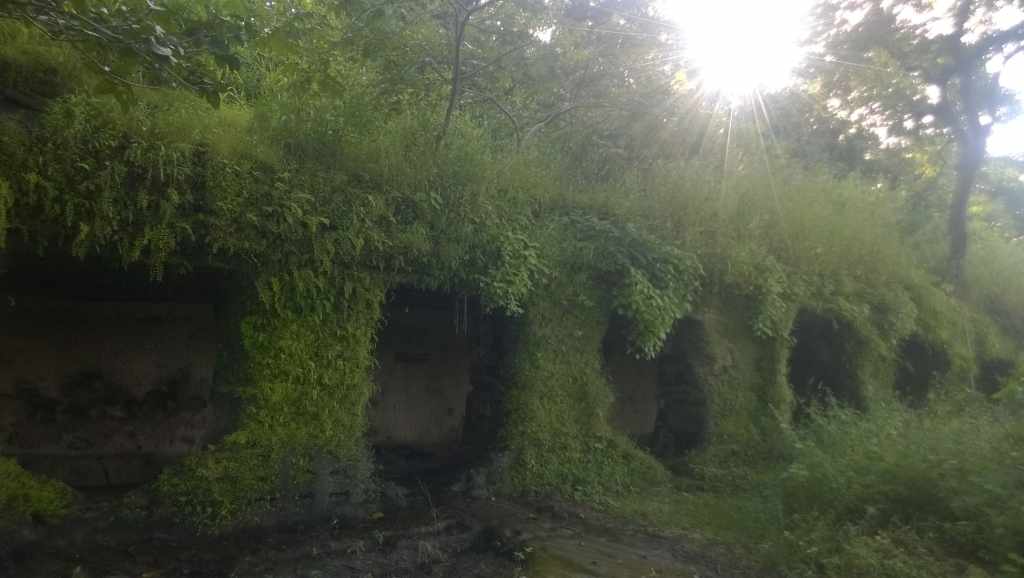
I kept reminding the guide about Seshsaiya to his bemusement, even as we stopped at points looking for traces left behind a tiger, sometimes leaving the main trail to go into nooks in search of the elusive tiger. One such narrow detour led us on an uphill path through the dense jungle, where first we encountered ancient structures with open rooms carved out of the hill-side. These supposedly served, in the distant past, as lodging for the visitors to Bandhavgarh. The guide looked at me with a smirk betraying the feeling that he was now going to grant my wish!
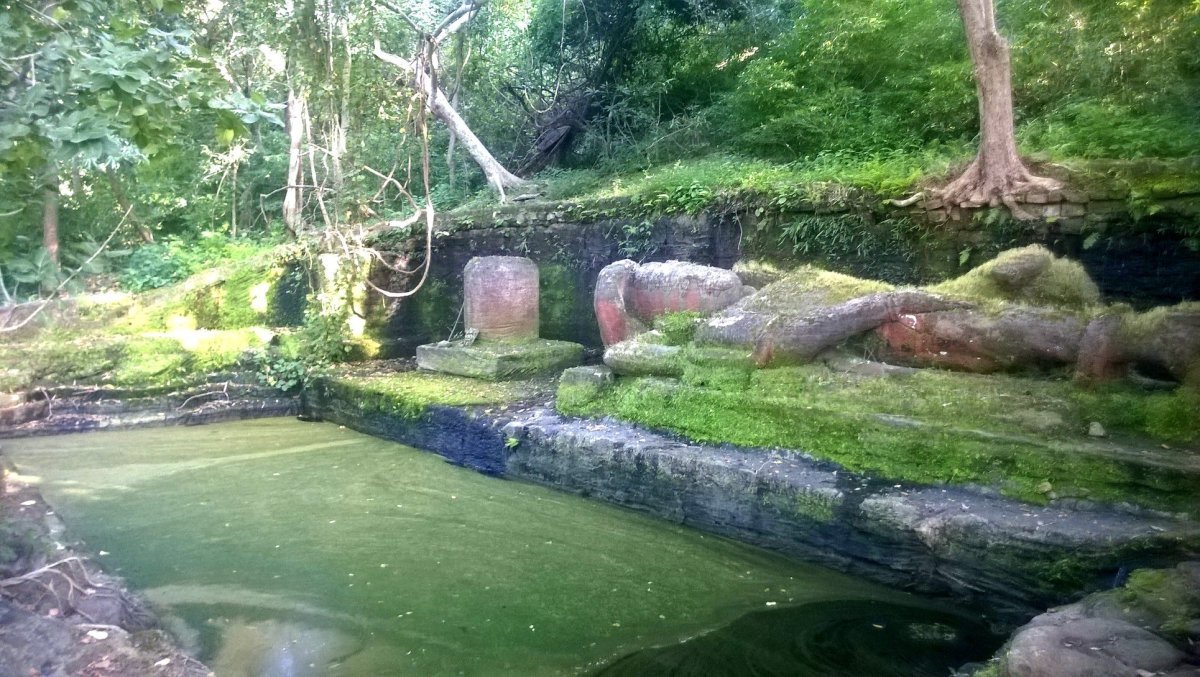
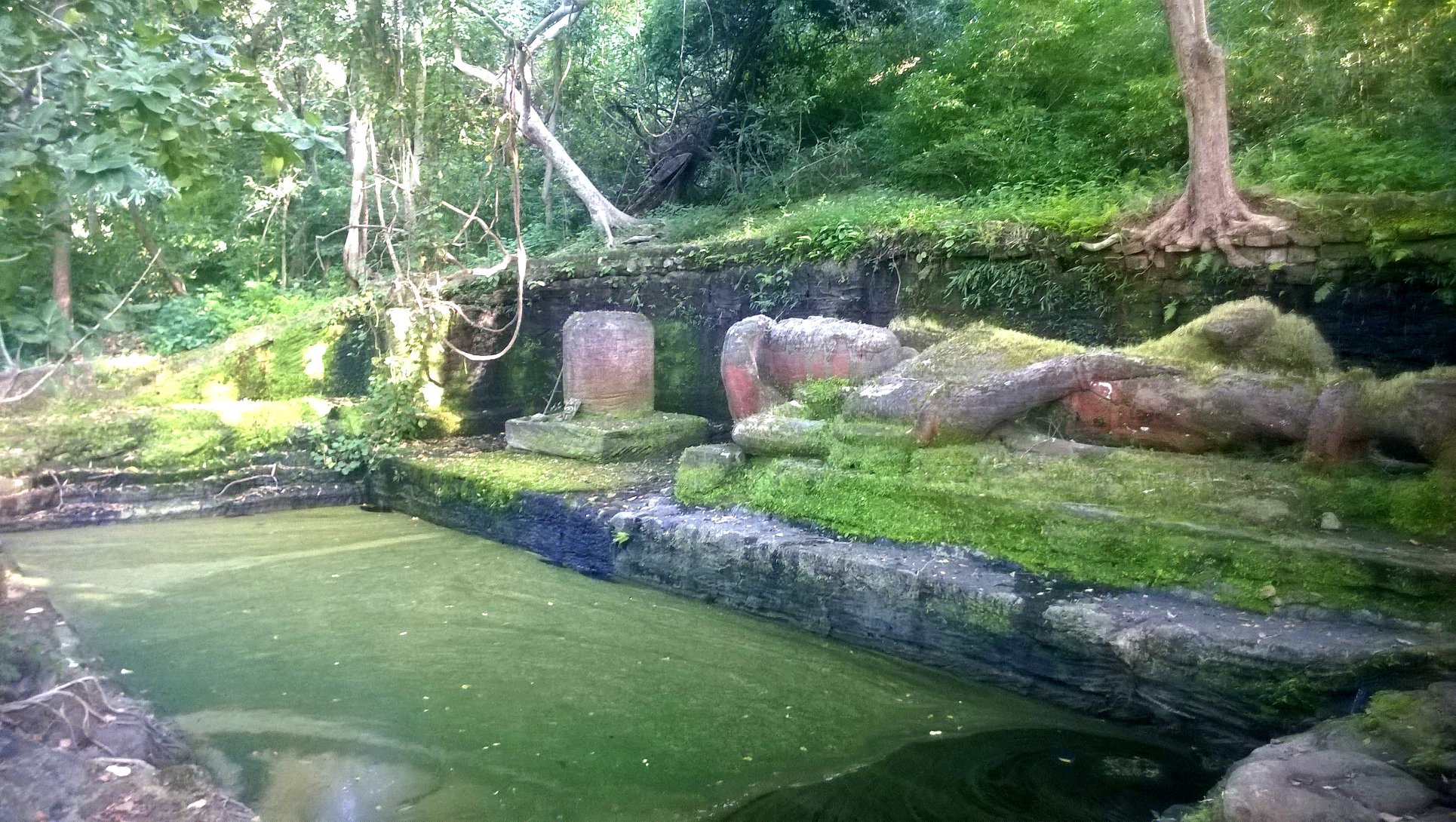
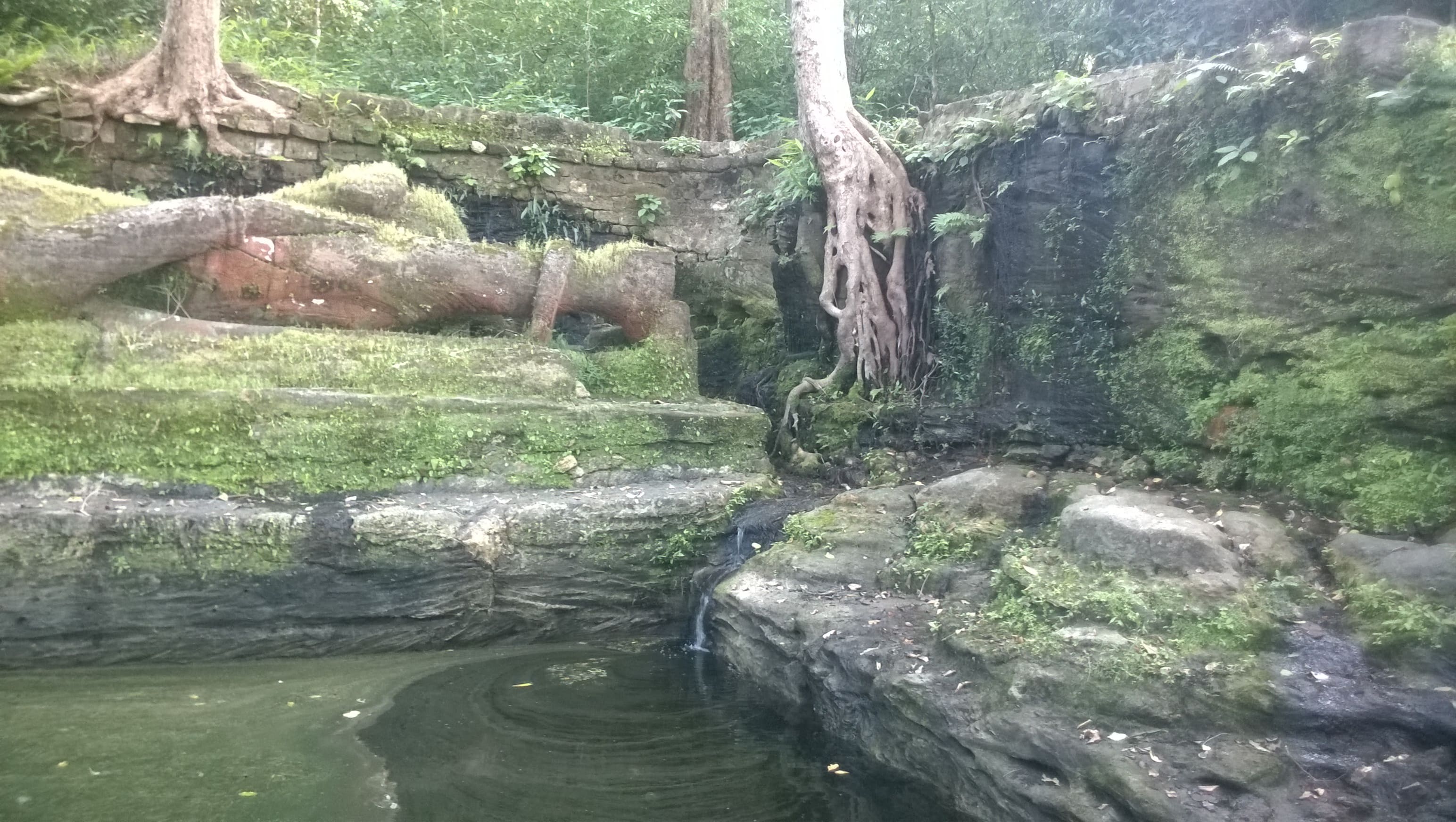
Soon, we came upon a fleet of stone steps leading to a ledge, where the guide beckoned us to get down and take a look. With anticipation writ large on my face, I climbed up the steps to the top, and there it was – the 10th century statue of Vishnu in sleeping position, dubbed the Seshsaiya! The moss-covered statue lay in its exquisite glory alongside the inner wall of a tank with the water level lying below the plinth on which the statue lay. Just above the head of Vishnu, lay Shiva in the form of a shivling, and beside the feet, at the corner of the tank, lay the statue of Brahma, now completely obscured by the thick roots of a banyan tree. Thus, the place was graced by all three forms of the divine trinity, the trimurti.
I was so enamoured of the place that I did not want to leave, imagining myself having many adventures around the place, perhaps discovering hidden treasures from inside the structures or protecting such treasures from evil treasure-hunters, à la Indian Jones . But we had to move on, as it was already 4 PM, and we had some ground to cover.
The tiger was elusive, even though we searched for it in the thickest parts of the jungle. Failing to spot one, we continued on the trail before we reached the buffer zone around 5 PM – where jungle and human habitation co-exist. Just as we were losing hope, we saw a group of Gypsies huddled in front of us. And there she was! A tigress burning bright in the rays of the sun setting just behind the tall trees, sauntering leisurely right in front of our very eyes! The excitement, not only in our Gypsy, but also in the other Gypsies was quite palpable.
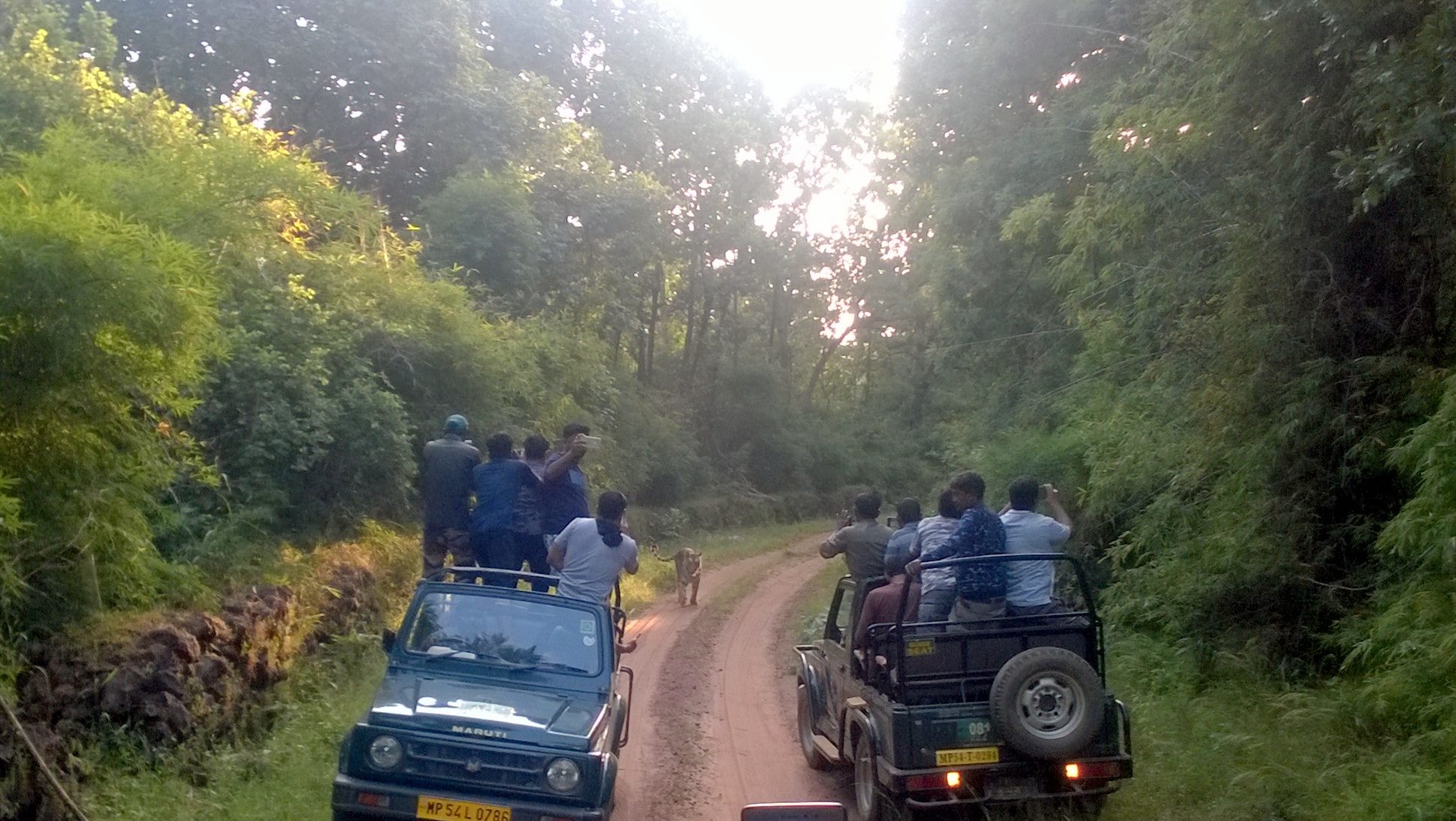
Minor tragedy, major scare
With the tiger spotting behind us, it was now time to head back. And to make up time, the Gypsy driver drove like a maniac, racing against time, to make it outside the park by the scheduled closing time. As, we stepped out of the Gypsy, I was met with a shocking realization – my mobile phone was missing! It was not on the Gypsy either. I called my mobile phone using Abhijit’s phone, but expectedly, there was no response.
Frantically, I ran to other Gypsy drivers asking if they had found a phone matching my phone’s description, and then to the gatekeeper, asking for advice. The gatekeeper suggested we take another safari of the same trail the next day to check if my phone had fallen somewhere on the trail. Although, we had indeed planned another safari for the next morning, I would have rather we did a different zone, for novelty’s sake.
While I resigned to the fact that we would have to do the same trail next day, knowing quite well that looking for a mobile phone in a National Park would be akin to looking for a needle in a haystack, I attempted one last call to my mobile no. and – surprise, surprise ! – a man received the call. Apparently, the man had found it on the ground on the trail itself – he assured me that the phone was safe with him, and he could hand it over to me… in return for an inaam (reward). While I offered him Rs. 500, he quoted 1000 – grateful for the ‘miracle’ that had just happened, I agreed, and within half an hour, my phone was securely back in my hands. It would not be a lie if I said I had one of the most enjoyable meals that night.
Day 4: Bandhavgarh (continued)
Waking up at 5 AM for the morning safari, we picked up our packed breakfasts and were at the Park by 6 AM for the safari starting at 6.30 AM. With the mobile phone saga behind us, we had the luxury to choose a newer zone on this day – and we chose Khitauli.
Soon, with the cool breeze blowing against our cheeks, and the mist caressing our hair, we perused the diverse fauna and flora inside the park. We came across giant spiders and their spider webs, myriads of birds, some deer… and leopard poo. Again, from across a patch of grassland, the flattop Bandhavgarh hill with the Bandhavgarh fort sitting atop it, stood there beckoning us, maybe not for this time, but for another time.
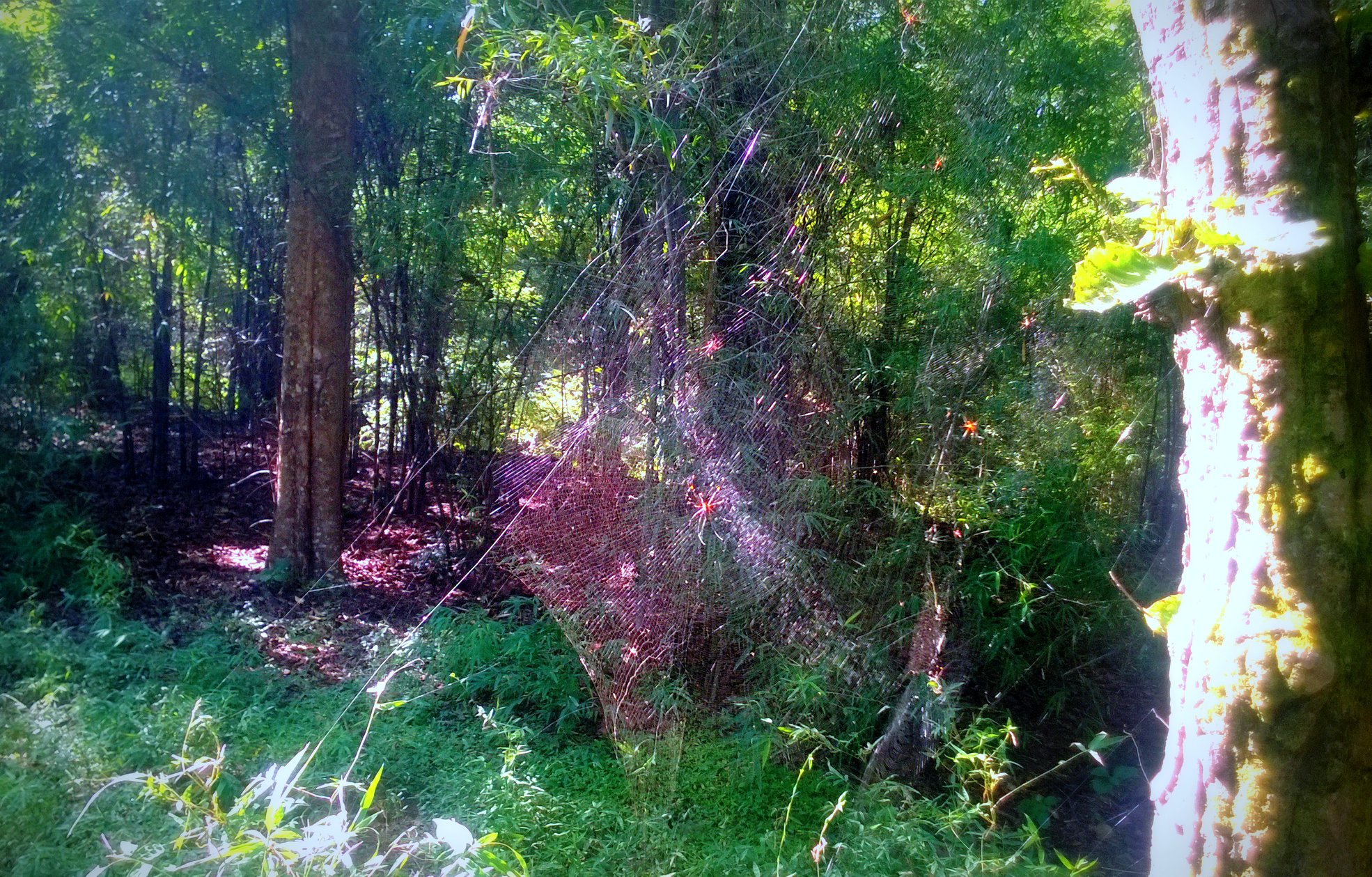
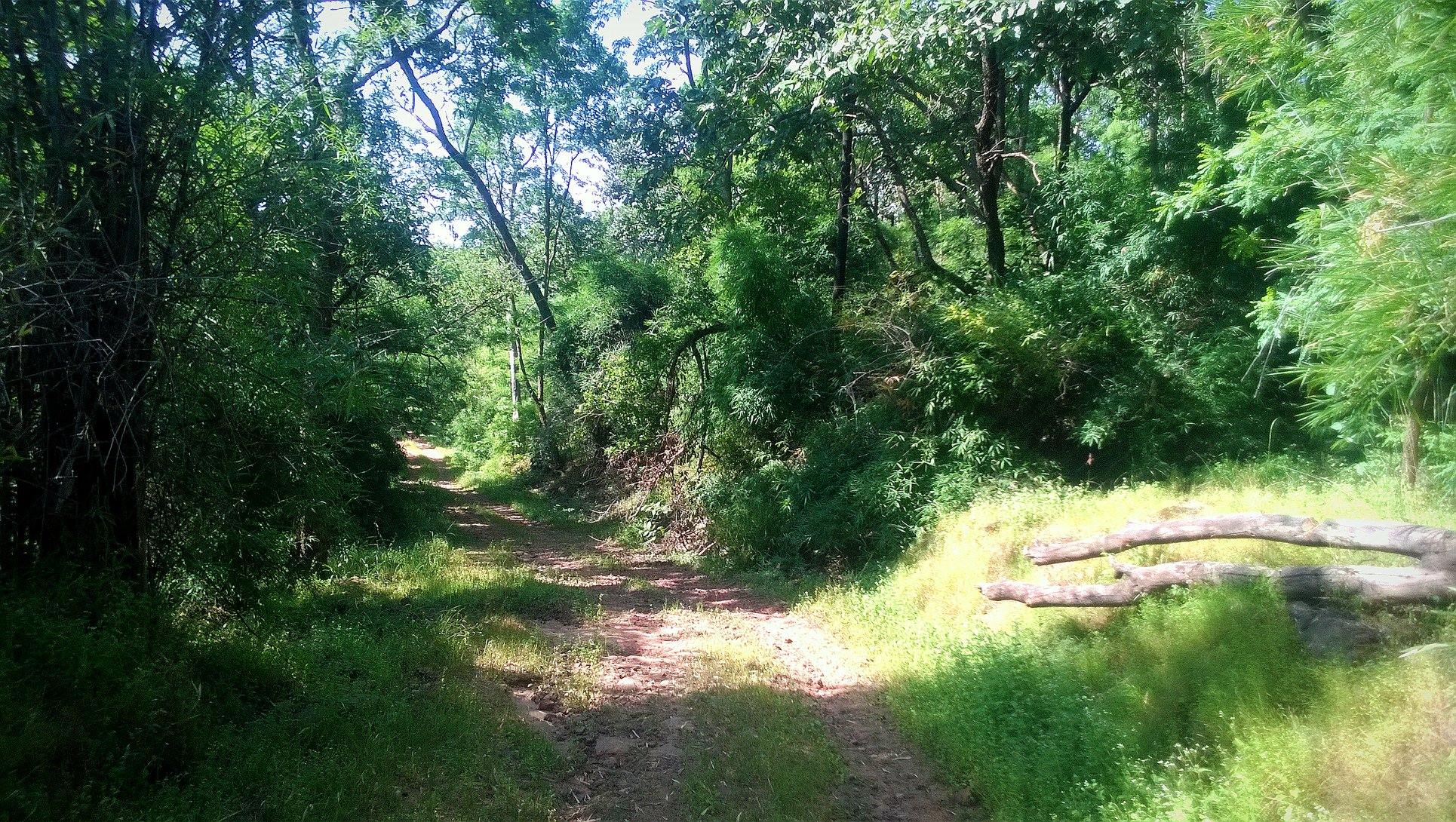
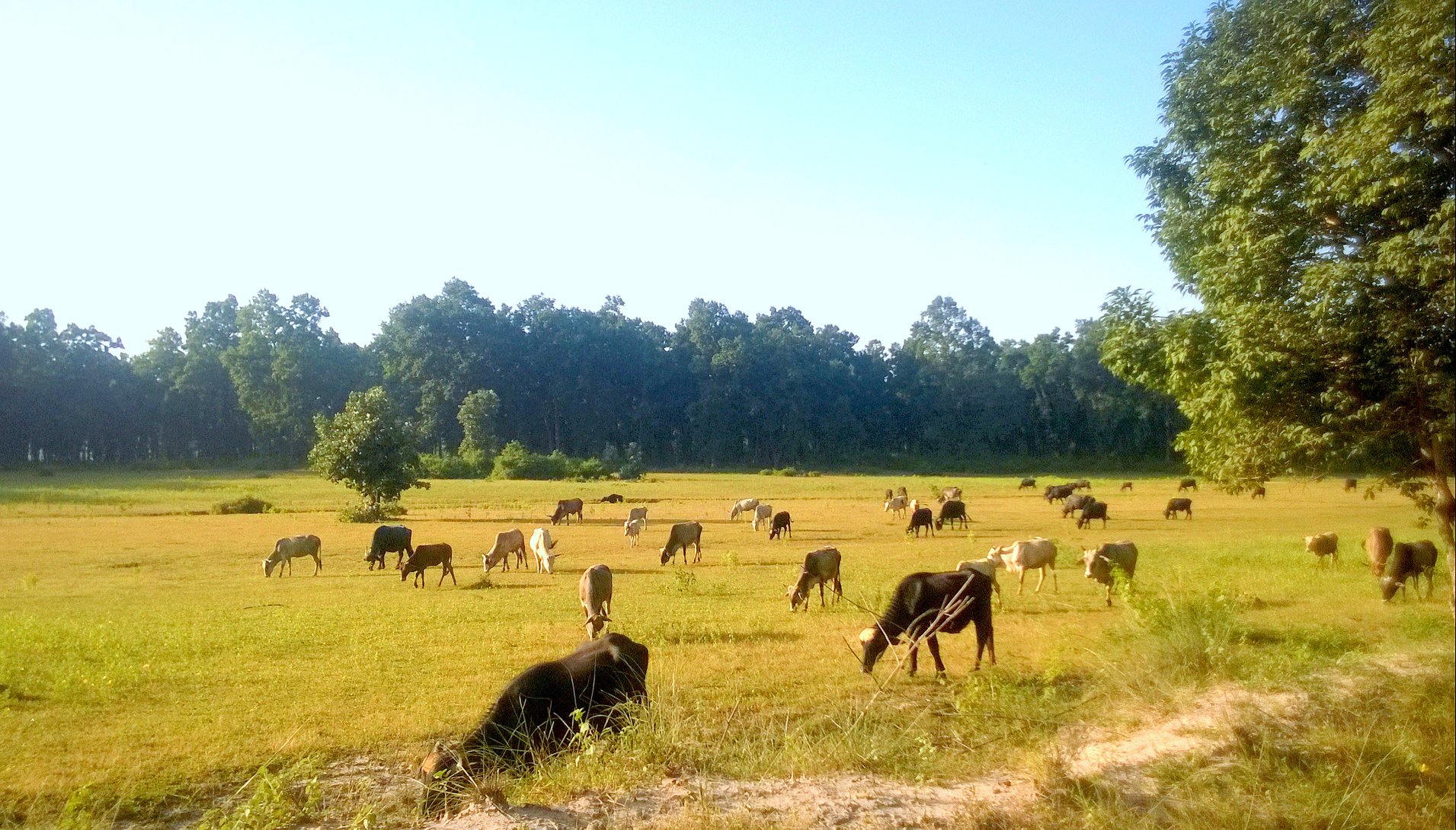
However, neither a tiger nor a tigress was not to be found on this day. As the sun rose higher and temperatures increased, it was now time to retreat. Back in the resort, we had another laidback meal, and after resting for a while, were ready to check-out. The resort staff refused to accept fees for either the stay or the meals, due to which we decided to drop what we thought was the meal price in the tip-box. By 4.30 PM, we were back at Umaria railway station to catch our overnight train to Delhi. That night’s sleep was one of the most gratifying that I had ever had on a train.
 The Timber Trawler